
A Lexile reading level is a score that measures two things: a reader's ability and a book's difficulty. The best part? It puts them on the exact same scale, making it much easier to match students with the right books.
Think of it like a shoe size for reading—it helps you find a comfortable fit that supports growth without causing frustration. This system uses a simple number followed by an "L" (like 800L) to guide parents, teachers, and librarians.
What Is a Lexile Reading Level and Why It Matters
Finding the right book for a child can feel like a total guessing game. Is this story too simple? Will that one be way too hard? The Lexile Framework for Reading cuts through that uncertainty by offering a clear, scientific way to connect readers with texts. It’s not just another piece of education jargon; it's a practical tool designed to build confident, capable readers.
The magic of the system is its two-part approach. By evaluating both the reader and the text, it creates a powerful link between them. This dual measurement is key to making sure a child is engaged with material that is both accessible and stimulating.
The Two Sides of the Lexile Coin
The Lexile framework is built on two core components that work together. Getting a handle on both is the first step to using this tool effectively.
- The Reader Measure: This score reflects a student's actual reading ability. It's usually found through school assessments they're already taking—not some special "Lexile test"—and it tells you the text complexity a student can likely handle.
- The Text Measure: This score represents the difficulty of a book or article. It's calculated by analyzing things like sentence length and how often complex words appear, giving every text an objective measure of its complexity.
When these two measures align, a child finds themselves in a reading "sweet spot." The book is challenging enough to introduce new words and ideas, but not so tough that it leads to frustration. This balance is absolutely critical for steady progress.
The goal isn't to restrict a child to a specific number but to use it as a guide. A book slightly above their measure can be a healthy stretch, while one below can build fluency and confidence.
Why This Measurement Matters
At the end of the day, the Lexile reading level is about much more than just numbers. It’s about fostering a genuinely positive relationship with reading. When kids consistently find books they can successfully read and enjoy, they start to see themselves as readers and build a lifelong passion for stories.
This personalized approach helps avoid the common pitfall of reading frustration, where a child just gives up because the material feels like an insurmountable wall. Instead, it builds a staircase of steady, achievable challenges.
Understanding your child's Lexile reading level is a foundational step in learning how to improve reading comprehension and gives parents a real, practical way to foster stronger literacy skills. Using this framework can help turn reading from a chore into a rewarding adventure.
How Do They Actually Figure Out a Lexile Score?
A Lexile reading level isn't just some number pulled out of thin air. It’s the result of a really smart, two-part system that connects a reader's actual skill with a book's complexity. Once you see how both sides of this equation work, the whole process makes a lot more sense. It’s less about opinion and more about concrete data.
First up is the reader measure. This is a common point of confusion. Parents often worry their child needs to take a special "Lexile test," but that’s almost never the case. A student’s Lexile score is typically pulled from reading assessments they’re already taking in school, like the NWEA MAP Growth tests or other standardized exams.
That number you see on a school report is simply a snapshot of your child's demonstrated reading ability on a standardized scale. It gives everyone a clear, practical starting point for finding the right books.
What About the Books?
The other half of the puzzle is the text measure. This is where MetaMetrics, the company that created the framework, analyzes a book or article to figure out how difficult it is. They don't guess based on grade levels or themes. Instead, their algorithm zeroes in on two key predictors of how complex a piece of writing really is.
It all boils down to two main things:
- Syntactic Complexity: This is just a fancy way of saying sentence length. Longer, more winding sentences are usually harder for our brains to process than short, direct ones.
- Semantic Difficulty: This is all about word frequency. Words that show up less often in a massive database of over a billion words are considered more difficult.
Think about it this way. An early reader book might have a sentence like, "The big dog ran fast." The sentences are short, and every word is super common. A middle-grade novel, on the other hand, might say, "The formidable canine galloped with astonishing velocity." The words are less common and the sentence structure is a bit more involved, which gives it a higher Lexile measure.
By focusing on these two objective data points, the Lexile framework assigns a score that reflects the structural difficulty of the text itself, independent of its subject matter or intended audience.
The Lexile Framework for Reading has made it so much easier for educators and parents to match kids with the right books. The scale starts below 200L for brand-new readers and goes all the way up to over 1700L for really advanced texts, covering everything from simple picture books to dense young adult novels. You can get a better feel for how this plays out by checking out these insights on Lexile reading levels.
Putting It All Together
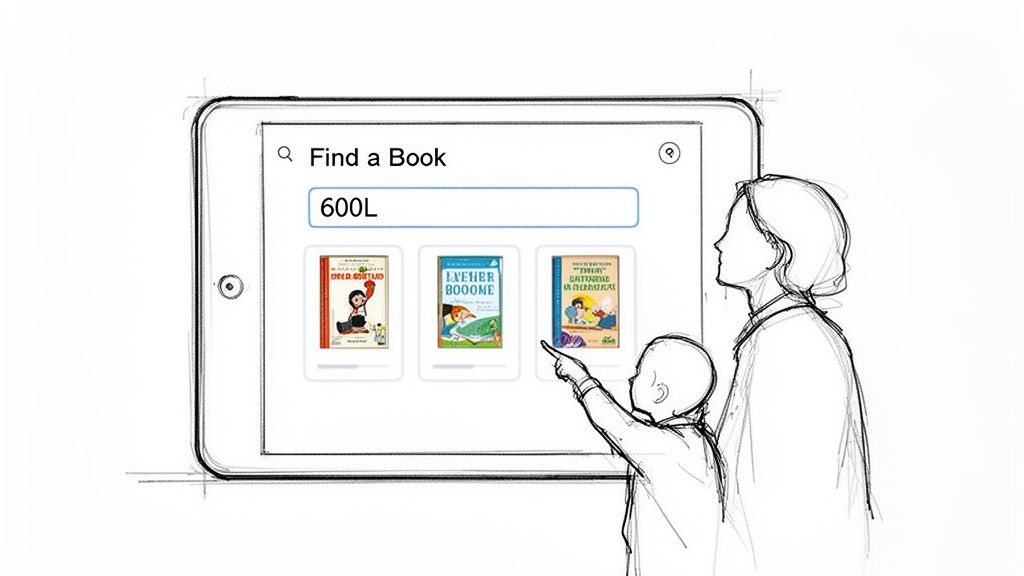
Once you have a score for both the reader and the text, the magic happens. The whole point is to match them up. Tools like the official "Find a Book" Hub let you pop in a reader's score and instantly discover a huge library of books that are right in their sweet spot.
Here’s a peek at what the "Find a Book" search tool looks like.
As you can see, a user can enter a student's Lexile score and even narrow the search by interests. This makes it a breeze to find texts that are not just readable but also genuinely engaging. It’s this powerful blend of data-driven matching and personal interest that makes the Lexile reading level such a fantastic tool for helping kids grow as readers.
Understanding Lexile Ranges and Grade Level Charts
A Lexile reading score is a fantastic piece of information, but let's be honest, a number like 750L or 1010L can feel a bit abstract on its own. To bring it down to earth, we can map these scores to the grade levels we all understand. This simple step translates a scientific measurement into a practical tool for finding the right books.
It’s important to remember, though, that these are just guides, not rigid rules. Every child develops at their own pace. Seeing a student read above or below their grade’s typical range is completely normal—in fact, it's expected! The real goal isn't to slap a label on a child, but to personalize their reading journey so they can grow and, most importantly, have fun doing it.
The Sweet Spot for Reading Growth
So, how do you use a Lexile score to really help a young reader? Experts point to a specific reading window, often called the "sweet spot." Think of it as the perfect balance between comfort and challenge, designed to keep a reader engaged and learning.
The ideal range is generally between 100L below and 50L above their reported Lexile measure.
- Why 100L below? Picking books in this slightly easier zone is all about building fluency and confidence. It lets a child breeze through the pages, enjoy the story, and feel successful without getting tripped up on every other word.
- Why 50L above? This upper end introduces a healthy stretch. It gently exposes them to new vocabulary and more complex sentences, which is exactly what they need to expand their skills.
Aiming for this range helps you sidestep the two biggest reading roadblocks: boredom from books that are way too easy and frustration from those that are just too hard.
A reader's "sweet spot" ensures a book is challenging enough to spark learning but not so difficult it causes them to give up. It’s the zone where comprehension and skill-building truly click.
Typical Lexile Reading Levels by Grade
While every reader is unique, it’s still helpful to see the general Lexile ranges that correspond to each grade level. It’s pretty amazing when you think about it—this data helps over 3 million students across the country track their reading growth every single year. You can dive deeper into how this information is gathered through MetaMetrics' vast norming studies.
This chart breaks down the 'typical' text measure ranges for students at the end of each grade. Keep in mind, this is a general guide, not a strict rule. Individual reading abilities can and do vary widely.
Typical Lexile Reading Levels by Grade
| Grade Level | Typical Lexile Range |
|---|---|
| 1 | Up to 300L |
| 2 | 140L to 500L |
| 3 | 330L to 700L |
| 4 | 445L to 810L |
| 5 | 565L to 910L |
| 6 | 665L to 1000L |
| 7 | 735L to 1065L |
| 8 | 805L to 1100L |
| 9 | 855L to 1165L |
| 10 | 905L to 1195L |
| 11-12 | 940L to 1210L |
Seeing these ranges laid out really clarifies how reading skills are expected to progress through the school years.
This whole system is built on connecting a reader's ability with a text's complexity—that's the core idea behind the Lexile formula.
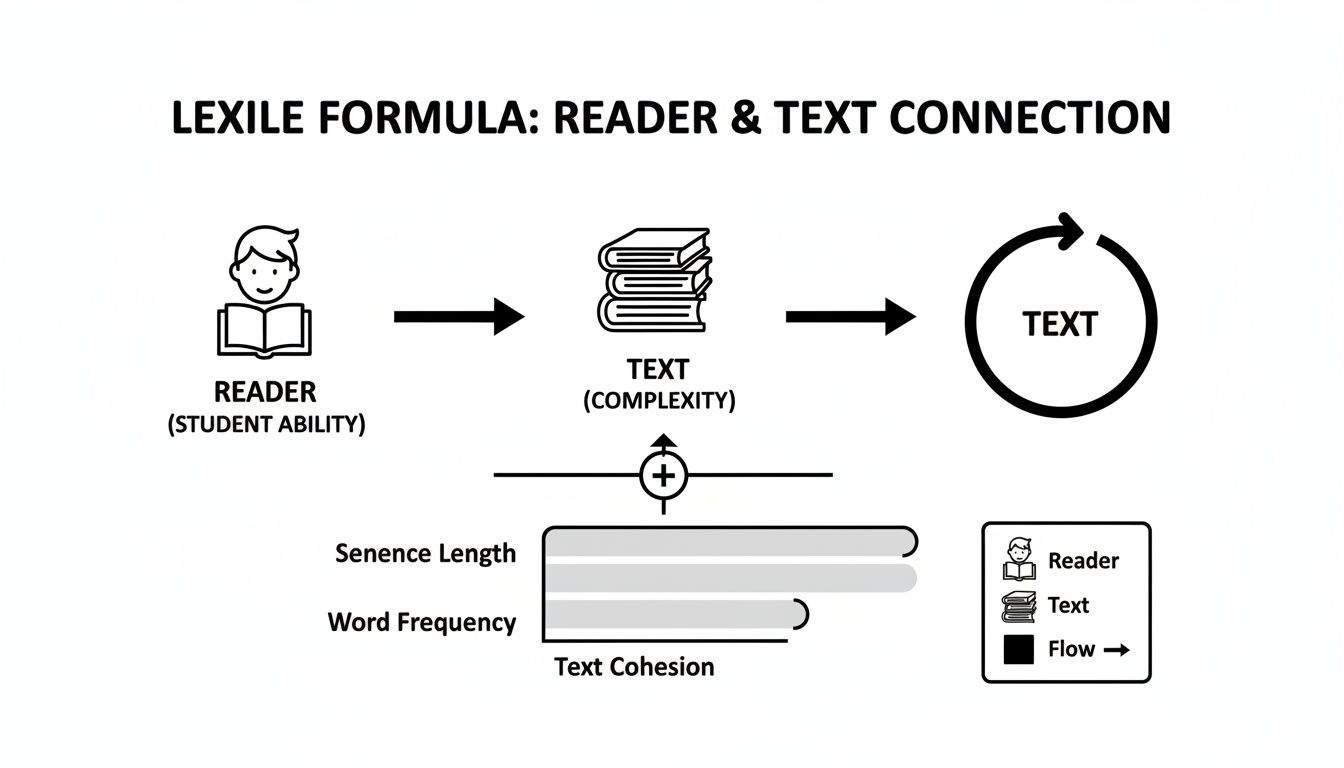
As the visual shows, the Lexile framework creates a direct bridge between the student and the book, which allows for an incredibly precise match. This systematic approach takes the guesswork out of picking reading materials. For a closer look at these grade-based charts, be sure to check out our guide on the Lexile level chart.
Moving Beyond Simple Grade Labels
Ultimately, this data gives parents and educators the power to make much smarter choices. Instead of just grabbing a book labeled "Grade 4," you can find one that’s a perfect 900L fit for a particular child.
This level of precision is what makes the Lexile reading level such a powerful tool for supporting a reader's development. By understanding these ranges, you can move past generic labels and truly tailor a child's reading list to their unique needs, fostering both skills and a genuine love for stories.
How to Find Your Child's Lexile and Books to Match
Okay, you’ve got the theory down. You know what a Lexile level is and how the scores come to be. Now for the fun part: putting it all into practice.
Figuring out your child’s measure and then connecting them with the right books is where this data really comes alive. It's a simple process that can completely change how they feel about reading, turning it from a chore into a confident and exciting adventure.
Locating Your Child's Lexile Measure
First things first, you need to find your child's personal Lexile reader measure. The good news is, you probably already have it. You don't need to hunt down a special "Lexile test," because this score is usually generated from the standardized tests students already take in school.
Here are the most common places you can find it:
- School Reports: Dig out those score reports from state or national tests like MAP Growth, STAAR, or Smarter Balanced. Many schools print the Lexile measure right on the report to give parents a clear, actionable piece of information.
- Reading Program Dashboards: If your child's school uses an online reading program, log into their account. These platforms often track reading progress and display a current Lexile measure right on the student dashboard.
- Ask Their Teacher: Your child’s English teacher is your best ally. They have access to all the latest assessment data and can quickly tell you your student's most recent score.
Once you have that number, you’ve got the key to unlocking a world of books that are just right for them.
Using the Lexile Find a Book Tool
With your child's Lexile measure in hand, your next stop is the official Lexile "Find a Book" tool. It’s a free, incredibly powerful search engine built for one purpose: helping you find books that perfectly align with a reader's ability and, just as importantly, their interests.
The idea of matching content to an individual's needs is the same principle behind advanced personalized learning software, which helps tailor educational material for every student.
Getting started is easy:
- Enter the Lexile Measure: Pop in your child’s score. The tool automatically sets up the recommended reading range—that sweet spot of 100L below to 50L above—that encourages growth without causing frustration.
- Filter by Interests: Don't skip this step! This is where you bring your child into the process. Let them pick the categories that excite them, whether it’s dragons, dinosaurs, sports, or mysteries. This is the secret recipe for real reading engagement.
- Browse the Results: The tool will whip up a list of books that fit both the Lexile range and your child's chosen interests. You can click on any book to see a summary, its publisher, and its exact Lexile text measure.
Finding Lexile Levels in the Wild
The "Find a Book" tool is a fantastic resource, but you'll start noticing Lexile measures everywhere once you know what to look for. Many publishers—including us here at Number 6 Publishing—put this info right on the book because we know how valuable it is. If you want to dive deeper into this, check out our guide on how to assess reading level.
Keep an eye out for the Lexile measure in these spots:
- On the Book Itself: Flip a book over and look at the back cover, usually near the barcode. You'll often see a code like "RL: 4.5, Lexile: 750L."
- Online Bookstores: Big retailers like Amazon and Barnes & Noble almost always list the Lexile measure in the "Product Details" section of a book's online page.
- Library Catalogs: Your school or local library's online catalog is another goldmine. Most systems show the Lexile measure for each title and many even let you filter your search by a specific Lexile range.
By combining your child’s score with these simple, accessible tools, you can confidently find books that will challenge, entertain, and inspire them on their reading journey.
Limitations and Other Factors in Choosing a Book
Think of a Lexile score as a fantastic GPS for finding the right book. It’s a powerful tool that helps match a reader with a text that’s not too hard and not too easy. But just like any tool, it has its limits.
Relying only on a Lexile score is like picking a vacation spot based purely on how far it is from your house. It tells you the distance, but it says nothing about the culture, the scenery, or the memories you'll make once you arrive.
A Lexile measure is a scientific calculation based on sentence length and word frequency. It’s a brilliant starting point, but it was never designed to measure the other crucial things that make a book truly right for a child.
What a Lexile Score Does Not Measure
It's really important for parents and teachers to know what falls outside the Lexile framework. Understanding this helps create a much more balanced and effective way to pick books, making sure a child isn't just reading at the right level, but also reading the right content for their maturity and interests.
Here are the key things a Lexile number won't tell you:
- Age-Appropriateness: A book's Lexile score is completely separate from its themes. John Steinbeck's classic, The Grapes of Wrath, has a Lexile measure of just 680L. Many fourth or fifth graders can easily handle the reading itself, but the mature themes of poverty and social injustice make it totally unsuitable for that age group.
- Book Quality or Merit: A high Lexile score doesn't automatically mean a book is well-written, and a low score doesn't mean it's poorly crafted. In fact, many beautifully written picture books and moving novels-in-verse have lower Lexile levels due to their structure, yet they offer incredible literary and emotional depth.
- Background Knowledge Required: A book on quantum physics might have a Lexile score a middle schooler can technically read, but the content will be completely lost on them without some prior knowledge. The score doesn't factor in the context a reader needs to bring to the table.
- Visuals and Text Features: The framework doesn't analyze illustrations, charts, graphs, or unique page layouts. A graphic novel, for instance, might have a low Lexile score for its text, but its rich visual storytelling adds layers of complexity and meaning.
The Art of Knowing Your Reader
This is where the science of Lexile meets the art of knowing your kid. A Lexile number gives you the "what," but a child's unique personality and passions provide the all-important "why." The best approach always blends the data with your personal insight.
Think of the Lexile measure as a recommendation from a scientist, but the final choice should be a collaboration between you and your young reader. The goal is to find books that are not just readable but also unputdownable.
For example, take two books with a similar Lexile score. One could be a lighthearted fantasy adventure full of action and humor, perfect for a kid who loves to escape into imaginative worlds. The other might be a quiet, thoughtful coming-of-age story about complex friendships, ideal for a more introspective reader. The numbers are the same, but the experiences are worlds apart.
At the end of the day, the Lexile framework is a guide, not a prescription. The best way to use it is as one of several tools in your toolkit. Combine the hard data of a Lexile score with the human elements—your child's passions, their emotional maturity, and what they're curious about right now. This thoughtful blend helps you find books that not only build skills but also spark joy and create a lifelong love of reading.
Using Lexile Levels to Track and Encourage Reading Growth
The real power behind a **Lexile reading level** isn’t just about picking the right book for right now. It’s about mapping a child’s entire reading journey over time. When you use it consistently, it becomes a simple, clear way for parents and educators to see progress and celebrate every step forward.This long-term perspective turns a Lexile score from a static number into a living, breathing indicator of growth. Watching that score climb from 700L to 780L and then up to 850L gives a young reader a real, tangible sense of accomplishment. It’s a lot like leveling up in a video game—each new score unlocks a whole new world of challenges and adventures, which keeps reading exciting.
Practical Ways to Foster Growth
Nudging this progress along doesn't have to be a big, complicated affair. With a student's Lexile score as your North Star, you can be much more strategic about nurturing their skills and broadening their horizons.
A few simple strategies can make a huge impact:
- Introduce "Stretch" Texts: Every so often, offer up books that are at the higher end of their recommended range—think about 50L above their current measure. This gentle push introduces new words and more complex sentences without being overwhelming.
- Explore New Genres: If your child is hooked on fiction, try introducing a non-fiction article or a biography about something they already love, like dinosaurs or a favorite athlete. These kinds of texts are packed with topic-specific vocabulary that expands their knowledge and their reading abilities at the same time.
The goal is to build momentum. When you provide a steady diet of books that are both engaging and just challenging enough, you create a positive feedback loop. Success makes them want to read more, and reading more leads to more success.
A Foundation for Lifelong Reading
At the end of the day, the Lexile framework is just a tool. It serves a much bigger and more important mission: fostering a genuine, lifelong love of reading. Here at Number 6 Publishing, we believe that connecting kids with stories that truly resonate with them is the most important work we can do.
When we help a child find a book that sparks their imagination, challenges how they see the world, and brings them joy, we’re laying the foundation for a future filled with curiosity. The lexile reading level simply helps clear the path for that connection to happen. For anyone looking for more ideas, our guide on how to help struggling readers offers plenty of additional insights. By taking the guesswork out of text difficulty, it allows the magic of a good story to shine through, making sure every child can find a book that feels like it was written just for them.
Frequently Asked Questions About Lexile Reading Levels
Even after you get the hang of Lexile levels, a few specific questions always seem to come up for parents and teachers. Let's tackle some of the most common ones to clear up any lingering confusion and make sure you feel confident using the framework.
Think of this as your quick-reference guide for those practical, "what-if" moments.
Can My Child Read Books Outside Their Lexile Range?
Absolutely! The recommended range (100L below to 50L above their score) is just a guideline, not a hard-and-fast rule. It's meant to be the “sweet spot” where kids can grow their skills without getting frustrated, but reading is about so much more than that.
-
Reading Below Range: Diving into easier books is fantastic for building confidence and improving reading speed, or what educators call fluency. More importantly, it lets kids just get lost in a good story, which is the best way to foster a true love of reading.
-
Reading Above Range: A book with a higher Lexile score can be a wonderful “stretch” text, especially if it’s about a topic your child is obsessed with. This is a perfect opportunity to read together, talk about new words, and explore bigger ideas.
The whole point is to empower kids, not box them in. A child's passion for a subject can easily help them conquer a more difficult book.
A reader's Lexile level is a starting point for a conversation about books, not the final word. Passion and curiosity are powerful tools that help readers overcome challenges.
Why Do Some Great Books Have Low Lexile Scores?
This is a really common and important question. A book’s Lexile score measures its text complexity—things like sentence length and how often certain words appear. It has nothing to do with a book's literary quality, emotional depth, or big ideas.
You'll find that many classics and award-winners have surprisingly low Lexile scores. For instance, John Steinbeck’s classic novel The Grapes of Wrath scores just 680L, a level many middle schoolers could easily read. But its mature themes of poverty and social injustice make it a book for older, more mature readers.
That's because the Lexile system simply isn't designed to analyze:
- Literary devices like symbolism or metaphor.
- Emotional complexity and mature themes.
- Unique formatting you might find in graphic novels or novels-in-verse.
So, always trust your own judgment when it comes to a book's content and whether it's the right fit for your reader.
How Often Does a Lexile Score Change?
A student's Lexile measure is never a permanent label. It’s just a snapshot of their reading ability at one moment in time, and you should fully expect it to change and grow.
Schools typically assess reading skills one to three times a year. This means you’ll likely get an updated Lexile score after each of these major assessments. It's a great way to track their progress, celebrate how far they've come, and adjust their book choices to match their growing skills. The best way to see that number climb is simple: keep reading.
At Number 6 Publishing, we believe the right story at the right time can make all the difference. We're dedicated to helping you find those unforgettable books. Explore our curated collections and discover your child's next favorite read at https://www.number6publishing.com.