
Before you can really help a struggling reader, you have to play detective. The first step is to figure out the specific area where they're getting stuck. Trying to fix the problem without knowing the cause is like trying to solve a puzzle with half the pieces missing.
A targeted approach is always better. By focusing on the five core pillars of literacy—phonological awareness, phonics, fluency, vocabulary, and comprehension—we can move from guessing what's wrong to knowing exactly what to fix.
Decoding the Struggle: Pinpointing Reading Roadblocks
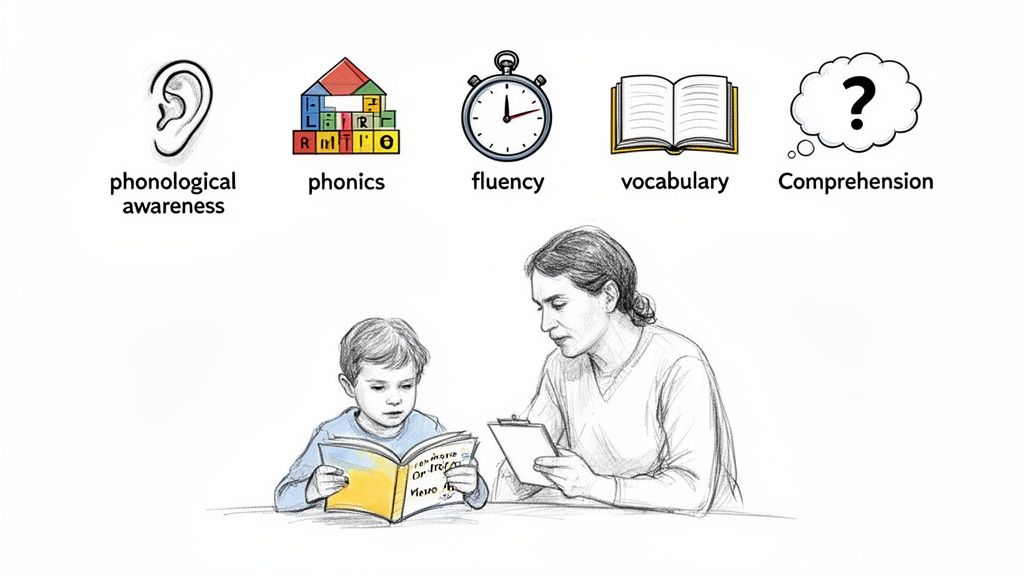
It’s easy to see the end result: a child who avoids books, stumbles over words, or just seems completely disengaged. But the real challenge is uncovering the root cause of their frustration. Reading isn't just one skill; it's a complex system of interconnected abilities. A breakdown in any one of those areas can bring the whole process to a halt.
This isn't a small problem, either. According to UNESCO, about 770 million people worldwide can't read a single word, and another 2 billion struggle with a simple sentence. Here in the United States, roughly 40% of students can't read at a basic level, which shows just how urgent the need for effective, early support really is.
To get to the bottom of it, you have to look closely at those five pillars of literacy.
What to Look For in Each Reading Pillar
Simply observing a child as they read can give you powerful clues. Instead of just noting that they are "struggling," try to pinpoint how they are struggling. Each of the core pillars has its own distinct warning signs that will point you in the right direction.
-
Phonological Awareness: This is all about hearing and playing with the sounds in spoken language, even before letters are on the page. A child with weak phonological awareness might have trouble recognizing rhymes (cat/hat), clapping out the syllables in their name, or telling you the first sound in a word like "dog."
-
Phonics: This is the bridge that connects spoken sounds to written letters. A classic sign of a phonics breakdown is a child who guesses at words based on the first letter. They might see the word "house" and say "horse" because they recognize the 'h' but can't sound out the rest.
-
Fluency: This is about more than just speed. It's reading with accuracy, a natural pace, and expression—like you're telling a story. A reader struggling with fluency often sounds slow, choppy, or robotic. They might lose their place on the page or read in a flat monotone voice.
-
Vocabulary: It's tough to understand a story if you don't know what the words mean. A child with a vocabulary gap might read a sentence perfectly but have no idea what it's about. You'll often hear them ask, "What does that word mean?" or see them skip over unfamiliar words entirely.
-
Comprehension: This is the ultimate goal—understanding the text. A child with comprehension issues can sometimes read a passage aloud beautifully but will be unable to summarize it, answer questions about it, or explain what just happened in the story.
"Pinpointing the specific roadblock is the most crucial first step. You can't fix a fluency problem with a phonics solution. Observation is your most powerful diagnostic tool."
From Observation to Action
Once you have a better idea of the specific challenge, you can start to target your support where it's needed most. Identifying that weak link in the chain is everything, and it doesn't always require a formal assessment. Just listening and watching carefully can tell you a whole lot. For those who want a more structured approach, our guide on how to assess reading level offers some great methods.
If you’re trying to understand more about specific learning challenges, a comprehensive special education testing guide can also help light the way. By becoming a keen observer, you can shift from feeling helpless to feeling empowered, ready to provide the precise support that will make a real difference.
Your Toolkit of Practical Reading Interventions
Once you’ve figured out where a child is getting stuck, it's time to roll up your sleeves with some targeted, hands-on strategies to build those skills. This isn't about boring drills or forcing a child through exercises that just lead to more frustration. The real goal is to offer engaging, evidence-based activities that make learning feel less like a chore and more like a game.
The most powerful interventions are the ones that match the need. A child struggling to sound out words needs a completely different kind of help than one who reads smoothly but can't recall what the story was about. Think of it like a toolbox—you need the right tool for the right job.
And this kind of early support is incredibly urgent. The latest national data from the U.S. is pretty sobering: fewer than one-third of students are reading at a proficient level. Even more concerning, students who don't catch up by the end of third grade are four times more likely to drop out of high school. These numbers show just how critical it is to use systematic, engaging support in the early years to help kids make that huge leap from learning to read, to reading to learn.
When you're trying to figure out which approach to take, it helps to see the challenge and the solution side-by-side.
Targeted Interventions for Common Reading Challenges
This table breaks down some common struggles and gives you a practical, hands-on activity you can try right away. It’s designed to make it easy to pick the right strategy for the child you're helping.
| Reading Challenge | What It Looks Like | Targeted Activity Example |
|---|---|---|
| Phonics | Struggles to connect letters to their sounds; has trouble sounding out new words. | Use magnetic letter tiles to build and change simple words (e.g., change "cat" to "bat" to "bit"). This makes phonemes feel tangible. |
| Fluency | Reads slowly and choppily, without expression; loses their place often. | Try paired reading, where you and the child read a text aloud together. It provides a live model of smooth reading without the pressure. |
| Vocabulary | Doesn't know the meaning of many words in a text, leading to confusion. | Create a "Word of the Day" jar. Pull a new word, discuss it, and challenge everyone to use it in a sentence throughout the day. |
| Comprehension | Can read the words correctly but can't explain what the text was about afterward. | Use the "Somebody-Wanted-But-So-Then" framework to help them summarize the key parts of a story in a structured way. |
Picking an activity from this list gives you a great starting point for providing support that is both fun and effective, helping build skills one step at a time.
Boosting Phonics with Multi-Sensory Fun
For kids who are having a tough time with phonics—that all-important link between letters and sounds—getting their hands involved can be a game-changer. Just staring at letters on a page often isn’t enough to make the connections stick. When you engage multiple senses, you help their brains build stronger pathways for learning.
Here are a couple of ideas that go way beyond flashcards:
- Build Words with Letter Tiles: Grab some magnetic letters, Scrabble tiles, or even alphabet blocks. Say a simple word like “mat” and have the child build it. Then ask, "What happens if we change the /m/ to a /s/?" They swap one tile and suddenly have "sat." This makes the idea of individual sounds (phonemes) concrete.
- Sand or Shaving Cream Writing: This one is always a hit. Have them trace letters in a shallow tray of sand or a bit of shaving cream while saying the sound the letter makes. The tactile feedback is fantastic for reinforcing letter shapes and their sounds.
Developing Smooth and Expressive Fluency
A fluent reader doesn't just read accurately; they read with speed and expression, almost like they're talking. When kids struggle with fluency, their reading is often slow and robotic. This eats up so much mental energy that there’s none left for actually understanding the story.
Paired reading is a fantastic strategy where a more confident reader and a struggling reader read a text aloud together. This provides a live model of fluent reading without the pressure of a solo performance.
It’s a simple but powerful technique. The two readers sit side-by-side and read the same book aloud at the same time. The struggling reader can help set the pace, while the stronger reader offers a steady, supportive voice that models good pronunciation and rhythm. As the child gets more confident, the supporting reader can gradually quiet their own voice, letting the child take the lead.
Expanding Vocabulary Beyond Memorization
You can't understand a story if you don't know what the words mean. For a child with a vocabulary gap, reading can feel like trying to crack a secret code. Just having them memorize definitions from a list rarely works because the words have no context.
To make new words actually stick, kids need to see them, hear them, and use them in meaningful ways.
- Create a Word of the Day Jar: Write interesting new words on slips of paper and put them in a jar. Each day, pull one out. Talk about what it means, find it in a sentence, and then challenge everyone in the family or classroom to use it in conversation.
- Word Webs: When you come across a new word, write it in the middle of a piece of paper. From there, draw lines out to related ideas: its definition, a sentence using it, a synonym, an antonym, and maybe even a quick sketch that represents it.
Strengthening Comprehension Skills
At the end of the day, the whole point of reading is comprehension—understanding, thinking about, and connecting with what the text says. Some kids can decode words perfectly but have a hard time grasping the big picture. Technology can offer some incredible support here; for example, exploring tools with features like AI auto-captioning for improved accessibility can be a huge help, providing visual text support that bridges the gap for many learners.
Another brilliantly simple technique is using a framework to summarize a story. One of the best is the "Somebody-Wanted-But-So-Then" (SWBST) method. After reading, you guide the child to break down the story:
- Somebody: Who was the main character?
- Wanted: What did they really want?
- But: What was the problem they ran into?
- So: How did they try to solve it?
- Then: What happened in the end?
This structure gives readers a clear roadmap to find the most important parts of a story. For even more great ideas, take a look at our guide on how to teach reading comprehension. These strategies help turn abstract skills into concrete steps, giving children the confidence to become active, thoughtful readers.
Building a Reading-Friendly Zone at Home and School
A child’s environment is one of the most powerful, and often overlooked, tools in their reading journey. The right surroundings can spark curiosity and build a genuine love for books, while a sterile or high-pressure setting can turn reading into a chore. Creating a "reading-friendly zone" is all about transforming the atmosphere—both at home and in the classroom—into a print-rich, inviting, and low-stress space.
It’s about so much more than just having a bookshelf. The real goal is to design an experience where reading is a natural part of daily life. A treat, not a task. For a child who's struggling to find their footing, this shift in environment can make all the difference in the world.
Cultivating a Reading Haven at Home
Your home is the first and most influential classroom your child will ever know. When you make it a place where books are visible, accessible, and celebrated, you send a clear message: reading is something we value here. You don’t need a huge budget or a dedicated library; a few thoughtful changes can have a massive impact.
Start by carving out a cozy reading nook. This can be as simple as a beanbag chair in a quiet corner, a small basket of books, and good lighting. The idea is to create a designated spot that feels comfortable and special—a place a child can retreat to with a story.
Another incredibly effective strategy is to "strew" books around the house. Leave an interesting graphic novel on the coffee table, a book of wild facts in the bathroom, or a silly poetry collection near the breakfast table. This casual placement puts books directly in a child's path and encourages spontaneous reading.
By making books a visible and accessible part of your home, you normalize reading as an everyday activity. You're not just telling them to read; you're showing them that reading is something your family does.
The environment is a critical piece of the puzzle, and the data backs this up. The World Literacy Foundation reports that book ownership among children from low-income backgrounds can be below 20%, meaning many kids have no books of their own. Yet, we know from countless studies that children from homes where books are present and stories are shared are far more likely to become strong readers. For a deeper look, you can explore more data on global literacy challenges to see the full picture.
Weaving Reading into Daily Family Rhythms
Beyond the physical space, embedding reading into your family's routine reinforces its importance and can make it a cherished shared experience. This is where you can truly transform a child’s relationship with books from strained to special.
-
Model the Behavior: Let your child see you reading for pleasure. It doesn't have to be a classic novel—a magazine, cookbook, or newspaper all count. When they see you enjoying it, the message is powerful: reading is a worthwhile and enjoyable adult activity.
-
Embrace Audiobooks: Audiobooks are a fantastic tool, especially for struggling readers. They expose kids to rich vocabulary and complex stories without the stress of decoding. Listen to them in the car on the way to school or during quiet time at home.
-
"Drop Everything and Read" (DEAR) Time: Set aside 15-20 minutes each day where everyone in the house—kids and adults—stops what they're doing and just reads. This creates a wonderful sense of community around books and makes reading a non-negotiable part of the day.
This flowchart illustrates how key interventions like phonics, fluency, and vocabulary work together to support a reader.
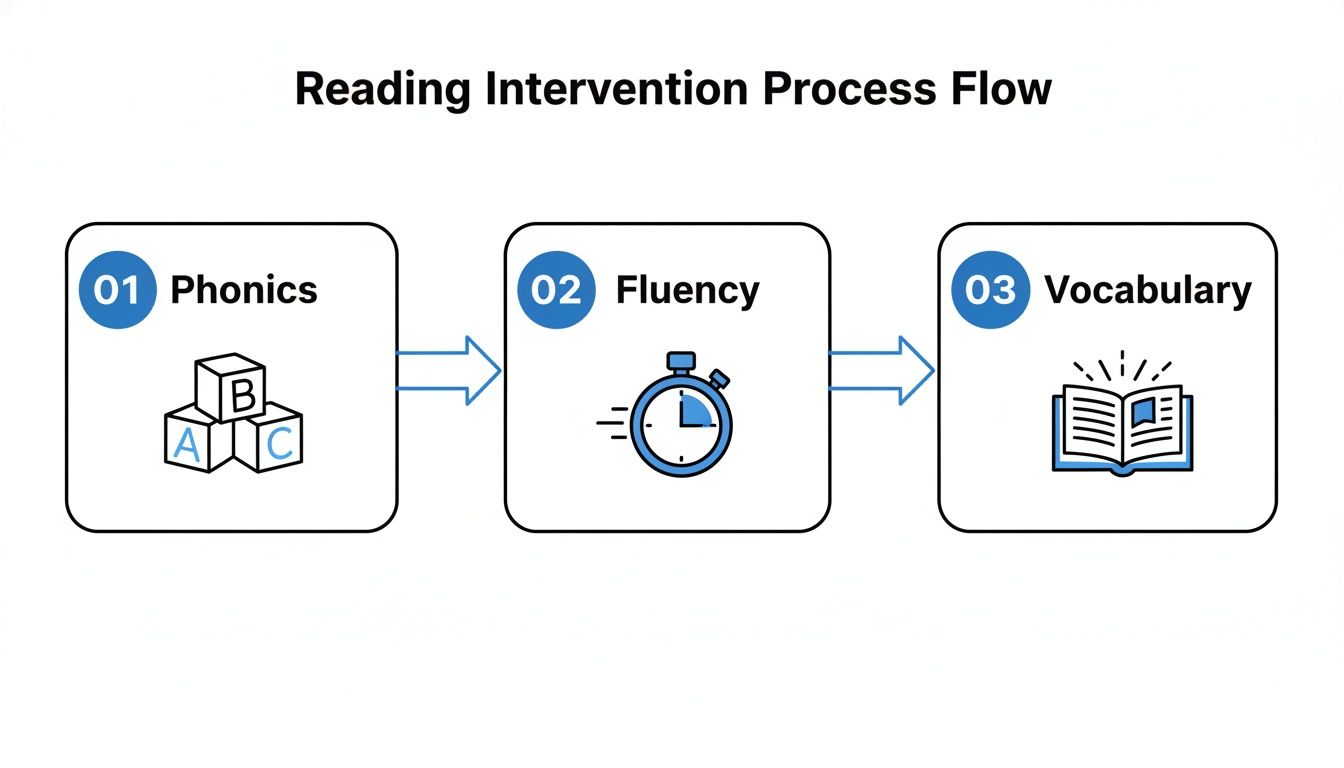
The process shows how these foundational skills build on one another, creating a clear path to confident reading.
Designing a Supportive Classroom Environment
In the classroom, the physical environment plays a huge role in both motivation and learning. A teacher can create a space that either invites exploration or causes anxiety for a struggling reader. Just like at home, the key is access, choice, and comfort.
A diverse classroom library is non-negotiable. It must be filled with a wide range of genres, formats, and reading levels. Make sure to include graphic novels, magazines, non-fiction texts with amazing visuals, and books that reflect the diverse backgrounds and experiences of your students. When a child can see themselves in a book, their engagement skyrockets.
Flexible seating is another powerful strategy. Offering options like floor cushions, standing desks, or comfy chairs allows students to find a spot where they can focus best. For a child who feels anxious about reading, being able to settle into a less exposed, more comfortable spot can make all the difference. When you create these supportive zones, you help turn the classroom into a place where every single reader feels they belong.
Finding the Right Book to Ignite a Spark
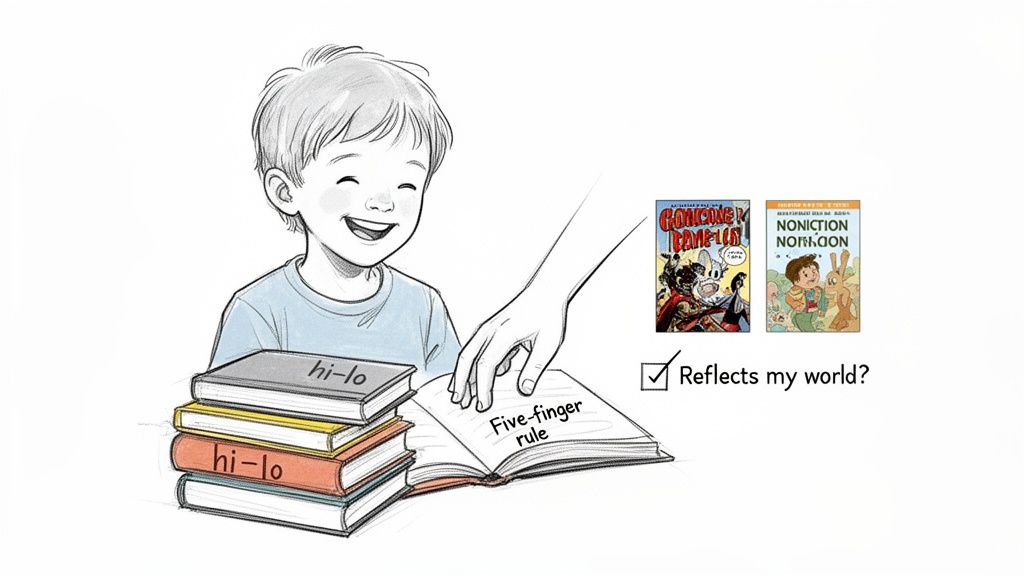
For a child who sees reading as a constant battle, the right book at just the right moment can feel like a miracle. It has the power to turn reading from a source of frustration into a gateway for adventure. The secret isn't just about finding any book; it's about finding their book—one that taps into their interests, speaks to their world, and is accessible enough to make them feel successful.
When a kid has a history of stumbling with reading, a single positive experience can rewrite their entire story. Our job is to help engineer that success by carefully choosing texts that build confidence instead of chipping away at it. This means we have to prioritize connection over curriculum and let their genuine interests lead the way.
Match the Book to the Child, Not the Grade Level
The fastest way to turn off a struggling reader is to hand them a book that looks like an impossible mountain to climb. What we need is a simple, quick way to gauge a book's difficulty on the fly, without a formal assessment.
This is where the "five-finger rule" comes in. It’s a wonderfully low-pressure tool that empowers kids to vet a book for themselves.
Here’s how it works:
- Ask the child to open the book to any page and start reading.
- For every word they don’t know or can't sound out, they put up one finger.
- After they finish the page, take a look at the finger count.
The result gives you an instant snapshot of whether the book is a good fit.
| Fingers Up | Meaning | Recommendation |
|---|---|---|
| 0-1 Fingers | Too Easy | Great for a quick, feel-good read, but it won’t build new skills. |
| 2-3 Fingers | Just Right | This is the sweet spot. The book is challenging enough to help them grow but not so hard it causes frustration. |
| 4-5 Fingers | Too Hard | This book will likely be too frustrating to read alone. Save it for a read-aloud you can do together. |
This simple method helps guide a child toward a "just right" book, creating an opportunity for them to feel competent and in control of their own reading journey.
Embrace High-Interest, Low-Vocabulary Books
Many struggling readers face a frustrating gap between their intellectual curiosity and their actual reading level. They might be fascinated by black holes or ancient Egypt but can't yet decode the complex texts on those subjects.
This is where high-interest, low-vocabulary (hi-lo) books are an absolute game-changer.
These books are specially written with mature themes, exciting plots, and great visuals, but they use simpler sentence structures and more accessible vocabulary. They allow older struggling readers to dive into content that respects their age and interests, which helps them avoid the embarrassment of being handed a book that feels "babyish."
The goal is to provide a reading experience where the child is so absorbed in the story that they almost forget they are practicing a skill. Hi-lo books are a perfect tool for achieving this.
This approach gives them the mental space to focus on understanding the story and actually enjoying it, rather than getting stuck on decoding every single word. If you're looking for ideas, exploring lists of books for reluctant readers can be a fantastic starting point.
Expand Your Definition of a "Good Book"
It's time to let go of the old idea that only traditional chapter books "count" as real reading. For a struggling reader, all sorts of formats can offer an inviting on-ramp to literacy. These alternatives are often far less intimidating and provide crucial visual support that can really help with comprehension.
Consider adding these to the mix:
- Graphic Novels: With their dynamic illustrations and dialogue-heavy stories, graphic novels are packed with contextual clues that help readers figure out the plot.
- Verse Novels: These stories are told through poetry. The use of white space and shorter lines makes a page look much less dense and overwhelming.
- Engaging Non-Fiction: Look for books filled with amazing photographs, infographics, and "did you know?" style fact boxes. These formats break text into manageable chunks and are perfect for kids who love learning facts.
By honoring a child's choices and offering a wide menu of engaging, accessible reading materials, you can help them find that one special book that finally ignites a spark.
Watching for Progress and Knowing When to Call for Backup
So you've put some new reading strategies into play. The next big question is, are they actually helping? When you're working with a struggling reader, tracking progress isn't about tests or grades. It's about spotting the small but meaningful shifts that show a child is gaining both skill and confidence.
These little check-ins are your guide. They tell you what's clicking and what might need a different approach. The whole idea is to measure growth in a way that feels supportive and encouraging, not like a pop quiz.
How to Spot Progress Without a Test
You don't need a formal assessment to know if a child is moving in the right direction. Just paying closer attention during your regular reading time can give you some amazing insights. The trick is knowing what to look and listen for.
One of the best ways is to tune in during read-alouds. Are they starting to self-correct? A child who reads "horse" instead of "house" but then pauses to fix it is showing a huge leap in their awareness of sounds and context. That's a moment to celebrate.
Also, listen to their rhythm. Is their reading becoming smoother, less choppy? When their voice starts to have more expression, it’s a great sign. It means their brain is no longer spending all its energy just decoding words and can start focusing on what the story actually means.
Tracking progress is less about scores and more about noticing the small victories. Celebrate when a child decodes a tricky word on their own or eagerly retells a story—these are the real indicators of success.
You could also try a reading log, but with a twist. Instead of just a list of books, make it about their experience.
| Date | Book Title | What I Liked | One New Word I Learned | How It Made Me Feel (😀😐😕) |
|---|---|---|---|---|
| Oct 15 | Frog and Toad | Frog was funny. | adventure | 😀 |
| Oct 17 | The Magic Tree House | They time-traveled! | dinosaur | 😀 |
| Oct 19 | Where the Wild Things Are | The monsters looked scary. | mischief | 😐 |
This simple chart shifts the focus from just finishing a book to connecting with it. It becomes a tool for reflection, not a chore.
Recognizing When You Need More Support
Even with the best strategies at home or in the classroom, some kids will continue to struggle in a way that feels stuck. It’s so important to recognize when a deeper issue, like a learning difference such as dyslexia, might be the cause. Knowing when to get professional help is a critical part of knowing how to help struggling readers for the long haul.
You might see persistent challenges that just don't get better with practice. Keep an eye out for signs like:
- Trouble with rhymes or hearing the individual sounds in words, even after a lot of practice.
- Difficulty remembering common sight words that they see over and over.
- A big difference between their spoken vocabulary (which might be great) and their ability to read those same words.
- A strong resistance to reading that feels more like genuine distress than simple reluctance.
These aren't just signs of a slow start; they can point to an underlying neurodevelopmental difference. Research shows that some older students face such profound decoding challenges that it can block nearly all academic progress by middle and high school.
How to Advocate for Your Child
If you suspect something more is going on, it's time to advocate for a formal evaluation. This is your right as a parent and a necessary step to get your child the specific, structured support they need to really succeed.
First, start documenting what you're seeing. Keep a simple log of the specific struggles, the strategies you've tried, and any patterns you notice. Having this concrete information will be a game-changer when you talk to the school.
Next, put your request in writing. Send a formal letter or email to the school's principal and special education coordinator requesting an evaluation. Be clear and direct. State that you are requesting a comprehensive evaluation to assess for a potential specific learning disability, like dyslexia.
This process can feel intimidating, but remember, you are your child's most powerful advocate. An evaluation provides a clear diagnosis and opens the door to specialized instruction and accommodations, like multi-sensory reading programs or assistive technology. It’s the right next step when your own best efforts aren't quite enough.
Burning Questions About Supporting a Struggling Reader
When you're trying to figure out how to best help a struggling reader, the questions can feel endless. Whether you're a parent watching your child get frustrated with a book or a teacher working hard to connect with every student in your classroom, you just want clear answers.
Let's tackle some of the most common concerns I hear from parents and educators. Remember, this is a journey. It’s not about finding an instant fix, but about making steady, patient progress with the right kind of support. Every small win is a huge victory.
Is It Okay to Let My Child Read "Easy" Books?
Yes, absolutely. In fact, I encourage it.
While our ultimate goal is to get them comfortable with more complex, grade-level texts, confidence is the fuel that powers their reading engine. Letting a child dive into books they can read easily—especially ones they pick out themselves—is fantastic practice. It gives them a chance to experience the pure joy of getting lost in a story without hitting a wall every few sentences.
Think of it as building momentum. These "easy" reads are anything but a waste of time. They help cement foundational skills, build reading speed, and most importantly, they begin to repair a child's relationship with books. It’s a powerful reminder that reading can actually be fun.
A quick note from the classroom: While top-performing schools don't exclusively use below-grade-level texts for core instruction, they absolutely see the value in them for independent reading. It's a proven strategy for building confidence and stamina.
My Older Child Still Can't Sound Out Basic Words. What Do I Do?
This is a really tough spot to be in, and it’s a serious hurdle. When a middle or even high school student is still tripping over basic decoding, it can slam the brakes on learning across every single subject. Research confirms that for some older students, this single issue can prevent any meaningful academic progress.
For a student in this situation, the answer is almost always more intensive, targeted support that goes beyond the standard curriculum.
Here’s where to start:
- Request a formal evaluation. This is the first step to pinpointing the root of the problem, which could be something like dyslexia.
- Find specialized instruction. Look for tutors or programs that teach advanced word analysis, like how to tackle multi-syllable words and tricky spelling rules.
- Advocate for accommodations. Tools like audiobooks and text-to-speech software are game-changers. They allow your child to keep up with grade-level content in history and science while they simultaneously work on their decoding skills.
How Much Should I Help When They Get Stuck on a Word?
It’s a delicate balance, isn't it? If you jump in too fast, you take away their chance to solve the puzzle themselves. But if you wait too long, frustration takes over and they just shut down.
I always recommend the "Wait, Prompt, Praise" method. It's simple and effective.
- Wait: When they get stuck, just give them a quiet 3-5 seconds. It can feel like a long time, but it gives their brain a chance to work.
- Prompt: If they’re still stuck, offer a small, gentle clue. Try something like, "What sound does that first letter make?" or "Look at the middle part of that word. Does it look like another word you know?"
- Praise: No matter the outcome, praise their effort. "I love how you tried to figure that out!" or "Great job trying to sound that out!" This builds resilience and teaches them that trying is what matters most.
At Number 6 Publishing, we believe the right book can change everything. We are dedicated to creating and curating stories that spark curiosity and build confidence in every reader. Discover books that will connect with your child and support their reading journey at https://www.number6publishing.com.