
There's a special kind of magic in the moment a child finds a book they can't put down. Getting them there involves a little bit of observation and a few simple at-home checks, like the five-finger rule, to see if a book is a good fit. This whole process is about matching your child with stories that are challenging enough to help them grow, but not so hard they just give up.
Why Finding Your Child's Reading Level Is So Important
Figuring out a child’s reading level isn't about slapping a label on them; it's the key to unlocking their confidence and sparking a genuine love for stories that can last a lifetime. When a book is too difficult, reading feels like a chore, leading to frustration and avoidance. On the other hand, a book that’s way too easy offers no room to grow, leaving young readers bored and looking for something else to do. The goal is always to find that "just right" sweet spot.
This guide gives you a simple framework to follow: Observe, Assess, Match. It takes the guesswork out of the process and turns it into an act of discovery, giving you a practical toolkit to support the young reader in your life.
Connecting Assessment to Confidence
Knowing how to check your child's reading level helps you understand where they are right now and what their next steps should be. Without that insight, it’s easy to get it wrong. You might push them toward a popular chapter book series before they're truly ready or keep them in picture books when they're secretly craving more complexity.
This isn't about testing, it's about empowering. It gives you the information you need to:
- Build Confidence: Success with the right kind of challenging book creates a positive feedback loop. Each finished page feels like a victory, motivating them to keep going.
- Prevent Frustration: By steering clear of books that are way beyond their ability, you protect them from the kind of discouragement that can turn them off reading for good.
- Target Skill Growth: When you can pinpoint specific struggles—whether it's with fluency, decoding new words, or just understanding the story—you can offer much more targeted support.
Understanding the Bigger Picture
Gauging reading ability also gives you context for where your child fits into broader educational benchmarks. Take the PISA 2022 results, for instance. Across OECD countries, 74% of students scored at Level 2 proficiency or higher, meaning they can identify a main idea in a text. But only 7% reached the top Levels 5 or 6, where they can handle long, complex texts and abstract ideas. You can learn more about these global reading proficiency findings.
When you know your child's reading level, every book you choose becomes an intentional step forward in their journey. It’s the difference between randomly picking books and strategically building a bridge to more complex stories.
Ultimately, taking the time to assess your child's reading level is an act of advocacy. It helps ensure every book they pick up is an opportunity to grow, explore, and truly fall in love with the written word.
Decoding the Three Pillars of Reading Ability
To really get a handle on a child's reading level, you first need to know what you’re looking for. It helps to think of reading not as one big skill, but as a structure built on three crucial pillars. When all three are strong and working together, a child reads with the kind of confidence and understanding we all hope for.
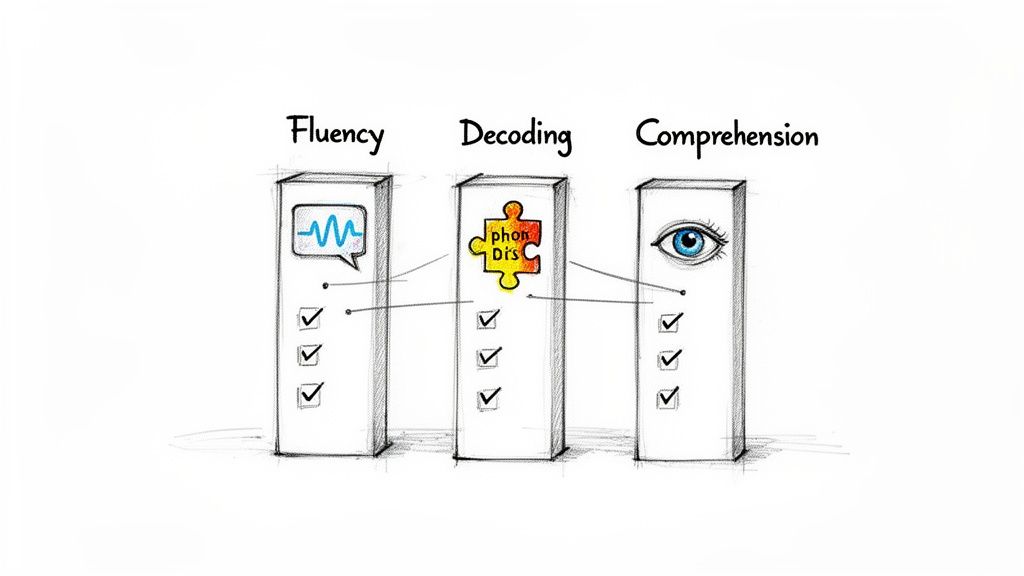
Getting to know these components—decoding, fluency, and comprehension—is the key to spotting both strengths and the areas that need a little more support. This knowledge is your foundation before you even think about picking up an assessment tool.
Decoding: Unlocking the Code
Decoding is where it all begins. This is the nitty-gritty of seeing letters on a page and translating them into the right sounds to build words. It covers everything from sounding out unfamiliar words (like c-a-t) to instantly recognizing common ones on sight, often called sight words.
A child who is a strong decoder can tackle a new word like "adventure" by breaking it down into smaller, familiar chunks. On the other hand, a child who’s struggling might guess wildly based on the first letter, turning "house" into "horse," or get tripped up by simple words they should know by now.
Here’s what solid decoding looks like in action:
- Accurate Word Recognition: They’re reading the words on the page correctly, with very few mistakes.
- Phonetic Strategies: When they hit a word they don't know, their first instinct is to sound it out, not just guess or skip over it.
- Growing Sight Vocabulary: High-frequency words like "the," "and," and "was" are recognized in a snap, without any hesitation.
Fluency: The Rhythm of Reading
Fluency is the essential bridge that connects decoding words to actually understanding them. It's about reading with the right blend of speed, accuracy, and expression. When a reader is fluent, they sound natural—almost like they’re just talking.
Think about listening to a good storyteller. A fluent reader’s voice rises and falls with the story, they pause for commas, and they stop at periods. Their reading is smooth, not stilted, which frees up their brain to focus on what the story means instead of just the mechanics of saying the words.
In contrast, a reader who isn't yet fluent can sound choppy or robotic. They often read word by painful word, blow past punctuation, and speak in a monotone. All of that makes it incredibly difficult to follow the plot.
When a child reads fluently, they’ve moved past the mechanics of sounding out each word. This frees up their mental energy to actually think about what the story means, which is the entire point of reading.
Comprehension: Making Meaning from Text
This is it—the ultimate goal of reading. Comprehension is the ability to understand, interpret, and really think about what’s on the page. This pillar is about so much more than just being able to summarize the plot; it involves digging deeper, making connections, and thinking critically.
A reader with strong comprehension doesn't just know that the main character went to the store. They can figure out why she went, guess what might happen next, and even connect the character's feelings to their own. As you decode the pillars of reading ability, remember that reading comprehension is central; exploring strategies to improve reading comprehension skills can significantly enhance a child's overall proficiency.
For parents, it’s vital to not only listen to your child read but to talk about the story with them afterward. To learn more, check out our guide on how to develop reading comprehension skills. Truly understanding these three pillars will transform how you look at a reading level, moving the focus from just performance to genuine understanding.
Practical Ways to Assess Reading Levels at Home
Knowing the theory behind reading levels is one thing, but actually putting that knowledge into practice is where you’ll see real progress. The good news? You don’t need a teaching degree or any special equipment to get a solid feel for your child’s reading abilities.
A few simple, low-stress techniques can tell you a surprising amount, and you can do them right from your living room couch. These methods are designed to feel more like a shared activity than a test, giving you the insights needed to find those perfect "just right" books.
Start with an Informal Reading Inventory
An Informal Reading Inventory (IRI) is just a fancy term for a straightforward way to see if a book is a good fit. It’s less about a score and more about observing how your child navigates a text in real-time.
The process couldn't be simpler. Pick a short passage—about 100 words is perfect—from a book you think is at their level. Sit with your child and listen as they read it aloud. Your job is to listen for fluency, notice any mistakes, and then ask a few questions to see what they understood.
Use the Five-Finger Rule
For a super quick and easy version of an IRI, try the beloved five-finger rule. It’s a classic for a reason—it works, and kids can even learn to do it themselves at the library or bookstore.
Here's the rundown:
- Pick a Page: Have your child open a book to any page with a good amount of text and start reading.
- Raise a Finger: For every word they don’t know or can't figure out, they should hold up one finger.
- Count the Fingers: Once they finish the page, see how many fingers are up.
If they have 0-1 fingers raised, the book is at their independent level. Perfect for pure enjoyment and building confidence. With 2-3 fingers up, it’s likely their instructional level, offering a healthy challenge with a little support. But if they raise 4-5 fingers, you've hit their frustration level, meaning the book is probably too difficult for now.
Scenario in Action
Sarah wants to see if her third-grader, Leo, is ready for the popular Dragon's Valley chapter book series. She hands him the first book and has him try the five-finger rule. Leo stumbles on six words before he's even done with the page, holding up five fingers. Sarah now knows this book is too challenging for him to read alone, so she suggests they read it together instead.
Track Progress with Simplified Running Records
While teachers use formal running records, you can use a simplified version at home to track accuracy and self-correction. This process helps you see how your child decodes words and what they do when they get stuck.
As your child reads a passage aloud, just make a checkmark on a piece of paper for every word they get right. If they make a mistake, jot down what they said instead of the actual word. This gives you a clear picture of their accuracy. For example, reading 97 words correctly out of 100 gives them a 97% accuracy rate—excellent for independent reading.
Even more importantly, watch for self-corrections. Does your child notice a mistake and go back to fix it? That’s a fantastic sign! It shows they're actively thinking about the meaning of the story, not just sounding out words.
Dive Deeper with Comprehension Checks
Reading the words correctly is only half the battle. True reading happens when a child understands the meaning behind them. After your child finishes a passage or chapter, go beyond basic "what happened" questions.
The best comprehension questions are open-ended. They encourage your child to think critically, make inferences, and connect the story to their own life. Instead of asking, "Who was the main character?" try asking questions that start with "why" or "how."
Here are a few powerful examples:
- "Why do you think the character decided to do that?"
- "How do you think they were feeling in that moment?"
- "What do you think might happen next? What clues make you think so?"
- "Does this story remind you of anything that's happened to you?"
These questions turn a simple check-in into a rich conversation, giving you a much clearer window into their understanding. They also reflect the skills assessed by global standards. For instance, the PIRLS 2021 achievement results highlighted that only 16% of U.S. fourth-graders reached the 'advanced' level of reading, where they could interpret complex information. The study also found that strong home literacy environments can boost scores by 20-50 points—a testament to the power of these at-home conversations.
Comparing At-Home Reading Assessment Methods
Feeling a bit overwhelmed by the options? Don't be. Each method has its own strengths, and you can choose the one that best fits your goals and time. This table breaks it down to help you decide where to start.
| Assessment Method | Best For Measuring | Time Required | Key Takeaway |
|---|---|---|---|
| Five-Finger Rule | Quickly matching a book's difficulty to a reader. | 1-2 minutes | The fastest way to see if a book is too easy, too hard, or just right for independent reading. |
| Informal Reading Inventory (IRI) | A balanced look at fluency, accuracy, and basic comprehension. | 5-10 minutes | A great all-in-one check to understand how a child handles a specific text. |
| Simplified Running Record | Word accuracy and decoding strategies (like self-correction). | 5-10 minutes | Pinpoints specific decoding habits and shows if a child is actively monitoring their own reading. |
| Comprehension Checks | Deeper understanding, critical thinking, and inference skills. | 5-15 minutes | Moves beyond word-calling to reveal if the story’s meaning is truly getting through. |
Ultimately, combining these methods gives you a well-rounded picture. You aren’t just looking at one metric; you’re observing decoding skills, checking book fit, and evaluating understanding. Using these tools, even just once a month, provides invaluable feedback. For additional support, you might also be interested in exploring some of the best reading apps for kids, which can offer engaging practice.
Making Sense of Formal Reading Level Systems
If you've ever felt a bit lost trying to decipher terms like "Lexile" or "Fountas & Pinnell" on a school report, you are definitely not alone. These formal systems are the tools schools use to measure reading progress, but the terminology can feel like a foreign language to parents.
The goal here isn't to turn you into a literacy specialist overnight. It's to give you the confidence to understand a teacher's feedback, make sense of the numbers you see, and use that information to find books your child will actually enjoy.
What Is a Lexile Measure?
One of the most common systems you'll encounter is the Lexile Framework for Reading. Think of it as a scale that measures two things: a reader's ability and a text's complexity. A student's Lexile measure is a number followed by an "L" (like 850L), which places them on this scale.
Books, articles, and even websites are also assigned a Lexile measure based on factors like sentence length and word frequency. The whole point is to match a reader with a text that provides just the right amount of challenge.
A good match typically happens when a book's measure is within a specific range of the reader's score—ideally from 100L below to 50L above. This sweet spot ensures the text is challenging enough to promote growth but not so difficult that it causes frustration.
A Lexile score is a powerful piece of data, but it's not the whole story. It measures the complexity of the text, not the maturity of its themes. A classic novel like The Grapes of Wrath has a surprisingly low Lexile measure of just 680L because of its straightforward language, but its content is best suited for older readers.
This simple infographic provides a clear process for checking a book's fit at home, which complements formal assessments by grounding them in real-world application.
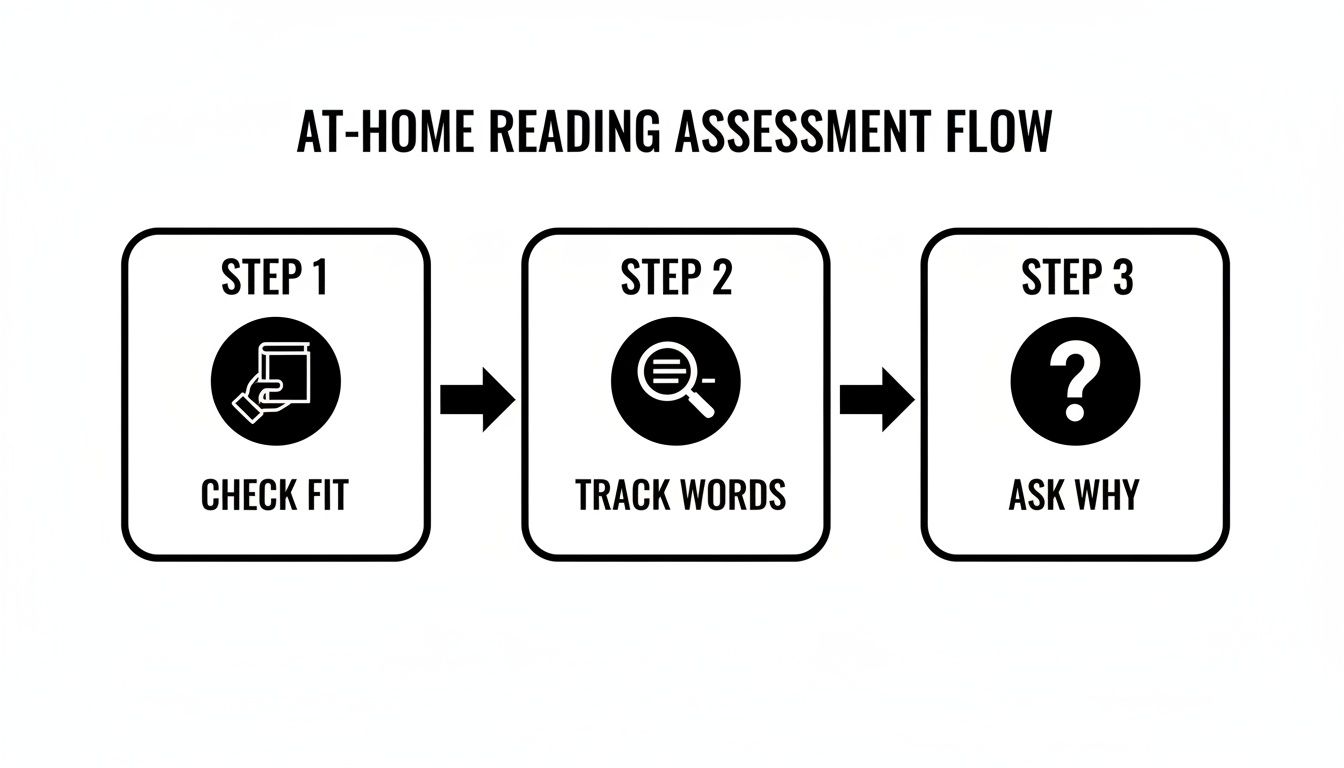
This visual reminds us that the best assessments combine data with observation, moving from a quick check to a deeper look at comprehension.
Understanding Guided Reading Levels
Another system you'll likely hear about is the Fountas & Pinnell (F&P) Guided Reading Level (GRL). This system uses letters of the alphabet, from A to Z, to categorize books by difficulty. A child starting kindergarten might be reading Level A books, while a proficient fifth-grader could be reading at a Level V or W.
Unlike Lexile measures, GRLs consider more than just sentence length and word count. They also factor in things like:
- Content and Themes: The complexity and maturity of the story's ideas.
- Text Structure: How the story is organized, including elements like flashbacks or multiple points of view.
- Language and Vocabulary: The use of figurative language, technical terms, or unfamiliar words.
- Illustrations: How much support the pictures provide to the reader.
Because GRLs are more qualitative, they are often used by teachers to group students for small-group instruction, providing targeted support based on their specific needs. As you delve into these evaluation methods, understanding the difference between informal and formal assessments can further clarify your approach.
Translating Scores Into Smart Choices
So what do you do with all these numbers and letters? The real value comes from using them to connect your child with the right books. The best way to do this is to see these scores as a starting point, not a strict rule.
Formal systems give you a reliable benchmark, but your at-home observations provide the essential context. A child might have a high Lexile score but struggle with a book on an unfamiliar topic. Conversely, their passion for a subject might empower them to tackle a text that is technically "above their level."
Ultimately, these systems are just one piece of the puzzle. They are valuable guides, but your knowledge of your child's interests, passions, and personality is what will turn a good book match into a great one.
Turning Your Assessment Into the Perfect Book Choice
After all the observing, listening, and questioning, you’ve gathered some fantastic insights into your child’s reading world. Now for the fun part: using that knowledge to find books they’ll actually want to read. This is where the data from your assessment turns into discovery and connects directly to the joy of a good story.
The secret is understanding the difference between two key reading zones: the independent level and the instructional level. Getting this right can make reading a rewarding adventure instead of a frustrating chore.
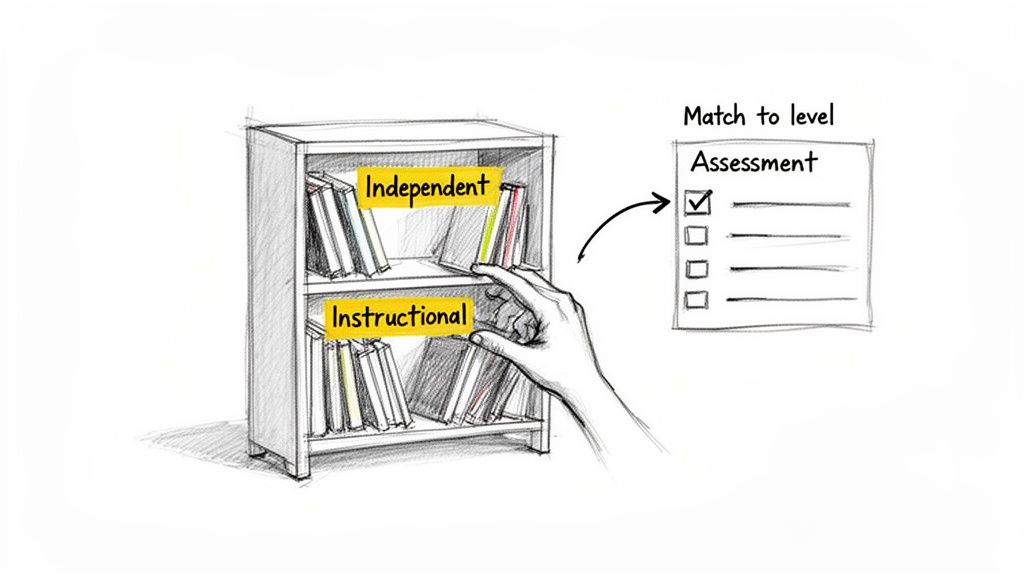
Independent vs. Instructional Level Reading
Think of these two levels as different settings for different reading goals. One is purely for enjoyment, and the other is for growth.
-
Independent Level: These are the books your child can pick up and read all on their own with almost perfect accuracy (around 95-100%). Reading these books feels easy, builds their speed and fluency, and most importantly, boosts their confidence. This is their "just for fun" zone.
-
Instructional Level: This is the learning sweet spot. Books here are a bit more challenging, with an accuracy rate of about 90-94%. They demand a little more effort and some support from you, making them perfect for guided practice where you can help them unpack new words and bigger ideas.
When you're browsing for new material, it’s smart to look for a mix of kids' books that land in both categories. A healthy reading diet has a little bit of comfort food and a few gentle challenges.
Translating Scores Into Stories
So, how do you take a number, like a Lexile measure of 650L, and turn it into the right book? This part is more of an art than a science, blending the hard data with what you already know about your child.
For a reader with a 650L score, their ideal range for growth (the instructional level) is somewhere between 650L and 700L. For independent reading, you'd hunt for books in the 550L to 650L range. This gives them a text that feels totally manageable and helps build positive momentum.
A Real-World Example
Let's say a fourth-grader named Maya has a Lexile score of 720L. Her mom uses the Lexile "Find a Book" tool and discovers that The Giver by Lois Lowry is 760L—a perfect fit for Maya’s instructional range. They can read that one together. For Maya’s own quiet reading time, her mom finds Where the Red Fern Grows at 700L, a slightly less complex text she can enjoy without any help.
Strategies for Choosing the Right Books
Knowing the numbers is only step one. The final, most important piece of the puzzle is matching that data with your child's personality and passions. A book that’s a "perfect" technical fit can still fall completely flat if they find the topic boring.
Here are a few tips to make sure your choices really connect:
-
Always Prioritize Interest: A child's passion for a topic can fuel their determination to work through a tougher text. If your kid is obsessed with dinosaurs, they might power through a book slightly above their instructional level just because they have to know more.
-
Use the "Just Below" Trick: To build reading speed and confidence, try picking a few books that are just below their independent level. When a child can fly through a story with ease, it reinforces the powerful feeling that they are a strong, capable reader.
-
Don’t Let the Level Become a Limit: Please, never tell a child, "You can't read that; it's not your level." If they're dying to read a book that seems too hard, make it a shared experience. Read it aloud to them, or take turns with the pages. This gives them access to the complex story they’re craving while you provide a supportive safety net.
Ultimately, the goal of any reading assessment isn’t to stick a label on your child. It's to open doors. It empowers you to be a better guide on their reading journey, armed with the insight to choose stories that will challenge, delight, and inspire them to keep turning the pages.
Wrestling with the Finer Points of Reading Levels
Once you start trying to pinpoint your child's reading level, you'll quickly find that a whole new set of questions bubble up. This is completely normal! Working through these little details is how you keep their journey with books feeling positive and full of forward momentum.
Let's dig into some of the most common questions we hear from parents who are right where you are. Getting these answers helps turn your observations into confident, supportive action that’s truly responsive to your child as they grow.
How Often Should I Be Checking In?
This is a fantastic question, and the honest answer is: it depends. For most kids in the K-8 range, doing a more formal check-in every two or three months is a pretty good rhythm. It gives them enough runway to make real progress without letting them get stuck or frustrated for too long.
That said, you should always trust your gut. If you see a sudden change—maybe books that were tricky a month ago are now a breeze, or they've started avoiding reading altogether—that’s your cue. A quick, informal check-in is a great idea at that point.
The goal here isn't constant testing. Think of it more as a gentle pulse check to make sure the books they're excited about are still a great match for their skills. It’s all about staying aware, not creating pressure.
What if They Want to Read a Book That's "Too Hard" for Them?
This happens all the time. You’ve got a third-grader who’s reading comfortably at a second-grade level, but they are desperate to get their hands on a massive fifth-grade fantasy novel. The absolute worst thing you can do is say, "Nope, that's too hard for you." That's a surefire way to kill their excitement.
Instead of seeing it as a problem, view it as an opportunity. A book they're passionate about is an invitation for you to connect.
- Read it together. Make it your shared read-aloud. You can do the heavy lifting with the complex sentences and vocabulary, and they can just soak up the amazing story.
- Grab the audiobook. Listening to a well-narrated audiobook while following along in the physical copy is an incredibly powerful tool. They get to hear what fluent reading of that text sounds like while their eyes connect the sounds to the words on the page.
- Take turns. You read a page, they read a page. This gives them a chance to practice in a low-stakes way, with you right there to help if they get stuck.
Never let a reading level stand in the way of a great story. When a child's interest outpaces their skill, it’s not a barrier—it’s an invitation for you to join them on the adventure.
We Seem to Have Hit a Plateau. Now What?
First thing: don't panic. Progress in reading is never a straight, even line. It’s full of leaps, stalls, and stutters. Hitting a plateau is a natural part of learning and often comes right before a big breakthrough. Your job is to shift from pushing for progress to simply rebuilding their joy and momentum.
If your reader seems stuck, try mixing things up a bit:
- Go back to old favorites. Let them reread a few books that are well below their current level. There's a huge confidence boost in flying through a familiar story, and it reminds them that reading can feel easy and fun.
- Try a new format. Maybe it's time to introduce graphic novels, a magazine about their favorite hobby, or some high-interest nonfiction. A change of scenery can be all it takes to get them re-engaged.
- Focus on a different skill. If fluency is the sticking point, maybe spend more time just talking about the stories to build comprehension. Taking the direct pressure off can often help a skill develop more naturally.
Reading plateaus are almost always temporary. When you meet them with patience and a little creativity instead of pressure, you help your child come out the other side as a more resilient, confident reader.
At Number 6 Publishing, we believe that finding the right book is the first step in a lifelong love of reading. Our curated collections and heartfelt stories are designed to connect with young readers and support families on their literary journey. Explore our books at https://www.number6publishing.com.