
A Lexile reading level is a score that measures two things: a reader's ability and a book's difficulty, putting both on the very same scale. Think of it like a shoe size for reading—it’s not a grade or a judgment, but a simple tool to find that perfect fit for comfort and growth. This system is all about matching kids with books that are challenging enough to be interesting, but not so hard that they cause frustration.
Your Quick Guide to Lexile Reading Levels
Have you ever seen a child pick up a book, flip through a few pages, and put it right back down? They might be bored, or they might be completely overwhelmed. Finding that “just right” book can often feel like a shot in the dark, but this is exactly where the Lexile Framework for Reading steps in to help.
The system works by assigning two distinct measures:
- A Lexile reader measure: This number shows a child’s reading ability. It’s usually figured out from a school reading assessment and tells you the level of text a student can read with about 75% comprehension.
- A Lexile text measure: This number shows the complexity of a book or article. It's calculated by looking at things like how long the sentences are and how often certain words appear.
By putting both the reader and the book on the same scale, the Lexile framework helps take the guesswork out of picking a book. It’s a simple but incredibly powerful idea for parents, teachers, and librarians.
Finding the Reading Sweet Spot
The goal isn't to find a perfect number-for-number match. It's really about finding a child's best reading range—their "sweet spot," where real learning and skill-building happen.
The ideal range for a child reading on their own is typically from 100L below their Lexile measure to 50L above it. This ensures the book is easy enough to read smoothly while still being challenging enough to introduce new words and ideas.
For instance, a student with a Lexile measure of 600L will probably do best with books rated somewhere between 500L and 650L. Books below this range are great for building confidence or just reading for fun. Books above it are perfect for reading together, with a parent or teacher there to help.
Understanding what a Lexile level is helps you become a better guide on a child's reading journey. It’s not about limiting their choices, but empowering them. When you give kids books that fit their abilities, you help create a positive experience, building the confidence they need to tackle tougher texts down the road and grow a real, lifelong love for stories.
Here’s the rewritten section, crafted to sound like it was written by an experienced human expert.
How Do They Come Up With Lexile Scores, Anyway?
Lexile scores can feel a bit like a mystery, these random numbers attached to books and our kids' reading reports. But once you pull back the curtain, it’s actually a pretty straightforward and scientific system. It’s all designed to help us map out a child's reading journey in a logical way.
The whole idea, known as the Lexile Framework for Reading, came out of a company called MetaMetrics back in the late 1980s. By the early 2000s, it was everywhere in U.S. schools. Their goal was simple: measure both a book's difficulty and a reader's ability on the very same scale, which runs from BR (for Beginning Reader) all the way up to over 2000L. This makes it incredibly easy to find that perfect book-to-reader match.
Looking at What Makes a Book Easy or Hard
When MetaMetrics assigns a Lexile score to a book, they’re not reading it for plot or character development. Instead, they're looking at two key ingredients in the text itself.
- Sentence Length: Are the sentences short and choppy, or are they long and winding with lots of clauses? Longer sentences are just plain harder for our brains to process, so they push the score up.
- Word Familiarity: How often do the words in the book show up in everyday language? A text filled with common, high-frequency words gets a lower score. Throw in more academic or rare vocabulary, and the score climbs.
Think about a simple picture book. It might have sentences like, "The cat sat. The dog ran." The sentences are short, the words are familiar, and the resulting Lexile score is low—maybe around 200L.
Now, picture a chapter book for a middle schooler. You’ll find sentences like, “Despite her initial apprehension, Eleanor discovered the ancient forest concealed a labyrinth of extraordinary secrets.” It’s longer, and words like “apprehension” and “extraordinary” aren’t ones you hear every day. That combination of complexity and vocabulary bumps the score way up, maybe to something like 850L.
This whole process is completely objective. It doesn’t care if a book is a literary masterpiece or a silly adventure. It’s only looking at the structure. That’s why a heavy classic like The Grapes of Wrath has a surprisingly low score of 680L—the sentences are direct and the vocabulary is straightforward, even though the themes are incredibly mature.
The Bottom Line: A book's Lexile score is all about its sentence length and word difficulty. It tells you how it’s written, not what it’s about.
Figuring Out a Student's Reading Level
So, what about the other side of the equation—the student? Many parents think they need to schedule a special "Lexile test," but thankfully, it's much simpler. Your child has probably already gotten a score without you even realizing it.
A student’s Lexile measure usually comes from the standardized reading tests they’re already taking at school. Schools use these assessments to see how students are progressing, and the Lexile score is often part of the report.
Some of the most common tests that provide Lexile measures include:
- State-level achievement tests
- MAP® Growth assessments
- STAR Reading™ tests
- Iowa Assessments™
When a student finishes the reading section on one of these tests, their performance is converted into a Lexile score. That number represents the text level they can read with about 75% comprehension. This is considered the sweet spot for growth—challenging enough to learn from, but not so hard that they get frustrated and give up.
Because both the book and the reader are measured on the same exact scale, you get a really reliable way to connect the two. You can even use free online tools to find books that fit a specific Lexile score.
For example, the official "Find a Book" tool lets you plug in a Lexile range and get a list of perfectly matched books.
This turns a simple number into a powerful tool. In just a few clicks, parents and teachers can build personalized reading lists that tap into a child’s unique interests while supporting their reading growth. It’s a great way to kickstart their next literary adventure.
Putting Lexile Measures into Action
Okay, so you understand the theory behind Lexile reading levels. That’s a great start. But the real magic happens when you use that knowledge to put the perfect book into a child’s hands. This is where a simple number transforms into a tangible reading list, moving you past the guesswork and toward building a library that truly supports and inspires a young reader.
First things first: you need to find the child's Lexile measure. This number isn't some big secret; it’s usually right there on the score reports from standardized reading tests their school uses, like the MAP Growth or STAR Reading assessments. If you don't see it on a recent report card, a quick email to their teacher is all it takes.
Finding the Reading Sweet Spot
Once you have that score, the goal isn't to find a book with that exact number. Instead, you want to find the child’s optimal reading range—their "sweet spot." This is the zone where a book is challenging enough to help them grow, but not so tough that it causes frustration and makes them want to give up.
A reader's ideal range for reading on their own is generally from 100L below their personal Lexile measure to 50L above it. This sweet spot ensures they can understand about 75% of the material, which is perfect for building skills and confidence.
Let's say a fourth-grader has a Lexile measure of 700L. Their reading sweet spot is anywhere between 600L and 750L. Books in this range are perfect for independent reading time. Anything below 600L is great for a fun, easy read that builds fluency, while books above 750L are excellent choices to read together, where you can help them navigate tougher words and ideas.
This infographic shows how both a book's complexity and a reader's ability are measured to create that perfect match.
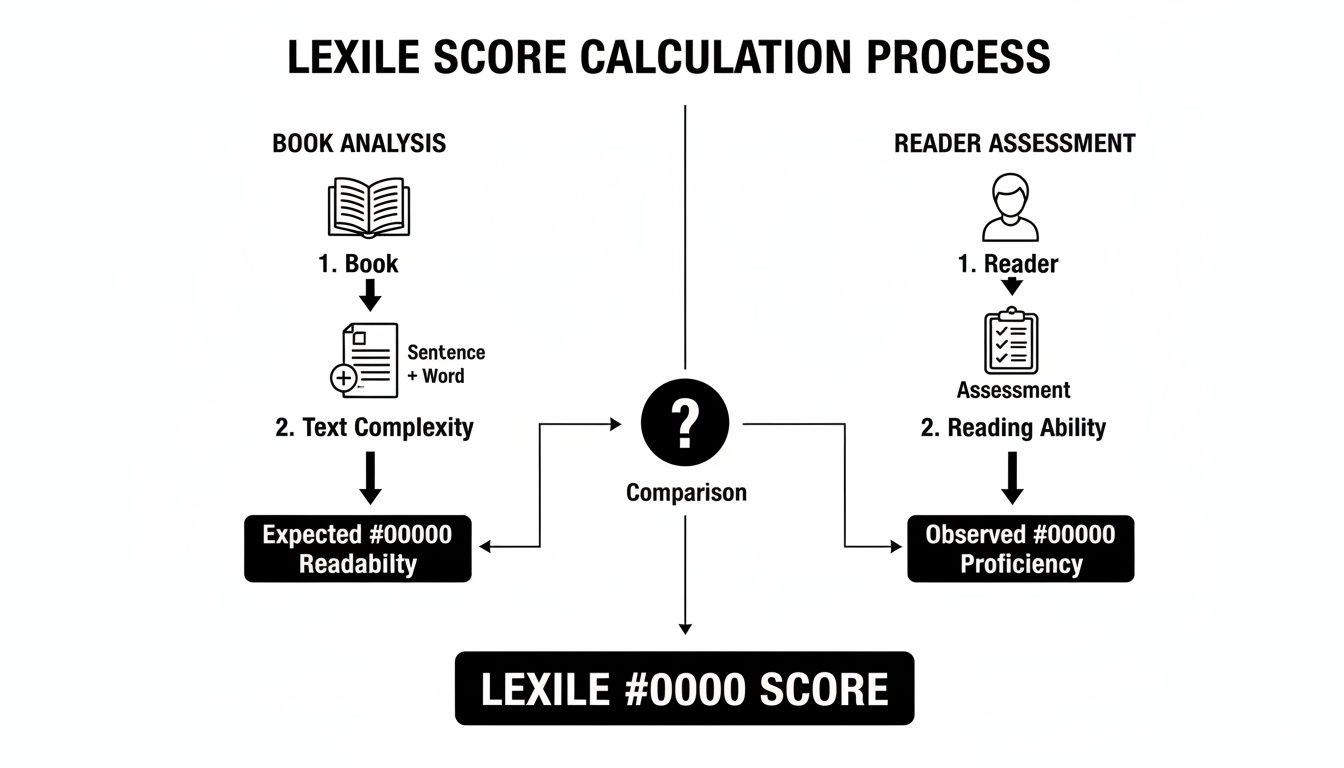
As you can see, the Lexile framework uses the same scale for both books and readers, which is what makes a direct, reliable match possible.
Building a Custom Reading List
With a target Lexile range in hand, you can use some fantastic free tools to find specific titles. The official Lexile "Find a Book" database is a parent's and teacher's best friend. It lets you filter thousands of books not just by Lexile measure but also by a child's personal interests—a total game-changer.
Let's walk through a real-world example. Imagine you have a fifth-grader with a Lexile score of 850L.
- Find the Target Range: Their sweet spot for independent reading is 750L to 900L.
- Think About Their Interests: You know they are obsessed with fantasy and adventure, especially stories with dragons.
- Use the "Find a Book" Tool: You can plug in the Lexile range (750L–900L) and select "Fantasy" and "Adventure" as interest categories.
- Check Out the Results: The tool will spit out a list of books that fit both their reading level and their passions. You might see titles like How to Train Your Dragon by Cressida Cowell (830L) or The Girl Who Drank the Moon by Kelly Barnhill (640L). The second one is a bit below their range, but it's such a fantastic story that it's still a great choice for an engaging read.
This simple process turns a number into a curated list of exciting new adventures. When you line up text complexity with what a child genuinely loves, you create a positive feedback loop: successful reading experiences fuel the desire to read even more. To see how these levels generally line up with school years, you can learn more about the Lexile level chart and grade equivalents.
Of course, finding the right book is only half the battle. As you're putting these Lexile measures to work, it's just as important to use proven strategies to improve reading comprehension. The right book is the first step, but actively building understanding is what comes next. Combine a well-matched book with strong comprehension skills, and you’ll set a child up for a genuine, lasting love for stories.
Tracking Your Child's Reading Progress
One of the most important things to remember about a Lexile score is that it isn't a permanent label. Think of it more like a milestone on a long and exciting journey—just a snapshot of a reader's ability at a single moment in time. The real magic happens when you see these numbers as a dynamic measure of growth.
A child’s Lexile measure will naturally climb as they move through elementary and middle school. This progression isn't always a straight line; some years might bring big jumps, while others show slower, steadier gains. The key is to celebrate the progress itself, not to get hung up on a specific number or compare one child's journey to another's. Every reader truly develops at their own pace.
Differentiating Instruction with Lexile Data
For educators, Lexile measures are an incredibly practical tool for what’s known as differentiated instruction. It’s a simple concept: tailoring teaching methods and materials to meet the individual needs of each student in a diverse classroom.
When a teacher has a clear picture of each student's reading level, they can make smarter decisions. They can hand out "stretch" texts—books just a bit above a student's current level—to those ready for a new challenge. At the same time, they can offer targeted support and more accessible books to students who need to strengthen foundational skills. This way, every child feels engaged and appropriately challenged.
This data-driven approach helps create a classroom where all students can feel successful, moving away from a one-size-fits-all model and toward a more personal learning adventure. You can dive deeper into the different ways to pinpoint a child's abilities in our guide on how to assess reading level.
Understanding Typical Reading Growth
While every child's path is unique, understanding expected growth patterns can be a game-changer. It helps parents and teachers set realistic expectations and know when a reader is making solid progress. For example, massive studies show that a student's progress over a school year often depends on their starting point.
A Scholastic analysis of over 370,000 U.S. students uncovered a fascinating trend: readers who start the year at a lower level often make the biggest gains. A third-grader beginning at 420L, for instance, is projected to jump 150L to reach 570L by the end of the school year. Meanwhile, a classmate starting at a higher 630L might see a 100L increase, ending at 730L. This shows how powerful targeted reading practice can be for accelerating growth, especially for developing readers. You can explore more from this Scholastic research on student growth.
This kind of information is invaluable, whether you're building a classroom library or a home reading collection designed to support steady development all year long.
The ultimate goal is to foster progress, not perfection. When a child sees their own reading ability grow, it builds the confidence and motivation needed to tackle the next book, and the one after that.
By tracking progress over time, the Lexile framework becomes more than just a measurement tool. It transforms into a roadmap, guiding a young reader toward greater challenges and deeper understanding. It allows us to celebrate every step forward on their unique literacy adventure, making sure they feel supported and excited about the world that opens up through reading.
Looking Beyond the Lexile Number
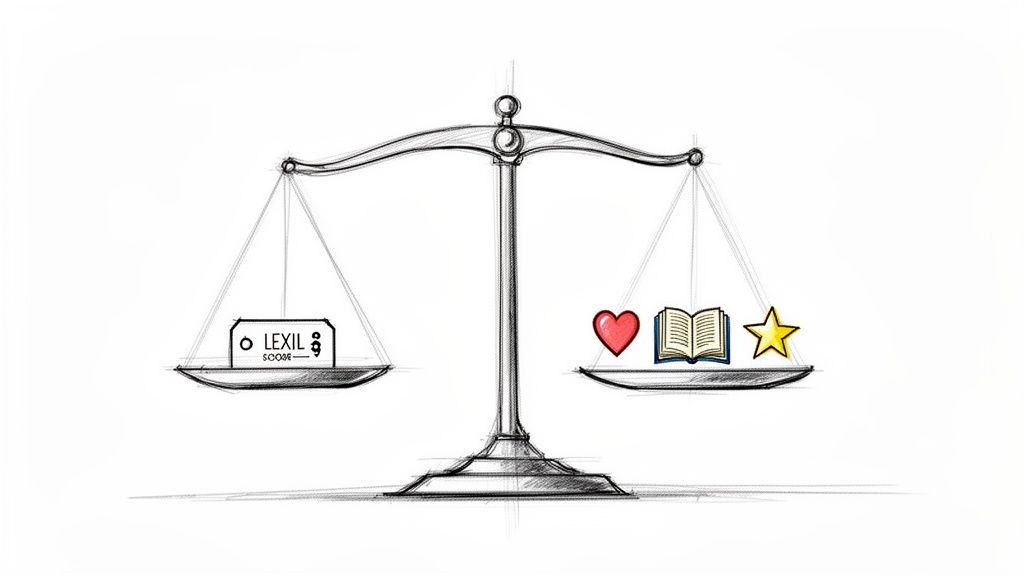
While Lexile measures offer a wonderfully clear starting point for matching readers with books, they are just that—a starting point. To truly nurture a lifelong love of reading, we have to look beyond the number and see the whole child. A Lexile score is a valuable piece of data, but it definitely doesn't tell the entire story.
The framework is designed to be objective, analyzing only how complex a text is based on sentence length and how often words appear. This scientific precision is its greatest strength, but it also creates its biggest limitation. The score tells you how a book is written, not what it’s about.
What a Lexile Score Does Not Measure
Think of a Lexile number as just one tool in a much larger toolkit. It can't account for several critical factors that determine if a book is actually a good fit for a specific child.
- Thematic Maturity: A book can have simple sentences and common words but explore incredibly deep, mature themes. Take John Steinbeck's classic The Grapes of Wrath. It has a Lexile measure of just 680L—a level typical for middle schoolers—yet its themes of poverty and social injustice are best suited for older, more emotionally ready readers.
- Content Appropriateness: The score won't flag potentially sensitive content. A book might be perfectly matched to a child’s reading ability but contain topics or scenes a parent might find unsuitable for their family.
- A Reader's Personal Interest: This is perhaps the most important factor of all. A kid who is passionate about dinosaurs will eagerly tackle a book rated 100L above their level, using sheer motivation to power through tricky vocabulary. On the other hand, a book that’s a "perfect" Lexile match but holds zero interest will feel like a total chore.
A high score doesn't automatically mean a book is "better" or more appropriate, especially for a younger, advanced reader. Their cognitive ability to decode text may have outpaced their emotional development, which is where your judgment as a parent or teacher becomes essential.
A Lexile score is a guide, not a gatekeeper. Its purpose is to open doors to new reading adventures, not lock a child into a narrow numerical box.
Using Lexile Scores as Part of a Holistic Approach
The best way to use Lexile data is to combine it with what you already know about your child or student. Think of it as a conversation between the data and the reader's unique personality.
Start with their Lexile range to pull together a list of potential books, and then use that list as a launchpad for discussion. Ask questions like, "This one is about a kid who travels back in time. Does that sound cool to you?" or "This story is about friendship, but it has some sad parts. Are you in the mood for something like that?"
This approach empowers children by giving them a real voice in their own reading journey. It shows them that their interests, feelings, and curiosity matter just as much as any number on a school report.
Of course, a Lexile number is just one piece of the puzzle; true reading proficiency also involves mastering fundamental skills. Developing a strong grasp of concepts like understanding the difference between topic and main idea is essential for confident reading and deeper comprehension. When a child can identify what a text is about versus what the author is saying about it, they unlock a much more meaningful connection to the story.
Ultimately, our goal is to cultivate curious, passionate, and resilient readers. By using Lexile scores as a supportive guide rather than a rigid rule, you can help a child build the confidence they need to explore the vast and wonderful world of books. This balanced approach is key as you work on strategies to develop reading comprehension skills that will last a lifetime.
Bringing It All Together for a Love of Reading
After digging into what Lexile levels are, how the scores work, and what to do with them, it all boils down to one simple, powerful goal: raising a kid who absolutely loves to read. The numbers and charts are just tools, really. They’re our way of finding that perfect starting line to build a solid foundation of confidence for young readers.
From that starting point, the real magic begins.
Once a child feels that spark of success—that feeling of "I can do this!" with a book that's right for them—their confidence takes off. It’s the fuel that gets them excited to check out different genres, find new authors, and tackle bigger ideas. A great experience with one book is often all it takes to make them eager to grab the next one.
More Than Just a Number
If there’s one thing to take away from all this, it’s that the Lexile framework isn't a restrictive rulebook. Think of it as a key. It's meant to unlock doors, not to stick a child in a narrow little box. When you take the data from a Lexile score and combine it with a real understanding of what a child is passionate about, you create the perfect environment for a love of reading to grow.
The ultimate aim is to move beyond matching numbers and start matching stories to souls. Lexile levels help clear the path, but the journey itself is fueled by interest, choice, and shared discovery.
This balanced approach gives every child a chance to see themselves in the pages of a book. It’s about using the tools we have to support their journey, whether that means finding a perfectly-leveled book they can read on their own or tackling a more challenging story together.
The Final Message
The final message here is one of empowerment for everyone involved—parents, teachers, and of course, the young readers themselves. By using what you now know about Lexile reading levels, you can help every child discover the joy, empathy, and wonder tucked between the pages of a good book.
You aren’t just teaching them to read; you’re giving them a gift that will enrich their entire lives, opening up a world of endless stories and boundless imagination.
Answering Your Top Lexile Questions
Getting a handle on reading metrics can bring up a lot of practical questions. Let's dig into some of the most common ones that parents and teachers ask about the Lexile framework, so you can start using it with confidence.
Where Can I Find My Child's Lexile Score?
Good news—you probably already have it. Your child's Lexile score isn't something you need to go out and get a special test for. More often than not, it’s sitting right on the score report from their school's regular standardized reading tests.
Most schools use assessments that automatically spit out a Lexile measure, including:
- State-level academic achievement tests
- MAP Growth assessments
- STAR Reading tests
The quickest way to find it is to look at your child's latest school report card. If you don't see it there, just shoot a quick email to their teacher. They usually have this data at their fingertips and can give you the most current score.
What if a Book Is Outside Their Lexile Range?
That’s perfectly fine! In fact, it can be a really great thing.
Remember, that recommended Lexile range—usually 100L below to 50L above their score—is just a guideline for comfortable, independent reading. It’s not a hard-and-fast rule. A child's own interest and excitement are incredibly powerful motivators.
If a book your child is dying to read is below their range, it can be a fantastic confidence booster or just a fun, relaxing read. There's so much value in reading for pure enjoyment, without the heavy lifting.
On the other hand, if a book is above their range, it's the perfect opportunity for some shared reading time. Reading it together lets you help with tricky words and talk about bigger ideas, turning what could be a frustrating experience into a wonderful chance to learn and bond.
Key Takeaway: Think of the Lexile range as a tool for finding those "just right" books for them to read on their own, but never let it be a barrier to a story that truly sparks their interest.
Do Lexile Levels Consider a Book's Content?
No, they don't, and this is probably the most important thing to understand about Lexile scores. A Lexile measure only looks at text complexity—how long the sentences are and how often challenging words appear.
It tells you nothing about:
- The age-appropriateness of the topic.
- The maturity of the book's themes.
- The overall quality or literary value of the story.
This is exactly why a parent's or educator's judgment is still the most critical part of picking a book. Always look at the book's subject matter alongside its Lexile measure to make sure it’s a genuinely good fit for your child.
At Number 6 Publishing, we believe the right story can spark a lifelong love of reading. We’re dedicated to creating and curating books that inspire curiosity and truly connect with young readers. Explore our collection of heartfelt children's and young adult titles at https://www.number6publishing.com.