
Ever wonder how teachers find books that seem perfectly suited for your child? It's not magic—it's a system called guided reading level. Think of it like a shoe size, but for reading. It helps match your child with books that are just right for their current skills, ensuring a story is challenging enough to help them grow, but not so hard that they get frustrated and give up.
Understanding What a Guided Reading Level Really Means
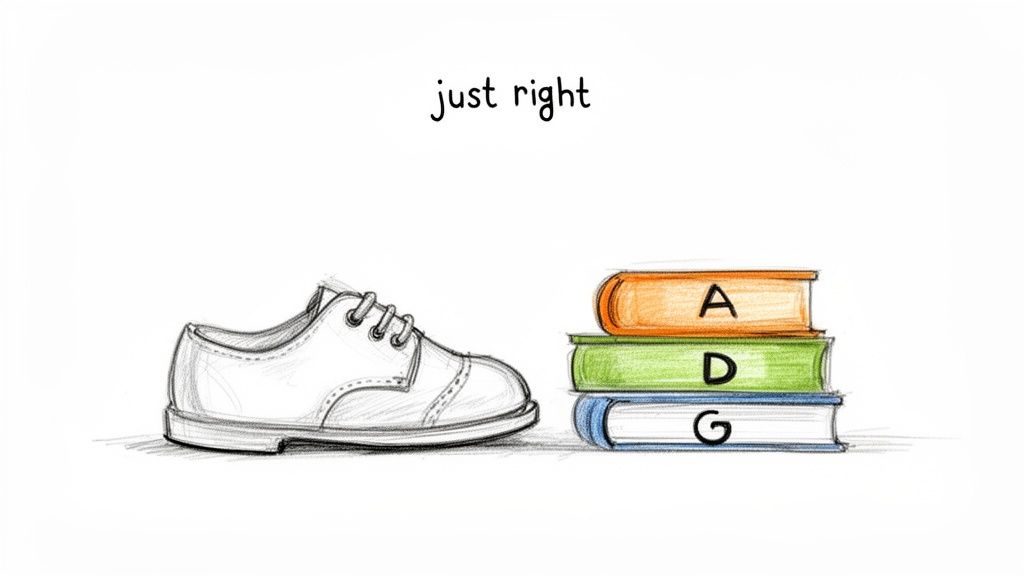
At its heart, a guided reading level isn't a grade or a permanent label. It’s a dynamic guidepost that helps educators and parents pick books that avoid the two biggest roadblocks to reading: the frustration that comes from texts that are too difficult and the boredom that sets in when they're too easy.
The whole point is to find a child's instructional level. This is that sweet spot where a young reader can handle a book with a high degree of success but still bumps into a few tricky spots that create teachable moments. It’s right there, in that zone, that real growth happens.
The A-Z System Explained
One of the most recognized frameworks for this is the Fountas & Pinnell A-Z system. Developed by educators Irene Fountas and Gay Su Pinnell in the late 1990s, this system sorts children's books from Level A for the earliest readers all the way to Level Z for highly fluent ones, typically covering pre-K through 8th grade.
The system aims to match texts to a child's instructional level, where they can read with about 95-98% accuracy and understand 75-89% of what they've read. This precision prevents frustration while opening the door for meaningful teaching. You can explore the history of this instructional approach to see its impact on reading education firsthand.
But this system is about so much more than just counting words or measuring sentence length. It dives deep into a book’s complexity, looking at things like:
- Story Structure: Is the plot simple and predictable? Or does it get more complicated with flashbacks or multiple points of view?
- Language and Vocabulary: Are the words familiar, everyday words, or are they more complex and specific to a certain topic?
- Illustrations and Support: Do the pictures give clear clues that support the story, or are they just for decoration?
- Themes and Ideas: Are the concepts concrete and easy to grasp, like a trip to the zoo? Or are they more abstract, requiring the reader to think about themes like courage or loss?
A guided reading level is the starting point of a conversation, not the final word on a child's ability. It's a tool to empower, not to limit.
Guided Reading Levels At a Glance
To give you a clearer picture, here's a quick overview of how the guided reading levels generally line up with grade levels and the skills a child is developing at each stage.
| Guided Reading Level Range | Typical Grade Level | Key Skills Being Developed |
|---|---|---|
| A-C | Kindergarten | Matching spoken words to print, one-to-one correspondence, using pictures for clues. |
| D-I | First Grade | Decoding simple CVC words, using context to self-correct, reading with more expression. |
| J-M | Second Grade | Reading chapter books, understanding plot and characters, tackling more complex sentences. |
| N-P | Third Grade | Building fluency and stamina, inferring character motivations, reading non-fiction. |
| Q-S | Fourth Grade | Analyzing themes, understanding multiple perspectives, using text evidence. |
| T-V | Fifth Grade | Reading complex plots, understanding figurative language, synthesizing information. |
| W-Z | Middle School (6-8) | Analyzing author's craft, navigating complex themes, engaging in deep literary analysis. |
Keep in mind, this is just a general guide. Every child moves at their own pace, and that's perfectly okay.
Why the Right Level Matters
When a child reads a "just right" book, something pretty incredible happens. They can stop focusing all their mental energy on just sounding out the words and start really understanding the story, connecting with the characters, and thinking about the plot.
This success builds confidence and shows them that reading is a fun, rewarding activity. Finding that perfect-fit book unlocks a child's natural curiosity and empathy, helping them connect with stories on a deeper level and laying the groundwork for a lifelong love of reading. The goal isn’t to race through the levels, but to help them build a rich and meaningful reading life.
Navigating the Different Reading Level Systems
When you first dip your toes into the world of guided reading, it can feel like you’re learning a whole new language. You’ll hear teachers throw around terms like Fountas & Pinnell (F&P), Lexile measures, or Developmental Reading Assessment (DRA), and it’s easy to feel lost.
Think of these systems like different currencies. A dollar, a euro, and a yen all represent value, but they’re measured on completely different scales. Reading level systems work the same way—they all aim to match a young reader with the perfect book, they just use different letters, numbers, and criteria to get there. One might use an A-Z scale, while another uses numbers that stretch into the thousands.
The Most Common Systems Explained
While there are quite a few systems out there, most schools stick to a few major players. Getting a handle on the basics will help you make sense of the report cards from your child's teacher or the letters you see on the back of books.
Here’s a quick rundown of the big three:
- Fountas & Pinnell (F&P): This is the popular A-Z system you'll often hear called the Guided Reading Level (GRL). It takes a holistic approach, looking at everything from sentence structure and vocabulary to the story's themes and how much the illustrations help the reader.
- Lexile Framework: This system gives books and readers a number on a scale (like 200L to 1600L). It focuses almost entirely on two things: sentence length and how often words appear. It's a useful metric, but it doesn't consider things like whether the content is appropriate or how pictures support the text. If you want to dive deeper, you can read our guide on what a Lexile reading level is.
- Developmental Reading Assessment (DRA): The DRA is both a test and a leveling system. It assigns numbers from 1 to 80 based on how a student reads aloud, paying close attention to their accuracy, fluency, and of course, their understanding of the story.
Each system offers a unique lens for viewing text complexity. An A-Z level provides a teacher-focused, instructional view, while a Lexile score offers a more data-driven, quantitative perspective.
Knowing the difference helps explain why a single book might have several levels printed on its cover. One isn't necessarily "better," they just measure different aspects of the text. For teachers and parents focused on hands-on reading instruction, the F&P A-Z system often provides the most practical, well-rounded information.
How the Reading Levels Compare
It helps to have a simple way to see how these different "currencies" convert. While no translation is perfect, a comparison chart can help you see how a level in one system roughly matches up with another. This is a game-changer when you're at the school book fair, the public library, or shopping online.
For instance, you might learn that your first-grader is reading at a Guided Reading Level I. That single letter can be translated to give you a much broader picture of where they are on their reading journey.
The chart below shows how the systems generally align with each other and with traditional grade levels. Think of it as your handy reference guide for finding that "just right" book, no matter what system it uses.
Reading Level Conversion Chart
| Grade Level | Guided Reading Level (F&P) | DRA Level | Lexile Range |
|---|---|---|---|
| Kindergarten | A-C | A-4 | BR - 200L |
| First Grade | D-I | 6-16 | 190L - 530L |
| Second Grade | J-M | 18-28 | 420L - 650L |
| Third Grade | N-P | 30-38 | 520L - 820L |
| Fourth Grade | Q-S | 40 | 740L - 940L |
| Fifth Grade | T-V | 50 | 830L - 1010L |
| Middle School (6-8) | W-Z | 60-80 | 925L - 1185L |
Keep this chart in your back pocket, and you’ll feel much more confident navigating the sometimes-confusing landscape of children's book levels.
How Teachers Determine Your Child's Reading Level
Ever wonder how your child's teacher lands on that specific reading level? It’s not a guess. Teachers use a structured, one-on-one assessment process to pinpoint exactly where a child is on their reading journey.
One of the most trusted tools in their toolkit is the running record. Think of it as a personal reading check-up. The teacher sits with your child and listens as they read a carefully chosen book aloud—one that’s believed to be right at their instructional level.
The Art of Listening: What Teachers Look For
During a running record, a teacher does far more than just listen for mistakes. They become reading detectives, gathering clues about how a child thinks and problem-solves their way through a text. Using a kind of special shorthand, they track every single word, noting not just the errors but also how a child tries to fix them.
This process gives them a wealth of information on three key areas:
- Accuracy: The teacher calculates the percentage of words read correctly. A rate of 95-99% is usually the sweet spot for an instructional-level text. Anything below 90% means the book is likely too difficult and will only lead to frustration.
- Fluency: This is all about the quality of the reading. Is it smooth and naturally paced? Does the child use expression? Good fluency sounds a lot like natural conversation, not choppy or robotic reading.
- Comprehension: After reading, the teacher will ask your child to retell the story and answer a few questions. This is the most important part—it shows whether they truly understood the meaning behind the words, not just decoded them.
A running record isn't a test with a pass or fail grade. It’s a diagnostic tool that paints a detailed picture of a reader’s strengths and the specific skills they need to develop next. It answers the question, "What does this reader need to learn right now to move forward?"
This kind of detailed observation lets educators see exactly what strategies a child uses when they hit a tricky word. Do they look at the pictures for clues? Sound it out? Reread the sentence to see what would make sense? This insight is pure gold for planning targeted, effective lessons.
Analyzing Reading Behaviors
Beyond the numbers, the real magic is in analyzing a child's reading behaviors. The teacher is watching their problem-solving skills in real time by looking at the types of errors made, often called miscues.
For example, if the book says, "The horse ran through the field," and a child reads, "The house ran through the field," a teacher makes a note. The error looks visually similar (house vs. horse), but it doesn't make any sense in the sentence. This tells the teacher the child might be relying too heavily on visual cues and needs more practice using context to self-correct. If you want to dive deeper into these methods, you might be interested in learning how to assess a reading level.
This flowchart shows how different reading systems, identified through assessments, categorize book complexity.
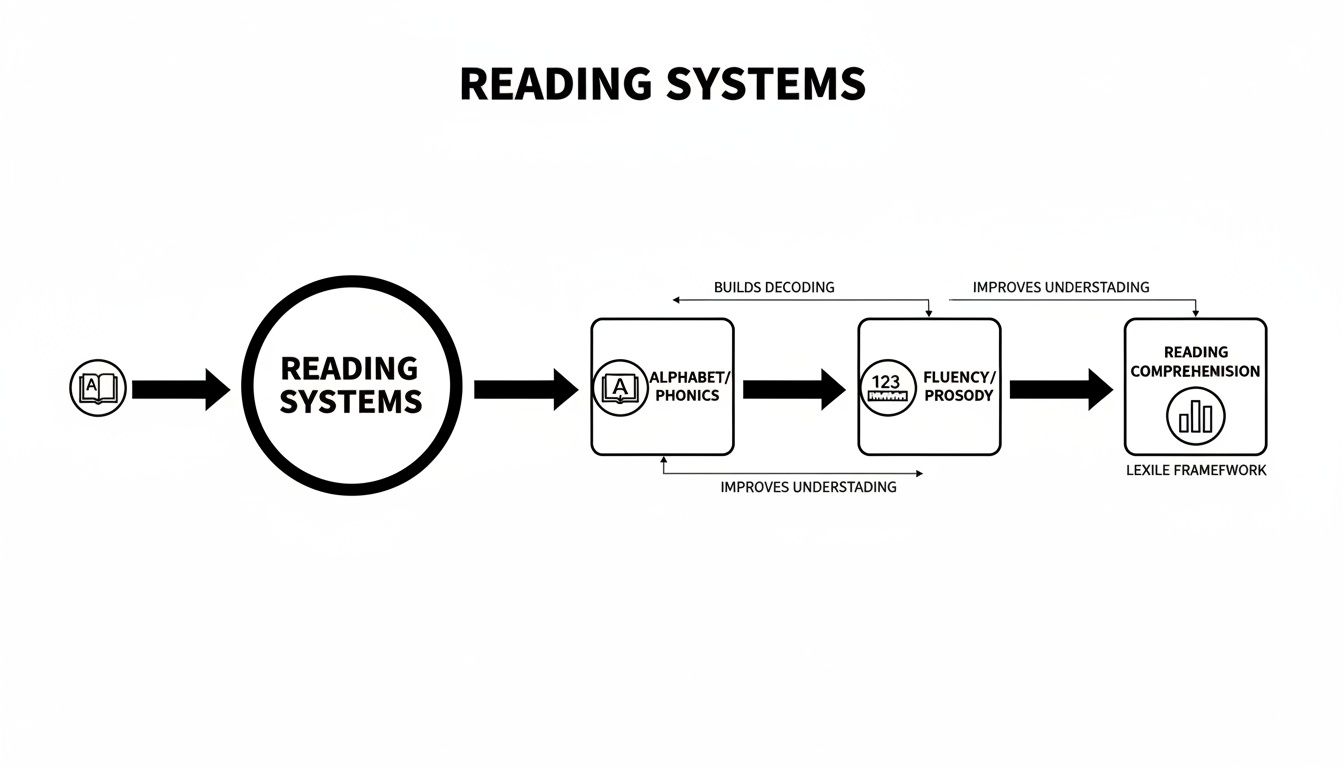 Each system uses its own method—letters, numbers, or scales—to help match the right book to the right reader at the right time.
For families, especially those who homeschool, adopting this kind of assessment can be a game-changer. The practice of tracking errors to find that just-right level can boost fluency up to 30% faster. It’s an ideal way to build a home library that truly supports your child's growth. Understanding this process helps you make sense of teacher feedback and empowers you to support your child’s reading journey at home.
Putting Guided Reading Levels into Practice
Figuring out a child's guided reading level is a huge first step, but the real magic happens when you know what to do with that information. A reading level isn't a label to stick on a kid; it's a practical tool for unlocking their potential and nurturing a genuine love for stories. For teachers and parents alike, it’s the key to making reading an empowering experience instead of a frustrating chore.
In the classroom, reading levels are the foundation for one of the most powerful teaching strategies out there: small-group reading. Teachers use these levels to gather small, flexible groups of students who are all tackling similar reading challenges. This isn't a new trend; it's been a cornerstone of primary education for decades. In fact, surveys from the early 2000s revealed that 58% of primary-grade teachers were already using small, ability-based groups with leveled texts, and 42% were strategically adjusting book difficulties for their students. You can dive deeper into this instructional shift on AFT.org.
How Teachers Use Guided Reading Groups
Imagine trying to teach one child how to sound out three-letter words while another is trying to infer a character's motivations. It's next to impossible to do that effectively with the whole class at once. Small groups solve this problem beautifully.
A teacher might pull together a handful of students who are all working at Level G, for example. In that focused setting, they can deliver targeted instruction that hits the nail on the head for every child in the group. The lesson might focus on a specific skill that’s common at that level, such as:
- Decoding Strategies: Practicing how to break down multi-syllable words.
- Fluency Building: Working on reading with expression and natural pacing.
- Comprehension Skills: Discussing how to find the main idea or make smart predictions.
This approach gives students the exact support they need to climb to the next rung of the reading ladder. These groups aren't set in stone, either. As a child masters new skills, they can move to a different group, ensuring the instruction always fits just right.
The goal of a guided reading group isn't just to read a book; it's to equip a child with the strategies they'll need to read the next book more independently.
A Parent's Guide to Using Reading Levels
As a parent, you can use your child’s reading level to become a rockstar at the library or bookstore. The secret isn't just finding books at their assigned level, but creating a "balanced reading diet" with three different kinds of books.
1. "Just Right" Books (Instructional Level) These are the books that match your child’s specific guided reading level. They should be able to read them with about 95% accuracy, which means they only need help with about one word out of every twenty. Reading these books with a little bit of support from you is how they stretch their skills and grow.
2. "Easy" Books (Independent Level) Think of these as books below their instructional level. They can fly through these on their own with nearly perfect accuracy and total understanding. These books are absolutely crucial for building confidence and fluency. Reading an easy book is like a victory lap—it’s pure fun and reminds them that reading is a joy, not a job.
3. "Challenge" Books (Read-Aloud Level) These are the books that are above their current reading level, full of rich vocabulary and complex ideas they aren't quite ready to decode alone. These are perfect for reading together. When you read these books aloud, your child's vocabulary and comprehension can soar far beyond what they can read by themselves.
By offering a mix of these three types, you create a rich reading life where reading isn't always "work." Sometimes it’s for learning, sometimes it’s for fun, and sometimes it’s just for cuddling on the couch and exploring a new world together. This balanced approach is how you find those perfect-fit adventures that can turn a reluctant reader into a lifelong book lover.
Don't Let the Letter Grade Kill the Love of Reading
It’s so easy to get fixated on the A-Z ladder. We watch that letter like a hawk, seeing it as the ultimate measure of our kid’s progress. But a guided reading level is really just a snapshot in time—a helpful tool for a specific moment, not a label that defines a child as a reader. The real goal isn't just to bump them up from Level G to H; it's to nurture a genuine, lifelong passion for stories.
After all, progress isn't a straight line. Real growth shows up in a child's curiosity, their empathy for characters, and the pure joy they get from being lost in a good book. Focusing too much on the letter can accidentally turn reading into a chore, making it feel like a series of hurdles to clear instead of whole new worlds to explore.
The Magic of Choice and Interest
If you want to raise an enthusiastic reader, one of the best things you can do is give them a little freedom. Let your child pick books based on what they're into, even if those books seem "too easy." When a child reads something they absolutely love, something well below their instructional level, they aren't taking a step back. They're taking a victory lap.
This kind of reading builds something just as critical as decoding skills: confidence and fluency. They get to read smoothly and with expression, soaking up story structures and new words without a struggle. It’s a powerful reminder that reading is fun and rewarding—the very fuel that will get them through tougher texts down the road.
The ultimate goal is not to raise a child who can read, but to raise a child who does read. A reading level is a temporary guide, but a love for stories can last a lifetime.
Sometimes, a child’s passion pulls them in the other direction, toward a book that looks way too hard. Don't immediately shut it down. A kid’s intense interest in a topic—whether it's dinosaurs, ancient Egypt, or a complex fantasy world—can give them the drive to wrestle with words and sentences they’d otherwise find overwhelming.
Can "Frustration Level" Actually Be a Good Thing?
We've always been told to avoid books that are too hard. It’s conventional wisdom. But it’s an idea worth questioning. Sometimes, stretching a child with a more difficult text, as long as they have the right support, can lead to some pretty amazing growth.
Interestingly, some research has challenged the strict idea of instructional levels. A landmark study from the 1980s found that second-graders actually made the most progress when they worked with "frustration-level" texts—books where they could only read with 85% accuracy and understood less than half of what was going on. This suggests that with a teacher's guidance, grappling with a challenging book can push a reader’s boundaries in powerful ways. You can discover more insights on text difficulty on AFT.org.
Now, this doesn't mean you should hand your second-grader a dense novel and just walk away. It means that when they’re fired up about a whimsical adventure or a mysterious tale that's technically "too hard," you can see it as an opportunity. Reading it together lets you show them how a skilled reader handles challenges, builds empathy for complicated characters, and expands their whole view of the world.
Creating a Rich Reading Life
Building a lifelong reader goes way beyond just tracking a guided reading level. It’s about creating a home where books are celebrated as a source of connection, imagination, and wonder.
Here are a few ways to nurture that spirit:
- Read Aloud Together: Keep reading aloud long after your child can read on their own. It gives them access to incredible stories and rich language they aren’t quite ready to tackle by themselves.
- Talk About Books: Go beyond the plot. Ask big questions like, "Why do you think the character did that?" or "How would you have felt if that happened to you?"
- Make the Library an Adventure: Turn library trips into a regular, exciting outing. Let your child browse and check out anything that catches their eye, no matter the level.
- Honor All Kinds of Reading: Graphic novels, audiobooks, magazines, and comics totally count. Embracing different formats shows that stories come in all shapes and sizes, and they're all valuable.
At the end of the day, a reading level is just a tool, not a final verdict. Use it to find good instructional books, but then step back and let your child’s own curiosity lead the way. That’s how you raise not just a skilled reader, but a person who truly loves to read.
How to Find Books at Your Child's Reading Level
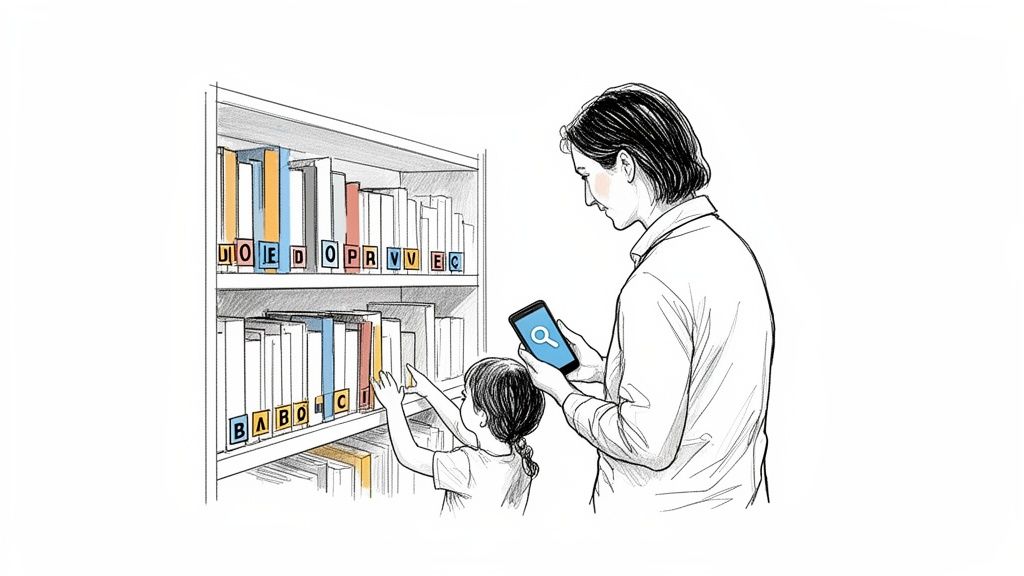
Knowing your child’s guided reading level is a huge step, but the real trick is finding books that actually match it. Luckily, publishers and educators have made this much easier than it used to be. With a few simple tricks, you can walk into any library or bookstore and feel confident in your choices.
The easiest place to look is right on the book itself. Many publishers now print the guided reading level (or GRL) on the back cover or inside the front flap, usually tucked away near the barcode. You might see a little note like "GRL: M" or something similar.
Of course, not every book has this handy label. That’s where a few online tools can really save the day.
Using Online Databases
There are some fantastic online databases that can help you find the level for almost any children's book with a quick search. These are total lifesavers for checking a book you already own or one you’ve just spotted at the store.
One of the best-known resources is the Scholastic Book Wizard. Just type in a book’s title, and it will instantly show you its guided reading level, Lexile measure, and DRA level. It's an incredible tool for turning that letter grade into a real book you can hold.
Here are a few trusted spots to check:
- Scholastic Book Wizard: Lets you search by title, author, or even keyword to find a book's level.
- The Fountas & Pinnell Leveled Books Website: This is a searchable database of books that have been officially leveled by the system's creators.
- Your Local Library's Catalog: Many library websites let you filter your search results by reading level, making it easy to find what you need.
Using these tools takes the guesswork out of the equation. You aren't just hoping a book is right; you're making an informed choice that builds both skills and confidence in your young reader.
Seeing Levels in Action
After a while, you’ll start to get a feel for what different levels look like. You’ll notice that early-level books have simple, repetitive sentences and a lot of picture support to help with the story. As a child moves up, the sentences get longer, the vocabulary gets richer, and the themes become more complex.
By the time readers reach the advanced Levels V-Z (around grades 4-8), they’re ready to tackle things like symbolism in myths and connect ideas across a book they read over several days. They can grasp perspectives different from their own—a crucial skill for middle-grade stories where 90% of proficient 8th graders can read silently with fluent phrasing.
To build a library that grows with your reader, you might want to explore our curated lists of the best kids' books, which cover a wide range of levels and genres.
Common Questions About Guided Reading Levels
Diving into the world of guided reading levels always brings up a few key questions for parents and teachers alike. Getting a handle on the answers can really demystify the whole process, making you feel much more confident as you help your child find their reading rhythm. Let's clear up a few of the most common ones.
Should My Child Only Read Books at Their Assigned Level?
Absolutely not. It’s best to think of a reading level as a tool for a specific kind of workout, not a strict diet for every single meal. A "balanced reading diet" is what really helps a child thrive.
For quiet, independent reading time, books at or even a little below their official level are perfect. These easier reads are fantastic for building confidence and improving reading speed (fluency). Most importantly, they remind kids that reading is just plain fun. On the other hand, tackling more challenging books together is a wonderful way to introduce new vocabulary and more complex ideas they aren't quite ready to read on their own.
How Often Is a Child's Reading Level Assessed?
This really changes depending on the child's age. In the early years, from kindergarten through second grade, you can see huge leaps in a very short time. Because of that, teachers often check in on reading levels every 6 to 10 weeks to make sure their teaching is keeping up.
For older kids in elementary school, this might happen just two or three times over the school year. The goal isn't to stamp a permanent label on a child but to get a current snapshot that helps guide the next steps in their learning journey.
Remember, a guided reading level is a tool to guide instruction, not a final judgment on a child's abilities. The most important factor is always fostering a positive and encouraging reading environment at home.
What if My Child Is Stuck on a Certain Reading Level?
It’s completely normal for a child to hang out at one level for a while. It happens all the time. Often, it just means they’re working hard to master a tricky new skill before they can move on, or that the books have taken a significant jump in complexity. If you're concerned, the best first step is always to chat with their teacher.
The teacher can give you the inside scoop on what specific skills your child is tackling in the classroom. At home, the most powerful thing you can do is keep reading a low-pressure, enjoyable activity. Focus on the magic of the story, not the letter on the back of the book.
At Number 6 Publishing, we believe the right story can spark a lifelong passion for reading. Our book lists and original titles are all about connecting young readers with stories that make them curious and feel understood. Discover your child's next favorite book with us.