
Informational books for kids are so much more than a simple collection of facts—they are powerful adventure guides to the real world. Think of these books as both windows into new subjects and mirrors that reflect a child's own passions and curiosities, building knowledge and sparking a sense of wonder at the same time.
What Makes Informational Books a Powerful Learning Tool
Forget the dry, dusty textbooks of the past. Today’s informational books are thrilling expeditions into reality. A book about deep-sea creatures can ignite the same awe as a fantasy novel about dragons, but it has the added benefit of building a child's real-world understanding. The very best informational books weave facts into compelling narratives, turning learning from a chore into a genuine discovery.
They fill two crucial roles for a developing reader. First, they are windows that open up worlds a child may never get to experience firsthand, from the surface of Mars to the inner workings of an ant colony. Second, they act as mirrors, allowing children to see their own interests—whether it's dinosaurs, ballet, or robotics—validated and explored in rich detail.
Sparking Curiosity with Story and Fact
Modern informational books have moved far beyond just listing data. They captivate young readers by using stunning visuals, engaging storytelling, and a clear narrative voice. For example, a biography of an inventor doesn’t just state their accomplishments; it tells the story of their struggles and breakthroughs, which makes the information both relatable and memorable. This narrative approach helps build foundational knowledge while nurturing critical thinking. You can learn more about how this connection between reading and understanding works in our guide on how to develop reading comprehension skills.
The power of these books is clearly reflected in their market growth. The global children's books market was valued at $11,935.2 million in 2021 and is projected to climb to $13,277.3 million by 2025, with North America holding a significant share. This trend shows that parents and educators truly recognize the immense value of books that both educate and inspire.
At its core, our publishing philosophy centers on finding these powerful stories within facts. We believe every child's bookshelf needs a healthy dose of reality-based wonder to build a lifelong love for learning.
Just as these books empower children, adults can also find profound growth and insight through reading. Consider exploring the best personal development books to continue your own learning journey. Ultimately, providing a rich diet of informational texts sets the stage for a child to become an inquisitive, informed, and thoughtful individual.
Matching Informational Books to Your Child's Age
Choosing the right informational book for a child isn't just about picking the one with the most interesting facts. It’s really about finding the right fit for where they are right now. A book that a seven-year-old absolutely loves might completely overwhelm a toddler, and a book that’s perfect for a preschooler could bore an older kid to tears.
The magic happens when the book meets their natural curiosity head-on. This connection makes learning feel like an adventure, not a chore. For the little ones, this means colorful, picture-heavy books that help new words stick. For older kids, it’s about digging into more complex texts that get them thinking and asking big questions about the world.
Toddlers and Preschoolers (Ages 2-5)
For this age group, think simple, bold, and visual. The best informational books are often sturdy board books with just one big idea on each page. Look for titles that introduce foundational concepts—like colors, shapes, animals, or trucks—using bright, clear photos or illustrations.
The main goal here is all about vocabulary building. You want to help them make those crucial connections between words and the world around them. When a book shows a picture of a lion right next to the word "lion," it helps build that mental dictionary. Books with repetitive text or fun interactive elements, like flaps to lift or different textures to feel, are fantastic for keeping their little hands and minds engaged.
Early Elementary Readers (Ages 6-8)
Once kids hit elementary school, their world explodes with "why" and "how" questions. This is when informational books really shine, becoming the go-to tools for discovery. It’s the perfect time to introduce books with a little more text, broken up into short chapters or easy-to-follow sections.
You’ll want to look for books that have:
- Clear Headings and Subheadings: These are like signposts that teach kids how to navigate a text and find exactly what they’re looking for.
- Glossaries and Indexes: Introducing these features early on teaches them how to use text tools—a skill they'll use for the rest of their lives.
- Labeled Diagrams: Visuals that break down a concept, like the life cycle of a butterfly or the parts of a volcano, are pure gold.
Books that explain a process—how a skyscraper gets built or why it rains—are especially captivating for this age. They not only support what kids are learning in school but also empower them to find answers on their own, which is a huge confidence booster.
This is where books act as both windows and mirrors for our kids.
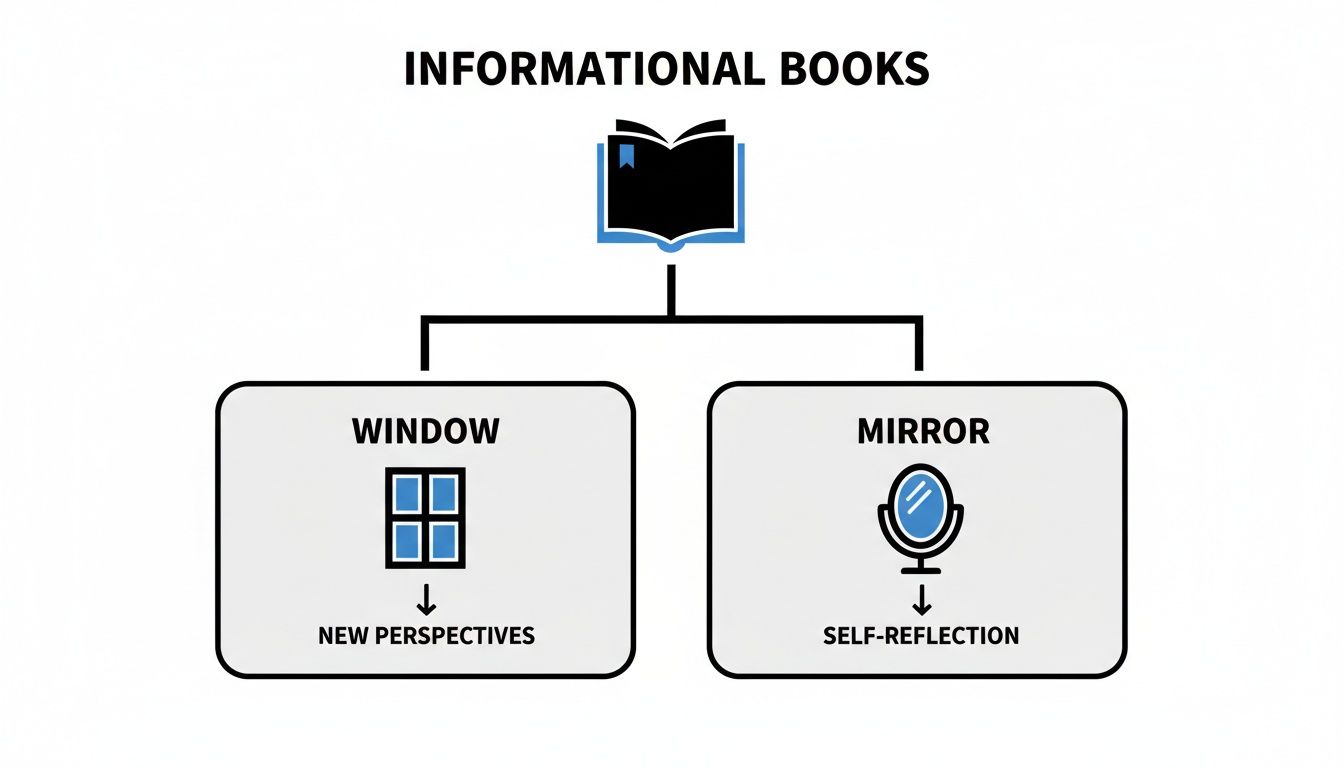
This idea is so important. We want to find books that reflect a child’s own life and interests (mirrors) while also opening their eyes to new people, places, and ideas (windows).
Upper Elementary and Middle Grade Readers (Ages 9-12)
By this stage, young readers are ready to dive deeper. They can handle more sophisticated vocabulary, longer paragraphs, and even abstract ideas. The focus shifts from just gathering facts to actively analyzing and interpreting information.
At this age, a great informational book doesn't just present facts; it presents a perspective. It encourages readers to question, compare sources, and form their own opinions.
This is the time to bring in narrative nonfiction, compelling biographies, and detailed explorations of historical or scientific topics. Look for books that include sidebars, timelines, and primary source documents. These elements challenge older readers to pull together information from different places and think like a real researcher.
If you’re looking for some great examples, you might want to check out our guide on nonfiction books for 6th graders to see how these more complex features come to life.
Informational Book Benefits Across Developmental Stages
As we've seen, what a child gets out of an informational book changes dramatically as they grow. The table below breaks down the key benefits for each age group, showing how these books support learning at every step.
| Age Group | Primary Learning Goal | Key Benefits | Example Book Type |
|---|---|---|---|
| Ages 2-5 | Vocabulary & Concept Building | Connects words to objects, builds foundational knowledge, enhances sensory skills. | Board books with photos, interactive "lift-the-flap" books. |
| Ages 6-8 | Answering "Why" & "How" | Develops research skills, fosters independent learning, builds reading confidence. | Early readers on science topics, simple biographies. |
| Ages 9-12 | Critical Thinking & Analysis | Encourages synthesis of information, develops media literacy, introduces nuance and perspective. | Narrative nonfiction, in-depth historical accounts, detailed science explainers. |
Ultimately, the goal is to provide a rich and varied diet of reading material that grows with the child, fueling their curiosity and equipping them with the skills to understand their world.
How to Spot a Truly Great Informational Book
Walking through the children's section of a bookstore or library can be a bit overwhelming, can't it? Especially when you're on the hunt for top-notch informational books for kids. A bright, flashy cover is no guarantee of quality. The really exceptional nonfiction titles do so much more than just spit out facts; they spin a compelling story, kickstart a child's curiosity, and present information in a way that’s easy to digest and genuinely exciting.
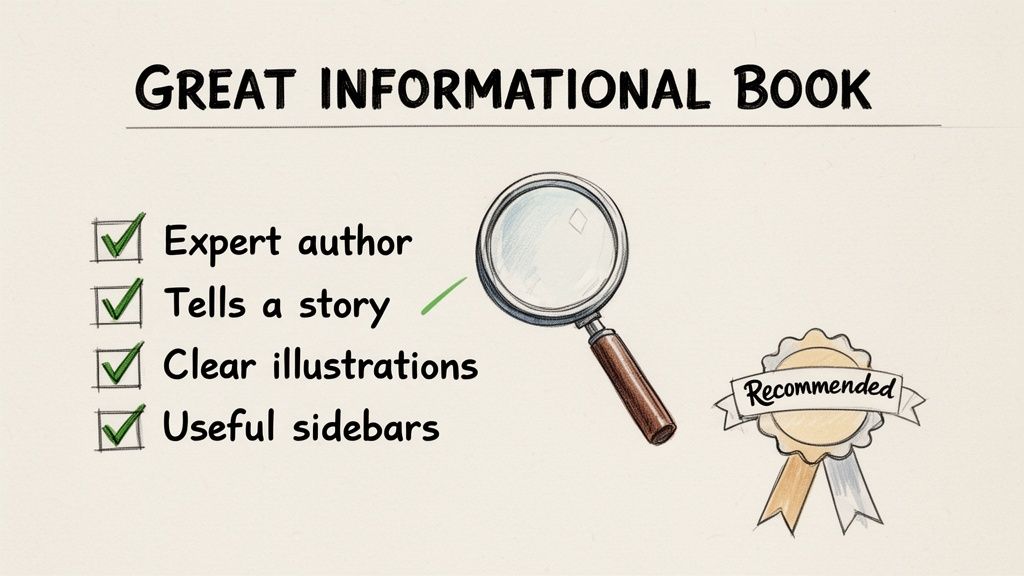
So, how can you tell the treasures from the simple shelf-fillers? It really comes down to looking past the topic and digging into the craftsmanship of the book itself. A fantastic informational book feels like it was written by a true expert, someone with a deep passion for sharing what they know, not just an author hired to compile a list of facts.
Look for Narrative Drive and Expertise
Let’s be honest, the best nonfiction reads like a story. Instead of a dry, bullet-pointed list about sharks, a standout book might follow a single great white on its epic journey across the ocean. That narrative hook is what makes the information stick and keeps a child turning the pages.
You should also do a little digging on the author. Do they have a real background in the subject, whether it’s science, history, or art? An author's genuine expertise almost always shines through in a richer, more detailed text that goes far beyond surface-level chatter.
If you're curious about what goes on behind the scenes, getting a glimpse into the process of creating a children's book can really highlight how all these crucial elements come together.
Evaluate Illustrations and Text Features
In a kid's nonfiction book, the visuals aren't just pretty decorations—they are vital learning tools. In a great book, the illustrations, photos, and diagrams all serve a distinct purpose. They should make complicated ideas clearer, add important context, or show you something in a way words just can't. Ask yourself: do these pictures actually help me understand the topic better?
And don't forget to check out the other features sprinkled throughout the pages:
- Captions and Labels: Do they offer up valuable little nuggets of information without making the page feel cluttered and chaotic?
- Sidebars and Fact Boxes: Are they placed thoughtfully to build on the main text, or do they just feel like random interruptions?
- Glossaries and Indexes: A solid glossary and a detailed index are the hallmarks of a well-researched, high-quality book. They show the author cared.
A truly great informational book doesn’t just answer a child's questions; it inspires them to ask new ones. The goal is to find books that invite rereading and launch conversations that continue long after the final page is turned.
When you use these things as your guide, you can confidently pick out books that are not only accurate and well-designed but also have that special spark to ignite a lifelong love of learning. It’s all about finding those titles that transform reading into a real adventure of discovery.
Simple Strategies to Make Nonfiction Reading Fun
How do you turn a book of facts into a real adventure? It's actually easier than you might think. The trick is to stop thinking of the book as the destination and start seeing it as a launchpad for discovery.
When we move beyond the page, we connect what kids are reading to the world they can see, touch, and explore. This simple shift transforms reading from a passive activity into a hands-on experience, sparking a genuine curiosity that makes learning feel just like play.
Bridge the Gap Between Text and World
One of the best ways to bring nonfiction to life is by creating "text-to-world" connections. It’s a simple idea: link what you’re reading to something you can actually do. If you've just read an amazing book about constellations, grab a blanket and go outside to hunt for the Big Dipper. Finished a book about insects? Time for a bug-finding mission in the backyard.
These activities are what make learning stick. They show a child that the ideas in their books aren't just words—they're real. It makes abstract concepts concrete and a whole lot more exciting.
Cultivate a Culture of Curiosity
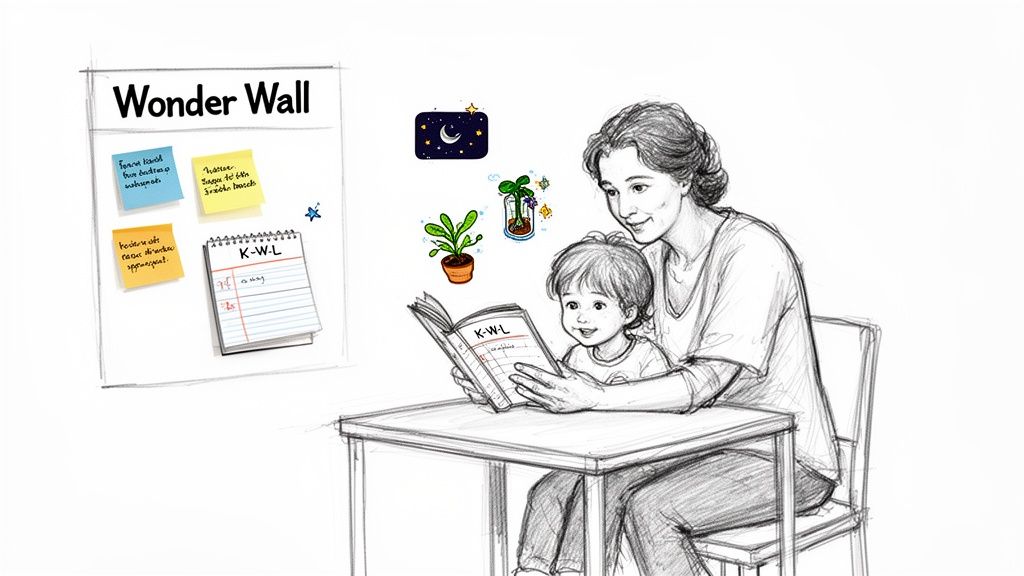
Questions are the engine of learning, so encourage them every step of the way. A fantastic tool for this is the "Wonder Wall." It can be a corkboard, a whiteboard, or even just a designated spot on the wall. As you read together, use sticky notes to capture every question that comes up.
What do astronauts eat in space? How do volcanoes erupt? Why do leaves change color?
No question is too big or too small. The Wonder Wall is a visual celebration of curiosity, showing kids that their questions are important and worth exploring. It also gives you a roadmap for what to read next, allowing their own interests to guide the learning journey.
Use Structured Learning Tools
If you're looking for a more organized approach, the K-W-L chart is a tried-and-true classic, perfect for both home and the classroom. This simple three-column chart helps kids map out their learning adventure before they even start reading.
- K (What I Know): Before cracking open the book, talk about what your child already knows about the topic. This taps into their existing knowledge and gives them a confident starting point.
- W (What I Want to Know): Next, brainstorm all the things they hope to find out. This gives them a real purpose for reading. They aren't just reading; they're on a mission to find answers.
- L (What I Learned): After you've finished the book, circle back and fill this column with all the cool new facts and information discovered.
This framework gives kids ownership over their learning. It turns them from passive readers into active investigators, helping them dive deeper into the material and remember what they’ve learned long after the book is back on the shelf.
Curating a Rich and Balanced Home Library
Think of building a home library less like stockpiling books and more like curating a small museum of ideas for your child. The real goal isn’t to hit a certain number, but to thoughtfully create a balanced and diverse collection that feeds all sorts of interests and sparks new ones. A well-rounded library becomes that trusted place where curiosity always has somewhere to go.What you're really creating is an environment rich with choice. By mixing fiction with high-quality informational books for kids, you have something for every mood and learning moment. One day your child might want to get lost in a fantasy world, and the next they might be determined to figure out how volcanoes actually work. A balanced library honors both of these powerful impulses.
Mix Topics and Formats
To build a truly rich collection, you have to aim for variety. It’s easy to just buy books on the topics your child already adores, but introducing new subjects is how you broaden their horizons.
- Science and Nature: Grab books about animals, outer space, the human body, or why it rains.
- History and Biography: Offer up stories of incredible people and moments that changed the world.
- Arts and Culture: Explore music, painting, dance, and different cultures from around the globe.
- How Things Work: Find books that pull back the curtain on technology, cars, or even everyday objects like toasters.
And don't forget that variety in format is just as important. Mix picture books with chapter books, and definitely don't overlook graphic novels—they are a fantastic way to present complex information visually. To keep it all tidy and easy for kids to find what they're looking for, you can explore our tips on how to organize a home library.
Blend Fiction with Factual Finds
A great library strikes that perfect balance between make-believe and reality. Fiction is where kids build empathy and imagination. Nonfiction is where they build knowledge and critical thinking. The two support each other beautifully.
A child who reads a fictional story about a dolphin might suddenly be inspired to grab an informational book to learn all about marine biology. This dance between story and fact is where deep, lasting learning really takes hold.
This approach is more important than ever. Educators around the world report that 70-80% of K-8 libraries are now prioritizing informational texts to align with school curriculums. You can read the full research on the global children's books market to see just how big this trend is. When you intentionally include a mix of voices, subjects, and formats, you create a vibrant collection that will grow right alongside your child for years to come.
Common Questions About Informational Books for Kids
Even with the best of intentions, getting kids into nonfiction can bring up a few tricky questions. How do you convince a child who lives and breathes dragon stories to even look at a book about real-life reptiles? Are ebooks just as good as the real thing? It's completely natural for parents and educators to run into these little roadblocks.
Navigating the world of informational books for kids often feels like a balancing act. You want them to fall in love with reading, but you also need to build their knowledge of the world around them. Below are some straightforward answers to the most common challenges you might face on this very rewarding journey.
How Do I Get My Fiction-Loving Child to Read Nonfiction?
The secret is to build a bridge from their imagination to the real world. Start by finding nonfiction that ties directly into what they already love. If they're obsessed with fantasy novels, hand them a book about the history of medieval castles or the real animals that might have inspired mythical creatures.
Another great trick is "book pairing." After you finish a thrilling story about a trip to Mars, follow it up with an exciting informational book packed with real photos from NASA of astronauts and their spacecraft. You can also try a few of these gateways:
- Narrative Nonfiction: These books tell true stories with all the good stuff from fiction, like a compelling plot and character development.
- Graphic Novel Nonfiction: The visual format is super engaging and can make even complex topics feel way more approachable.
The goal is to show them that true stories and real-world facts can be every bit as captivating as any adventure they can imagine.
Are Ebooks and Digital Versions Just as Good as Print?
Honestly, both have their own unique strengths, and the best approach is usually a mix of the two. Neither one is automatically "better"; they just serve different purposes.
Physical books are fantastic for a focused, shared reading experience. They help children learn how to use traditional text features like a table of contents or an index without the constant distraction of notifications popping up. Plus, there’s just a simple, tactile satisfaction in turning a real page that so many young readers enjoy.
On the other hand, a well-designed ebook can offer interactive extras like embedded videos, sound clips, and animations. These can seriously deepen a child's understanding, especially for kids who are more visual or auditory learners.
Think of it this way: use physical books for the deep dives and cozy read-alouds. Then, bring in high-quality digital resources to supplement that learning with dynamic content that makes the subject leap off the screen.
How Can I Verify the Accuracy of an Informational Book?
Making sure the information your child is reading is solid is absolutely crucial. Fortunately, there are a few reliable clues you can look for to get a sense of a book's credibility.
First, always check the publication date, especially for topics like science and technology that change quickly. A book about planets from 1995 is going to be missing a ton of new discoveries.
Next, look for books from reputable educational publishers known for their tough fact-checking. An author's bio that mentions their expertise in the subject is another great sign. Finally, flip to the back of the book for features that signal a real commitment to getting things right, such as:
- A bibliography or a list of sources
- A detailed index
- Notes about contributions from expert consultants
Trustworthy books are proud of their research and want you to know exactly where their information came from.
What Exactly Is Narrative Nonfiction?
Narrative nonfiction is a powerful type of book that tells a true story using all the classic tools of storytelling. Instead of just giving you a list of facts about a historical event or a scientific breakthrough, it weaves a compelling narrative with a clear plot, engaging characters, and even moments of suspense.
For example, rather than a dry rundown of a famous scientist's achievements, a narrative nonfiction book would tell their life story, focusing on their personal struggles, their big "aha!" moments, and the emotional journey they went on. This approach is incredibly effective because it makes facts stick. It hooks readers emotionally, helping them connect with complex subjects on a much deeper level while building both knowledge and empathy.
At Number 6 Publishing, we believe that the right book can open up a whole new world of discovery. We are dedicated to helping you find those perfect stories and informational texts that will spark curiosity and inspire a lifelong love of reading.
Explore our curated book lists and find your next reading adventure at https://www.number6publishing.com.