
To effectively teach reading comprehension, we have to start by playing detective. Before we can jump into teaching cool strategies like predicting and questioning, we first need a solid diagnosis of what's really holding a student back. It's a journey from diagnosis to instruction, making sure the ground is firm before we try to build anything on top of it.
Building the Foundation for Comprehension
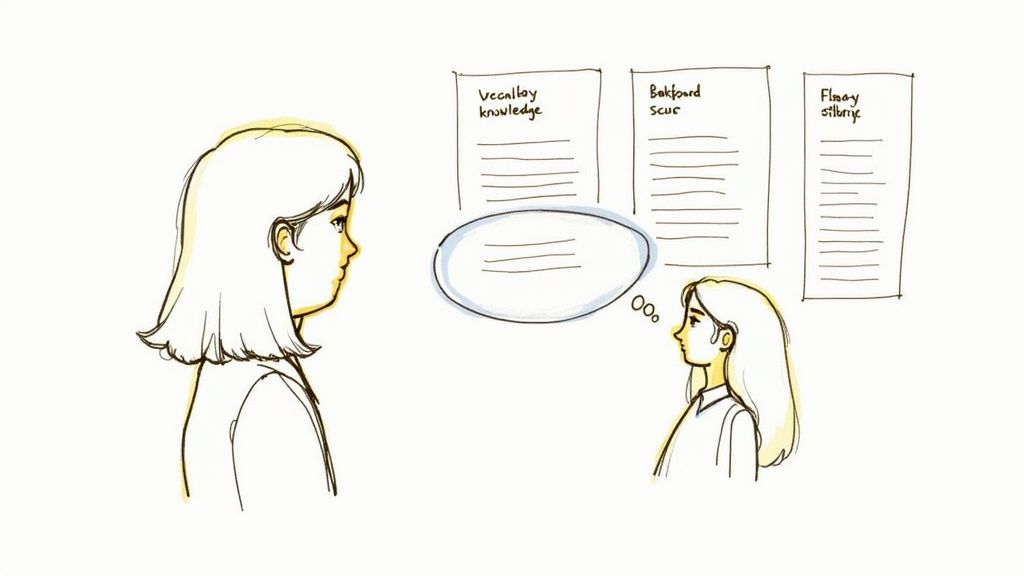
You wouldn't build a skyscraper without inspecting the foundation first, right? The same logic applies to teaching reading comprehension. Throwing complex strategies like inferencing at a student who lacks the foundational skills is like building on sand.
So, the first and most critical step is to figure out where your students truly are.
This goes way beyond simple question-and-answer quizzes. Sure, a student might recall a fact to answer a question correctly, but that doesn't mean they understand the text. We have to dig deeper to find the real barriers preventing them from making meaning from the words on the page.
Identifying the Core Components
True comprehension is a complex skill with many moving parts. When a student is struggling, the breakdown is almost always in one of a few key areas. Our job is to pinpoint which of these components needs the most support.
Think of these as the essential building blocks:
- Decoding and Fluency: Can the student actually read the words on the page accurately and smoothly? If all their mental energy is going toward just figuring out the words, there's none left for understanding the message.
- Vocabulary Knowledge: Do they know what the words mean? A weak vocabulary is one of the biggest roadblocks to comprehension.
- Background Knowledge: What does the student already know about the topic? Readers constantly use what they already know to make connections and fill in the gaps.
- Language Structures: Can they make sense of complex sentences, figurative language, or how a text is organized?
A snag in any one of these areas can easily look like a general "comprehension problem." Your detective work starts by pulling them apart.
A critical mistake is assuming a student who struggles with comprehension just needs to 'try harder.' More often than not, there's a specific, teachable skill gap that, once identified, can be directly addressed.
Practical Assessment From Day One
You don't need a battery of formal, time-consuming tests to get these initial insights. Simple, everyday observations can tell you so much.
For instance, just listening to a child read a short passage aloud can instantly flag fluency issues. Asking them to retell what they just read in their own words is a fantastic window into their vocabulary and their grasp of the main idea.
Here’s a quick way to think about what you’re looking for as you assess these core components.
Core Components of Reading Comprehension at a Glance
| Component | What It Is | Key Assessment Question |
|---|---|---|
| Decoding & Fluency | Reading words accurately and at a smooth, natural pace. | "Does the student stumble over words or read in a robotic way?" |
| Vocabulary Knowledge | Understanding the meaning of words within the context of the text. | "Can the student define key words or use them in a new sentence?" |
| Background Knowledge | The prior information a reader brings to the text. | "What does the student already know about this topic?" |
| Language Structures | Understanding sentence complexity, syntax, and how the text is organized. | "Can the student follow a long, complex sentence and explain its meaning?" |
This kind of initial diagnostic work really sets the stage for everything that comes next. It helps you tailor your instruction, ensuring you’re targeting the precise needs of each reader instead of just teaching generic strategies.
The global gap in these foundational skills is staggering. A massive World Bank report analyzing early grade reading across 48 countries found that after three years of school, more than 90% of students couldn't hit basic benchmarks like identifying letter names or reading simple words. It’s a stark reminder of how a weak foundation can cripple comprehension from the very beginning.
For younger kids, technology can be a great partner in this. To supplement your classroom instruction, check out our guide on the best reading apps for kids. By understanding the "why" behind a student's struggle, you can build a clear path toward a classroom full of confident readers who don't just see words—they truly understand them.
Unlocking the Five Core Comprehension Strategies
Once you’ve figured out where the gaps are, it's time to start teaching the active strategies that strong readers use instinctively. This isn’t about handing over a checklist. It's about building a mental toolkit students can pull from with any book, any time.
We're shifting from diagnosis to direct instruction. The whole point is to make the invisible thinking of a proficient reader visible and concrete for every student in your classroom.
Let's break down the five most important strategies you can teach.
Making Predictions Before and During Reading
Prediction is what hooks a reader. It’s that simple question: "What do I think will happen next?" This single strategy turns kids from passive observers into active participants who actually care about what happens in the story.
With the little ones in grades K–2, this usually starts with a "picture walk." Before you even read a word, guide them through the illustrations. Ask things like, "Looking at the cover, who do you think this story is about?" or "This picture looks a little stormy. What kind of problem do you think might happen?"
Once they hit grades 3–5, their predictions can get more sophisticated. They should start pulling evidence from the text to back up their ideas. Nudge them with sentence starters:
- "Because the character said ______, I think..."
- "The chapter title is 'The Unexpected Guest,' so I'm predicting..."
- "I know this author likes surprise endings, so I predict..."
By middle school (grades 6–8), students can start thinking like literary critics, analyzing genre, foreshadowing, and recurring themes to make much more nuanced predictions.
The Power of Asking Questions
Curiosity is the engine for deep comprehension. When you teach students to ask their own questions as they read, it completely changes their relationship with the text. They stop hunting for answers you've planted and start having a genuine conversation with the author.
In K–2, a simple anchor chart distinguishing between "thin" questions (answers you can point to) and "thick" questions (the big ideas) works wonders. During a read-aloud, just pause and model it: "You know, I'm wondering why the wolf is dressed up like a grandma. That's pretty weird. What are you guys wondering?"
For older students, I love using the Question-Answer Relationship (QAR) framework. It helps them see that answers can come from different places:
- Right There: The answer is sitting right there in one sentence.
- Think and Search: The answer is in the book, but you have to piece it together from a few different spots.
- Author and Me: You need to use clues from the text and what you already know.
- On My Own: The answer comes completely from your own experiences.
This helps them understand that not every question has a simple, easy-to-find answer, which is a huge leap in their critical thinking. If you want to give your students even more tools, you might want to look into these additional reading comprehension strategies for students to boost their understanding.
Clarifying Confusion and Monitoring Understanding
Good readers know when they're lost, and they know how to get back on track. This metacognitive skill—thinking about your own thinking—is one of the most powerful things we can teach.
Start by creating a "fix-up" strategies anchor chart. Make it simple and actionable.
- Reread: Just go back and try the sentence again.
- Read Ahead: Sometimes the next few sentences clear everything up.
- Use Context Clues: Look at the words around the tricky one for hints.
- Ask a Friend: A quick turn-and-talk can work magic.
- Look It Up: Grab a dictionary or glossary.
The key is to model this constantly. While reading aloud, stop and think out loud: "Wait, I'm not totally sure what the word 'gregarious' means here. Let me reread... it says he was 'gregarious' and 'always the life of the party.' Okay, that makes me think it means he's really social and friendly."
The simple act of admitting, "I'm confused by this part," is a powerful model for students. It normalizes confusion as a natural part of the reading process and empowers them to take action instead of just skipping over what they don't understand.
The Art of Summarizing Key Information
Summarizing forces students to cut through the noise, grab the most important ideas, and let go of the fluff. It’s a skill that pays off well beyond your classroom walls.
For the K–2 crowd, a simple retell using the "Somebody-Wanted-But-So-Then" (SWBST) framework is perfect. They can say it out loud or draw a picture for each part.
In grades 3–5, they can move on to writing a single-paragraph summary of a chapter, focusing on the main idea and a few key details. This is where you teach the difference between a long, drawn-out retelling and a tight, concise summary.
By middle school, things get more complex. Students should be able to summarize long articles or entire non-fiction books, pulling together information and pinpointing the author's main argument. For a deeper dive, check out our guide on effective reading comprehension strategies for teachers.
Making Inferences and Reading Between the Lines
This one is often the trickiest to teach because it’s so abstract. Inferencing is the real magic of reading—using clues from the text and your own life experiences to figure out what the author isn't saying directly.
I love to introduce this with pictures. Show the class an image—maybe a kid with muddy cleats and a soccer ball tucked under their arm—and ask, "What can you infer about what this kid was just doing?"
From there, you can introduce a simple formula: Text Clues + My Brain (Schema) = Inference.
In K–2, this might sound like: "The book says the boy's lip was trembling and a tear ran down his cheek. I know that when people cry, they're usually sad. So, I can infer that the boy is feeling sad right now."
For the older grades, you can apply this same thinking to character motivation, theme, and author's purpose. Ask questions that force them to infer: "The author never calls the main character brave, but what does she do that makes us think she is?"
And the data backs this up. The 2021 Progress in International Reading Literacy Study (PIRLS) found a strong link between explicit strategy instruction and higher student achievement. In fact, school systems that really focused on teaching skills like summarizing and inferencing saw their comprehension scores jump by up to 20%.
Knowing the five core reading strategies is one thing, but actually teaching them effectively? That’s the real art. The best way to help kids truly grasp reading comprehension isn't to just explain a strategy and hand them a worksheet. It’s a delicate process of guiding them from watching you, to trying it with friends, and finally, to flying solo.
This classic framework is called the Gradual Release of Responsibility. I always think of it like teaching a kid to ride a bike. You don't just shove the bike at them and say "good luck!" You start with training wheels, then you run alongside them holding the seat, and only when they're steady do you finally let go.
Start with “I Do” Teacher Modeling
This is the most important step, and honestly, it’s the one that often gets rushed. During this "I Do" phase, you are the expert reader. Your job is to make your thinking visible. You’re not just reading a book; you're performing your thought process out loud for your students to see and hear.
For example, if you're modeling how to make an inference, you might pause and say, "Hold on. The book says Maya slammed the door and stomped up the stairs. The author doesn't come right out and say she's angry, but I know when people slam doors, they're usually pretty upset. I'm going to infer that Maya is feeling very angry right now." You’re showing them exactly how you connect clues in the text with what you already know about the world.
Move to “We Do” Collaborative Practice
After you’ve modeled a strategy a few times, it’s time to invite your students to join in. The "We Do" phase is all about shared practice and working together. This is where the training wheels start to come off, but you're still right there to give a little nudge or prevent a major wipeout.
This can look a lot of different ways in the classroom:
- Shared Reading: You read a text out loud, pausing to have students apply the strategy. "Okay, we just finished the first chapter. Turn to your partner and see if you can summarize the most important thing that just happened."
- Small-Group Work: During guided reading, you can give groups a specific task. "As you read this page together, I want your group to come up with two really 'thick' questions you're wondering about."
- Paired Practice: Have students team up with a partner to practice a skill, like jotting predictions on a sticky note and then talking about why they made them.
The whole point of the "We Do" stage is to lower the stakes and build confidence. Working together lets students test out their ideas in a safe space, learn from each other, and get instant feedback from you before they have to do it all on their own.
These are the key strategies you’ll be modeling and guiding your students through during this entire process.
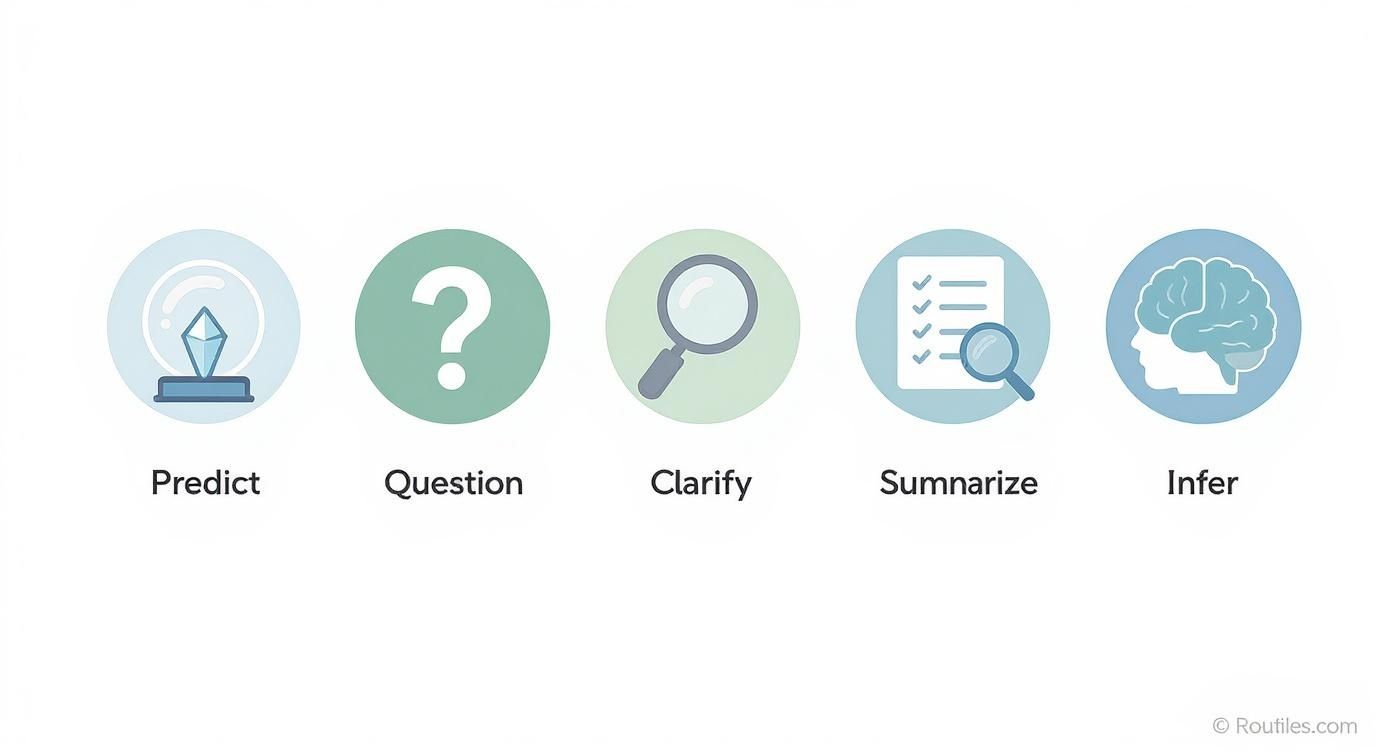
This flow shows the active thinking skills—from predicting what’s next to inferring what’s unsaid—that we want to become second nature for them.
Finish with “You Do” Independent Application
Finally, after plenty of modeling and practice together, students are ready for the "You Do" phase. This is their turn to apply the strategy all by themselves, using a text that's at their just-right reading level. It's how they show they've truly got it and can use the skill without you looking over their shoulder.
This independent work could be:
- Responding to a reading journal prompt that asks them to make an inference.
- Using a graphic organizer to break down and summarize a chapter they read silently.
- Putting sticky notes in their book to mark spots where they had to stop and clarify something.
Common Pitfalls to Avoid
One of the biggest mistakes I see is rushing this process. Pushing students into independent work too quickly is a recipe for frustration—for them and for you. If you assign a task and get a sea of blank stares, that's your cue to pull back and spend more time in the "I Do" or "We Do" phases.
And remember, the Gradual Release of Responsibility isn't a straight line. You'll often find yourself moving back and forth between the stages. A student who can summarize a story on their own might need you to go back to modeling when they tackle a dense non-fiction article. By using this framework flexibly, you give every student the support they need to climb toward becoming a confident, independent reader.
Choosing Texts That Build Better Readers

The book you place in a student's hands holds incredible power. It can be just another assignment, or it can be the key that unlocks a new world, sparking curiosity and a genuine desire to understand. Choosing the right texts is truly the foundation of effective reading comprehension instruction; it’s where all our strategies come to life.
A vibrant classroom library should act as both a mirror and a window. Kids need to see their own lives, cultures, and experiences reflected in the pages they read. That kind of validation builds a personal connection to reading, making the hard work of comprehension feel relevant and deeply meaningful.
At the same time, books have to be windows that open up different perspectives, places, and ideas. This balance is critical. Offering a rich variety of genres, authors, and subjects not only builds crucial background knowledge but also cultivates empathy—a cornerstone of deep understanding. For an excellent starting point, explore this curated list of multicultural books for elementary students.
Balancing Challenge and Support
One of the biggest debates in reading instruction revolves around text difficulty. Do you give students books at their so-called "instructional level," or do you push them with complex, grade-level texts? The real answer is, you need both, but for very different reasons.
- Instructional-Level Texts: These are your go-to for small-group, guided practice. When a student is working closely with you, a text they can read with 90-95% accuracy allows them to focus their mental energy on applying a new comprehension strategy without getting bogged down by decoding.
- Grade-Level Texts: These are absolutely essential for whole-group instruction and read-alouds. Consistently exposing students to complex sentence structures, rich vocabulary, and sophisticated ideas is what builds stamina and pulls their skills upward. With your modeling and support, they learn to navigate the very texts they are expected to master.
A classroom that only uses "easy" books robs students of the opportunity to grow. The goal isn't to avoid frustration entirely; it's to provide the right scaffolds so that challenging texts feel like achievable puzzles, not impossible barriers.
A Practical Checklist for Text Selection
When you're evaluating a book for your next lesson, think beyond its surface appeal. A great story is just the beginning. The right text provides fertile ground for teaching specific comprehension skills.
I find it helpful to use a simple checklist to make sure a book will do the heavy lifting I need it to. This framework helps me think through how a single text can serve multiple instructional goals across different age groups.
Text Selection Checklist for Comprehension Instruction
Use this checklist to evaluate texts for their potential to support strong reading comprehension lessons across different grade levels.
| Evaluation Criteria | Look Fors in K-2 Texts | Look Fors in 3-5 Texts | Look Fors in 6-8 Texts |
|---|---|---|---|
| Complexity | Clear plot with a simple problem/solution. Obvious character feelings. | Multiple characters or subplots. Room for basic inference about motives. | Nuanced themes, unreliable narrators, flashbacks, or symbolic elements. |
| Vocabulary | A few "Tier 2" words that can be explained with pictures or actions (e.g., enormous, scamper). | Rich descriptive language and content-specific words that require context clues. | Figurative language (metaphors, irony) and abstract concepts. |
| Knowledge Building | Introduces basic concepts about the world (e.g., seasons, community helpers, different families). | Builds on existing schema in science or social studies. Introduces historical events or scientific processes. | Connects to complex historical contexts, social issues, or scientific debates. |
| Engagement Factor | High-interest topics, humor, relatable characters, and engaging illustrations. | Compelling plot, surprising twists, or characters facing relatable dilemmas. | Thought-provoking themes, moral ambiguity, or connections to current events. |
By thinking through these criteria, you can move from simply finding a "good book" to strategically selecting a powerful teaching tool. It ensures the text not only grabs your students' attention but also gives them something substantive to sink their teeth into, making your comprehension instruction all the more effective.
Assessing Progress and Adapting Your Approach
Teaching reading comprehension isn’t a one-and-done lesson plan. The real art is in the follow-through—watching how students are actually using the new strategies and then tweaking your instruction to meet them exactly where they are.
This doesn't mean you need to constantly give high-stakes tests. It's more about building a responsive classroom culture where assessment is just part of the daily conversation about learning. True progress monitoring is subtle and ongoing, less about grades and more about gathering insights that tell you what to do next.
Gathering Meaningful Data Day to Day
Often, the most useful information comes from simple, low-prep tools that capture a student's thinking in the moment. These quick snapshots give you authentic data on how a student is applying a strategy, not just whether they can recall a fact.
Here are a few practical methods I’ve found invaluable:
- Anecdotal Notes: I always keep a clipboard handy during independent reading or small group work. Jotting down specific observations, like "Liam used context clues to figure out 'vast' but struggled to summarize the paragraph," is pure gold for planning.
- Exit Tickets: A single, targeted question on a sticky note at the end of a lesson can tell you so much. For instance: "What is one inference you can make about the main character so far?" The responses give you an immediate pulse check on the whole class.
- Running Records: While they're a classic tool for fluency, I love using them for comprehension, too. After listening to a student read a short passage, I'll ask them to retell it. This gives me a rich window into what they understood and what information they prioritized.
The goal of these informal checks isn't to fill a gradebook. It's to answer one critical question: "What does this student need from me next?" This mindset shifts assessment from a judgment to a guide.
From Data to Differentiation
Once you have these observations, the next step is putting them to work through differentiation. Your anecdotal notes and exit tickets will probably reveal a few distinct groups of learners, each needing a different kind of support. This is where you can be truly strategic.
This targeted instruction is incredibly effective. Research shows that explicitly teaching comprehension strategies can improve reading scores by up to 25%. That same study highlighted the power of integrating writing—having students compose short summaries really cements their understanding.
Tailoring Support for Every Reader
Differentiation doesn't have to be complicated. It often just comes down to adjusting the task, the text, or the level of support you provide.
- For Struggling Readers: Pull them into a small group to reteach or model a strategy using a simpler text. Sentence starters or graphic organizers can be fantastic scaffolds to build their confidence.
- For On-Level Readers: Push them to apply the strategy more deeply. Have them discuss their thinking with a partner or apply the skill to their independent, grade-level book.
- For Advanced Readers: Challenge them to think more critically. Ask them to analyze the author's purpose, compare the text to another they've read, or debate a character's motivations.
When it's time for more formal evaluation, you can also explore modern methods like assessing learning with interactive video, which can boost engagement and provide clear metrics. By consistently checking for understanding and adapting your approach, you create a classroom where every single reader gets the specific support they need to grow.
Common Questions About Teaching Reading Comprehension
Even with a great game plan, you’re bound to run into questions and challenges in the classroom. Teaching reading comprehension isn't just about the framework; it's about navigating the day-to-day realities of working with students. Here are some real-world answers to the questions I hear most often from educators.
How Long Should I Teach One Strategy?
There’s no magic number for this, and the real answer depends entirely on your students and the text you're working with. A solid rule of thumb is to spend one to two weeks focusing intensely on a new strategy, while still spiraling back to skills you’ve already covered.
With younger kids in grades K–2, you might model something like "predicting" across a few different read-alouds in one week. For older students in grades 3–8, a week-long deep dive into a skill like inferencing, using a single, richer text, can be incredibly effective.
The goal is never to just "finish" a strategy and check it off the list. You're building a toolkit your students can use forever. You have to keep revisiting and applying all the strategies with all kinds of texts throughout the year.
This is what makes the skills stick and become second nature, not just something they did for a week in October.
What If a Student Decodes Perfectly But Still Doesn't Understand?
This is probably one of the most common and critical hurdles we face. It’s a huge red flag that there's a gap between the student's decoding ability and their language comprehension. They can sound out the words beautifully, but the meaning just isn't landing.
When this happens, it's time to shift your focus to a few key areas:
- Vocabulary Building: Don't wait for them to stumble. Directly pre-teach the words they’ll need to know before they even start reading the text.
- Background Knowledge: You can't assume they know the context. Use a short video, a few pictures, or even just a quick class discussion to build a bridge to the topic before they dive in.
- Explicit Inferencing: Model your own thinking constantly. Use think-alouds to show them how you connect clues from the author to what you already know to figure things out.
I’ve found that using the "Question-Answer Relationship" (QAR) framework works wonders here. It helps students physically see that not all answers are spelled out on the page, which forces them to dig deeper and think about what the author is really trying to say.
How Do I Fit This Into a Packed ELA Block?
The secret isn't to add more to your plate; it's to integrate comprehension into everything you already do. Instead of trying to find a separate "comprehension time," make these strategies the way you approach every single text you read.
This approach is so much more efficient and effective. Reading a science textbook? Model how to summarize a paragraph on photosynthesis. Looking at a primary source in social studies? Have students ask questions about what the author's perspective might be. By weaving comprehension instruction into your read-alouds, guided reading, and content-area lessons, you reinforce the skills in a natural way that actually saves you time.
Here at Number 6 Publishing, we believe the right book is the best tool you can have for building comprehension. Our lists are filled with heartfelt stories we chose specifically to spark curiosity and give kids something meaningful to think about. Explore our collections to find the perfect texts for your classroom.