
Ever heard the term "guided reading level"? It's simply a way to match a child with books that are just right for them—not so easy they get bored, but not so hard they get frustrated.
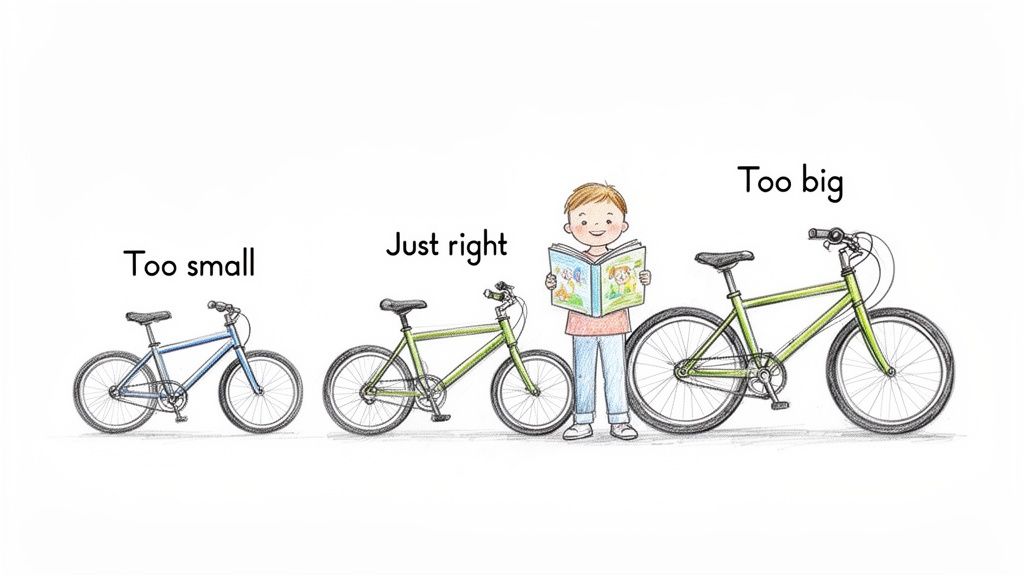
Think of it like getting a kid their first bicycle. You want one that fits perfectly. It lets them build skill and confidence at the same time, preventing a wobbly, frustrating start and paving the way for real growth.
What Is a Guided Reading Level and Why It Matters
Imagine giving a child a bike that’s way too small or one where their feet can't even touch the pedals. Either way, learning to ride is going to be a discouraging, awkward mess. A guided reading level is designed to prevent that exact scenario, but with books. It ensures the text a child practices with is perfectly suited to their current abilities.
This systematic approach makes reading feel positive and empowering. Instead of wrestling with a book that's overwhelming, young readers get to dive into stories they can actually understand and enjoy. This builds momentum and turns what could have been a roadblock into a moment of pure achievement.
The Goal of Leveled Reading
The whole point of using a guided reading level is to pinpoint a child's instructional reading level. This is the sweet spot. It's where a book is challenging enough to introduce new words and ideas, but not so tough that it makes the reader want to give up. At this level, a student can typically read with about 90-94% accuracy when a teacher or parent is there to help.
This targeted approach helps kids develop critical reading strategies without feeling like they're under a microscope. The focus is on:
- Building Fluency: Helping them read smoothly and with natural expression.
- Expanding Vocabulary: Letting them meet and learn new words in a meaningful context.
- Deepening Comprehension: Moving past just sounding out words to truly understanding the story.
- Boosting Confidence: Creating a cycle of success that fosters a genuine love for reading.
The Origins of Guided Reading Levels
The concept was brought to the forefront by two educators, Irene Fountas and Gay Su Pinnell, who completely changed how teachers pair books with students. Their system came from watching over 100,000 reading sessions and identifying distinct levels from A to Z, each one carefully measured for things like text complexity and vocabulary.
By 2018, their framework was being used in over 65% of U.S. elementary schools. This had a huge impact on publishers, who now offer thousands of leveled titles. You can see how this plays out in comprehensive programs like those from Scholastic, which are built around these standards.
The core idea is simple but powerful: meet children where they are. By providing texts that offer a gentle challenge, we empower them to become strategic, independent readers who not only can read but choose to read.
Ultimately, a guided reading level is much more than just a letter or a number. It's a tool that helps adults guide a child along their unique literacy journey, making sure every book builds their skill, nurtures their confidence, and deepens their connection to the incredible world of stories.
Decoding the Different Reading Level Systems
If you’re a parent or teacher, you’ve probably heard terms like GRL, DRA, and Lexile thrown around. It can feel a bit like learning a new language, but these are just different systems used to measure how challenging a book is. They each look at slightly different things.
Think of it like getting a car reviewed. One expert might give you a detailed breakdown of its features and handling. Another might focus purely on a real-world driving test. A third could just give you the raw engine specs. All of these are useful, but they tell you different things. Understanding these reading systems helps you see the whole picture of a child’s progress.
Fountas & Pinnell Guided Reading Level (GRL)
This is one of the most common systems you'll find in elementary schools, often called GRL or F&P levels. The Fountas & Pinnell system runs on an A-Z scale. A Level A book is just right for an early kindergartener, while a Level Z book is geared toward middle schoolers and beyond.
What sets this system apart is how it looks at the whole book, not just a few data points. It analyzes a text based on ten key characteristics that shape how a reader experiences it.
These factors include things like:
- Book and Print Features: The way text is laid out, the font size, and how illustrations support the story.
- Vocabulary: The complexity and familiarity of the words.
- Sentence Complexity: The structure and length of the sentences.
- Themes and Ideas: The maturity and abstract nature of the concepts.
Because it’s so thorough, the GRL system is fantastic for matching young readers with books that will help them grow their skills in a small group setting.
Developmental Reading Assessment (DRA)
The Developmental Reading Assessment (DRA) is both a leveling system and a hands-on assessment. Where GRL focuses on the book itself, the DRA is all about the reader’s performance. It’s the “real-world driving test” of reading.
A teacher using the DRA will observe a child reading a specific text, measuring their accuracy, fluency, and how well they understood it. Based on that observation, the student gets a numerical DRA level, like Level 16 or Level 38. These levels help teachers pinpoint exactly what a student needs to work on, whether it's retelling a story or using context clues.
The key difference is the focus: F&P levels a book's characteristics, while the DRA levels a child's reading behaviors. Though the goals are similar, the methods provide different kinds of insights into a reader's progress.
The Lexile Framework for Reading
The Lexile Framework takes a completely different path. It’s a scientific tool that measures both a book’s difficulty and a reader’s ability on the same number scale. This scale typically runs from below 0L for brand-new readers to over 1600L for highly advanced texts.
Unlike GRL or DRA, Lexile measures are calculated by a computer algorithm that analyzes two main things:
- Sentence Complexity (Syntactic Complexity): How long and complex are the sentences?
- Word Frequency (Semantic Difficulty): How common or rare is the vocabulary?
This system is less concerned with things like themes or illustrations and more focused on the hard data of the text. You’ll see Lexile measures everywhere—on standardized tests, in libraries, and across online book databases.
Comparison of Common Reading Level Systems
To make sense of it all, here’s a quick side-by-side look at how these three popular systems stack up. Each one offers a unique lens for viewing a book's complexity and a child's reading ability.
| System | Scale/Format | Primary Focus | Best For |
|---|---|---|---|
| Fountas & Pinnell (GRL) | A–Z Alphabetic Scale | Qualitative analysis of text features (themes, layout, vocabulary) | Small-group instruction and matching books to specific learning needs. |
| DRA | 1–80 Numeric Scale | Student's reading performance (accuracy, fluency, comprehension) | Assessing individual student progress and identifying skill gaps. |
| Lexile Framework | Numeric Scale (e.g., 200L, 950L) | Quantitative text analysis (sentence length, word frequency) | Independent reading, standardized testing, and large book databases. |
While they don’t provide the same kind of instructional detail as F&P or DRA, Lexile levels are incredibly useful for building independent reading lists. To dive deeper, you can explore how a Lexile level chart helps you find books perfectly suited to a student's reading range. Getting comfortable with these systems means you can support a child’s reading journey from every angle.
What Guided Reading Level Should My Child Be At?
It’s one of the first and most common questions I hear from parents and new teachers: "What guided reading level should my child be at?" And it's a great question—a perfect starting point for understanding how to support a young reader.
Think of it like the growth chart hanging on the wall at the pediatrician's office. The chart shows you the average height for kids at a certain age, but it doesn't define your child's health or who they are. In the same way, a reading level conversion chart gives you a helpful snapshot of where your child is on their reading journey. It’s a tool, not a label.
Why Benchmarks Are a Teacher's Best Friend
Having a general map of grade-level expectations helps you see where a student is and where they're headed. For instance, knowing that a Level M book is typically a great fit for a third grader helps you pull the right titles from the library shelf.
But here’s where the real teaching magic happens: you have to stay flexible. That same Level M book might be the perfect challenge for a bright second grader who’s devouring every story you give them. Or it could be a fantastic confidence-booster for a fourth grader who needs a win. The goal is always to use the guided reading level as a compass, not a cage. The system is designed to match kids with books, not to sort kids into boxes.
And this approach works. A 2019 report from Education Week found that a staggering 95% of K-8 teachers in the U.S. use some form of leveled reading. Even more telling, a major study that tracked 10,000 elementary students discovered that kids in guided reading groups jumped 1.5 grade levels in a single year. Their peers in non-leveled programs? They only grew about 0.8 levels. If you're curious, you can explore the effectiveness of guided reading workbooks to see these ideas put into practice.
Guided Reading Level to Grade Level Conversion Chart
To help you connect the dots between the different systems you might see, I've put together a quick-reference chart. It maps the popular Fountas & Pinnell (GRL) system, DRA, and Lexile measures to their corresponding grade levels. This is a great tool to bring to parent-teacher conferences or to have handy when you're picking out books.
| Grade Level | F&P (GRL) Level | DRA Level | Lexile Range |
|---|---|---|---|
| Kindergarten | A–C | A–4 | BR–200L |
| First Grade | D–I | 6–16 | 190L–530L |
| Second Grade | J–M | 18–28 | 420L–650L |
| Third Grade | M–P | 30–38 | 520L–820L |
| Fourth Grade | P–S | 40 | 740L–940L |
| Fifth Grade | S–V | 50 | 830L–1010L |
| Sixth Grade | V–Y | 60 | 925L–1070L |
| Seventh Grade | Y–Z | 70 | 970L–1120L |
| Eighth Grade | Z | 80 | 1010L–1185L |
A Quick Reminder: A child’s reading level isn’t set in stone. It’s constantly changing and growing, especially during the school year. The levels on this chart show a typical path, but it's completely normal for a student to be working a little ahead or a little behind at any given time.
At the end of the day, these charts and levels are just tools. They help us get to the real goal: raising kids who truly love to read. Use them to open doors to amazing new stories, build up their confidence, and make sure every single child gets to feel like a successful, inspired reader.
How to Find a Child's Reading Level
Figuring out a child's guided reading level isn't about some big, scary test. It’s more like being a reading detective, gathering clues from observation to find that perfect "just right" book. Both teachers and parents have their own methods for solving this puzzle, but they all lead to the same goal: matching a child with books that help them grow without taking the fun out of reading.
The main objective is to pinpoint their instructional level. Think of it as the sweet spot where a book is challenging enough to stretch their skills but not so hard that it causes frustration. This isn't a one-and-done deal; it's an ongoing conversation where we listen, watch, and adjust as a young reader’s confidence and abilities blossom.
The Teacher's Toolkit: Running Records
In the classroom, one of the most trusted tools is the running record. It might sound a bit technical, but it’s really just a teacher listening to a child read out loud while taking notes on their performance. It’s a lot like a coach reviewing game footage to see exactly where a player is shining and where they could use a little more practice.
During a running record, a teacher is keeping an eye on a few key things:
- Accuracy: How many words did the student read correctly? For a book to be at the right instructional level, the reader should have an accuracy rate of 90-94%.
- Errors (Miscues): What kinds of slip-ups did they make? Did they swap a word that looked similar (like saying "house" for "horse") or one that still made sense in the sentence?
- Self-Corrections: This is a big one. Did the child catch their own mistakes and go back to fix them? That’s a fantastic sign of a reader who is really thinking about the text!
- Fluency: Was their reading smooth and full of expression, or was it choppy and slow?
- Comprehension: After they finish, can the child retell the story in their own words or answer some basic questions about what happened?
This close observation gives a teacher a really clear picture of a child’s reading habits and helps them pick the perfect guided reading level for small-group work. To go deeper on this, you can check out other ways for how to assess reading level.
A Quick Check for Parents: The Five Finger Rule
You don't need a teaching degree to figure out if a book is a good fit. The Five Finger Rule is a super simple trick that works wonders at the library or bookstore. Best of all, it empowers kids to take part in choosing their own books.
Here’s all you have to do:
- Ask your child to open a book to a page with plenty of words.
- Have them start reading the page aloud.
- Every time they hit a word they don't know or can't pronounce, they hold up one finger.
- Once they finish the page, just count the fingers.
If they have 0-1 finger up, the book is probably on the easy side—perfect for reading just for fun, but not for building new skills. If they’re holding up 2-3 fingers, you've likely found a "just right" book. But if they get to 4-5 fingers, the book is probably too tough and will only lead to frustration.
Finding the right book is all about balancing skill and interest. A child's reading level points to their skill, but what they want to read is just as important. The Five Finger Rule helps you find a book that checks both boxes right on the spot.
Beyond Informal Assessments
Sometimes, a child's reading struggles need a closer look. When informal checks aren't enough, more comprehensive psychoeducational testing can uncover specific learning profiles that might be affecting their reading level and help guide more targeted support.
This visual helps show how all these ideas connect, starting from a broad grade level and narrowing all the way down to a specific book match.
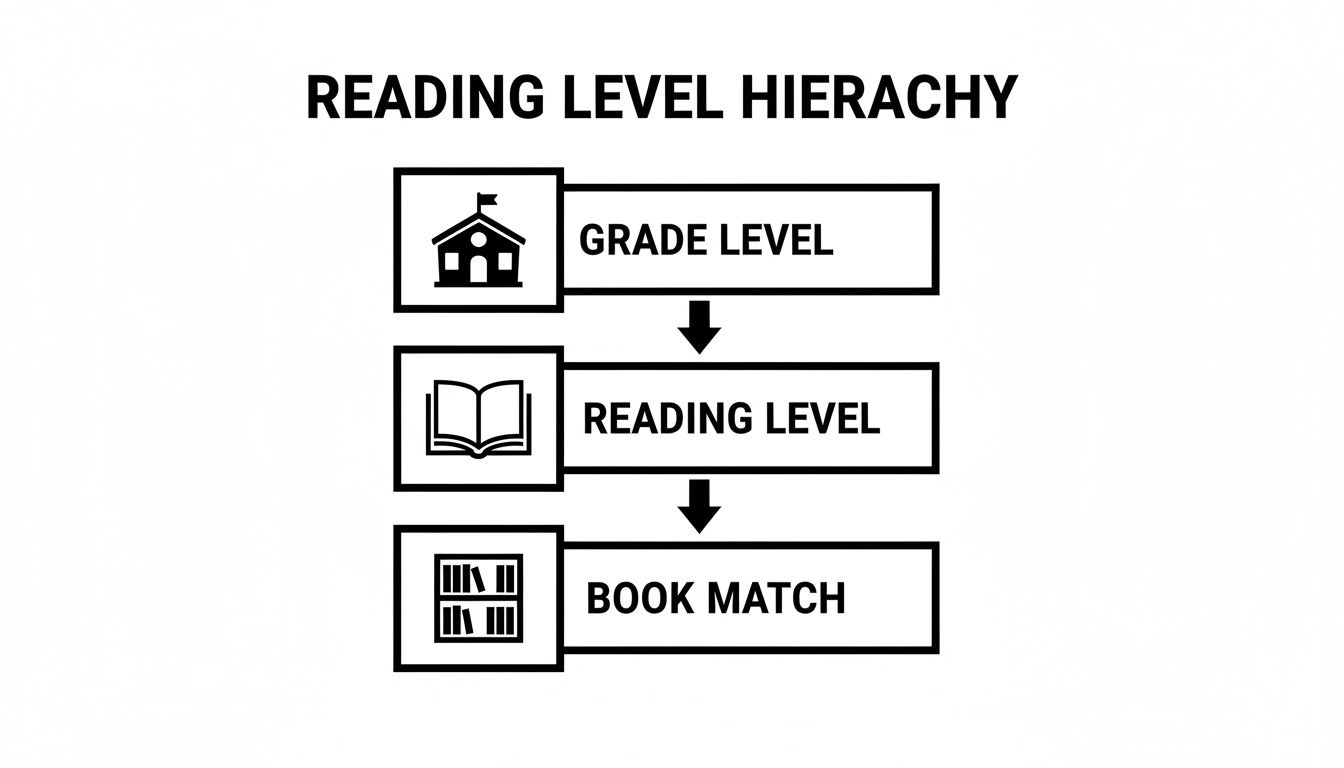
As the hierarchy shows, finding the right book is a process. You start with a general grade, pinpoint a more precise reading level, and finally land on a book that will help a young reader feel successful.
How to Run an Effective Guided Reading Session
A truly effective guided reading session isn’t just about reading a book together. It follows a predictable rhythm that helps kids build the strategies they need to eventually read on their own. Think of it like a coach getting an athlete ready for a game: you have the warm-up, the game itself, and the post-game review.
Each part of this process is designed to build a child’s confidence and skill as they tackle texts at their specific guided reading level.
- Warm-up: The Book Introduction
- Game: Shared Reading
- Post-game Review: Discussion and Activities
Choosing The Right Text
Everything starts with picking the right book. This is the foundation of a great guided reading group, and getting it right makes all the difference.
The sweet spot is a text where students can read with 90-94% accuracy. This means it's challenging enough to promote growth but not so difficult that it causes frustration. You’re looking for books with engaging topics, illustrations that support the story, and new vocabulary that stretches them just a little.
- Text Complexity: Look for varied sentence lengths to help them practice new skills.
- Vocabulary Level: New words should be within reach, solvable with a bit of support.
- Interest Match: Nothing gets kids reading like a topic they’re genuinely curious about.
- Print Features: A clear font and helpful pictures go a long way.
Introducing The Book
Before anyone even reads the first word, you need to set the stage. Start with a brief introduction to build some background knowledge and give the reading a purpose.
You can use questions, show them pictures from the book, or tell a quick story to connect the book's ideas to something the students already know.
- Go over a few key vocabulary words, giving simple definitions.
- Talk about the cover and have the kids make predictions about the story.
- Set a simple reading goal, like, “Today, let’s see if we can find three new things we learn about frogs.”
Supporting During Reading
Once the reading begins, your role shifts from instructor to guide on the side. You're there to observe and gently nudge, not to give them all the answers.
Watch for moments when they self-correct—that’s a huge win! Help them remember to use their strategies, like sounding out a tricky word or using the pictures for clues. Simple prompts like, “What would make sense there?” or “Try reading that sentence again,” can work wonders.
“Effective prompts help readers think through challenges without giving away answers.”
Follow-up And Skill Building
After the reading is done, it's time for the post-game review. This is where you really cement their comprehension and reinforce the skills they just practiced.
Ask open-ended questions that get them thinking more deeply about the story’s characters, plot, and themes. You can also mix in short, fun activities like word hunts, acting out a scene, or drawing their favorite part to bring the story to life.
- Connect to Prior Learning: Ask how this story reminds them of other books they’ve read.
- Encourage Reflection: Have students share which reading strategy helped them the most.
- Plan Next Steps: Make a mental note of any areas that might need more practice in your next session.
Comparison Of Session Phases
Here’s a simple breakdown to help you keep the session on track:
| Phase | Focus | Activity |
|---|---|---|
| Warm-up | Build background | Discuss the cover and key words |
| Reading | Strategy use | Partner reading with prompts |
| Review | Comprehension | Ask how, why, and what-if questions |
Having a quick reference like this helps maintain a good pace and ensures you’re hitting all the key support points at each stage.
Example Guided Reading Scenario
Let’s imagine you're working with a group of second-graders reading at Level J.
You might start by showing them a book about farms and previewing words like "silo," "pasture," and "harvest." As they begin reading, you listen in, quietly noting any miscues but also giving a thumbs-up when a student fixes their own mistake.
- Step 1: Introduce the first few pages, setting the scene.
- Step 2: Monitor their reading, offering a prompt here and there.
- Step 3: Pause to discuss what just happened and ask what they think will happen next.
Best Practices You Need To Know
To make these sessions truly powerful, it helps to keep a few things in mind. Always jot down your observations—this will be invaluable for planning future lessons.
It’s also a great idea to rotate books weekly and circle back to tricky strategies often. And don't forget to use a good mix of fiction and nonfiction to build a wider range of reading skills.
- Keep groups small, around 3–5 students, to make sure everyone gets a chance to participate.
- Record your notes on a simple checklist or grid to stay organized.
- Plan for flexible 15–20 minute time slots for each group.
Troubleshooting Common Challenges
Of course, even the most perfectly planned session can hit a snag. Kids get distracted, a book doesn’t land, or you run short on time. It happens!
- Students zone out: Try using tactile props like finger puppets or whisper phones to keep them engaged.
- Group skills are too varied: If one student is struggling more than others, try pairing them with a slightly more confident reader for a portion of the time.
- Time runs short: It’s okay to shorten the reading section and focus on just one or two key passages.
Over time, making these small adjustments will help your sessions run much more smoothly. Remember to celebrate progress, no matter how small, to keep the excitement for reading alive and well.
Finding Leveled Books for Your Child
Alright, so you’ve figured out your child’s guided reading level. That’s a huge win! Now for the fun part: finding books that click. Building a little library of "just right" books at home is what transforms reading practice from a chore into a genuine adventure. Luckily, you don't have to go it alone—there are some fantastic resources out there to help you find the perfect titles.
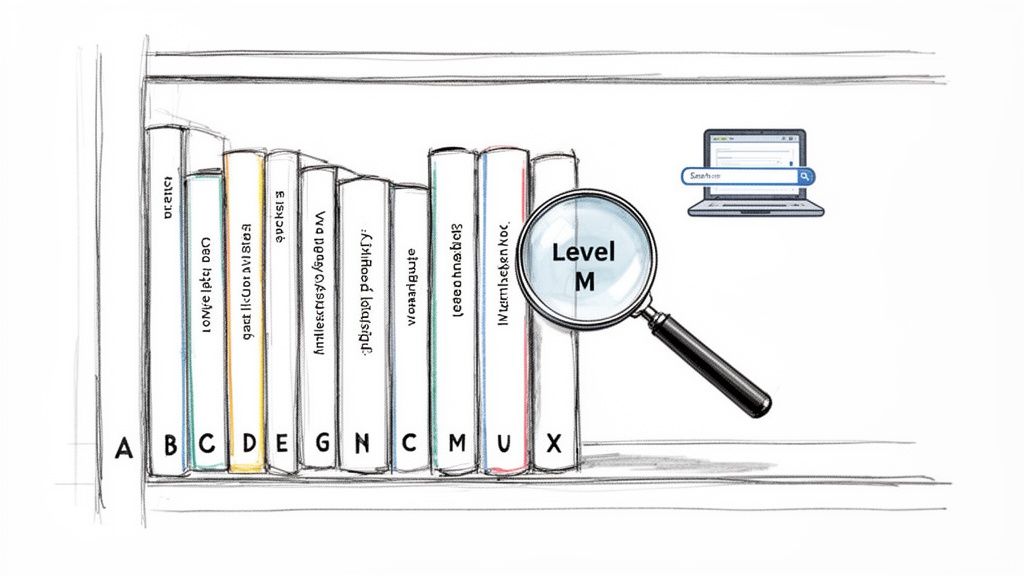
Many books, especially those aimed at early readers, actually have the reading level printed right on them. Take a look at the front or back cover for a small letter or number. This little clue makes spotting an appropriate book on the shelf quick and easy.
Powerful Online Search Tools
When you need to check a book's level or hunt for titles in a specific range, online tools are an absolute lifesaver. They really take the guesswork out of it and can introduce you to amazing stories you might have otherwise missed.
One of the best-known resources is the Scholastic Book Wizard. It's a free database where you can type in a book's title and instantly see its GRL, DRA, and Lexile levels. You can also work backward by filtering for a specific guided reading level, and it will generate a whole list of books that fit the bill.
Your Local Library Is a Goldmine
Never underestimate your community library. It’s an incredible partner in your child's reading journey. Many libraries organize their early reader sections by reading level, making browsing a breeze. And don’t ever hesitate to ask a children’s librarian for help—they are true experts at connecting kids with books they’ll absolutely love.
A great librarian can do more than just find books at a certain level. They can introduce your child to new authors and series that tap into their passions, whether it's dinosaur adventures or magical mysteries.
Most libraries also let you search their online catalog by Fountas & Pinnell or Lexile level before you even leave the house. This lets you build a list and place holds on the books you want, saving you a ton of time. For more great ideas, you can also explore our curated lists of incredible kids' books designed to spark imagination and a lifelong love for stories.
Popular series are another fantastic way to keep a reader hooked. Once a child gets attached to a set of characters, they can't wait to see what happens in the next book. Here are a few well-loved examples for different stages:
- Early Emergent (Levels A-C): The Bob Books series
- Developing (Levels G-I): Elephant & Piggie by Mo Willems
- Transitional (Levels J-M): The Magic Tree House series by Mary Pope Osborne
- Fluent (Levels N+): The Chronicles of Narnia by C.S. Lewis
Using these resources puts you in the driver's seat, allowing you to confidently build a library that supports your child's growth and ensures reading always feels like a rewarding experience.
Answering Your Questions About Guided Reading
Even with a good road map, the journey into guided reading can bring up a few questions along the way. As you start putting these ideas into practice, it's totally normal to wonder about the little details. This final section tackles some of the most common questions from parents and teachers, offering clear answers to help you support your young reader with confidence.
Think of it as a friendly FAQ—quick, straightforward, and designed to get you right back on track.
Should My Child Only Read Books at Their Exact Level?
Definitely not! A child’s instructional guided reading level is really just for those focused, skill-building sessions you have with them. For independent reading—reading for the pure joy of it—they should absolutely be encouraged to pick up easier books they already love. This is how they build fluency and, more importantly, learn that reading is fun.
A good way to think about it is like a well-rounded fitness plan:
- Challenging Workouts: This is reading at their instructional level, with your support.
- Easy Jogs: This is them reading familiar, easier books on their own to build stamina and confidence.
- Watching the Pros: This is when you read more complex stories aloud to them, expanding their vocabulary and showing them what great storytelling sounds like.
What if My Child Wants a Book That Is Too Hard?
First off, never discourage that interest! Passion is one of the most powerful motivators in a child’s reading life. When a kid is genuinely excited about a book, even if it seems way above their level, it’s the perfect opening for some shared reading time.
You can read the book aloud to them, take turns reading pages, or just be on standby to help with tricky words. This approach honors their curiosity while giving them the support they need to succeed. It turns what could be a frustrating moment into a great bonding experience and a chance to learn together.
The goal is never to restrict a child's reading choices but to provide the right support for whatever they choose to explore. A challenging book read together is far more valuable than an "appropriate" book that gathers dust.
How Often Should My Child's Reading Level Be Checked?
In a school setting, teachers usually run formal assessments a few times a year. At home, though, you can do informal checks all the time just by observing.
A good rule of thumb is to simply pay attention to how easily and smoothly they're reading. If a book that was a good fit a month ago now seems way too easy (they're flying through it without a single mistake), it's a good sign they've grown. On the flip side, if they start stumbling on more than five words per page, their guided reading level has likely shifted up. Progress isn't always a slow and steady climb; it often happens in little bursts, so just being observant is key.
For children who might still be navigating reading challenges, exploring tools like assistive technology for reading can provide crucial support. These resources can help bridge gaps and make texts more accessible, complementing the work done during guided reading sessions.
At Number 6 Publishing, we believe that the right story can change a life. We are dedicated to helping parents and teachers find books that inspire joy and build confident, lifelong readers. Explore our curated book lists and discover your child’s next favorite adventure at https://www.number6publishing.com.