
Knowing when to introduce the first chapter books for 1st graders is a huge milestone for any young reader. It's that exciting moment they move beyond picture-heavy stories and dive into longer, richer narratives. This is where they really start building reading stamina and a deeper understanding of storytelling.
The Big Leap to Chapter Books
Moving from picture books to chapter books is a lot like graduating from training wheels to a two-wheeler. At first, it can feel a little wobbly. Picture books offer constant support with their bright illustrations and short bursts of text. But chapter books ask a child to balance on their own, using just the words to paint pictures in their mind.
This leap is about more than just reading more words on a page. It’s about developing entirely new mental muscles. Kids have to learn to focus for longer as a story unfolds over several days. They practice tracking plot points, remembering who’s who, and holding the entire narrative in their head between reading sessions. This process does wonders for their memory and critical thinking.
Signs Your First Grader Is Ready
So, how do you know if your child is ready to ditch the training wheels? There are a few clear signs that it’s time to start exploring chapter books. Spotting these signs helps make the transition feel like an accomplishment, not a struggle.
Look out for these clues:
- Reading with Flow: They can read early-reader books pretty smoothly without needing to sound out every single word.
- Remembering the Story: They can tell you the main things that happened in a story they just finished and answer basic "who, what, where" questions.
- Longer Attention Span: They’re happy to sit through longer read-alouds and might even beg for "just one more chapter!" at bedtime.
- Genuine Curiosity: They start eyeing the "big kid" books on the shelf and asking what they're about.
To help you put these pieces together, here’s a quick checklist to see if your 1st grader is showing the key signs of readiness.
Is Your 1st Grader Ready for Chapter Books?
| Readiness Sign | What It Looks Like in Practice | Why It Matters for Chapter Books |
|---|---|---|
| Reading Stamina | Sits through a 15-20 minute read-aloud without getting too fidgety. | Chapter books require focus across multiple pages and sittings. |
| Decoding Skills | Reads familiar words automatically and can tackle new, simple words. | Reduces frustration so they can focus on the story, not just the words. |
| Story Recall | Can summarize a picture book, naming the main character and problem. | This is crucial for following a plot that develops over many chapters. |
| Making Predictions | Guesses what might happen next in a story. | Shows they are engaged and thinking beyond the immediate page. |
| Book Interest | Expresses excitement about reading longer or more complex stories. | Motivation is the most powerful tool for overcoming reading challenges. |
Seeing a few of these signs is a great indicator that your child is ready for the next step in their reading adventure.
Building Foundational Skills
The journey to chapter books also has a physical side. Handling a thicker book with thinner pages takes a surprising amount of coordination. As you get ready for this milestone, it can be helpful for parents to understand what fine motor skills are and how they support a young reader’s independence.
The goal is to make this transition feel like an exciting adventure, not a chore. When a child feels successful with their first chapter book, it builds a powerful sense of accomplishment that fuels a lifelong love of reading.
Ultimately, readiness isn’t tied to a specific age but to each child's unique development and interest. If you want to dig a little deeper into your child's abilities, our guide on how to assess reading level has some practical advice. Matching the right book to their current skill level is the key to setting them up for a joyful and rewarding experience.
Anatomy of a Perfect First Chapter Book
So, what exactly separates the perfect first chapter book from any other book on the shelf? It’s about so much more than just the word count. I like to think of it like finding the right pair of shoes for a new runner—the fit is absolutely everything. A book that’s too difficult can lead to frustration and a quick exit, but one that’s just right gives them the support and comfort they need to go the distance.
The best chapter books for 1st graders are built with a specific goal in mind: to grow a child’s confidence and reading stamina. These books act as a crucial bridge, guiding young readers away from the heavy visual support of picture books and into the incredible world of longer stories that live mostly in their imagination.
Let’s break down the key ingredients that make a first chapter book a successful and truly joyful experience.
The Magic of Short Chapters
For a reader who is just getting their footing, a 100-page book can feel like an unclimbable mountain. Short chapters, however, completely change the landscape, turning that mountain into a series of small, satisfying hills. Each chapter they finish offers a natural place to pause and, more importantly, a powerful feeling of accomplishment.
These built-in breaks are essential for a few reasons:
- Building Endurance: Finishing a chapter in a single sitting gives a child a sense of completion. This helps build the focus they’ll need for longer reading sessions down the road.
- Reducing Fatigue: A six or seven-year-old’s attention span is still a work in progress. Reaching the end of a chapter feels like a small victory, which helps prevent the burnout that can happen with long, unbroken stretches of text.
- Encouraging Return: Knowing they can finish a whole chapter before bed or during quiet time makes the idea of picking the book up again feel less like a chore and more like an invitation.
This structure is brilliant because it teaches kids how to pace themselves, turning what could be an overwhelming task into a series of rewarding little sprints.
Illustrations as Helpful Guideposts
While chapter books lean more heavily on words to carry the story, illustrations still play a vital part. Think of it as an evolution. Unlike in picture books, where images often dominate the page, the art in early chapter books becomes a supportive tool rather than the main event.
In these books, illustrations act as friendly visual signposts. They help a child confirm that what they’re picturing in their head matches the story. Seeing a drawing of a character's surprised face or a map of a whimsical land reinforces what they've just decoded from the text, which is a huge boost for both comprehension and confidence. They provide just enough context to keep young readers anchored without doing all the imaginative heavy lifting for them.
This simple infographic shows how these elements work together to build the core skills of comprehension and focus.
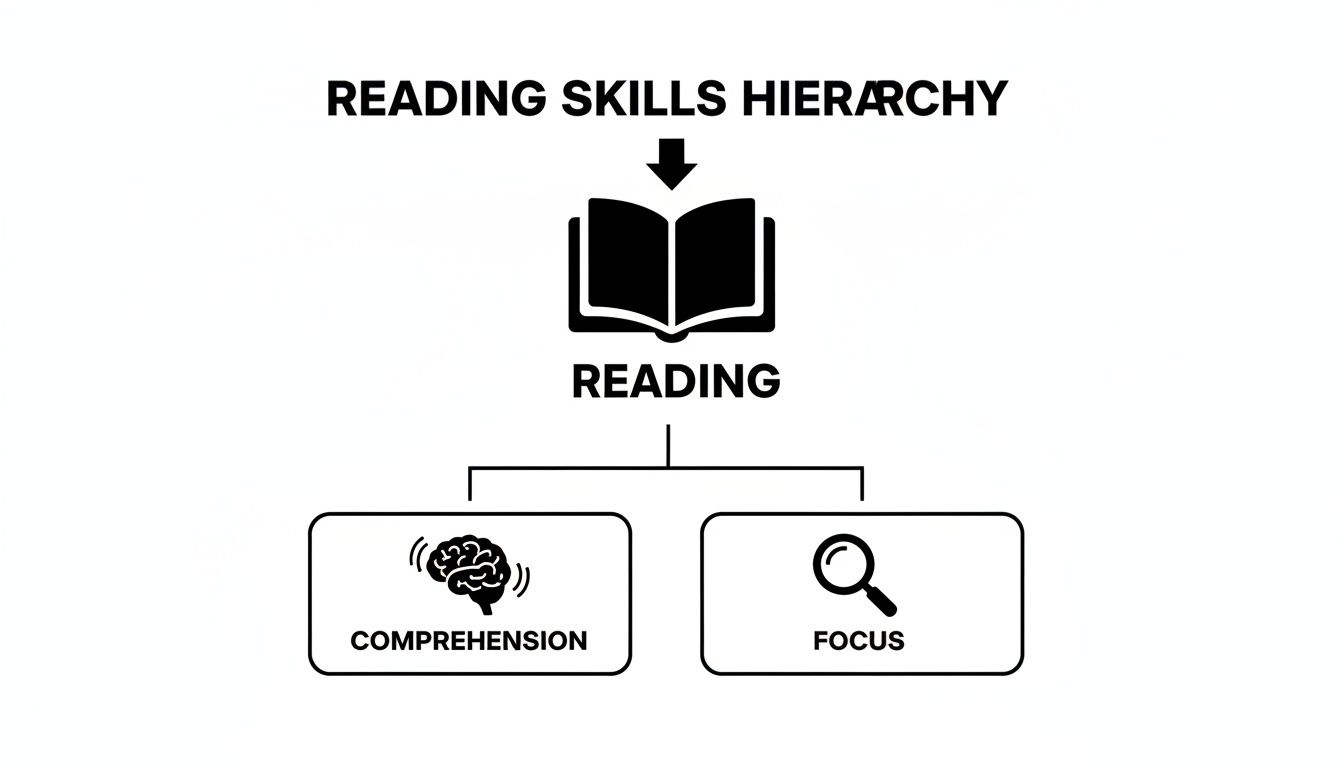
As the image shows, foundational reading skills directly feed into the development of deeper understanding and the ability to stay focused—two skills that are absolutely critical for tackling chapter books.
Relatable Themes and Gentle Conflicts
The chapter books that really stick with first graders are the ones with stories that mirror their own world. The themes feel familiar, the problems are solvable, and the characters could easily be their friends.
A great first chapter book should feel both exciting and safe. It pushes a child's reading skills forward while keeping the emotional content grounded in experiences they can understand and process.
You’ll want to look for stories that revolve around age-appropriate topics like:
- Friendship and Teamwork: Books about making friends, sharing, and working together resonate deeply with first graders, as they are navigating these exact social skills every day.
- School and Family Adventures: Everyday settings like the classroom, the playground, or home provide a familiar backdrop for extraordinary (or just plain silly) things to happen.
- Gentle Problem-Solving: The conflicts are always low-stakes—a lost toy, a misunderstanding with a pal, or a funny mishap. This lets kids see problems get resolved without causing them any real anxiety.
This focus on relatable content is a big reason the children's book market continues to thrive. The children and young adult books market, which includes chapter books for 1st graders, was valued at USD 12.16 billion and is expected to hit USD 13.45 billion by 2029. This growth is powered in part by a global focus on early literacy and by parents actively seeking out books that reflect their children's lives. You can discover more about the children's book market trends on ResearchAndMarkets.com.
When you combine manageable chapters, helpful illustrations, and themes they can connect with, a book can make a child feel seen, understood, and incredibly capable.
How to Choose the Right Book for Your Child
Knowing the ingredients of a great book is one thing, but actually standing in a library aisle surrounded by hundreds of options can feel overwhelming. The secret to finding the perfect chapter books for 1st graders isn’t about grabbing the most popular title off the shelf. It’s about becoming a book detective and matching a story to your child’s unique personality.
Think of yourself as a literary matchmaker. Your job is to connect your young reader with a book that sparks genuine excitement. That connection is what turns reading from a chore into a lifelong hobby.
Follow Their Interests and Passions
The quickest way to get a child hooked on a book is to tap into something they already love. If they spend hours lining up dinosaur figures, find a series about time-traveling paleontologists. If they’re constantly cracking silly jokes, a book filled with humor and mischief is a guaranteed win.
When a book lines up with a child's existing passion, it doesn't feel like work—it feels like an extension of their playtime. This is an incredibly powerful strategy for reluctant readers because it makes the story instantly inviting.
Here are a few interest-based starting points:
- For the Animal Lover: Look for series centered on pets, wildlife rescues, or talking critters.
- For the Budding Detective: Mystery series with fun, low-stakes puzzles are perfect for curious minds.
- For the Fantasy Fan: Gentle adventures with dragons, magic, and faraway kingdoms can ignite their imagination.
- For the Sports Fanatic: Stories set on the baseball field or basketball court can be a home run.
The Power of Seeing Themselves in a Story
Beyond just interests, it’s vital for children to see themselves and their own world reflected in the books they read. When characters look like them, share their cultural background, or come from a similar family, it sends a powerful message: your story matters.
This isn't just about diversity; it's about validation. It helps kids build a positive sense of identity and self-worth.
Reading a book with a relatable character is like looking in a mirror and seeing a hero. It builds confidence and shows a child that someone just like them can be the star of the story.
This "mirror" effect is crucial, but it's just as important for children to have "windows" into the lives of others. Reading about characters with different experiences and backgrounds builds empathy and a broader understanding of the world. It teaches them to appreciate differences and find common ground.
How to Find Your Next Great Read
So, you know what you’re looking for. But where do you find these literary gems? Becoming a skilled book selector means using a few key resources to uncover titles that go beyond the bestseller list.
Here are a few practical tips for your book-finding toolkit:
- Become a Library Regular: Your local children’s librarian is your best friend. They are experts in children's literature and can offer personalized recommendations based on your child's reading level and passions.
- Read Reviews and Summaries: Don’t just judge a book by its cover. Reading online summaries and reviews from other parents gives you a feel for the book's tone, themes, and complexity.
- Use Online Databases: Websites like Goodreads or Common Sense Media provide detailed information, including age ratings and content guides, helping you make an informed choice.
Understanding reading level systems can also be a huge help. While they aren't the only factor, knowing where a book falls on a scale can guide your search. To get more familiar with these metrics, you can learn more from a helpful Lexile level chart that breaks down the system. When you combine this kind of knowledge with what you know about your own child, you become an unstoppable book-finding force.
Our Curated List of First Chapter Book Series
Alright, you know what to look for—now comes the fun part. Let's find that perfect series to get your first grader hooked on reading. Think of this less as a list and more as a guided tour through some of the most beloved and effective chapter books out there. We’ve pulled together a mix of modern hits and timeless classics to give you a solid place to start.
Every book here was chosen to build confidence and make reading feel like an adventure, not a chore. We've sorted them by what kind of reader you have—the budding detective, the future scientist, or the kid who just loves a good laugh.
For the First-Time Chapter Book Reader
This is the starting line. These books are for the child just dipping their toes into longer stories. They’re designed to be completely unintimidating, with plenty of pictures, simple sentences, and short chapters that make finishing a book feel like a huge win.
-
Mercy Watson by Kate DiCamillo: Mercy is a pig who absolutely loves hot buttered toast and has a knack for finding herself in the middle of hilarious situations. These books are filled with vibrant, full-page illustrations and playful language that act as the perfect bridge from picture books.
-
Elephant & Piggie Like Reading! series: While not a traditional chapter book, this series from Mo Willems is a fantastic stepping stone. The stories have multiple parts and use simple, repetitive text with wonderfully expressive illustrations. They are masters at helping new readers build confidence and track a slightly longer plot.
Laugh-Out-Loud Adventures
Humor is a parent's secret weapon. A funny story can turn a kid who's "meh" about reading into one who can't wait to see what happens next. These series are packed with mischief and silliness that will have your first grader giggling from page one.
Laughter makes reading a joyful, shared experience. When a child associates books with fun, they are far more likely to pick one up on their own, building a positive habit that can last a lifetime.
-
Ivy + Bean by Annie Barrows: This series is all about the unlikely friendship between quiet, thoughtful Ivy and loud, rambunctious Bean. Their adventures come from wild ideas and relatable kid logic, celebrating friendship and creative problem-solving in a way that feels both genuine and hilarious.
-
Princess in Black by Shannon Hale & Dean Hale: By day, she’s the proper Princess Magnolia. But when the monster alarm rings, she becomes the Princess in Black! This series is a brilliant blend of princess and superhero stories, packed with action and energetic illustrations that appeal to just about everyone.
Mysteries and Magical Quests
Got a kid with a curious mind and a big imagination? Nothing beats a good mystery or a journey into a fantasy world. These books encourage critical thinking and transport readers to new places, making them feel like they're part of the adventure.
-
Magic Tree House by Mary Pope Osborne: A true classic for a reason. Siblings Jack and Annie travel through time in their magical treehouse, and each book is a fast-paced historical adventure. The series masterfully blends facts with fiction, sparking curiosity about the real world.
-
Dragon Masters by Tracey West: This is the perfect entry point for young fantasy lovers. Drake is chosen to train a dragon, and the story takes off from there. With accessible text, lots of illustrations, and high-stakes adventures, it’s a fantastic introduction to fantasy.
-
Zoey and Sassafras by Asia Citro: A brilliant mix of science and magic. Zoey uses the scientific method to help injured magical creatures that show up at her barn. It’s a wonderful series for encouraging curiosity, critical thinking, and a love for both the natural and fantastical worlds.
The children's book world is always changing to keep up with young readers. With kids' attention being such a precious commodity, we're seeing more diverse stories, eco-themes, and books focused on mental wellness. The industry is healthy, too—the US children's book publishing sector brings in $3.3 billion in revenue and has seen steady growth.
Stories with Big Feelings
Chapter books can be a safe space for first graders to explore complex emotions. These stories feature relatable characters navigating the ups and downs of friendship, family, and school, helping kids build empathy and emotional intelligence.
-
The Critter Club by Callie Barkley: A sweet series about a group of best friends who start an animal rescue shelter. Each book centers on their animal adventures while gently exploring themes of responsibility, teamwork, and what it means to be a good friend.
-
Cam Jansen by David A. Adler: Cam Jansen has a photographic memory she uses to solve all sorts of mysteries. Beyond the fun puzzles, the series gives us a smart and capable female hero who uses her unique skills to help others, reinforcing the value of paying close attention to the world.
Top Chapter Book Series for 1st Graders by Genre
To make it even easier, here's a quick-glance table to help you find the perfect series based on what your young reader loves most.
| Series Title | Author and Illustrator | Best For This Type of Reader | Key Features to Look For |
|---|---|---|---|
| Mercy Watson | Kate DiCamillo, Chris Van Dusen | The Absolute Beginner | Full-color illustrations, hilarious plots, short chapters. |
| Ivy + Bean | Annie Barrows, Sophie Blackall | The Comedian & Adventurer | Unlikely friendships, funny dialogue, relatable mischief. |
| Magic Tree House | Mary Pope Osborne, Sal Murdocca | The Curious Explorer | Blends history and adventure, fast-paced, sparks curiosity. |
| Dragon Masters | Tracey West, Graham Howells | The Fantasy Fan | Accessible fantasy, action-packed, heavy on illustrations. |
| Zoey and Sassafras | Asia Citro, Marion Lindsay | The Little Scientist | Mixes science and magic, promotes problem-solving. |
Finding the right series is a journey of discovery for both you and your child. Don't be afraid to try a few different genres to see what clicks. For a wider view of fantastic reads across different age groups, you can also explore our guide to the best book series for kids, which offers even more ideas for your growing reader.
Making Reading a Lasting Habit
Watching a first grader finish their first chapter book is a huge milestone. But the real goal is much bigger than just getting through a few stories; it's about turning that first spark of excitement into a fire that burns for a lifetime. The true victory comes when a child starts grabbing a book on their own, not because it’s an assignment, but simply because they want to.
This is the magic moment when guided reading turns into genuine, independent joy. By making reading an interactive, fun, and regular part of family life, you're nurturing a habit that will pay dividends forever. It's all about making books feel like a treat, not a task.
Bring Stories to Life with Read-Alouds
Even after your child can read alone, reading aloud together is still one of the most powerful things you can do. Think of it as a live performance of the story. Your voice, your expression, your excitement—it all transforms the black and white text into a full-color world. This helps them hear the natural rhythm of language and feel the emotion behind the words.
Here are a few simple tricks to make your read-aloud time something special:
- Use Different Voices: You don't have to be a professional voice actor. A squeaky voice for a little mouse or a deep rumble for a giant is all it takes to make the characters pop off the page.
- Vary Your Pace and Volume: Speed up when the action gets exciting and slow way down for a suspenseful part. A dramatic whisper or a surprised shout can pull your listener right into the middle of the plot.
- Pause to Ask Questions: Stop and wonder aloud, "What do you think will happen next?" or "Why would she do that?" This little trick gets them thinking and listening on a whole new level.
These shared moments create powerful, positive memories around books, connecting them with comfort, closeness, and fun.
Extend the Story Beyond the Page
The adventure doesn't have to stop when you close the book. Simple, fun activities after reading can lock in what they’ve learned and help them connect with the story on a personal level. The trick is to make sure it always feels like play, never like homework.
When a child retells, reimagines, or physically creates something from a story, they are cementing its details in their mind. This active engagement is a powerful tool for building deeper understanding and long-term memory.
Even the simplest activities can have a huge impact:
- Draw a Favorite Scene: Ask them to grab some crayons and illustrate the part of the story they loved most. It’s a fantastic way for them to process the narrative visually.
- Act It Out: Put on a quick, silly play of a single chapter. This helps them get inside the characters’ heads.
- Build Something: If the characters in the book built a fort, grab some pillows and blankets and build one, too. Connecting the story to a hands-on activity makes it feel real.
Create a Reading-Rich Environment
Kids are sponges; they absorb the habits they see every day. One of the best ways to raise a reader is to live in a home where reading is a visible, valued activity. You don't need a formal library—just a few thoughtful touches can make all the difference.
Start by making books an easy and appealing choice. Place a basket of inviting chapter books in the living room, or carve out a cozy reading corner with a good lamp and comfy pillows. When a book is just as easy to grab as a tablet, kids are far more likely to pick it up. This strategy is more important than ever, with the children's book market booming. The global market, which includes early chapter books, hit USD 9.85 billion and continues to grow as digital formats make stories even easier to access. You can discover more insights about the booming children's book market on 360iResearch.com.
Ultimately, when you model reading as a fun way to relax and make books a central part of your home, you send a powerful message: stories are an essential, wonderful part of life.
Common Questions About First Chapter Books
Watching your child move from picture books to their first chapter book is a huge milestone. It's exciting, but it can also bring up a lot of questions. How do you know if they’re ready? What if they don’t seem interested? This is a big step, and it's completely normal to wonder how to best guide your new reader.
We’ve put together straightforward answers to the questions we hear most often from parents and teachers. The goal is to help you feel confident and make sure your child’s journey into chapter books is a positive one, filled with fun and success.
What if My 1st Grader Is Not Interested?
First off, don't panic. If you push too hard, reading can start to feel like a chore, and that’s the last thing anyone wants. Patience is your best tool here, along with finding just the right book to spark their imagination.
Think of it like finding the right key for a lock. You might have to try a few. Start with highly-illustrated books that bridge the gap between picture books and chapter books—more pictures and less text can feel much less intimidating. Humor is almost always a winner with this age group, so look for a series known for being silly. You could also try reading the first few chapters aloud with lots of energy and funny voices to get them hooked on the story. If nothing sticks, just back off. Keep enjoying picture books together and celebrate any kind of reading they choose to do.
How Many Books Should They Be Reading?
Honestly, there’s no magic number. The focus should always be on quality and enjoyment, not quantity. The real mission is to help them build a consistent, positive reading habit that feels like a treat, not a task.
For one first-grader, finishing a single chapter book over a month is a massive accomplishment worth celebrating. Another kid might zip through a book a week. Both are perfectly fine and represent progress.
The right amount is whatever keeps them engaged and feeling successful without pressure. Aim for about 15-20 minutes of reading time daily, and be sure to celebrate the completion of every single book, no matter how long it takes.
Are Graphic Novels a Good Choice?
Absolutely! Graphic novels are a fantastic tool for building literacy skills, especially for visual learners or kids who are hesitant to pick up a book with dense blocks of text. Don't ever think of them as a "lesser" form of reading—they are a powerful and completely valid format for storytelling.
The way images and text work together helps kids decode important parts of a story they might otherwise miss:
- Plot Development: Following the action in the panels makes it easier to understand cause and effect.
- Character Emotions: A character’s facial expression can tell a whole story on its own.
- Context Clues: The pictures provide rich details about the setting and action, which boosts comprehension.
Many graphic novels have surprisingly rich vocabularies and complex plots. They can be a perfect bridge to traditional chapter books or simply a favorite format all on their own.
How Do I Know if a Book Is Too Difficult?
Finding that “just right” book—one that provides a little challenge without causing frustration—is crucial. One of the simplest and most effective ways to check is the five-finger rule.
Here’s how it works:
- Have your child read one full page from the book out loud.
- Each time they struggle with or don't know a word, they hold up one finger.
- If they get to five fingers before the page is done, the book is probably too challenging for them to read independently right now.
A book that fails the five-finger test can still be a great one to read together! Other signs that a book is too hard include very choppy reading, obvious frustration, or an inability to tell you what’s happening in the story.
At Number 6 Publishing, we believe that finding the right book is the key to unlocking a lifelong love for stories. We are dedicated to helping families and educators discover books that inspire and delight young readers. Explore our curated book lists and find your child's next great adventure at https://www.number6publishing.com.