
When a child learns to read smoothly, accurately, and with genuine expression, it’s like watching them learn to speak all over again.That natural, conversational flow is the heart of reading fluency. The secret isn't just about speed; it's about helping them master three core skills: accuracy (getting the words right), rate (reading at a comfortable pace), and prosody (adding the "music" of language).
By consistently practicing with texts that are both engaging and at the right level, we can help transform reading from a difficult chore into a source of confidence and joy.
Understanding the Three Pillars of Reading Fluency
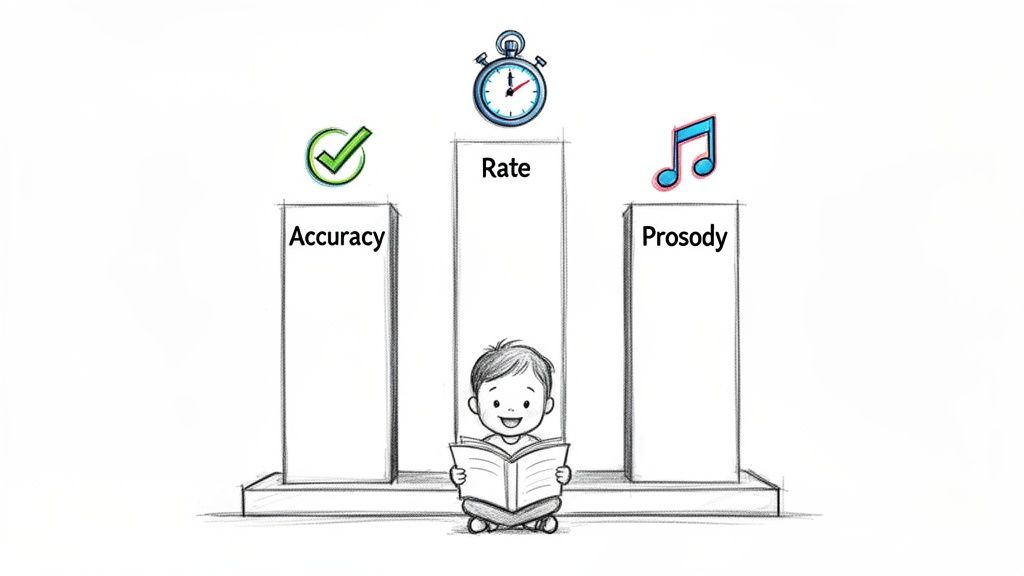
It’s a common trap to think that reading fluency is all about speed. While rate is certainly part of the equation, chasing a faster reading speed is a mistake I’ve seen many times. Real fluency is a delicate balance of three interconnected components. Together, they bridge the crucial gap between just saying the words and actually understanding the story.
Think of these pillars as the legs of a stool—if one is shaky, the whole thing becomes unstable. Nurturing all three turns reading from a mechanical task into a deeply meaningful experience.
The First Pillar: Accuracy
Accuracy is where it all begins. It’s the simple, yet critical, ability to recognize and say words correctly. Without a solid foundation in accuracy, the meaning of a sentence can fall apart. Imagine a child reading "house" as "horse"—the entire mental picture they're building crumbles.
This goes beyond just phonics. It’s about automaticity, that moment a reader sees a word and knows it instantly without needing to sound it out. When a reader becomes accurate, their brain is freed up to think about what the story means instead of wrestling with decoding every single word.
The Second Pillar: Rate
Rate is about finding a natural, comfortable rhythm. The goal isn’t to race through the page; it's to read at a speed that feels like a conversation. Reading too slowly makes it tough to hold the beginning of a sentence in your mind by the time you get to the end.
On the flip side, reading too quickly often causes mistakes and tanks comprehension. The sweet spot is a pace that allows the reader to process information smoothly. As a child’s accuracy and word recognition improve, their reading rate naturally finds its groove.
A fluent reader doesn’t just say the words; they understand them as they go. This seamless connection between decoding and comprehension is the ultimate goal of fluency instruction.
The Third Pillar: Prosody
Prosody is the music of language. It's the rhythm, the tone, and the inflection that bring words on a page to life. A reader with strong prosody will naturally pause at commas, raise their voice for a question, and pour emotion into their reading that matches the text.
This is often the most overlooked pillar, but it's a huge clue that a reader is truly comprehending. A child reading in a flat, robotic monotone might be saying all the right words, but they probably aren't connecting with their meaning. When you hear a reader use expressive tones, you know they're not just reading—they're living the story.
Before you jump into specific strategies, it helps to know where your reader is starting from. You can learn more about how to assess reading level to find the perfect jumping-off point.
Engaging Activities to Build Fluency at Every Grade Level
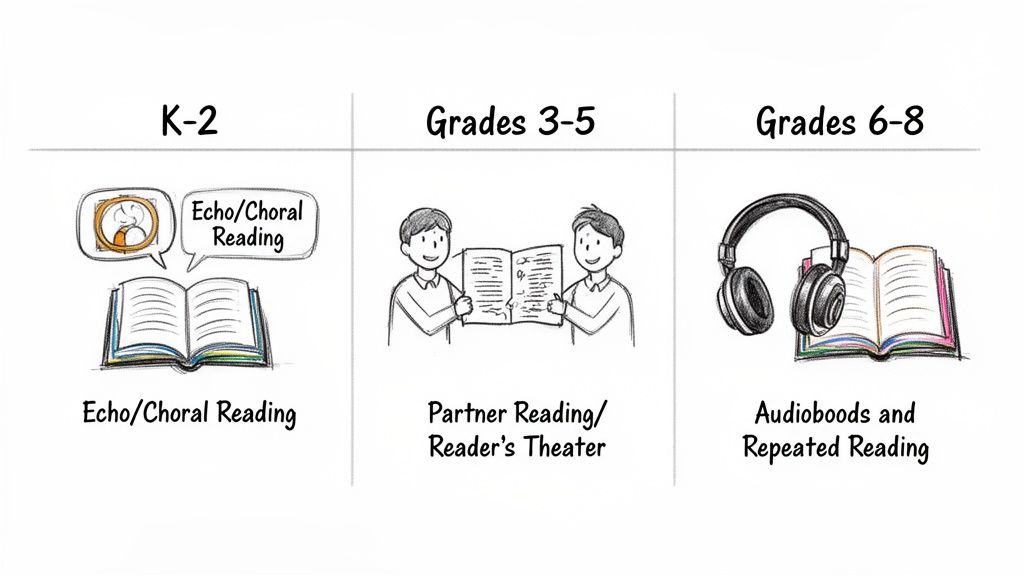
Theory is one thing, but real progress is made in the doing. The right activities can turn fluency work from a chore into something genuinely fun and dynamic. The secret is to match the strategy to the reader's developmental stage, making sure the task is supportive but still offers a healthy challenge.
You want to provide just enough scaffolding to build confidence without taking away the chance for them to stretch and grow. Here’s a toolkit of proven methods, broken down by grade level, that you can use to help every reader find their flow.
Foundational Fun for Early Readers (K-2)
For our youngest readers, fluency activities need to feel like play. The main goal here is modeling good reading, getting in lots of repetition, and building a happy, positive connection to reading out loud. Keep sessions short and sweet—just a few minutes at a time is often all you need.
A simple but incredibly powerful technique is Echo Reading. As the fluent reader, you read a short sentence or phrase from a book with plenty of expression. The child then immediately reads it back to you, like an echo, trying to match your pacing and tone.
This takes all the pressure off of decoding and lets the child zero in on what fluent reading sounds like. It's a fantastic way to introduce the music of language, or prosody, right from the start.
Another great one is Choral Reading, where you and the child read the same text aloud together. This works especially well with predictable books that have lots of rhymes or repeating lines. Think of those classic stories with a recurring chorus—kids quickly learn to anticipate it and join in with growing confidence.
Key Takeaway: For K-2 students, it's all about exposure and imitation. By hearing and repeating fluent reading in a low-stakes setting, they build the essential auditory and oral skills for independent fluency down the road.
Building Confidence with Intermediate Readers (Grades 3-5)
By the intermediate grades, students are ready for more independence. The activities for this age group shift toward collaborative and performance-based work, which can be incredibly motivating for them.
Partner Reading is a classroom staple for a reason—it works. You simply pair students up to take turns reading a text aloud to one another. It’s valuable practice time and helps foster a sense of shared responsibility.
To make it successful, be sure to:
- Model it first: Show students what it looks like to offer gentle, helpful feedback.
- Give them roles: One student can be the "Reader" while the other is the "Coach," ready to help with tricky words.
- Have them switch: Ask pairs to reread the same paragraph but swap roles to really build that automaticity.
Reader's Theater is another fantastic activity. Students get to rehearse and perform a script based on a story. This isn't about fancy costumes or sets; the focus is on using their voices to bring characters and emotions to life. Reading a script over and over for a performance is a natural—and fun—way to get that fluency practice in.
Mastering Complexity with Older Readers (Grades 6-8)
For middle schoolers who are tackling much more complex academic texts, fluency strategies have to evolve. At this stage, the link between reading smoothly and understanding deeply becomes absolutely critical.
Repeated Reading is one of the most heavily researched and validated strategies out there. The idea is simple: a student reads a short, meaningful passage (about 100-200 words) several times until they hit a specific fluency goal.
The evidence for this method is powerful. A major 2017 meta-analysis found that Repeated Reading interventions boosted words read correctly per minute (WCPM) by 1.41 standard deviations. One study with struggling middle schoolers saw immediate WCPM gains of 81.7%, 61.8%, and 51.5% on the passages they practiced, and those skills carried over to new texts.
Another highly effective approach is using appropriately leveled materials, like Spanish graded readers, to progressively build students' skills and confidence.
Using Audiobooks as a Model is also a game-changer. Have a student listen to a chapter read by a professional narrator while they follow along in their book. This provides a perfect model of prosody. Afterward, ask them to read a favorite paragraph aloud, trying to copy the narrator's style. Don't forget that modern tech can be a great partner in this; check out our guide on the best reading apps for kids for more tools to support fluency.
Targeted Fluency Strategies for Middle Schoolers
Middle school is a different ballgame. The reading material gets denser, the vocabulary becomes far more complex, and the academic stakes are suddenly much higher. If a student is still struggling with reading fluency, this leap can feel like hitting a brick wall.
The generic activities that worked in elementary school often fall flat here. We need targeted, age-appropriate strategies that respect their growing maturity and get straight to the point of their specific needs.
Getting buy-in from the student is the first, and often trickiest, hurdle. Many middle schoolers feel "too old" for read-aloud practice. The key is to reframe the goal entirely. It’s not about "reading like a little kid"; it's about mastering a skill essential for crushing it in high school and beyond. Frame fluency as the key that unlocks faster, deeper understanding of everything from science textbooks to historical documents.
A Proven Protocol for Older Readers
One of the most effective ways I've seen to improve reading fluency for this age group is through a structured, multi-faceted approach. A daily 20-minute session that blends repeated reading with vocabulary and goal-setting can produce some seriously impressive gains. This isn't just about reading the same thing over and over—it's a purposeful routine with a clear objective.
A recent yearlong study really highlighted the power of this kind of intervention. Researchers tested a protocol on sixth graders that combined Repeated Reading with word-level strategies and culturally relevant passages. The students who were below the 50th percentile in reading efficiency showed statistically significant gains.
With nearly 70% of U.S. eighth graders lacking proficiency according to 2022 NAEP scores, this shows that focused interventions truly make a real difference. You can read the full research about these promising fluency findings to dig into the data.
Structuring a 20-Minute Fluency Session
To make this work in your classroom or at home, consistency is everything. Here’s a simple way you can structure a daily practice session for maximum impact:
-
Select a High-Interest Text: Find a passage of about 150-250 words from a book or article the student actually finds interesting. This is non-negotiable. Young adult novels, articles about their hobbies, or even song lyrics can work wonders. Check out our guide on compelling books for middle schoolers to read for some great ideas.
-
Set a Personal Goal: Start with a one-minute timed reading to get a baseline WCPM (Words Correct Per Minute). Then, sit down with the student to set a realistic improvement goal for the end of the session or week. Giving them this ownership is crucial for motivation.
-
Conduct Repeated Readings: Have the student read the passage aloud three to four times. After each reading, provide brief, specific feedback. I find it helps to focus on one element at a time—maybe accuracy on the first read-through, and then expression on the next.
The goal of repeated reading isn't just speed; it's comfort. Each repetition builds automaticity, freeing up the reader's mental energy to focus on the meaning and emotion behind the words.
This routine does more than just build the technical skills of fluency—accuracy, rate, and prosody. It empowers students. It gives them a clear, manageable process to see their own growth, turning a point of frustration into a source of real accomplishment.
How to Measure and Track Fluency Progress
To get a reader where they need to go, you first have to know where they're starting. Working on reading fluency without a clear way to measure progress can feel like wandering in the dark.
Thankfully, you don’t need any fancy equipment. A timer, a grade-level reading passage, and a few minutes of focused time are all it takes to get a solid baseline and track growth from there.
The go-to metric here is Words Correct Per Minute (WCPM). It’s a simple calculation that cuts through the guesswork and gives you a concrete number, a snapshot of a reader's accuracy and speed. It’s also an incredibly powerful way to see the results of practice and celebrate those small but mighty wins.
Calculating Words Correct Per Minute
Calculating WCPM is a straightforward process you can easily do at home or in the classroom. Think of it as a friendly check-in, not a high-stakes test. It creates a consistent benchmark that makes it easy to see progress over weeks and months.
Here’s a quick rundown of how to do a one-minute reading:
- Find a Passage: Grab a new, unpracticed text at the student's independent reading level. Most graded reading materials will tell you the word count.
- Time It: Set a timer for exactly one minute. Have the student start reading when you say "go."
- Count Errors: Follow along on your own copy and mark any mistakes, but try not to interrupt the reader's flow.
- Do the Math: When the timer goes off, see how many total words they read. Subtract the number of errors to get the WCPM score.
The formula is simple: (Total Words Read in One Minute) - (Number of Errors) = WCPM
So, what counts as an error? Keep it simple: mispronounced words, substitutions (like reading “house” for “horse”), skipped words, or any word you have to supply after a three-second pause. Don't count self-corrections as errors! In fact, when a student catches their own mistake and fixes it, that’s a fantastic sign that they’re paying attention to meaning.
This simple process gives you a vital piece of data. It’s all about creating a positive cycle of improvement: picking good stories, practicing them, and then setting new goals.
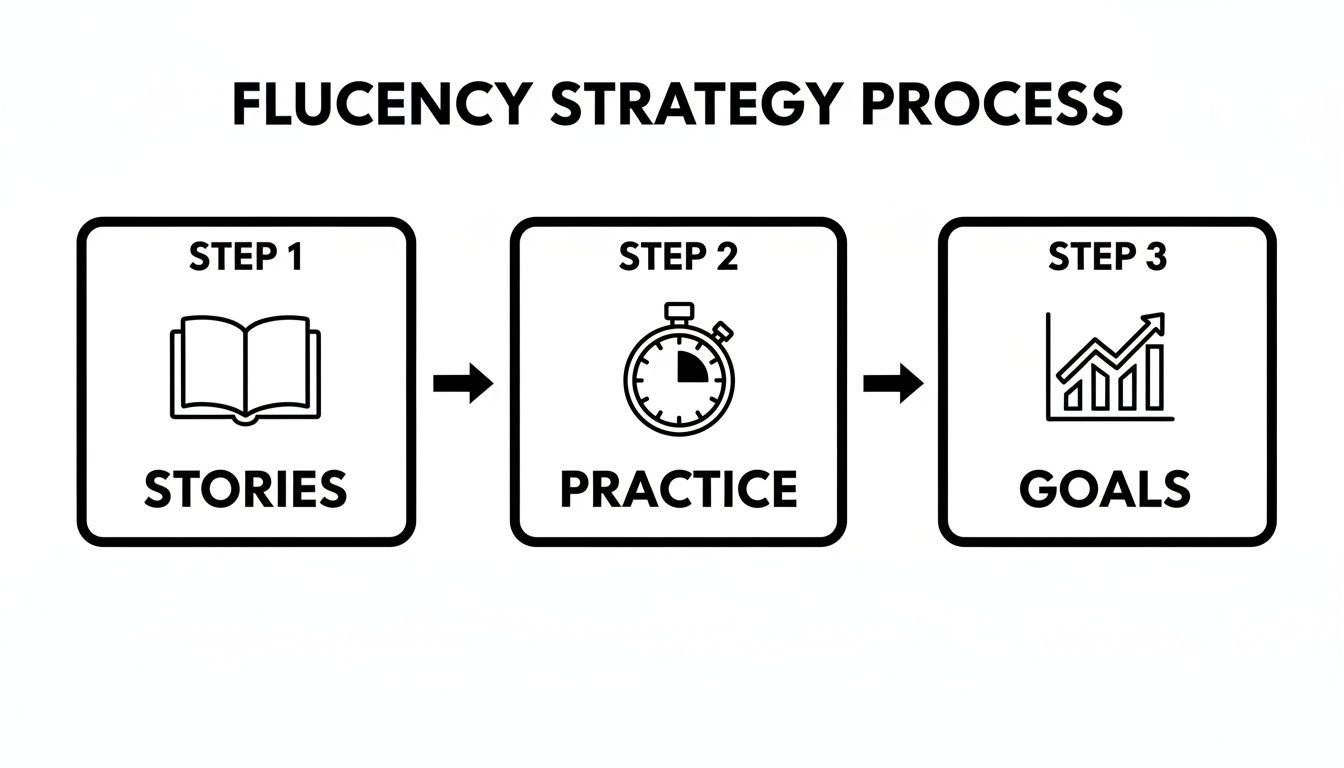
This workflow is clear and repeatable. You start with engaging stories, move into consistent practice, and use the data to set measurable goals.
What Do the Numbers Mean?
Once you have a WCPM score, you might wonder what to do with it. Research has consistently shown a strong link between fluency and overall reading success. A massive study of over 110,000 students found that while fluent readers hit a median of 114 WCPM, the bottom 25% of readers were stuck at just 72 WCPM.
There’s also a powerful correlation (0.68) between fluency and comprehension scores. This tells us that measuring and improving WCPM isn't just about speed—it’s about unlocking understanding.
To get a sense of where a student stands, it helps to have some benchmarks. These numbers from Hasbrouck & Tindal are based on oral reading fluency norms and represent the 50th percentile for students at different points in the school year.
Grade-Level Reading Fluency Goals (WCPM)
This table provides general benchmarks for Words Correct Per Minute (WCPM) to help you gauge your child's progress against typical expectations for the end of each school year.
| Grade Level | Fall WCPM | Winter WCPM | Spring WCPM |
|---|---|---|---|
| 1 | - | 23 | 53 |
| 2 | 51 | 72 | 89 |
| 3 | 71 | 92 | 107 |
| 4 | 94 | 112 | 123 |
| 5 | 110 | 127 | 139 |
| 6 | 127 | 140 | 150 |
| 7 | 128 | 136 | 150 |
| 8 | 134 | 146 | 151 |
Remember, these are just averages. Every reader develops at their own pace, but these numbers can be a helpful guidepost as you track their journey.
By tracking WCPM, you're not just counting words; you're measuring the reader's growing ability to access meaning. Each increase in the score reflects a brain that is becoming more automatic in its decoding, freeing up precious cognitive resources for understanding.
Don't Forget to Listen for Prosody
Numbers are a huge help, but they don't tell the whole story. The "music" of reading—prosody—is just as important. Are they pausing at commas? Does their voice rise when they read a question? Are they reading with feeling that matches the story?
This is the qualitative side of fluency, and you can track it with a simple rubric. Just create a little checklist to listen for specific things:
- Pacing: Does the reading sound natural, like someone talking?
- Phrasing: Are they grouping words into meaningful chunks, or is it choppy and word-by-word?
- Expression: Does their voice match the characters' emotions and the story's mood?
- Punctuation: Are they noticing and responding to commas, periods, and question marks?
As you track these different elements, it's a great idea to implement effective progress report templates to share what you’re seeing with students and parents.
Pairing the hard data from WCPM with these thoughtful observations gives you a complete picture of a reader’s progress. It helps you zero in on exactly what they need to work on next.
Creating a Reading Environment That Fosters Fluency
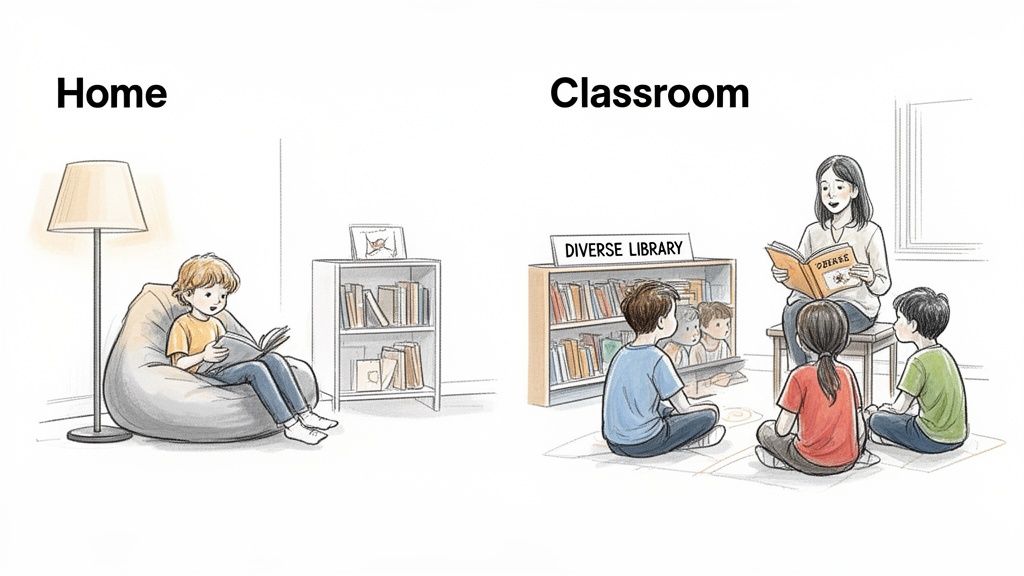
The most effective fluency exercises can easily fall flat if they feel like a chore. Real, lasting progress happens when reading is woven into the fabric of a child's daily life—not as a drill, but as a celebrated activity. Creating that kind of supportive, engaging environment is just as crucial as the practice itself.
Whether at home or in a classroom, the goal is the same: build a culture where books are treasures and reading aloud feels natural. This positive association is the secret ingredient that makes a child want to practice, transforming fluency work from a task into a treat.
For Parents Nurturing Fluency at Home
As a parent, your most important job is to be a reading champion. You don't need a teaching degree; you just have to model a genuine love for stories and create a space where your child can explore them without any pressure.
One of the simplest things you can do is create a cozy reading nook. It doesn’t have to be anything fancy. A corner with a comfy chair, a beanbag, and a basket of books is absolutely perfect. This special spot sends a clear message that reading is a valuable and relaxing way to spend time.
Another game-changer is building a family read-aloud routine. Even just 15 minutes a night can make a world of difference. When you read to your child, no matter their age, you’re providing a perfect model of what fluent reading actually sounds like. They hear your expression, your pacing, and your natural pauses, creating a mental blueprint they can later imitate in their own reading.
Your enthusiasm is contagious. When you talk about a book you're reading with genuine excitement or laugh out loud at a funny part, you send a clear message: reading is a source of joy and connection.
Finally, fill your home with a variety of high-interest books. The right book can make a reluctant reader completely forget they're even "practicing."
- Graphic novels: These are fantastic for fluency. The dialogue-heavy format naturally encourages expressive reading as kids act out the different parts.
- Magazines about their hobbies: Whether it's video games, animals, or sports, these texts are incredibly motivating.
- Series books: Getting a child hooked on a series is a huge win. It encourages binge-reading, which provides a massive amount of natural, sustained practice.
For Educators Fostering Fluency in the Classroom
In the classroom, the challenge is a bit different. You need to seamlessly integrate fluency practice into a packed schedule while supporting a whole range of readers. The key is to make it a consistent, low-stakes part of your daily routine.
Your classroom library is the foundation. Make sure it’s diverse and inviting, with books that represent various cultures, genres, and, of course, reading levels. When students can see themselves and their interests reflected on the shelves, they are far more likely to pick up a book on their own.
Positive reinforcement is your most powerful tool here. It’s all about celebrating effort over perfection. Instead of only praising a flawless performance, try saying things like, "I loved how you made your voice sound just like the character!" or "You fixed that word all by yourself—great job!" This builds the confidence that struggling readers desperately need to take risks.
Try weaving fluency practice into the small moments of your day:
- Warm-ups: Kick off your reading block with a quick choral read of a fun poem or a familiar short passage.
- Transitions: Have students partner-read a single paragraph while they're waiting for the next activity to begin.
- Choice: Give students options in how they practice. Let them choose between reading to a partner, recording themselves on a tablet, or even reading to the classroom pet.
By making reading a celebrated, shared, and supportive activity, you create an environment where every student feels safe enough to find their voice. That safety is what allows them to build the skills they need to become confident, fluent readers.
Of course. Here is the rewritten section, crafted to sound like it was written by an experienced human expert and matching the provided style examples.
Common Questions About Reading Fluency
As you dive deeper into helping your child with reading fluency, you’re bound to have questions. It’s a journey with a lot of nuance, and it's completely normal to wonder if you’re on the right track. Let’s tackle some of the most common questions we hear from parents and educators to give you the confidence you need.
Getting these details right helps you shape your approach, making sure your practice sessions are both effective and encouraging.
How Long Should We Practice Fluency Each Day?
When it comes to building fluency, consistency always trumps duration. I’ve seen many parents surprised to learn that long, drawn-out sessions aren't just unnecessary—they can actually backfire. The real goal is to build skills without letting frustration or burnout creep in.
Short, frequent sessions are far more effective. For most younger students, aiming for 10-15 minutes of focused practice, about three or four times a week, really is the sweet spot. For older students in middle school, the daily 20-minute routine we talked about earlier can produce fantastic results.
The most important rule? Keep it positive. It's always better to stop before your child gets tired or discouraged. Mixing up the activities—maybe Repeated Reading one day and some fun Paired Reading the next—also keeps things fresh.
My Child Reads Fast But Doesn't Understand a Thing
This is an incredibly common and important issue. It's a classic sign that the focus has accidentally shifted too much onto speed, leaving accuracy and—most critically—prosody behind. True fluency is the bridge to comprehension. If understanding isn't there, the bridge isn't finished.
The best way to fix this is to immediately shift your focus to expressive, meaningful reading.
- Model It: Read a sentence from their book with plenty of feeling and then have them echo you, trying to match your tone and emotion.
- Use Character Voices: Encourage them to read a line of dialogue as if they were the character. Ask them, "How do you think the giant would sound? What about the little mouse?"
- Pause and Ask: After a paragraph, ask a simple, low-pressure question like, “Who was that mostly about?” or “What do you think will happen next?”
These little adjustments gently reconnect the act of reading with its true purpose: making meaning from the words on the page.
What's the Difference Between Phonics and Fluency?
This is a fantastic question because it gets right to the heart of how reading skills are built. Phonics and fluency are deeply connected, but they represent two very different stages in a reader's journey.
Phonics is all about decoding. It’s the foundational skill of connecting letters to their sounds to figure out individual words. It's the mechanics—knowing what "c-a-t" says.
Fluency is about automaticity and expression. It's the ability to read those words without stumbling, at a natural pace, and with the rhythm of real speech. A child has to have solid phonics skills before they can even begin to build fluency.
I like to think of it like learning to drive a car. Phonics is learning what the pedals do and how to turn the steering wheel. Fluency is when you can do all of that without thinking, so you can focus on the road ahead and actually enjoy the drive.
Can Audiobooks Help Improve Reading Fluency?
Absolutely. Audiobooks are a powerful—and often overlooked—tool for modeling what excellent fluency sounds like. They provide a perfect auditory blueprint for prosody, which can be tough to explain but is easy to understand once you hear it.
When a child follows along in a physical book while listening to a skilled narrator, they’re essentially getting a reading lesson. They hear a perfect example of pacing, pausing, and how to put emotion into the text. This kind of passive learning is incredibly valuable.
To make it more active, you can encourage them to read a favorite paragraph aloud right after listening to it. This "listen first, then read" approach helps them immediately practice what they just heard, building both their skills and their confidence.
At Number 6 Publishing, we believe that the right story can ignite a lifelong passion for reading. Explore our collection of heartfelt children’s and young adult books designed to connect with readers and make practice a joy, not a chore. Find your next reading adventure with us.