
Remember the classic book report? A single sheet of paper, a few sentences about the plot, and a simple drawing of the main character. While valuable, the world of reading comprehension has blossomed, offering far more dynamic ways to engage young minds. For 2nd graders, who are solidifying their foundational reading skills and developing a personal love for stories, the right project can transform a book from a simple assignment into a memorable adventure. Creative book reports invite young readers to step inside the narrative, connect with characters, and express their understanding in ways that resonate with their unique learning styles. They build confidence, foster critical thinking, and, most importantly, make reading fun.
This guide offers seven fresh and engaging book report ideas for 2nd grade, designed specifically for parents, teachers, and homeschoolers. Each idea moves beyond the standard format to encourage creativity, deep thinking, and a genuine connection to literature. Whether your reader is a budding performer, a hands-on builder, or a quiet artist, you'll find an activity here that sparks their imagination and showcases their understanding in a meaningful way. We'll provide step-by-step guidance, differentiation tips for diverse learners, and practical examples to get you started.
1. Character Costume and Performance Book Report
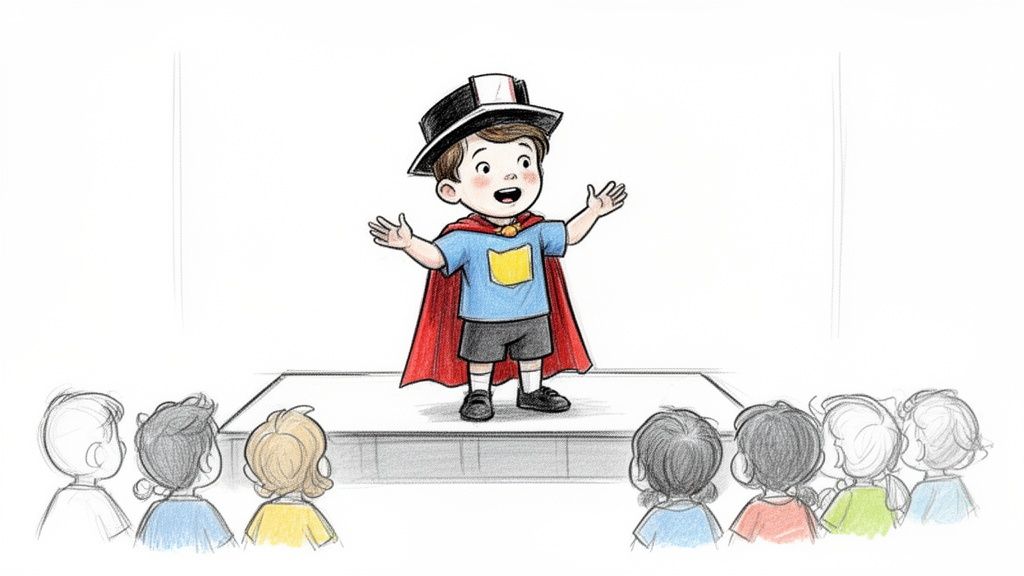
This imaginative book report idea for 2nd grade lets students step directly into the shoes of their favorite characters. Instead of a traditional written summary, children dress up as a character from their book and perform a short monologue or skit. This hands-on approach encourages them to think deeply about a character's personality, motivations, and journey, demonstrating their comprehension through creative expression.
Why It Works for 2nd Graders
At this age, children are natural performers and benefit greatly from kinesthetic learning, which connects physical action with understanding. Embodying a character helps them grasp complex themes like empathy and emotional growth in a tangible way. It's a fantastic alternative for students who may find writing challenging but excel at storytelling and creative play.
How to Implement It
Getting started is simple. Guide your student to think like their character by asking targeted questions.
- Who are you? (State the character's name and role in the story.)
- Where are you from? (Describe the setting.)
- What is your biggest challenge? (Explain the main conflict from their perspective.)
- How did you change? (Share what the character learned or how they grew.)
Provide a simple worksheet with these prompts to help them organize their thoughts into a 2-3 minute presentation. You can find excellent character choices in some of the best read-aloud books for 2nd grade, which often feature relatable protagonists.
Pro-Tip: Offer the choice to perform live or record a video. This empowers shy students to participate fully and allows all children to practice and perfect their performance.
For example, a child could dress as Peter from The Snowy Day, describing the joy and wonder of his adventure. Another might portray Grace from Amazing Grace, sharing her determination to land the lead role in the school play. By becoming the character, they present the book's core message in a memorable and personal way.
2. Book in a Box Project
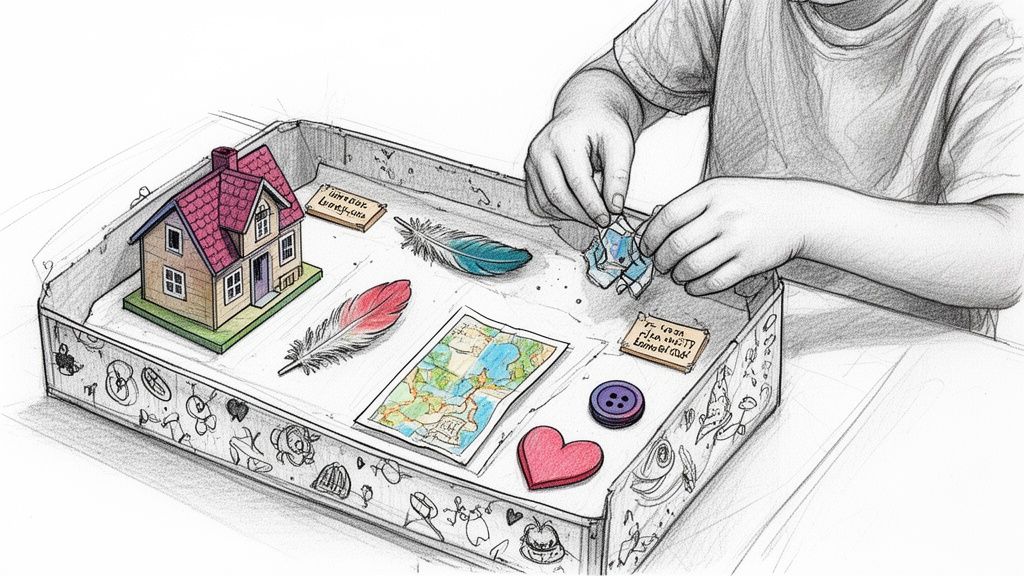
The Book in a Box project is a tactile and highly visual book report idea for 2nd grade that transforms a simple shoebox into a treasure chest of story elements. Students decorate a box to represent the book's setting or theme and fill it with 5-7 items that symbolize key characters, objects, or plot points. This hands-on method helps them distill a story down to its most essential parts, reinforcing comprehension through tangible creation.
Why It Works for 2nd Graders
Second graders are concrete thinkers who learn best when they can connect abstract ideas to physical objects. Curating items for their box requires them to analyze the story, identify what is most important, and justify their choices. It’s an excellent project for developing critical thinking and summarization skills without the pressure of a long written report. This approach also caters to artistic and kinesthetic learners.
How to Implement It
To get started, provide students with a simple planning template. Encourage them to brainstorm items before they start gathering or creating them.
- Choose 5-7 key items: What objects were important to the story? What could represent a character or a big feeling?
- Write a short explanation for each: Why did you choose this item? What part of the story does it represent?
- Decorate the outside: How can the box’s exterior show the book's setting or mood?
- Prepare to share: Practice explaining each item to a friend or family member.
Using a title from an engaging 2nd grade book list can provide a strong foundation for this creative project.
Pro-Tip: Have students create small, written labels for each item inside the box. This reinforces writing skills and helps them remember the significance of each object when they present their project to the class or small groups.
For example, a box for Frog and Toad Are Friends might contain a letter, two clay figures of the main characters, a swimsuit, and a bag of "lost" buttons. For a book like A Complicated Journey, a student could include items representing key emotional milestones, such as a hand-drawn map showing the path from sadness to hope. The finished projects make a wonderful classroom display, showcasing each student's unique interpretation of their book.
3. Illustration and Caption Series
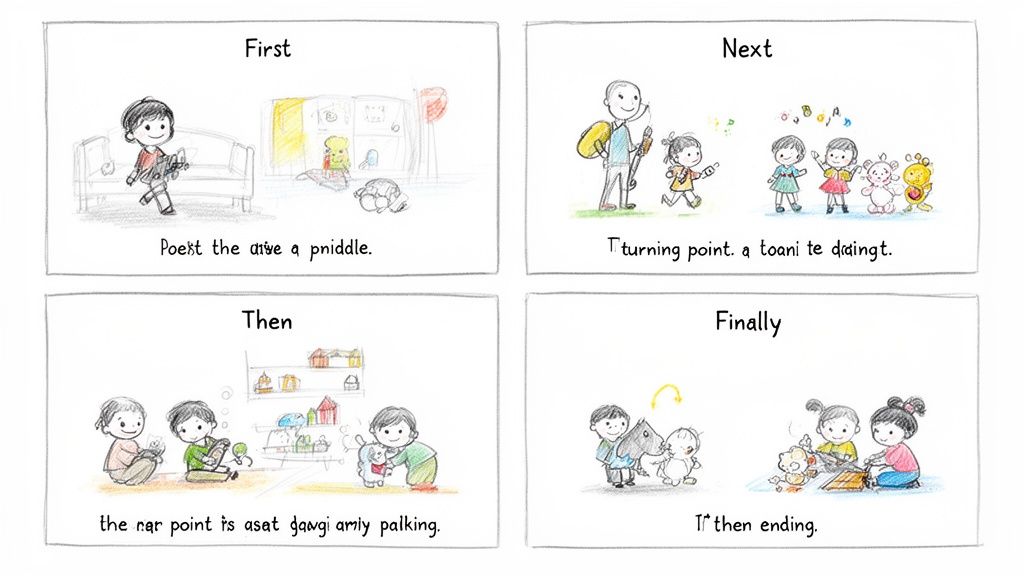
This visual book report idea for 2nd grade taps into a child's natural love for drawing to demonstrate comprehension. Students create a series of 4-6 illustrations that depict the main events of their story in sequential order. Each picture is accompanied by a short written caption, blending artistic expression with essential writing practice.
Why It Works for 2nd Graders
Second graders are rapidly developing their ability to sequence events and identify key plot points like the beginning, middle, and end. This project makes the abstract concept of story structure concrete and visible. It’s an excellent choice for visual learners and provides a low-pressure way for emerging writers to practice constructing sentences.
How to Implement It
Set your student up for success by providing a clear framework for their visual story.
- Plan the sequence: Before drawing, help your child identify 4-6 of the most important moments in the book.
- Sketch the scenes: Encourage them to draw one key event in each box. Focus on conveying the idea, not on artistic perfection.
- Write the captions: Under each illustration, have them write a simple sentence describing what is happening in the picture.
- Add details: Finally, they can add the book title and author's name to complete the report.
Provide sentence starters like "First…," "Next…," "Then…," and "Finally…" to guide their caption writing and reinforce the concept of story progression.
Pro-Tip: Offer a pre-made template with boxes for the illustrations and lines for the captions. This structure helps students organize their thoughts and focuses their energy on the content of the story rather than the layout.
For example, a student reading A Complicated Journey by Cale Atkinson could create a six-image sequence showing the main character's journey from start to finish. Another might make a story wheel for Eleanor the Mockingbird, with illustrations of her key actions radiating from the center. This project allows students to proudly display their understanding in a format that feels more like art than work.
4. Story Puzzle or Wheel Report
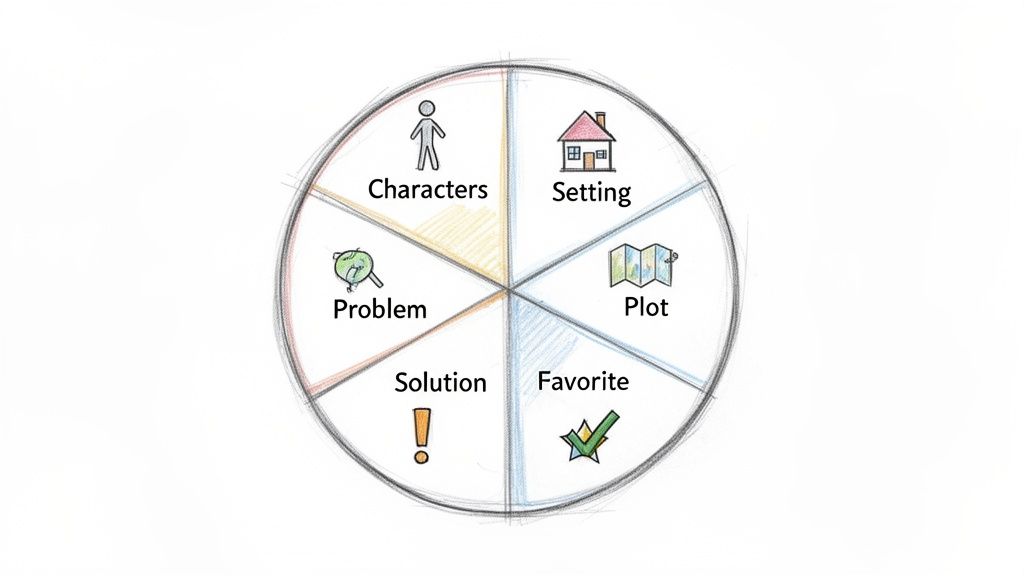
This book report idea for 2nd grade turns a traditional summary into a hands-on, visual mapping exercise. Students create a circular "wheel" or a puzzle-piece format where each section represents a key story element: characters, setting, problem, solution, and their favorite part. This geometric approach helps them organize multiple components of a book into a single, cohesive visual that is perfect for young, analytical minds.
Why It Works for 2nd Graders
Second graders are learning to deconstruct stories and identify their core components. The segmented format of a wheel or puzzle visually reinforces the idea that all these parts work together to create a whole story. It’s an excellent tool for visual learners and helps children practice summarizing information concisely, using a mix of drawings and short sentences.
How to Implement It
Provide a template to help students focus on content rather than on drawing the structure. Label each segment clearly and guide them with simple prompts for each section.
- Characters: Who are the main people or animals in the story?
- Setting: Where and when does the story take place?
- Problem: What is the main challenge the characters face?
- Solution: How is the problem solved at the end?
- Favorite Part: What was your favorite moment and why?
Encourage students to color-code each section for better organization and visual appeal. For those interested in digital options, platforms like Lumi H5P Cloud can be utilized to create interactive story puzzles or wheel reports.
Pro-Tip: Create a classroom gallery walk where students can view each other's completed wheels. This encourages peer-to-peer learning and gives them a chance to discuss different interpretations of the same book.
For example, a student reading A Complicated Journey could create a problem-solution wheel showing the obstacles and resolutions in separate segments. Another might make a character puzzle for Eleanor the Mockingbird, with each puzzle piece dedicated to a different character and their relationship to the protagonist. This format makes literary analysis accessible and engaging.
5. Letter or Postcard Writing Report
This book report idea for 2nd grade taps into a classic form of communication to build a personal connection with a story. Instead of a standard summary, students write a letter or postcard either to a character, from a character, or to the author. This format encourages them to think critically about the story's events and express their understanding through authentic, purpose-driven writing.
Why It Works for 2nd Graders
Second graders are developing their writing skills and learning about different forms of communication. Writing a letter is a practical, real-world skill that feels more engaging than a simple summary. It allows them to step into the story, offer advice, ask questions, or share their feelings, which deepens their comprehension and helps them organize their thoughts in a structured yet creative way.
How to Implement It
Start by teaching the basic parts of a friendly letter (date, greeting, body, closing, signature). Then, provide students with a clear choice and guiding prompts.
- Writing to a character: "Dear [Character Name], I am writing to you because..."
- Writing from a character: "Hi! My name is [Character Name]. I want to tell you about..."
- Writing to the author: "Dear [Author Name], I really loved when..."
Give students postcard templates or decorative paper to make the activity feel special. A student reading about Eleanor in Eleanor could write her a letter about how to be brave. Another might write a postcard from a character in Down Home, describing their favorite family memory from the book.
Pro-Tip: Display a large poster showing the correct letter format as a visual guide. Offer sentence starters like "I wonder why you..." or "You made me feel..." to help students who struggle with getting started.
This approach transforms a book report into a meaningful dialogue. For an exciting extension, you can even look up the author's contact information (often available on their website) and mail the letters. Getting a reply, even a form letter, can be an incredibly motivating experience for a young reader and writer.
6. Book Review or Recommendation Badge System
This engaging book report idea for 2nd grade turns students into book critics, allowing them to share their opinions through a visual and easily digestible format. Children create a decorative badge, star, or seal to rate the book they read. The badge includes key details like the title and author, a simple rating system (like stars or smiley faces), and a short sentence explaining their review. It's a fantastic way to teach critical evaluation and build a community of readers.
Why It Works for 2nd Graders
Second graders are beginning to form their own opinions and love to share what they think. This project channels that enthusiasm productively, teaching them how to justify their likes and dislikes in a concise way. Creating a visual badge is a low-pressure, artistic activity that appeals to creative learners and provides a tangible sense of accomplishment. It’s an excellent method for building a classroom culture where peer recommendations are valued.
How to Implement It
You can easily introduce this system with a few simple resources. Provide badge templates and sentence starters to guide students.
- Choose a Rating: Use a 1-5 star system, smiley faces, or a simple thumbs-up/down.
- Explain the "Why": Ask them to complete a sentence like, "I give this book ___ stars because..." or "I recommend this book to friends who like..."
- Design the Badge: Encourage students to decorate their badge with colors and drawings that reflect the book's theme.
Display the completed badges on a classroom "Book Wall" or "Recommendation Board." This creates an interactive display that encourages students to browse peer-approved titles and discover their next favorite read.
Pro-Tip: Create a class-wide goal, like seeing which book receives the most "five-star" badges by the end of the month. This adds a fun, collaborative element and helps highlight the most-loved books in your classroom library.
For example, a student might create a gold star badge for Eleanor the Mockingbird, writing, "I loved this book because Eleanor learns to be brave." Another could design a thumbs-up badge for a popular adventure story, recommending it to anyone who likes exciting mysteries. This simple system makes sharing opinions fun and accessible for every student.
7. Book-to-Self Connection Journal or Drawing
This deeply personal book report idea for 2nd grade helps students see themselves in the stories they read. Instead of summarizing the plot, children create a journal entry or a drawing that explores how the book connects to their own lives, feelings, and experiences. This reflective approach builds emotional literacy and reinforces the powerful idea that books can be mirrors.
Why It Works for 2nd Graders
Second graders are developing a greater sense of self and are beginning to understand empathy on a deeper level. Connecting a story to their own life makes reading more meaningful and memorable. This method validates their personal feelings and experiences, showing them that their responses to a story are important. It’s an excellent way to boost engagement for students who thrive on introspection and self-expression.
How to Implement It
Guide your student’s reflection with gentle, open-ended prompts. You can offer a simple worksheet or a dedicated journal for their responses.
- How are you similar to one of the characters? (Think about personality, actions, or feelings.)
- When have you ever felt the same way the character felt? (Describe a time you felt happy, sad, scared, or brave like them.)
- What did this story make you think about in your own life? (Did it remind you of a family member, a pet, or a special place?)
- How did the book help you understand something new? (Did you learn about a different perspective or a new idea?)
Encourage students to choose whether they want to write a few sentences or draw a picture to answer a prompt. This choice allows them to express themselves in the way they feel most comfortable, strengthening their overall reading comprehension skills by focusing on personal meaning.
Pro-Tip: Emphasize that there are no "right" or "wrong" answers. The goal is personal reflection, so create a safe space where students feel comfortable sharing their connections without judgment, perhaps in a private journal that is only shared if they volunteer.
For instance, a child reading Alexander and the Terrible, Horrible, No Good, Very Bad Day might draw a picture of a time they felt grumpy and everything seemed to go wrong. Another could write a journal entry comparing their own first-day-of-school nerves to the character’s in The Kissing Hand. For more elaborate journals or multi-page drawing series, you might explore how to print a book from Word to create a lasting keepsake of their reflections.
Comparison of 7 Book Report Ideas for 2nd Grade
| Activity | Implementation (🔄) | Resources (⚡) | Expected Outcomes (⭐ 📊) | Ideal Use Cases (💡) | Key Advantages |
|---|---|---|---|---|---|
| Character Costume and Performance Book Report | Moderate–High 🔄 — requires rehearsal, staging, and time management | Costumes/props, classroom space, parent help; prep time ⚡ (moderate) | High engagement; oral language, character insight, memory recall ⭐📊 | Character-driven, emotionally rich stories; in-person performances 💡 | Builds confidence and public speaking; kinesthetic learning |
| Book in a Box Project | Moderate 🔄 — planning item lists and presentation slots | Shoeboxes/containers, found objects, basic craft supplies; may need parent-sourced items ⚡ | Strong synthesis of themes and symbolism; concrete representation of ideas ⭐📊 | Books with important objects, themes, or rich sensory detail 💡 | Promotes critical thinking, reusable/displayable, budget-friendly |
| Illustration and Caption Series | Low–Moderate 🔄 — provide templates and sequencing guidance | Paper, pencils/markers; minimal materials ⚡ (low) | Clear demonstration of sequence and plot; supports early writing skills ⭐📊 | Stories with clear, linear plot progression 💡 | Low-pressure, easy to assess, minimal prep |
| Story Puzzle or Wheel Report | Moderate 🔄 — teacher prepares templates and color-coding system | Printed templates, coloring tools, optional lamination ⚡ | Organized overview of story elements; supports discussion and recall ⭐📊 | Books with distinct characters, settings, conflicts; class discussions 💡 | Scaffolded format, tidy display, accommodates varied writing levels |
| Letter or Postcard Writing Report | Low–Moderate 🔄 — requires instruction on letter format and prompts | Paper/postcard templates, sentence starters; conferencing time ⚡ | Develops perspective-taking and authentic writing purpose; reflection ⭐📊 | Character-focused stories and emotional dilemmas; author outreach 💡 | Builds empathy, real audience, easily differentiated |
| Book Review or Recommendation Badge System | Low 🔄 — quick templates and rating procedure | Badge templates, craft supplies, display area ⚡ (fast) | Teaches opinion formation; builds classroom reading culture (peer recommendations) ⭐📊 | Any classroom library book; quick end-of-unit reflection 💡 | Fast to complete, shareable, encourages peer choice |
| Book-to-Self Connection Journal or Drawing | Low–Moderate 🔄 — needs sensitive facilitation and prompts | Journals, drawing tools, private sharing space ⚡ | Strengthens SEL, personal relevance, and reflective comprehension ⭐📊 | Emotionally resonant stories; SEL-focused lessons 💡 | Promotes self-awareness, flexible formats, informs instruction |
Fostering a Lifelong Love of Stories
Moving beyond the traditional written summary is the key to unlocking a second grader's enthusiasm for reading. The diverse array of book report ideas for 2nd grade explored in this guide, from crafting a detailed "Book in a Box" to designing an imaginative Story Puzzle, serves a purpose far greater than simply assessing comprehension. These projects are strategic tools for building confidence, celebrating individual creativity, and forging a positive, lasting relationship with literature. By offering choices, you empower young readers to take ownership of their learning and connect with stories on a deeply personal level.
The true value of these creative alternatives lies in their ability to cater to different learning styles and strengths. A student who thrives on performance can shine with a Character Costume presentation, while a more introspective child might find their voice through a heartfelt letter to the author or a private Book-to-Self Connection Journal. Each project validates a unique way of processing and sharing information, transforming what could be a chore into an exciting opportunity for self-expression.
Key Takeaways for Inspiring Young Readers
To make these ideas truly effective, remember these core principles:
- Choice is Paramount: Always offer a few different project options. This simple act of providing agency can dramatically increase a child's motivation and engagement with both the book and the report.
- Process Over Perfection: For 2nd graders, the goal is to encourage effort, creativity, and a genuine attempt to engage with the story's themes. Focus on celebrating their unique interpretations rather than demanding flawless execution.
- Connection is the Goal: The most memorable book reports are those that allow students to link the story's characters, settings, and problems to their own lives. Encourage projects that facilitate these personal connections.
- Make it a Celebration: Frame the sharing of book reports as a celebration of reading. Create a "gallery walk" for visual projects or a "story showcase" for performances to build a positive and supportive classroom or home learning culture.
By implementing these engaging and multidimensional book report ideas for 2nd grade, you are not just teaching literary analysis; you are nurturing future lifelong readers. You are showing them that books are more than words on a page. They are gateways to new worlds, new perspectives, and a deeper understanding of themselves. The ultimate goal is to help them discover the joy of getting lost in a good story and the pride that comes from sharing that experience with others.
Ready to find the perfect story to inspire your next creative book report? Explore the imaginative and emotionally rich collection of children's books at Number 6 Publishing. Our titles are crafted to spark curiosity and provide the ideal foundation for projects that bring stories to life. Discover your next favorite read at Number 6 Publishing today