
Welcome, educators and caregivers! In a kindergarten classroom, a shared story isn't just a way to pass the time; it's a powerful tool for building community, vocabulary, and a lifelong love of reading. The magic of a read-aloud lies in the shared experience: the collective gasps, the infectious giggles, and the thoughtful questions that follow. It’s where abstract concepts like empathy, courage, and friendship take shape through memorable characters and captivating plots.
But with endless shelves of options, how do you choose the perfect book? This guide is your definitive resource for the best read aloud books for kindergarten. We have curated a list of timeless treasures and modern classics, each chosen for its unique ability to spark imagination, encourage participation, and foster deep connections. Engaging in regular read-alouds is widely recognized as one of the best practices for early childhood education, laying a strong foundation for literacy.
This is more than just a book list. For each selection, we will go beyond the title to provide you with a comprehensive toolkit. You will find:
- Actionable read-aloud techniques to bring each story to life.
- Engaging discussion prompts to deepen comprehension and critical thinking.
- Creative extension activities to connect the story to hands-on learning.
- Diversity and inclusion notes to help you build a more reflective and respectful classroom library.
Our goal is to help you transform every story time into an unforgettable learning adventure. Let's turn the page together and discover the stories that will define your kindergarteners' year.
1. The Very Hungry Caterpillar by Eric Carle
Few books capture the wonder of early childhood education quite like The Very Hungry Caterpillar. This timeless classic, first published in 1969, remains one of the best read-aloud books for kindergarten because it masterfully blends multiple learning concepts into a simple, interactive, and visually stunning story. The book follows a tiny caterpillar on its week-long journey of eating, growing, and finally transforming into a beautiful butterfly.
What makes it exceptional for a read-aloud session is its multi-sensory design. Eric Carle’s iconic collage illustrations are vibrant and captivating, while the die-cut holes in the pages invite little fingers to trace the caterpillar's path. This tactile element transforms passive listening into an active, hands-on experience, keeping even the wiggliest kindergarteners engaged.
Why It Works for Kindergarteners
The story’s structure is perfect for this age group, introducing foundational concepts in a narrative context. As the caterpillar eats its way through the week, children learn:
- Days of the Week: "On Monday, he ate through one apple..."
- Counting: Children can count the fruits and the holes on each page.
- Nutrition: The story subtly contrasts healthy fruits with a Saturday feast of "junk food," leading to a stomach ache.
- Life Cycles: The book provides a simple, memorable introduction to the concept of metamorphosis.
Read-Aloud Tips & Activities
To make the reading experience even more impactful, try these strategies:
- Emphasize Repetition: Use a consistent, cheerful voice for the repeating phrase, "but he was still hungry!" and encourage children to say it with you.
- Pace for Suspense: Slow down dramatically when the caterpillar builds its cocoon. Pause for a moment before the final page reveal to build anticipation for the beautiful butterfly.
- Ask Interactive Questions: Pause to ask questions like, "What day comes after Tuesday?" or "How many strawberries did he eat? Let's count them together!"
- Extension Activity: Create a story-sequencing craft using paper plates. Divide a plate into sections for each day of the week and have children draw or glue pictures of the food the caterpillar ate. This reinforces memory, sequencing, and fine motor skills.
2. Guess How Much I Love You by Sam McBratney
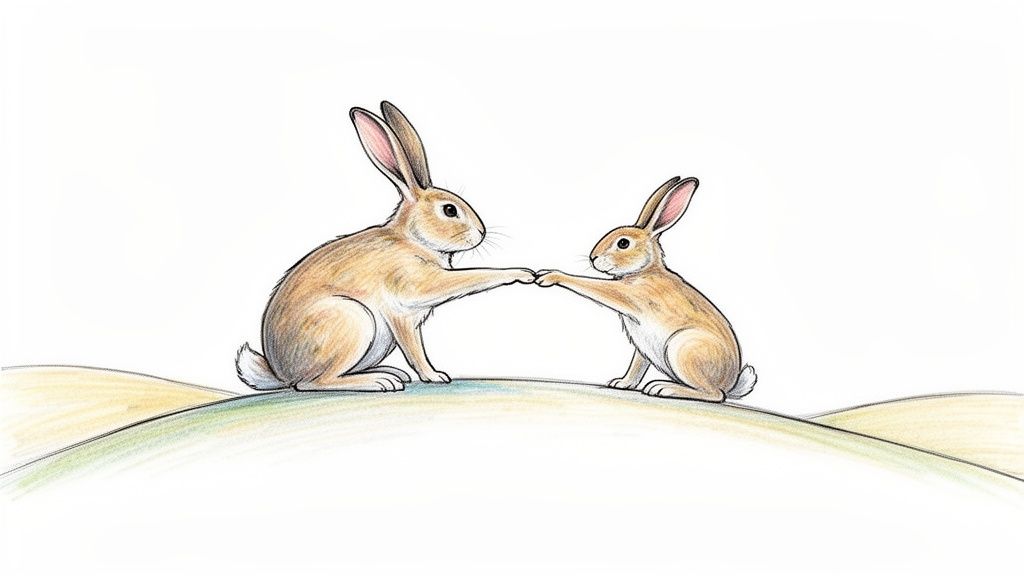
For a story that nurtures emotional intelligence and creates a tranquil atmosphere, Guess How Much I Love You is an unparalleled choice. This tender story, published in 1994, details a loving exchange between Little Nutbrown Hare and Big Nutbrown Hare as they try to measure their affection for one another. Its gentle, repetitive language and heartwarming message make it one of the best read-aloud books for kindergarten, perfect for quiet moments and building a sense of security.
The book’s power lies in its simplicity and emotional resonance. The soft, expressive watercolor illustrations by Anita Jeram perfectly complement Sam McBratney’s rhythmic prose. Unlike stories focused on action or complex concepts, this book provides a space for children to explore feelings of love and connection in a way that is both accessible and profound, making it a staple in classroom quiet corners and bedtime routines.
Why It Works for Kindergarteners
The story’s focus on expressing emotions helps kindergarteners develop crucial social-emotional skills. Its call-and-response structure naturally engages young listeners and helps them learn:
- Emotional Vocabulary: The book provides simple language ("I love you right up to the moon") for expressing big feelings.
- Comparative Language: Children are introduced to concepts of measurement and size (wide, high, far) in a deeply personal and meaningful context.
- Relational Bonds: The narrative reinforces the secure and loving bond between a child and a caregiver.
- Predictable Patterns: The back-and-forth dialogue creates a predictable rhythm that is comforting and easy for young children to follow.
Read-Aloud Tips & Activities
To make the reading experience even more impactful, try these strategies:
- Use a Soothing Tone: Read in a soft, gentle voice to match the book’s calm mood. This is ideal for naptime, quiet time, or before dismissal.
- Incorporate Gestures: Act out the physical measurements with your arms. Stretch them wide, reach up high, and encourage the children to do the same.
- Personalize the Story: Pause and ask questions like, "How much do you love your family? Can you show me with your arms?" This helps connect the story to their own lives.
- Extension Activity: Create "I Love You to the Moon and Back" artwork. Give children black construction paper, star stickers, and a moon cutout. Have them draw or write about someone they love, reinforcing the book’s central theme while practicing fine motor skills.
3. Where the Wild Things Are by Maurice Sendak
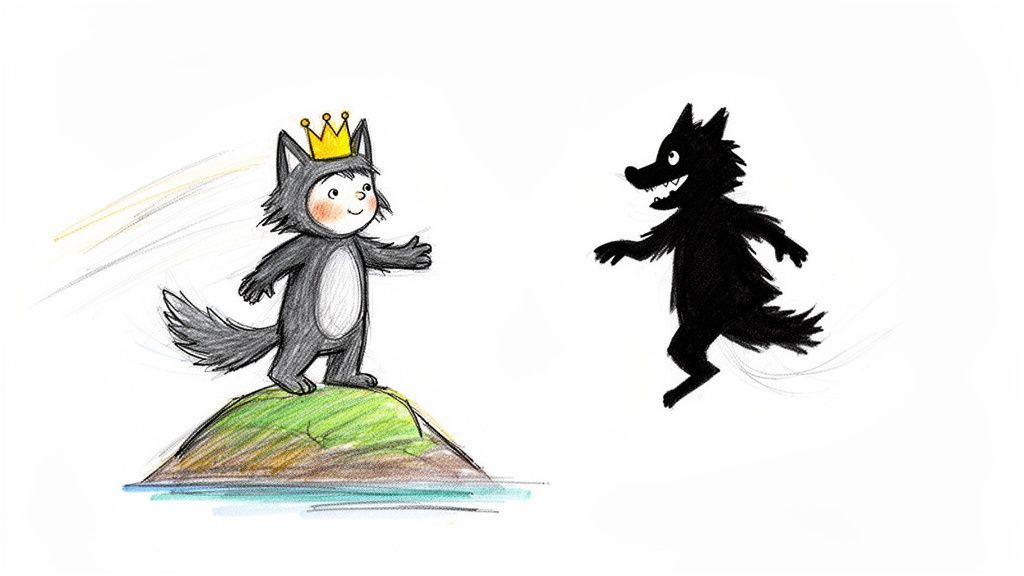
Maurice Sendak's Caldecott Medal-winning masterpiece, Where the Wild Things Are, is a foundational text in children's literature and an essential read-aloud for kindergarten. The story follows a mischievous boy named Max, who, after being sent to his room without supper, sails away to an island inhabited by magnificent, fearsome creatures. It's a powerful exploration of managing big emotions, the boundlessness of imagination, and the comforting pull of home.
This book is exceptional for kindergarteners because it validates their complex feelings. It acknowledges that it’s okay to feel angry or "wild" sometimes, providing a safe narrative space to explore those emotions. Sendak’s iconic illustrations are rich with detail and emotion, perfectly capturing the untamed energy of Max's adventure and making it one of the best read-aloud books for kindergarten classrooms.
Why It Works for Kindergarteners
The book’s emotional honesty and fantastical plot resonate deeply with young children who are just beginning to navigate their own inner worlds. It offers important lessons in a subtle, accessible way:
- Emotional Regulation: The story provides a vocabulary for feelings like anger and frustration, showing a constructive outlet through imagination.
- Problem-Solving: Max tames the Wild Things not with force, but with a clever trick, demonstrating confidence and ingenuity.
- Security and Love: The book ends with the powerful reassurance that after any emotional storm, love, safety, and a warm supper are waiting.
- Imagination as a Tool: It celebrates imaginative play as a way to process feelings and explore independence.
Read-Aloud Tips & Activities
To bring Max's adventure to life, consider these engaging techniques:
- Act Out the "Rumpus": When the "wild rumpus" starts, encourage children to get up and stomp, roar, and gnash their teeth along with the story. This channels their energy physically and makes the reading interactive.
- Vary Your Voice: Use a mischievous tone for Max, deep and growly voices for the Wild Things, and a calm, soothing voice for the final pages when Max returns home.
- Discuss Big Feelings: Pause to ask, "Why do you think Max was so angry?" or "Have you ever felt like a 'wild thing'?" This helps children connect the story to their own experiences. For an in-depth analysis of the book, you can learn more about Where the Wild Things Are on number6publishing.com.
- Extension Activity: Have children draw their own "Wild Thing" on paper. Then, ask them to describe their creature: What is its name? What does it like to do? This activity promotes creativity, descriptive language, and personal expression.
4. The Lion, the Witch and the Wardrobe by C.S. Lewis (Picture Book Edition)
While the full chapter book is a classic for older children, beautifully illustrated picture book editions of The Lion, the Witch and the Wardrobe make its epic fantasy accessible to a kindergarten audience. These adaptations preserve the core of C.S. Lewis’s magical story about four siblings who discover the land of Narnia through a wardrobe. It’s an ideal choice for introducing young listeners to more complex narratives and timeless themes.
What makes these editions exceptional for a read-aloud is how they pair Lewis's rich, lyrical prose with stunning visuals that help younger children follow the plot. The illustrations provide crucial context and emotional cues, capturing the wonder of Lucy’s first encounter with a faun and the intimidating power of the White Witch. This visual support transforms a longer story into a manageable and mesmerizing experience, making it one of the best read aloud books for kindergarteners ready for a grander adventure.
Why It Works for Kindergarteners
This story introduces children to the building blocks of classic literature in a format they can comprehend. Through the adventure, they are exposed to:
- Complex Characters: Children meet heroes, villains, and characters who are brave, selfish, and loyal.
- Story Elements: It provides a clear example of setting (Narnia), conflict (the White Witch’s rule), and resolution.
- Rich Vocabulary: Words like "wardrobe," "faun," and "enchanted" expand a child's lexicon in a memorable context.
- Moral Themes: The story gently explores concepts of courage, forgiveness, sacrifice, and the difference between right and wrong.
Read-Aloud Tips & Activities
To make this epic tale resonate with five-year-olds, try these engagement strategies:
- Use Expressive Voices: Differentiate your voice for each character. Use a gentle, curious tone for Lucy, a booming, noble voice for Aslan, and a cold, sharp voice for the White Witch.
- Pause for Predictions: The story is filled with suspense. Pause before key moments, like when Edmund follows the White Witch, and ask, "What do you think will happen next?"
- Focus on Feelings: Ask questions that connect the story to their own experiences, such as, "How do you think Lucy felt when her siblings didn't believe her?"
- Extension Activity: Create a "Narnia Wardrobe" in the classroom or at home. Use a large cardboard box or drape a sheet over a doorway. Have children draw pictures of their favorite Narnia scene and hang them inside the "wardrobe" for others to discover.
5. Click, Clack, Moo: Christmas on the Farm by Doreen Cronin
The beloved farm animals from the Click, Clack, Moo series bring their signature wit and hilarious antics to the holiday season in this charming tale. While holiday-themed, the book’s clever dialogue and endearing characters make it a fantastic read-aloud choice year-round. The story follows Farmer Brown’s preparations for Christmas, which are quickly upended by the cows, who go on strike until they receive a proper Christmas tree from Santa.
What makes this book a standout for kindergarten read-alouds is its perfect blend of humor, repetition, and expressive illustrations. Doreen Cronin’s deadpan narration combined with Betsy Lewin’s watercolor art creates comic moments that children instantly understand. The story’s pacing and witty punchlines are ideal for capturing and holding the attention of a young audience, making it a reliable choice for boosting classroom engagement.
Why It Works for Kindergarteners
The book’s appeal for this age group lies in its simple plot, recurring characters, and playful use of language. It offers several learning opportunities wrapped in a fun narrative:
- Humor and Inference: Children learn to pick up on humor from both the text and the illustrations, such as the ducks sneakily listening at the door.
- Perspective-Taking: The story encourages children to understand a situation from different points of view: Farmer Brown’s, the cows’, and the neutral ducks’.
- Dialogue and Voice: The distinct typed notes from the animals provide a clear, visual representation of written dialogue.
- Problem-Solving: The animals work together to solve their problem, demonstrating negotiation and creative thinking in a humorous way.
Read-Aloud Tips & Activities
To maximize the fun and learning during your reading session, consider these techniques:
- Use Distinct Voices: Give Farmer Brown a slightly grumpy voice, the cows a matter-of-fact tone, and the ducks an energetic quack. This helps children differentiate characters and adds to the humor.
- Build Dramatic Timing: Pause before reading the animals' typed notes. Let the children see the note on the page and build anticipation for what their demands will be.
- Point Out Visual Gags: Take time to show the illustrations. Ask kids, "What are the ducks doing in this picture?" to draw attention to Betsy Lewin’s funny details.
- Extension Activity: Have the children write their own "note" from a different farm animal (or a classroom pet). They can dictate the note to you or draw a picture of what their animal wants, reinforcing the concept of written communication and point of view.
6. Corduroy by Don Freeman
Don Freeman’s Corduroy is a heartwarming classic that has earned its place as one of the best read-aloud books for kindergarten through its gentle exploration of belonging and unconditional love. Published in 1968, this tender story follows a small teddy bear in a department store who worries that his missing button will prevent him from finding a home. His late-night adventure to find it ends with him meeting a kind girl named Lisa, who loves him just as he is.
What makes this book so powerful for a read-aloud setting is its deep emotional resonance. The story validates common childhood feelings of being imperfect or overlooked, while delivering a comforting message that everyone deserves to be loved for who they are. Freeman’s warm, expressive illustrations create an intimate and cozy atmosphere, drawing young listeners into Corduroy's world and making his quest for a friend deeply personal and engaging.
Why It Works for Kindergarteners
Corduroy connects with young children by focusing on themes that are central to their social and emotional development. It provides a perfect vehicle for discussing:
- Belonging and Friendship: The story gently explores the desire for a friend and a place to belong, a universal feeling for this age group.
- Empathy and Perspective-Taking: Children easily empathize with Corduroy’s loneliness and hope, learning to understand feelings from another’s point of view.
- Unconditional Love: Lisa’s immediate acceptance of Corduroy, despite his missing button, is a powerful and reassuring example of loving someone for their true self.
- Problem-Solving: Corduroy's determined (if misguided) search for his button demonstrates simple problem-solving and perseverance.
Read-Aloud Tips & Activities
To create a memorable and emotionally rich reading experience, try these techniques:
- Use a Warm, Gentle Tone: Your voice should reflect the story's comforting nature. Use a slightly softer, more curious voice for Corduroy and a kind, friendly voice for Lisa.
- Pause on Emotional Beats: Linger on the moments when Corduroy feels sad on the shelf or hopeful when he sees Lisa. Ask children, "How do you think Corduroy is feeling right now?"
- Connect to Personal Experiences: Encourage children to talk about their own special toys. Ask, "What makes your favorite stuffed animal special to you?"
- Extension Activity: Set up a "button hunt" in the classroom or at home. Hide various buttons and have children find them, then sort them by color, size, or shape. This activity enhances observation skills and ties directly into the story's central plot point. Learn more about the enduring legacy of Corduroy and its classroom applications.
7. The Cat in the Hat by Dr. Seuss
No list of the best read aloud books for kindergarten would be complete without this iconic, rhythm-filled classic. The Cat in the Hat revolutionized children's literature with its high-energy story of two bored children whose rainy day is turned upside down by a mischievous, hat-wearing feline. Dr. Seuss's masterpiece uses a limited vocabulary of just 236 distinct words, proving that simple language can create an endlessly entertaining and memorable story.
What makes it a phenomenal read-aloud is its sheer sound and energy. The driving, anapestic meter and clever rhyming couplets make the text practically sing off the page. The story is pure, unadulterated fun, filled with chaos, suspense, and a delightfully absurd sense of humor that kindergarteners find hilarious. The dynamic illustrations perfectly match the zany tone, giving children plenty of visual action to follow along with.
Why It Works for Kindergarteners
The book is an absolute powerhouse for developing pre-reading and early literacy skills in a way that feels like pure playtime. Its structure inherently teaches:
- Phonics and Rhyme: The repetitive rhyme schemes (hat/cat/sat, ball/wall/fall) are perfect for developing phonemic awareness.
- Rhythm and Cadence: The book’s strong, predictable rhythm helps children internalize the patterns of language.
- Imagination: The story celebrates creative, imaginative play and provides a wonderful escape from the ordinary.
- Problem-Solving: Children watch as the initial fun creates a huge mess, prompting a discussion about consequences and responsibility.
Read-Aloud Tips & Activities
To make your read-aloud session as dynamic as the Cat himself, try these ideas:
- Use an Exaggerated Voice: Give the Cat a playful, over-the-top voice. Vary your tone for the worried fish and the astonished children to bring the characters to life.
- Emphasize the Rhymes: Really punch the rhyming words to help children hear the patterns. Pause before a rhyming word and let the children guess what it will be.
- Ask Predictive Questions: Pause when the Cat brings in Thing One and Thing Two and ask, "What do you think is going to happen now?"
- Extension Activity: Host a "rhyming hat" activity. Write a word like "cat" on a paper hat and have children brainstorm and write all the words that rhyme with it (bat, sat, mat, flat) on paper strips to glue onto the hat. This reinforces rhyming families in a fun, hands-on way.
8. Charlotte's Web by E.B. White (Picture Book or Chapter-by-Chapter Edition)
While often considered a classic for older elementary students, Charlotte's Web can be a profoundly moving and accessible read-aloud for kindergarteners, especially when approached thoughtfully. This enduring story explores the deep friendship between Wilbur the pig and Charlotte the spider, weaving together themes of loyalty, loss, and the beauty of a well-lived life. E.B. White’s elegant prose, paired with Garth Williams' gentle illustrations, introduces young listeners to sophisticated emotional concepts in a safe, narrative context.
The true power of this book as a read-aloud lies in its ability to spark meaningful conversations. It is often a child's first literary encounter with themes of mortality and grief, handled with grace and tenderness. By reading it chapter by chapter or using an abridged picture book version, you can introduce complex ideas at a pace that kindergarteners can process, making it one of the most impactful, if unconventional, best read aloud books for kindergarten.
Why It Works for Kindergarteners
Reading this classic aloud offers a unique opportunity to build emotional literacy and introduce the structure of longer narratives. The story helps children understand:
- Deep Friendship: The bond between Wilbur and Charlotte provides a powerful example of unconditional love and support.
- Emotional Complexity: It gently introduces concepts like loss, sacrifice, and the cycle of life, helping children build empathy.
- Vocabulary Growth: White's precise and beautiful language exposes children to a richer vocabulary than typical picture books.
- Sustained Narrative: Reading it chapter by chapter helps build listening stamina and an understanding of plot development over time.
Read-Aloud Tips & Activities
To make this classic accessible and impactful for younger listeners, consider these approaches:
- Choose the Right Format: Start with a high-quality picture book adaptation to introduce the characters and basic plot. For a more in-depth experience, read the original chapter by chapter, one chapter per session.
- Pace for Emotion: Read slowly and allow for pauses, especially during poignant moments like Charlotte's death. This creates a safe space for children to feel and process their emotions without being rushed.
- Ask Open-Ended Questions: Prompt discussions with questions like, "Why was Charlotte a good friend to Wilbur?" or "How do you think Wilbur felt when he found out Charlotte's babies had hatched?" For a deeper dive into the book's themes, you can learn more about Charlotte's Web and its lasting impact on Number 6 Publishing.
- Extension Activity: Create a "Word Web" craft. Write a character's name (like Wilbur or Charlotte) in the center of a paper plate and have children suggest words that describe them. Write these words around the center and connect them with yarn to create a spider web of character traits.
9. Pete the Cat: I Love My White Shoes by James Dean
For a story that effortlessly combines rhythm, repetition, and a powerful lesson on resilience, look no further than Pete the Cat: I Love My White Shoes. This groovy tale introduces Pete, a cool cat who stays positive even as his brand-new white shoes get stained by strawberries, blueberries, and mud. The book’s laid-back vibe and musical quality make it an absolute favorite and one of the best read-aloud books for kindergarten.
What makes it so perfect for a group setting is its infectious, sing-song nature. The story is built around a simple, repetitive refrain that children quickly learn and love to chant. This call-and-response element transforms reading into a joyful, interactive performance, keeping every child hooked from the first page to the last. James Dean’s bold, simple illustrations perfectly capture Pete's unflappable attitude, making the story visually engaging and easy to follow.
Why It Works for Kindergarteners
The book's appeal lies in its simple yet profound message, delivered through a structure that supports early learning:
- Emotional Resilience: The core theme is handling setbacks with a positive attitude. Pete’s response, "Did I cry? Goodness, no!" teaches a valuable lesson in emotional regulation.
- Color Recognition: As Pete steps in different things, his shoes change color, providing a natural and fun way to reinforce color words (red, blue, brown, wet).
- Predictable Text: The repetitive structure helps build reading confidence. Children can easily predict and "read" along with the repeating phrases.
- Cause and Effect: The story presents a very clear cause-and-effect sequence: Pete steps in something, and his shoes change color.
Read-Aloud Tips & Activities
To make your reading of Pete the Cat truly groovy, try these tips:
- Get into Character: Use a cool, laid-back, rhythmic voice for Pete. Make the "Oh no!" moments sound surprised but not truly upset.
- Lead a Sing-Along: Emphasize the musical refrain, "I love my white shoes," and make it a true sing-along. Pause before the color reveal and let the children shout it out.
- Incorporate Movement: Have children stomp their feet along with Pete as he walks down the street. You can even have them act out stepping in the different messes.
- Extension Activity: Create a "What Color Are My Shoes?" craft. Give each child a paper cut-out of a shoe. Call out different scenarios ("You stepped in a big pile of green grass!") and have them color their shoe to match. This reinforces colors and listening skills.
10. The Snowy Day by Ezra Jack Keats
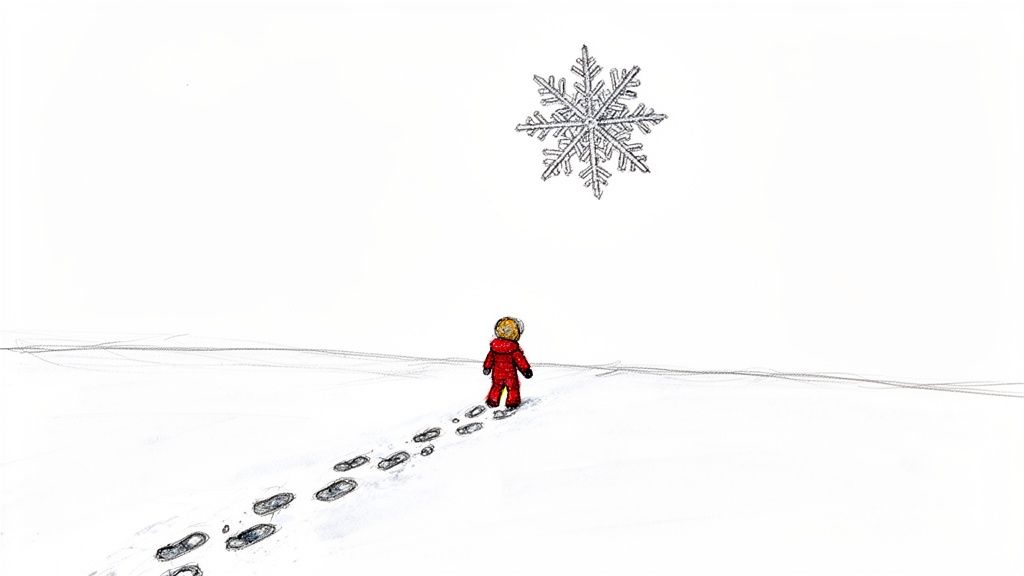
Ezra Jack Keats’ Caldecott Medal-winning masterpiece, The Snowy Day, captures the quiet magic of a child’s first solo adventure in a winter wonderland. This iconic story follows a young boy named Peter as he explores his neighborhood after a fresh snowfall. Its power lies in its simplicity and sensory richness, making it one of the best read-aloud books for kindergarten to celebrate curiosity, independence, and the joy found in the simple moments of childhood.
What makes this book so profound for a read-aloud is its tranquil pace and groundbreaking artwork. Keats’ use of minimalist text paired with exquisite collage illustrations invites children to slow down and immerse themselves in Peter's world. The story validates a child’s perspective, treating their small discoveries-like making footprints and finding the perfect stick for smacking a snow-laden tree-with gentle importance and respect.
Why It Works for Kindergarteners
The book's gentle narrative is perfectly tuned to the kindergarten experience, focusing on concepts that are both relatable and educational. Through Peter’s journey, children explore:
- Sensory Language: The story evokes the senses with words like "crunch, crunch, crunch" and visual descriptions of sliding down a snowbank.
- Problem-Solving: Peter's attempt to save a snowball in his pocket introduces cause and effect in a simple, memorable way.
- Emotional Connection: Children easily connect with Peter’s joy, disappointment, and the comfort of returning home to a warm bath.
- Imaginative Play: The book is a beautiful model for how children can create their own adventures using just their imagination and surroundings.
Read-Aloud Tips & Activities
To enhance the magic of Peter's snowy adventure during your reading, try these techniques:
- Use a Quiet, Wonder-Filled Voice: Read the story slowly and softly to match its peaceful, contemplative tone. Allow for long pauses so children can absorb the details in the illustrations.
- Focus on Sound Effects: Make the "crunch, crunch" of the snow audible with your voice, and the "plop!" of the snow falling from the tree extra dramatic.
- Ask Sensory Questions: Prompt discussion by asking, "How do you think the snow felt on Peter's cheeks?" or "What do you think his warm bath felt like after being outside?"
- Extension Activity: Create your own "snowy day" collages. Provide white paper, cotton balls, fabric scraps, and colored construction paper, and encourage children to recreate a scene from the book or imagine their own snowy adventure, mimicking Keats' artistic style.
Top 10 Kindergarten Read-Alouds Comparison
| Title | 🔄 Implementation Complexity | ⚡ Resource Requirements | ⭐ Expected Outcomes | 📊 Ideal Use Cases | 💡 Key Advantages / Tips |
|---|---|---|---|---|---|
| The Very Hungry Caterpillar — Eric Carle | Low — single-session, interactive read-aloud | Low — board/die-cut copy; optional butterfly activity | ⭐⭐⭐⭐ — counting, days, life-cycle awareness | Circle time, science intro, K read-alouds | 💡 Tactile die-cuts; pause to count and follow with craft |
| Guess How Much I Love You — Sam McBratney | Low — calm, call-and-response style | Low — board book; quiet space | ⭐⭐⭐⭐ — emotional bonding, prediction skills | Bedtime routines, transitions, bonding activities | 💡 Read softly; invite children to compare measures of love |
| Where the Wild Things Are — Maurice Sendak | Moderate — expressive performance and framing | Low — picture book; prep for SEL discussion | ⭐⭐⭐⭐ — imagination, emotional expression | Imagination lessons, SEL talks, dramatic read-alouds | 💡 Use varied voices; discuss feelings and consequences |
| The Lion, the Witch and the Wardrobe (Picture Book) — C.S. Lewis | High — multi-session, thematic prep | Medium — picture editions or chapter schedule; teacher prep | ⭐⭐⭐⭐ — moral reasoning, listening stamina | Unit-long read-alouds, thematic discussions (ages 5–8) | 💡 Use picture edition for K; chunk into chapters with pauses |
| Click, Clack, Moo: Christmas on the Farm — Doreen Cronin | Low — dialogue-driven, energetic reading | Low — picture book; voice cues for animals | ⭐⭐⭐ — engagement, humor appreciation | Morning read-alouds, reluctant readers, voice practice | 💡 Use distinct animal voices; time punchlines for laughs |
| Corduroy — Don Freeman | Low — gentle pacing, reflective moments | Low — picture book; prompts for feelings | ⭐⭐⭐⭐ — empathy, belonging conversations | SEL lessons, discussions on inclusion and adoption | 💡 Read warmly; connect story to children's own attachments |
| The Cat in the Hat — Dr. Seuss | Low–Moderate — rhythmic performance, phonics focus | Low — picture edition; optional props | ⭐⭐⭐⭐ — phonemic awareness, high engagement | Phonics lessons, guided reading, energetic storytime | 💡 Emphasize rhythm and rhyme; discuss rules vs. fun |
| Charlotte's Web — E.B. White (Picture/Chapter) | High — mature themes; extended sessions | Medium — picture/chapter editions; emotional supports | ⭐⭐⭐⭐ — empathy, processing loss, rich vocabulary | Upper K/early elementary SEL units, extended read-alouds | 💡 Use picture edition for younger children; allow processing time |
| Pete the Cat: I Love My White Shoes — James Dean | Low — musical, repeatable refrain | Low — picture book; optional music or chants | ⭐⭐⭐ — growth mindset, participation | Morning circle, character education, music integration | 💡 Chant refrain with class; pair with art extensions |
| The Snowy Day — Ezra Jack Keats | Low — visual exploration, slow read | Low — picture book; art materials for collage follow-up | ⭐⭐⭐⭐ — sensory awareness, representation, art discussion | Seasons units, art lessons, diversity conversations | 💡 Read slowly to examine collage art; try a class collage project |
Keeping the Story Going: Your Next Chapter in Reading Adventures
As we turn the final page on this curated collection, it's clear that the journey through the best read aloud books for kindergarten is about so much more than just finishing a story. It’s about beginning a lifelong dialogue. From the rhythmic counting in The Very Hungry Caterpillar to the emotional depth of Where the Wild Things Are, each book we've explored serves as a powerful tool for connection, learning, and discovery.
Reading aloud is not a passive activity; it is an interactive, dynamic experience that builds a crucial foundation for literacy and emotional intelligence. The true magic happens in the moments between the pages: the thoughtful pause after a poignant scene, the burst of laughter at a silly rhyme, and the curious questions that follow "The End." This list is designed to be your launchpad, providing not just titles but a blueprint for turning story time into an enriching adventure.
From Passive Listening to Active Engagement
The most significant takeaway is the shift from passive listening to active engagement. The strategies we've discussed, such as using different voices for characters in The Cat in the Hat or asking predictive questions during Corduroy, are essential for transforming your kindergarteners from spectators into participants.
Remember these key principles to maximize your read-aloud sessions:
- Embrace the Performance: Your enthusiasm is contagious. Vary your tone, use facial expressions, and don't be afraid to be a little dramatic. Think of yourself as a storyteller, not just a reader.
- Ask Open-Ended Questions: Move beyond "Did you like it?" to "Why do you think the Wild Things made Max their king?" or "What would you do if your shoes changed colors like Pete the Cat's?" These questions foster critical thinking and empathy.
- Connect to Their World: Bridge the gap between the story and your child’s life. After reading The Snowy Day, talk about your own memories of snow or plan a winter-themed activity. These real-world connections make literature meaningful and memorable.
Building a Diverse and Inclusive Bookshelf
Another crucial theme woven throughout our recommendations is the importance of a diverse library. Books like The Snowy Day broke new ground by featuring a Black protagonist in a simple, universal story. This serves as a powerful reminder that every child deserves to see themselves reflected in the pages of a book.
A child’s bookshelf should be both a mirror, reflecting their own life and experiences, and a window, offering views into the lives and experiences of others. This dual purpose builds self-esteem and cultivates empathy, creating a more inclusive and understanding worldview from a young age.
As you continue to search for the best read aloud books for kindergarten, actively seek out stories that represent a wide array of cultures, families, and perspectives. This intentional curation doesn't just benefit children from marginalized groups; it enriches the understanding of every child, preparing them to be compassionate and informed global citizens.
Your Continuing Role as a Reading Guide
Whether you are a parent, teacher, or caregiver, your role as a reading guide is invaluable. The books on this list are just the beginning. The real goal is to cultivate a deep-seated love for stories that will last a lifetime. You are planting the seeds of curiosity, creativity, and compassion with every book you share.
The adventure doesn't stop here. Use these books and techniques as a foundation. Visit your local library, talk to librarians and booksellers, and, most importantly, pay attention to what sparks your child’s imagination. Let their interests guide your next selection. By fostering a positive and engaging reading environment now, you are giving them a gift that will continue to support their academic, social, and emotional growth for years to come. The stories you share today will become the cherished memories and foundational lessons of tomorrow.
Ready to discover the next classic for your classroom or home library? Number 6 Publishing is committed to bringing unforgettable stories to life, crafting narratives that resonate with young readers and spark meaningful conversations. Explore our catalog of award-winning titles perfect for read-alouds at Number 6 Publishing.