
When you're trying to find the best homeschool reading curriculum, it really boils down to what works for your child and what you can stick with. Does your child need a super structured, phonics-based program like All About Reading? Or would they blossom in a literature-rich environment, diving headfirst into wonderful stories?
Truthfully, the "best" program is the one that sparks curiosity and doesn't feel like a chore—for either of you.
Your Guide to Finding the Perfect Reading Program
Picking a homeschool reading curriculum can feel like a monumental task. You’re definitely not alone in feeling that pressure. The options out there are endless, and the market is booming.
In North America alone, the homeschool curriculum market was valued at $4.8 billion in 2025, and the number of homeschooled students in the U.S. climbed to 3.7 million for the 2024-2025 school year. It’s clear that more and more families are looking for a personalized approach to education.
This guide is here to help you cut through all that noise. We’re going to sidestep the overwhelming lists of options and focus on what really matters: raising a confident kid who enjoys reading. You'll quickly see why a one-size-fits-all curriculum rarely works and discover that your involvement is the real secret to success.
What to Expect in This Guide
Think of this as your roadmap. We’re turning a potentially stressful job into an empowering part of your homeschool journey, giving you the tools to make a great choice for your family.
Here's a peek at what we'll cover:
- Pinpointing Needs: We’ll show you how to figure out your child's current reading level without any stress.
- Understanding Philosophies: We'll demystify the big three: phonics, whole language, and balanced literacy, so you know what you’re looking at.
- Evaluating Programs: You’ll get a simple framework for comparing different curricula and learning how to spot potential red flags.
- Implementation Tips: We’ll share ideas for bringing the lessons to life, from scheduling your day to adding fun, enriching activities.
Speaking of scheduling, building a solid daily routine can make all the difference. For some great tips on structuring your days, check out your ultimate homeschool daily schedule template guide.
The ultimate goal isn't just to teach a child how to read, but to cultivate a lifelong love of reading. The right curriculum is simply a tool to help you get there.
A huge part of that is creating a home filled with books. When books are accessible and exciting, kids are naturally drawn to them. If you need some inspiration, check out our tips on how to organize your home library.
By the time you finish this guide, you’ll feel confident and ready to pick the perfect reading curriculum for your family.
Pinpointing Your Child's True Reading Level
Before you even think about flipping through curriculum catalogs, the very first step is to get a clear, honest picture of where your child stands as a reader. Finding the right fit depends entirely on meeting your child exactly where they are—not where a grade-level chart says they should be.
This isn’t about formal, high-stakes testing. Think of yourself as a reading detective. You’re gathering clues that reveal your child’s strengths and the specific spots where they need a little more support. This low-pressure approach gives you the accurate insight you need without causing any anxiety for your young learner.
Listen to Them Read Aloud
The single most effective way to gauge reading skills is to simply listen. Find a book you suspect is right at their comfort level (or maybe just a tiny bit above) and ask them to read a few pages out loud to you.
As they read, listen for more than just the words.
- Decoding Skills: Do they sound out new words using phonics, or do they just guess based on the first letter? If you notice a lot of guessing, it might signal a weakness in their foundational phonics.
- Fluency and Pacing: Is their reading choppy and slow, or does it flow with a natural rhythm? True fluency sounds almost like conversational speech, with the right pauses and expression.
- Self-Correction: When they make a mistake, do they catch it and go back to fix it? This is a fantastic sign that they’re actively thinking about what the text means.
I often see what I call the "fluent but forgetful" reader. They might read a passage beautifully, with perfect inflection, but have absolutely no idea what they just read. This tells me their mental energy is completely maxed out on just decoding the words, leaving no room for actual comprehension.
Check for Comprehension and Vocabulary
Reading isn’t just about saying the words correctly; it’s about understanding them. After your child finishes a passage, shift into a casual conversation about the story. This is how you’ll know if they are truly connecting with the material.
For instance, a second-grader might read about a character who found a lost puppy. If they can tell you the character felt "sad and then happy" but can’t quite explain why, it could point to a gap in comprehension. On the other hand, if they stumbled over the word "relieved," that's more likely a vocabulary issue.
"Reading level" is a complex mix of things—sentence structure, vocabulary, and even the reader's own background knowledge all play a part in a text's difficulty.
Simple Tools for a Baseline Assessment
While your own observations are priceless, a few simple, free tools can help confirm what you’re seeing and give you a more standardized baseline. Think of these as a quick, informal second opinion.
Here are a few trusted options you can try:
- San Diego Quick Assessment: This is a straightforward word recognition list. Your child reads from lists of words that get progressively harder. The point where they start to consistently struggle gives you a pretty good estimate of their word-reading grade level.
- Online Graded Reading Passages: You can find tons of websites with free, short passages leveled by grade. Have your child read one and then answer a few simple comprehension questions to see how well they understood it.
- The Five Finger Rule: This is a great in-the-moment test for any book. Have your child open to a random page and start reading. If they come across five or more words they don't know on that single page, the book is probably too difficult for them to read independently right now.
By combining your own thoughtful observations with these simple tools, you can build a complete and accurate profile of your child’s reading abilities. This is the crucial first step that will empower you to choose a curriculum that truly builds their confidence and fosters a genuine love of reading.
Understanding Different Reading Philosophies
When you start digging into how to teach reading, you'll quickly find it’s a whole world of its own. Figuring out the "how" is a massive part of finding the best homeschool reading curriculum for your family, and you’ll almost immediately run into three big teaching philosophies that shape nearly every program out there.
Getting a handle on what makes each one tick is your first real step. These aren't just stuffy academic theories; they represent fundamentally different beliefs about how a child's brain actually learns to make sense of words on a page. Let's break down the big three you'll keep hearing about: phonics, whole language, and balanced literacy.
The Phonics-First Approach
At its core, a phonics-based approach treats reading as a code. The main goal for a new reader is to master the relationship between letters (graphemes) and the sounds they make (phonemes). Once they can crack that code, they can sound out almost any word they come across.
I like to think of it like building with LEGOs. First, you learn what each individual brick can do. Then you learn how to connect them, and pretty soon, you can build anything you can imagine, one piece at a time.
Programs like All About Reading are perfect examples of this. They are highly structured and sequential, making sure a child really masters one skill before they're asked to build on it with the next one.
- Core Idea: Reading is taught explicitly and systematically, starting with the smallest units of sound.
- What it Looks Like: You'll see a lot of hands-on activities like letter tiles and flashcards, alongside decodable readers (which are special books that only use the phonetic rules a child has already learned).
- Strength: It’s incredibly effective for building strong decoding skills, which is often the biggest hurdle for young readers. This method really leaves nothing to chance.
It’s this structured, mastery-based philosophy that helps so many families find success. Market analysis from firms like Strategy MRC shows that core reading curricula are poised for major growth in the homeschool market. It’s no surprise that programs like All About Reading and Reading Horizons often lead the pack because of their clear, step-by-step methods.
The Whole Language Philosophy
On the complete opposite side of the spectrum is the whole language philosophy. The belief here is that learning to read should feel as natural and intuitive as learning to speak. It’s all about immersing a child in rich, authentic books from day one, with the trust that they will gradually absorb the patterns of language through context and exposure.
Instead of sounding out "c-a-t," a child is encouraged to use clues—like the pictures on the page, the flow of the sentence, and their own intuition—to figure out the word. The entire focus is on making meaning and ensuring reading is a joyful experience right from the start.
A whole language advocate might put it this way: "We don't teach toddlers the rules of grammar before they can speak; we just talk to them. Reading should be the same."
This approach puts the love of reading and comprehension first. A classic example is a Charlotte Mason-style education, which relies on beautiful, engaging "living books" instead of structured readers or textbooks.
The Balanced Literacy Approach
As you might have guessed, balanced literacy tries to pull the best ideas from both worlds. It recognizes that systematic phonics instruction is crucial, but it also weaves in the meaning-focused, literature-rich activities from the whole language camp.
In a balanced literacy setup, you'll see a little bit of everything. There will be dedicated time for explicit phonics work, but you’ll also find guided reading with authentic books, lots of independent reading time, and writing workshops. The goal is to build a well-rounded reader who has a full toolkit of strategies to use.
The one thing to watch out for is that some "balanced" programs can become pretty unbalanced, leaning too heavily on guessing strategies and not providing enough solid, systematic phonics practice. When you’re looking at these programs, you have to be a bit of a detective and see exactly how much explicit phonics instruction is truly included.
So, how do you choose? It really comes down to your child. The table below gives a quick overview of the key differences to help you think it through.
Phonics vs. Whole Language vs. Balanced Literacy at a Glance
This quick comparison should help you see where different programs are coming from and which philosophy might be the best starting point for your child.
| Approach | Core Principle | Primary Focus | Common Activities | Best For Learners Who... |
|---|---|---|---|---|
| Phonics-First | Reading is a code that must be explicitly taught. | Decoding and phonetic rules. | Drills, decodable readers, word-building with tiles. | Thrive with structure and clear, logical steps. |
| Whole Language | Reading is a natural process learned through immersion. | Comprehension and love of literature. | Read-alouds, predicting text, using picture cues. | Are intuitive and learn well through context and stories. |
| Balanced Literacy | A mix of explicit instruction and literature immersion. | Multiple reading strategies. | Guided reading groups, phonics mini-lessons, independent reading. | Are flexible and benefit from a variety of teaching methods. |
Ultimately, understanding these philosophies isn't about crowning a "winner." It's about finding the approach that feels like the most natural and effective fit for your child's unique brain and learning style.
How to Evaluate and Choose Your Curriculum
Alright, you've figured out your child’s reading level and have a good feel for your teaching philosophy. Now comes the fun part—shifting from theory to vetting actual programs. This is where you put on your curriculum analyst hat and look past the glossy marketing to see if a program’s structure, content, and daily demands will actually work for your family.
Finding the best homeschool reading curriculum feels a bit like detective work. You’ll want to examine how a program builds skills over time, what the day-to-day lessons actually look like, and how it helps you track your child’s progress without overwhelming them (or you).
Dig Into the Scope and Sequence
The very first thing I always look at in a potential curriculum is its scope and sequence. Think of this as the program’s long-term map, showing you exactly what skills are taught and in what specific order. A solid scope and sequence is your best guarantee against learning gaps, ensuring that concepts build on each other in a way that makes sense.
For instance, a good phonics program isn’t going to throw complex vowel teams at a child who hasn't yet mastered simple consonant-vowel-consonant (CVC) words like "cat" and "dog." A key part of choosing well is understanding learning outcomes and objectives—knowing what the curriculum promises versus the specific skills it will teach.
A quality scope and sequence should be:
- Logical: Does the skill progression feel natural? It should move clearly from simple to complex.
- Comprehensive: Does it hit all the big five of reading? Look for phonemic awareness, phonics, fluency, vocabulary, and comprehension.
- Transparent: You should be able to find it easily on the publisher's website. If a company hides its teaching framework, that’s a major red flag for me.
Look for Multisensory Engagement
Kids, especially in the early elementary years, learn best when they can use more than just their eyes. Reading instruction shouldn't be a passive activity. It needs to involve hearing, speaking, and even touching to make abstract concepts like letter sounds feel concrete and real.
This is why so many of the best programs include hands-on components. These aren't just fun little extras; they are incredibly powerful tools for making learning stick, especially for kinesthetic learners or any child who gets fidgety with just books and worksheets.
I remember when my own son was struggling to differentiate between 'b' and 'd'. No amount of worksheet practice was helping. It wasn't until we started tracing the letters in a salt tray and building them with play-doh that it finally clicked. The physical act of forming the letters locked the information into his brain in a way that just looking at them never could.
Many programs are now blending physical materials with digital tools. For some great supplemental practice, you can explore some of the best reading apps for kids, which can be a fantastic complement to your main curriculum.
The flowchart below gives you a nice visual of how a child’s learning preferences might point you toward a specific approach to reading.
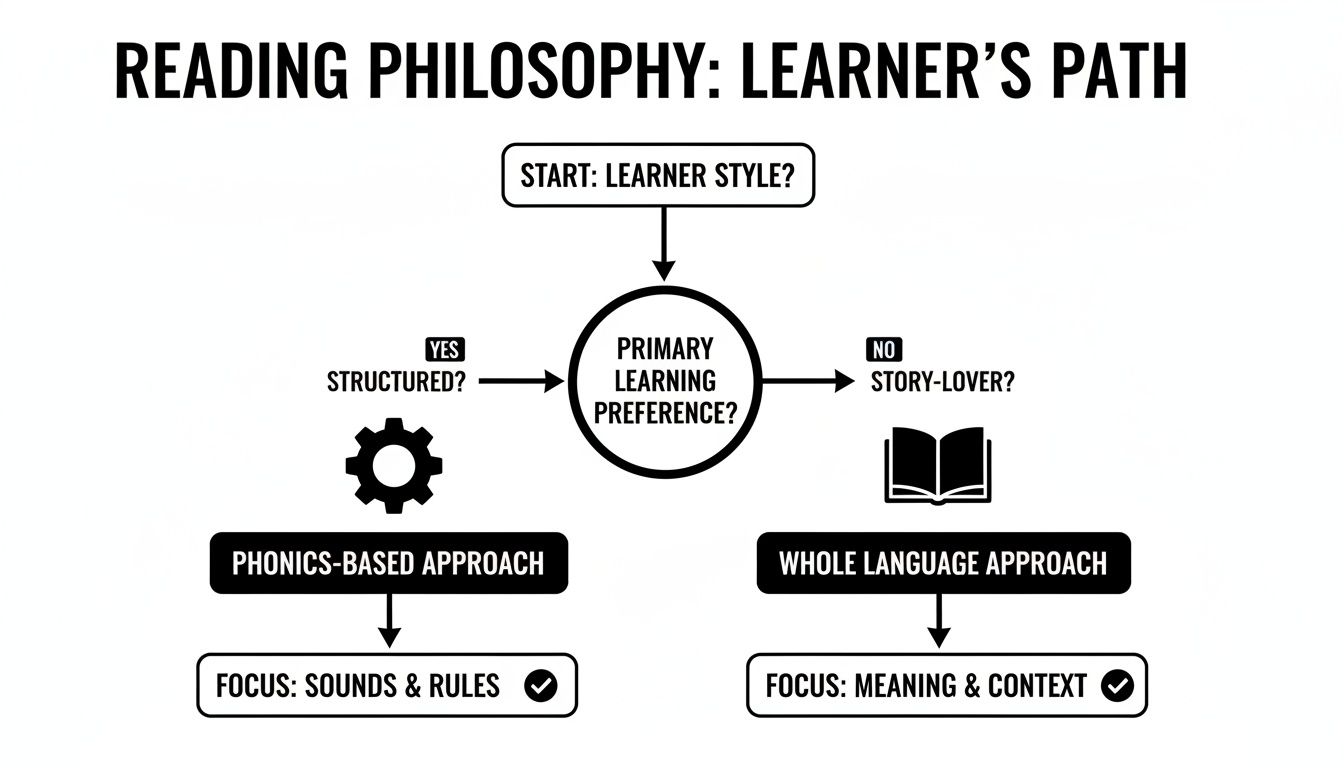
As you can see, a child who thrives on structure often does well with systematic phonics, whereas a story-loving, big-picture kid might be more drawn to the immersive world of whole language.
Evaluate Progress Tracking and Your Time Commitment
So, how will you know if any of this is actually working? A good curriculum should have built-in, low-stress ways for you to monitor progress. I'm not talking about formal tests every Friday. I'm talking about gentle assessments like fluency checks, a few quick comprehension questions, or simple review activities that show you whether a concept has truly sunk in.
The other crucial factor here is your own time. Be brutally honest with yourself about how much prep you’re willing—and able—to do each day.
- Open-and-Go Programs: These are a lifesaver. They're often scripted and require almost no prep. You just open the teacher's guide and start the lesson.
- Prep-Intensive Programs: These can be amazing, but they might require you to gather craft supplies, print worksheets, or plan activities in advance. They are a tough fit if you're already juggling a packed schedule.
Before you buy anything, look for sample lessons on the publisher's website. Reading through a full week of lessons gives you a realistic feel for the daily rhythm and whether it’s a good match for your teaching style. This one simple step has saved me countless times from buying a curriculum that just ends up gathering dust on a shelf.
Bringing Your Reading Lessons to Life
You've picked the curriculum, the boxes have arrived, and now the real adventure begins. It’s time to weave those lessons into the fabric of your family’s daily life. This is the moment the best homeschool reading curriculum moves from a plan on paper to a vibrant, living part of your day, turning instruction into a cherished habit.
The key to success isn't some rigid, military-style schedule. It’s about finding a rhythm that feels natural and sustainable for your family. A flexible routine brings consistency without feeling confined, ensuring that reading lessons are something you and your child can actually look forward to.
Creating a Weekly Rhythm
Instead of just checking off boxes, think about structuring your week with a blend of core instruction and joyful reinforcement. A predictable pattern helps children feel secure and know what to expect, which is half the battle.
Here’s a look at how a week could flow for the early elementary years. Think of it less as a strict mandate and more as a flexible template to spark your own planning.
Sample Weekly Reading Schedule (Grades 1-3)
This table shows one way to balance direct instruction with the fun stuff. The goal is to cover the essentials while leaving plenty of room for creative, low-pressure activities that make learning feel like play.
| Day | Core Lesson Focus (20-30 min) | Practice & Application (15 min) | Enrichment (20+ min) |
|---|---|---|---|
| Monday | Introduce new phonics rule (e.g., 'sh' digraph) | Use letter tiles or magnets to build 'sh' words. | Read a picture book together that features 'sh' sounds. |
| Tuesday | Review phonics rule and read from decodable book | Play a simple phonics game (e.g., 'I Spy' with the 'sh' sound). | Watch a short educational video about the lesson topic. |
| Wednesday | Introduce new sight words | Write sight words in a salt tray or with sidewalk chalk. | Go on a "sight word hunt" around the house. |
| Thursday | Practice fluency with a familiar passage | Child reads the passage to a stuffed animal or family pet. | Listen to an audiobook version of a favorite story. |
| Friday | Review the week's concepts | Play a board game that reinforces phonics or sight words. | Visit the library or have a "book picnic" in the yard. |
See how that works? You’re consistently hitting the core skills from your curriculum but wrapping them in experiences that make the learning stick.
Keeping Your Child Engaged and Motivated
Let’s be honest: every child hits a wall at some point. One day they’re racing to their lessons, and the next, it feels like pulling teeth. Your ability to adapt and keep things fresh is your superpower as a homeschool parent.
When you see that motivation starting to dip, try shifting the format:
- For the Struggling Learner: If a concept just isn't clicking, step away from the workbook. Use physical movement—have them jump on letters written in chalk to spell a word or toss a beanbag to the correct sound. Short, frequent, and successful sessions build confidence far more than one long, frustrating lesson.
- For the Advanced Learner: When your child is flying through lessons, don't just accelerate. Go deeper. Challenge them to write their own alternate ending to a story, create a comic strip based on their reader, or start a "word journal" for interesting vocabulary they stumble upon.
The goal is to keep that spark alive by matching the challenge to their current skill level, which prevents both boredom and burnout.
One of the most powerful motivators is seeing reading as a key to a world they want to unlock. If your child loves Minecraft, find books about building and strategy. If they're obsessed with horses, the library's equine section becomes a treasure trove.
Building a Print-Rich Environment
Your curriculum is just one piece of the puzzle. A home that celebrates reading naturally encourages it. You don’t need a massive home library; it's about making words and stories a visible, accessible part of your everyday life.
Simple ways to do this include:
- Placing book baskets in multiple rooms, not just on the bookshelf.
- Turning on subtitles for the TV shows they watch.
- Leaving comics, magazines, and joke books on the coffee table.
These small touches send a powerful message: reading isn't just a school subject—it's part of life. As you build this environment, it's just as important to focus on the deeper skills of understanding. For practical strategies, you can learn more about how to develop reading comprehension skills in our detailed guide. Making that connection between seeing words and understanding their meaning is where the real magic happens.
Your Homeschool Reading Questions, Answered
Choosing a reading curriculum is a big decision, and it’s natural to have questions pop up along the way. It's completely normal to wonder if you're on the right track! We've gathered some of the most common concerns we hear from homeschooling families to give you clear, straightforward answers and help you move forward with confidence.
How Do I Know If a Reading Curriculum Is Not Working?
One of the biggest anxieties is picking the "wrong" program. The good news is that you, as the parent, are in the best possible position to see when something isn't clicking. You'll spot the signs long before any formal test could.
Keep an eye out for persistent frustration that seems to go beyond a normal learning curve. If lessons regularly end in tears or your child starts trying to get out of reading time altogether, that’s a major red flag. Another telltale sign is a lack of real progress over several weeks. If you're putting in the time and effort but the skills just aren't sticking, the teaching method might not be the right fit for your child.
A curriculum's job is to build a child up, not wear them down. If your child’s confidence is visibly dropping and their natural curiosity about books is fading, it is always okay to pause, reassess, and make a change. Sometimes a small tweak is all that's needed, but don't be afraid to switch programs entirely for their long-term success.
Can I Really Teach Reading If I’m Not a Teacher?
This is a huge one for so many parents, but let me put your mind at ease: yes. You absolutely can. The best homeschool reading programs are designed for parents, not certified reading specialists. They often come with scripted, "open-and-go" lesson plans that literally tell you what to say and do.
Your greatest strengths aren't a teaching degree; they're your one-on-one attention and your deep, intuitive knowledge of your own child. You know their quirks, their passions, and when they need a break versus a gentle push. Focus on being consistent, patient, and positive. You'll also find that many curriculum publishers have fantastic customer support and active online communities where you can get advice from other parents using the exact same materials.
How Much Should I Budget for a Quality Program?
The cost of reading curricula varies so much that it can be a source of real confusion. Does a bigger price tag automatically mean better results? Not at all.
Here’s a general idea of what to expect:
- All-in-One Boxed Sets: These comprehensive kits, often filled with physical books, workbooks, and hands-on manipulatives, can range from $200 to $500.
- Digital Programs: Subscription-based online platforms or apps are typically more affordable, usually running from $15 to $40 per month.
- Single-Book Methods: Simple, effective books like Teach Your Child to Read in 100 Easy Lessons often cost less than $30 and have an incredible track record.
The most important thing is to decide on your budget first, then explore the many excellent options within that price range. A program's real value is measured by how well it works for your child, not by its price.
What If My Child Is an Advanced Reader?
Having a child who reads far beyond their grade level is a wonderful "problem" to have! Your goal simply shifts from learning to read to reading to learn. The main challenge is keeping them engaged without pushing them into books with emotional or thematic content they aren't ready for.
You can often fly through your chosen curriculum, maybe combining two lessons into one or skipping review sections for concepts they've already mastered. This is the perfect time to introduce richer, more complex books and start discussing literary elements like character development, setting, and theme. Let them follow their curiosity and dive deep into topics that fascinate them—the library becomes their playground. A literature-based approach can truly shine here, letting their skills grow organically through exposure to fantastic stories.
At Number 6 Publishing, we believe that the right book can change a life. Our curated collections and original stories are designed to spark curiosity and connect with young readers on a meaningful level. Explore our book lists to find the perfect stories to complement any curriculum and help build a lifelong love of reading. Find your next great read at https://www.number6publishing.com.