
Have you ever read a story that just sticks with you, long after you’ve turned the final page? Kate DiCamillo’s The Miraculous Journey of Edward Tulane is one of those books. It tells the story of a fancy china rabbit who, after being separated from his owner, learns what it truly means to love.
This modern classic follows Edward on a long and often heartbreaking adventure. He's passed from one person to another, and each new owner teaches him something new about the human heart. At its core, it’s a powerful story about loss, empathy, and the risk we take when we open ourselves up to others.
Embarking on Edward's Extraordinary Journey
Welcome to the world of a china rabbit whose life becomes an unexpected odyssey. We first meet Edward as a proud, self-absorbed toy who belongs to a loving girl named Abilene. He has it all—fine clothes, a comfortable home, and endless adoration—but he feels absolutely nothing for the people who cherish him.
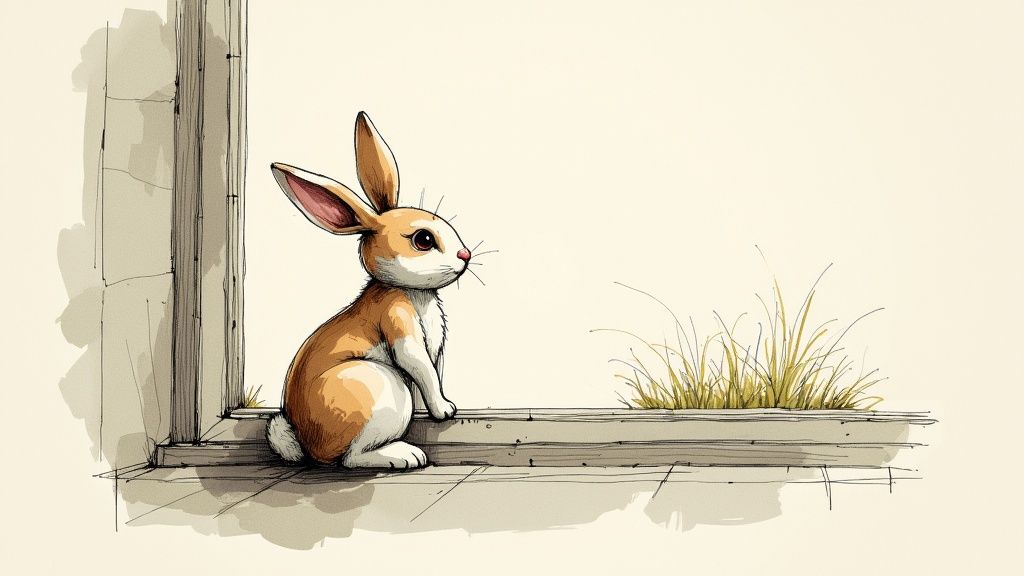
His perfect, predictable world is shattered when he’s accidentally tossed overboard a ship and sinks to the bottom of the ocean. This single moment kicks off a remarkable, decades-long journey. From the depths of the sea to the loving hands of a fisherman, a wandering hobo, and a sick child, Edward is forced to see life from perspectives he never could have imagined.
The Path to an Open Heart
Edward’s adventure isn’t just about changing locations; it’s about a complete internal shift. Each new person he meets and every challenge he faces chips away at his cold, china heart, teaching him lessons he never could have learned sitting in Abilene's dollhouse. He finally discovers what it means to care deeply for someone else—and the immense pain that comes when that connection is broken.
We're going to trace Edward's path together, breaking down the key stages of his evolution:
- A Life of Comfort: We'll start by looking at his initial selfishness and total inability to love.
- The Pain of Loss: Then, we'll follow his journey through hardship, loneliness, and separation.
- The Capacity for Love: We'll see how different relationships teach him empathy and compassion.
- A Final Redemption: Finally, we’ll explore his ultimate return to a life of connection.
To give you a quick overview, here’s a look at the major stops on Edward's long road home.
Edward Tulane's Journey at a Glance
This table breaks down the key phases of Edward’s transformation, showing who he was with, where he was, and what he learned along the way.
| Stage of Journey | Owner(s) | Setting | Core Lesson Learned |
|---|---|---|---|
| The Vain Rabbit | Abilene Tulane | The Tulane Family Home | His initial state of self-absorption and inability to feel love for others. |
| Lost at Sea | N/A (alone) | The Bottom of the Ocean | The first taste of helplessness, loneliness, and the beginning of reflection. |
| The Fisherman's Friend | Lawrence & Nellie | A Fisherman's Cottage | The warmth of simple, unconditional love and being cared for as "Susanna." |
| The Hobo's Companion | Bull & Lucy (the dog) | Hobo Camps & Freight Trains | The meaning of camaraderie, storytelling, and shared hardship as "Malone." |
| A Brother's Love | Bryce & Sarah Ruth | A Shack in Memphis | The profound, selfless love for a dying child and the agony of heartbreak. |
| The Broken Toy | N/A (broken) | A Doll Mender's Shop | The depths of despair, giving up on love, and eventually, the rekindling of hope. |
| The Return Home | The Grown-Up Abilene | A Toy Shop | The culmination of his journey: finding his way back to love after all his loss. |
Each step, no matter how painful, was essential in turning a hollow toy into a being capable of immense love.
At its core, the story delivers a powerful message: opening your heart, even with the risk of loss, is the most important journey anyone can take. It’s a lesson that has resonated with readers of all ages since its publication in 2006.
Meet the Storyteller: Kate DiCamillo
To really get to the heart of The Miraculous Journey of Edward Tulane, you have to understand the incredible storyteller who dreamed him up. Kate DiCamillo has a rare talent for writing stories that feel like they're speaking directly to you, weaving together moments of deep sorrow and powerful hope in a way that sticks with readers of all ages.
Born in Philadelphia and raised in Florida, DiCamillo’s journey to becoming a beloved author wasn't a straight line. She actually spent time working in a book warehouse in Minneapolis, an experience that surrounded her with stories and fueled her own desire to write. You can see how that time gave her a unique feel for the magic of books and their power to bring people together.
DiCamillo’s Unique Voice
What makes a Kate DiCamillo book so special? It's her elegant, simple, and emotionally honest style. She never shies away from tough subjects like loneliness, grief, or loss. Instead, she explores them with a gentle touch and real compassion, always making sure there’s a glimmer of hope on the horizon.
Her characters are often the forgotten ones—lonely kids, misplaced toys, or quirky animals—who discover where they belong through the most unexpected friendships. This is what has made her one of the most respected voices in children's literature today.
DiCamillo’s stories, filled with animals, oddballs, and brave hearts, have traveled far because they speak to something true in all of us. In every story, she gives us a reason to believe that kindness matters and that love, even in its simplest forms, can save us.
A Legacy of Acclaimed Storytelling
There's no question about DiCamillo's impact. She's one of only seven authors in history to have won two Newbery Medals, which is basically the top honor in American children's literature. She won her first for The Tale of Despereaux in 2004 and her second for Flora & Ulysses in 2014.
With over 37 million books in print worldwide and translations into more than 20 languages, her stories have clearly found a home in the hearts of readers everywhere. You can learn more about her celebrated career on Wikipedia.
Her gift for writing tales that are both timeless and deeply personal is what makes her work—including The Miraculous Journey of Edward Tulane—so powerful. Her masterful storytelling cements her place as an author whose books will be passed down and cherished for generations to come.
Mapping Edward's Physical and Emotional Transformation
Edward Tulane’s story isn’t a single event, but a long, winding road where his physical travels perfectly mirror his inner growth. At its heart, The Miraculous Journey of Edward Tulane is a map of a heart learning to feel.
We first meet Edward as a pristine, self-centered china rabbit who exists only to be admired. He lives in a lovely home with a girl named Abilene who adores him, yet he feels absolutely nothing in return. His world is small, his heart completely closed. He’s an object of affection, but he’s totally incapable of giving it back.
This comfortable, insulated existence is shattered when he’s lost at sea, which kicks off his real journey. Sinking to the ocean floor, alone in the dark for 297 days, Edward experiences his first real emotions: fear and a longing for connection he never knew he was missing.
From the Sea to Newfound Shores
When a storm finally frees him from the ocean depths, he’s found by a kind fisherman named Lawrence. Lawrence brings him home to his wife, Nellie, who bathes him, puts him in a girl's dress, and names him Susanna. For the very first time, Edward is treated not just as a toy but as a member of a loving family. He listens to their conversations, their worries, and their joys.
This period is critical. Nellie and Lawrence talk to him, sharing their lives in a way that forces Edward to become a silent confidant. He actually starts to care for them, a startling new sensation. But like every stage of his journey, this comfort is temporary. Their daughter, Lolly, seething with jealousy, cruelly tosses him in a garbage dump, thrusting him right back into a world of neglect and loss.
This timeline of author Kate DiCamillo's career highlights some key moments, including the publication of Edward Tulane in 2006.
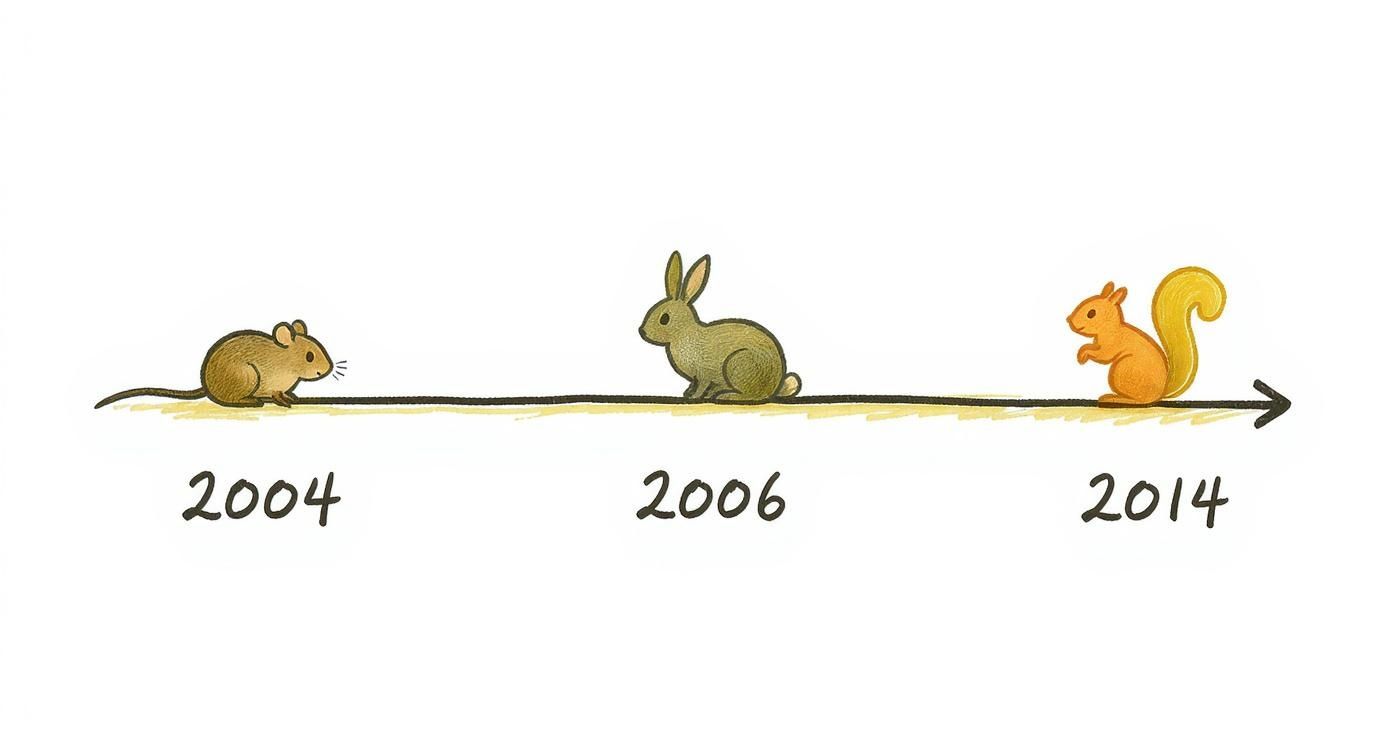
As the graphic shows, The Miraculous Journey of Edward Tulane sits right between her two Newbery Medal-winning books, cementing this era as a particularly significant period in her celebrated career.
Companionship on the Rails
From the trash heap, Edward is discovered by a hobo named Bull and his dog, Lucy. Renamed Malone, Edward joins them on their travels, riding the rails and sitting by campfires. With Bull, Edward learns about a completely different kind of life—one of hardship, sure, but also one of deep companionship and shared stories. He hears the names of Bull's lost children whispered into his china ears at night.
This phase teaches Edward about camaraderie and shared sorrow. He is no longer just a listener; he is a companion who provides silent comfort to a man who has lost everything. This experience deepens his capacity for empathy, preparing him for his most heartbreaking and important lesson yet.
"If you have no intention of loving or being loved, then the whole journey is pointless." - Pellegrina's warning to Edward at the start of the novel.
This chilling advice from Abilene's grandmother becomes the central theme of Edward's entire existence, echoing through every stage of his painful but necessary education in love.
The Ultimate Lesson in Love and Loss
Edward's time with Bull comes to an end when a cruel railroad guard kicks him off a train. He is then found by a young boy named Bryce, who takes him home to his desperately ill sister, Sarah Ruth. For Sarah Ruth, Edward is not a toy; he is a friend, a comfort, and something to hold onto as her life fades.
Here, Edward's heart cracks wide open. He loves Sarah Ruth with a fierce, protective love he never imagined possible. When she dies, his grief is so profound that he welcomes the moment Bryce smashes him against a diner counter, shattering his china body.
Broken physically, he feels his emotional journey is over. He decides he never wants to love again. It is only in a doll mender's shop, painstakingly repaired, that he slowly, cautiously, learns to hope once more, finally completing his miraculous journey.
The people Edward meets are far more than just plot devices; they are the chisels that sculpt his heart. Each one leaves an indelible mark, teaching him a new facet of love, loss, and connection.
Key Characters and Their Impact on Edward
| Character | Role in Edward's Life | Impact on Edward's Transformation |
|---|---|---|
| Abilene | Edward's first owner | Introduces Edward to devoted, one-sided love. He is cherished but feels nothing, establishing his initial state of arrogance. |
| Nellie & Lawrence | Fisherman and his wife | Treat Edward like a child (Susanna). They are the first to make him feel like a listener and a part of a family, sparking his first stirrings of affection. |
| Bull & Lucy | A hobo and his dog | Show Edward (Malone) a life of hardship, friendship, and shared grief. He learns about companionship and the comfort of silent presence. |
| Sarah Ruth | A terminally ill child | The first person Edward truly and deeply loves. Her love and subsequent death break his heart completely, teaching him the profound pain of loss. |
| Bryce | Sarah Ruth's older brother | Demonstrates desperate, sacrificial love. His actions, born of grief, lead to Edward's physical destruction, which mirrors his emotional shattering. |
These encounters, from the gentle to the brutal, are what transform Edward from a hollow object into a being with a rich, feeling soul. They show us that it’s our connections with others, no matter how fleeting, that truly make us who we are.
Unpacking the Core Themes of Love and Loss
At its heart, The Mirac-ulous Jour-ney of Edward Tulane is a deep dive into two of life’s most powerful forces: love and loss. Kate DiCamillo skillfully uses Edward's story to explore a truth that hits home for readers of any age. A life without love feels empty, but opening yourself up to it means you also risk getting hurt.

This central idea is planted right at the beginning with the cautionary fairy tale told by Abilene’s grandmother, Pellegrina. Her story about a beautiful princess who couldn't love—and met a terrible end because of it—acts as a grim forecast for Edward. He, too, is beautiful and admired, but he's completely unable to give any affection back. Pellegrina’s parting words to him, “You disappoint me,” really set the stage for his whole journey, which becomes a long, hard answer to her warning.
The Many Forms of Love
Edward's education in love isn’t a single, simple lesson. Instead, it’s a series of intensely personal encounters, each one showing him a different side of what it means to connect with someone. He experiences several distinct types of love that slowly chip away at his cold, china exterior.
- Devotion: Abilene’s love is pure and doting, but Edward is far too self-absorbed to really appreciate it. This is the kind of love we often take for granted.
- Companionship: With the fisherman Lawrence and his wife Nellie, Edward feels the warmth of simple, steady care. They talk to him and make him a part of their daily lives, teaching him the quiet comfort of belonging to a family.
- Camaraderie: Bull the hobo treats Edward not as a toy, but as a fellow traveler and someone he can trust with his secrets. This relationship introduces Edward to a love built on shared struggles and mutual respect.
- Selfless Love: His connection with the dying Sarah Ruth is the most powerful of all. It’s here that Edward finally learns to love someone else more than himself, and in doing so, he feels the soul-crushing agony of loss when she passes away.
This progression is no accident. It carefully moves Edward from being a passive object of affection to an active participant in a loving relationship. His journey makes it clear that love isn’t just a feeling; it’s an action, a choice to care for another being with your whole heart.
The Inevitability of Loss
DiCamillo doesn't shy away from the hard truth: love and loss are two sides of the same coin. For Edward to truly learn how to love, he must also go through being lost, abandoned, and literally broken. Every single time he starts to open his heart, he is violently torn away from the ones he's come to care about.
“Someone will come for you, but first you must open your heart... someone will come. Someone will come for you.”
This powerful quote, spoken by an old doll in the repair shop, really gets to the core message of the book. After Bryce shatters him, Edward is ready to close his heart for good, convinced that the pain of loss is just too much to bear.
But the novel argues that shutting yourself off from love is the real tragedy. The "miracle" of his journey isn't just that he survived; it's that he eventually becomes willing to risk heartbreak all over again. The story acts as a gentle guide for young readers, making it one of the most effective books that teach empathy and emotional resilience. In the end, Edward’s story shows us that a mended heart, even with its scars, is far stronger and more capable of love than one that has never been broken at all.
Why Edward Tulane Is a Modern Literary Classic
What really makes a children’s book a classic? It’s a special kind of magic, and for The Miraculous Journey of Edward Tulane, that magic comes from a perfect mix of beautiful writing, raw emotional honesty, and big ideas that stick with you long after you’ve grown up. This isn't just a story to keep kids entertained; it’s one that genuinely deepens our understanding of the human heart.
So many books for young readers dance around tough feelings like grief, loneliness, and even despair. Not this one. Kate DiCamillo walks right up to them with incredible grace, showing us that being vulnerable isn't a weakness—it's actually a core part of living a full life. That sophisticated touch is a huge reason the book connects with everyone, from kids to grandparents, making it an absolute gem to read aloud as a family.
Lasting Literary Impact
From the moment it hit the shelves in 2006, the book world knew this one was different. The novel quickly started collecting some of the most respected awards in children's literature, a clear sign of its power and importance.
Its list of honors is impressive, including the Boston Globe–Horn Book Award for fiction, a Parents' Choice Award, and being named an ALA Notable Children's Book. This wasn't just a popular book; it was a critically celebrated one. You can get a better sense of its incredible reception and explore additional book insights if you're curious.
All this acclaim cemented the book’s place in schools and libraries all over the world. Teachers and librarians love using it to introduce kids to more complex literary ideas and, more importantly, to kickstart conversations about empathy, resilience, and what it truly means to love. By now, it’s a fixture in school curricula, ensuring that Edward’s journey continues to find a new audience year after year.
A children’s story which is enjoyed only by children is a bad children’s story. - C.S. Lewis
C.S. Lewis really nailed it, and his words perfectly sum up Edward Tulane's magic. For a child, it's a grand, compelling adventure. For an adult, it's a moving reflection on the terrifying but beautiful risk of opening your heart to others.
A Timeless Tale of Hope
In the end, what truly makes The Miraculous Journey of Edward Tulane a modern classic is its timeless message. The story gently reminds us that even when we’ve been lost, abandoned, or broken into pieces, healing is possible. We can always find the courage to love again.
The way the story is built is a thing of beauty. Each person Edward meets, each new home he finds, is another step in his journey toward learning how to feel. This masterful storytelling makes the hopeful ending feel completely earned and deeply moving. It’s this powerful blend of gorgeous prose, emotional depth, and an unwavering message of hope that has locked in this novel’s legacy as a true cornerstone of modern children's literature.
Bringing Edward's Journey Beyond the Page
Edward Tulane's story doesn't just live on the printed page. It has found new life in all sorts of different formats, which just goes to show how deeply his emotional quest connects with people, whether they're curled up with the book or watching a performance unfold on stage.
One of the most beloved adaptations is the stage play by Dwayne Hartford. It's a real feat how this version takes the book's quiet, internal journey and turns it into a captivating experience for a live audience. The play has become a favorite for schools and community theaters, giving actors and theatergoers a chance to experience Edward's story together, in a very immediate and personal way.
Edward in the Classroom
Beyond the theater, The Miraculous Journey of Edward Tulane has become a powerful teaching tool. You'll find it in classrooms all over, where it's used to spark conversations about empathy, emotional awareness, and what makes a story tick. Its spot on school reading lists, like those for Grades 4 and 5 in Anne Arundel County Public Schools, is a testament to its educational value. You can see more about the book's widespread educational use across curriculums.
The story is a perfect jumping-off point for big, important discussions, making it one of the most effective kids' books on emotions and resilience out there.
Seeing how a story like this can morph and grow in different mediums makes you think about the evolving world of digital narratives. These new takes on Edward's tale really highlight its versatility, proving that a powerful story can make an impact no matter how you tell it.
Your Questions About Edward Tulane, Answered
Before families and teachers dive into The Miraculous Journey of Edward Tulane, a few common questions usually pop up. It’s a book that masterfully walks the line between simple prose and incredibly deep themes, so it’s natural to wonder where it fits. Let's tackle some of the big ones.
What’s the Right Age for This Book?
Generally, Edward Tulane is a perfect fit for readers between 7 and 12 years old, which lands it squarely in the 3rd to 6th-grade range. The language is straightforward enough for kids in this bracket to read on their own.
But here’s the thing: the story’s powerful exploration of love, loss, and finding hope again hits home for teenagers and adults just as much. It’s a phenomenal book to share across generations. For younger kids, or those who are more sensitive, reading it together is a great approach. It creates a space to talk through the tougher emotional moments and unpack the big feelings that come up.
Is This a Sad Story?
In a word, yes. The Miraculous Journey of Edward Tulane doesn't pull any punches when it comes to sadness. Edward’s journey is filled with painful separations, profound loneliness, and some truly heartbreaking moments of loss. These parts can be quite a lot for a young reader to navigate alone.
But—and this is a big but—the sadness serves a purpose. The overarching message of the book is one of incredible hope and redemption. It’s a beautiful, moving story that shows how loving others is always worth the risk of getting hurt. The ending brings the emotional journey to a deeply satisfying and hopeful conclusion, making every tear feel earned and meaningful.
At its heart, the story teaches that a life without love isn't really a life at all. Edward learns about empathy, the sting of loss, and the absolute beauty of connecting with others. He goes from being a self-centered, unfeeling toy to someone who understands that opening your heart is the greatest journey you can take, even if it comes with the chance of heartbreak.
Here at Number 6 Publishing, we know that stories like Edward's are vital for building empathy and starting those important family conversations. You can find more books that will stick with your family by checking out our curated collections at https://www.number6publishing.com.