
Finding the right book for a young reader can feel like discovering a hidden treasure. The perfect story can unlock new worlds, foster empathy, and ignite a lifelong passion for reading. But with countless options lining the shelves, how do you choose? This curated guide cuts through the noise, offering a comprehensive look at exceptional and recommended books for elementary students that resonate deeply with young minds.
Each selection in this list has been chosen not just for its engaging plot, but for its narrative power and emotional honesty. We will dive into timeless classics and modern marvels, exploring what makes each story so effective. This list goes beyond simple summaries, providing a practical toolkit for parents, caregivers, and educators. For each book, you will find:
- Grade and Reading Level: Clear guidance to match books with the right readers.
- Key Themes: Insights into social-emotional learning, diversity, STEM, and more.
- Classroom & Home Activities: Actionable ideas to deepen engagement and spark discussion.
Our goal is to help you select stories that become cherished parts of a child's literary journey. To truly build a lifelong love of reading, it's essential for young minds to develop strong foundational abilities. Exploring strategies to improve reading comprehension skills can transform a good reading experience into a great one, ensuring that children not only decode words but also connect meaningfully with the stories they consume. Let's explore the books that will inspire, challenge, and captivate the next generation of readers.
1. Wonder by R.J. Palacio (Grades 4-7)
R.J. Palacio's Wonder is a powerful and transformative novel that has earned its place as a modern classic in elementary and middle school classrooms. The story centers on August "Auggie" Pullman, a ten-year-old boy with a rare facial difference, as he enters a mainstream school for the first time. Told from multiple perspectives, the narrative masterfully explores themes of kindness, acceptance, bullying, and the courage it takes to be true to oneself.
This book is more than just a story; it's a vehicle for social-emotional learning (SEL). Its multi-perspective structure is a key reason it is one of the most highly recommended books for elementary students, allowing young readers to step into the shoes of not only Auggie but also his sister, his friends, and even those who are unkind to him. This fosters a deep sense of empathy and encourages critical thinking about personal impact and responsibility.
Why It Belongs on This List
Wonder has become a cornerstone for school-wide initiatives like the "Choose Kind" movement, which encourages positive social interactions and anti-bullying stances. The novel provides a safe and accessible entry point for discussing complex social dynamics, making it an invaluable resource for teachers, librarians, and parents aiming to cultivate a compassionate classroom or home environment. For a deeper look into books perfect for this age group, you can explore additional top 10 books for 4th graders.
Actionable Classroom & Home Activities
- Point-of-View Journaling: Have students write journal entries from the perspective of different characters after key events in the book. This sharpens writing skills while deepening their understanding of character motivation.
- Precept Discussions: Use Mr. Browne's precepts (like "When given the choice between being right or being kind, choose kind") as prompts for weekly discussions or writing assignments. Encourage students to find or create their own precepts to live by.
- Kindness Challenge: Create a "Kindness Jar" where students can anonymously write down acts of kindness they witness. Read them aloud at the end of each week to celebrate positive behavior and reinforce the book's central message.
2. The One and Only Ivan by Katherine Applegate (Grades 3-6)
Katherine Applegate's Newbery Medal-winning novel, The One and Only Ivan, offers a profoundly moving story based on the real-life tale of a silverback gorilla who spent decades in a shopping mall enclosure. Told from Ivan's own perspective, the narrative masterfully weaves together themes of friendship, art, memory, and the deep yearning for freedom. Its simple yet powerful prose makes complex emotions accessible to young readers.
The story follows Ivan, his elephant friend Stella, and a baby elephant named Ruby as they navigate their confined existence. When Ivan makes a promise to Stella, he finds a new purpose: using his art to communicate a message of hope and fight for a better life for Ruby. This journey of self-discovery and advocacy provides a gentle yet impactful introduction to animal welfare and conservation issues.

Why It Belongs on This List
The One and Only Ivan is one of the most highly recommended books for elementary students because it builds empathy in a unique and powerful way. By giving a voice to a non-human protagonist, Applegate encourages children to consider the world from a completely different viewpoint. The book serves as an excellent starting point for conversations about ethical responsibility, the role of zoos, and the importance of every creature's right to a dignified life, making it a staple in environmental education curricula and grade 4-5 book clubs.
Actionable Classroom & Home Activities
- Perspective Writing: Encourage students to write a short story or journal entry from the perspective of an animal they know or have observed. Ask them to think about what that animal might see, feel, and want.
- Investigate the True Story: Research the real Ivan and compare his life story to the fictionalized account. Discuss why the author might have made certain creative choices. This can be paired with watching documentaries about gorilla conservation.
- Art for a Cause: Have students create their own artwork inspired by Ivan's mission. The art could depict what "home" means to them or raise awareness for an animal welfare or environmental cause they care about.
3. Ramona Quimby series by Beverly Cleary (Grades 2-5)
Beverly Cleary’s Ramona Quimby series is a treasured collection that captures the authentic, often hilarious, and sometimes frustrating experiences of childhood with unparalleled warmth and wit. Following the spirited and misunderstood Ramona Quimby, these stories navigate the everyday adventures of family life, school, and friendships. Cleary's masterful storytelling validates the complex feelings of young children, making Ramona a friend to generations of readers.
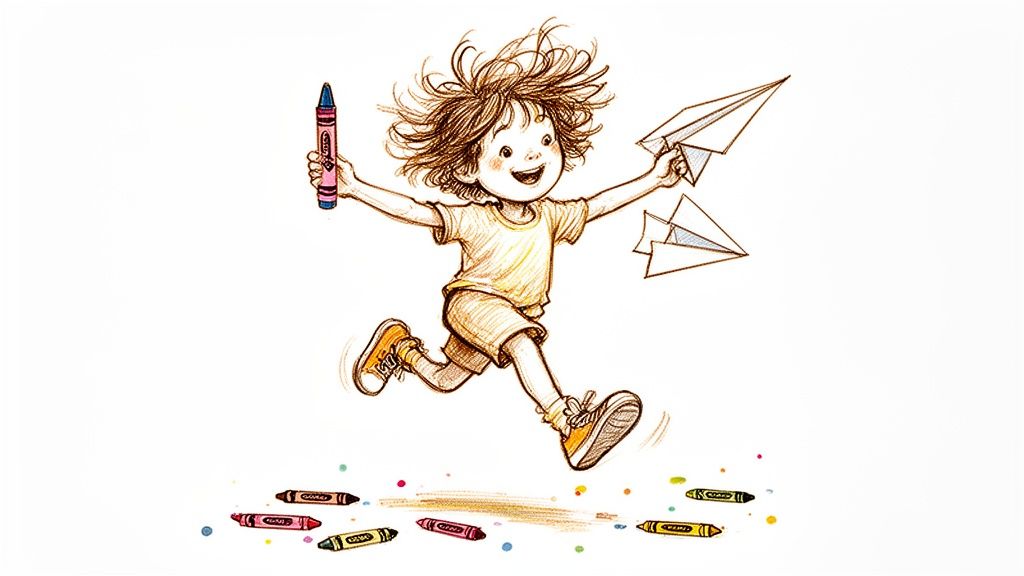
These books are essential recommended books for elementary students because they excel at portraying a child’s world from a child’s point of view. Ramona’s struggles, from being misunderstood by her teacher to navigating sibling dynamics with her sister Beezus, are deeply relatable. This authenticity provides a powerful mirror for young readers, helping them understand their own emotions and experiences while building empathy for others. The series has become a multi-generational favorite and a staple in reading intervention programs for its accessible language and engaging plots.
Why It Belongs on This List
The Ramona series serves as a perfect bridge for students transitioning into chapter books. Its enduring popularity, fueled by decades of praise from educators and Scholastic Book Clubs, speaks to its timeless appeal. The stories offer a gentle yet realistic look at family challenges, like a parent losing a job or the financial strains of daily life, presenting them in a way that is honest and reassuring for children. This makes the series an excellent tool for starting important family conversations. To find more series that captivate young readers, you can explore some of the best book series for kids.
Actionable Classroom & Home Activities
- Relatable Moments Journal: Have students create a journal to record moments when they felt just like Ramona. This "Ramona and Me" journal helps them make personal connections to the text and boosts comprehension.
- Character Trait Mapping: As students read through the series, have them create a character map for Ramona, tracking how she changes and grows from book to book. This is a great activity for guided reading groups.
- Problem-Solving Scenarios: Use Ramona's predicaments as prompts for class discussions. Ask students, "What would you have done in Ramona's situation?" to encourage critical thinking and social-emotional problem-solving skills.
4. Hatchet by Gary Paulsen (Grades 5-8)
Gary Paulsen's Hatchet is a masterclass in survival fiction, captivating older elementary and middle school readers with its raw, intense narrative. The story follows 13-year-old Brian Robeson, the sole survivor of a plane crash who must learn to survive in the vast Canadian wilderness with nothing but the clothes on his back and a hatchet. This gripping tale is a powerful exploration of resilience, resourcefulness, and the profound connection between humans and nature.
This novel stands out as one of the most highly recommended books for elementary students moving into middle school because it brilliantly merges high-stakes adventure with deep introspection. As Brian confronts challenges ranging from finding food to building shelter and fending off wildlife, readers witness his transformation from a city boy into a capable survivor. The narrative is a compelling study of problem-solving and the psychological strength required to overcome immense adversity.
Why It Belongs on This List
Hatchet is a literary rite of passage that challenges readers to think critically about their own capabilities and priorities. It serves as a perfect vehicle for teaching essential literary elements like person vs. nature conflict, character development, and theme. The book's straightforward, action-driven prose makes it highly accessible, even for reluctant readers, while its emotional depth provides ample material for rich classroom discussion and analysis.
Actionable Classroom & Home Activities
- Survival Skills Research: Assign students to research a real-world survival skill mentioned in the book, such as making a fire, finding a source of fresh water, or building a lean-to shelter. They can present their findings to the class, connecting fiction to practical knowledge.
- Character Development Map: Have students create a visual timeline or a "before and after" chart tracking Brian's physical, mental, and emotional changes throughout the story. This helps them analyze how the setting and plot directly influence his development.
- "What If?" Scenarios: Pose hypothetical challenges to students (e.g., "What if the hatchet was lost? What if Brian encountered another person?"). This encourages creative problem-solving and a deeper engagement with the narrative's core themes of self-reliance and adaptation.
5. Pax by Sara Pennypacker (Grades 4-7)
Sara Pennypacker's Pax is a profoundly moving and beautifully written novel that explores the unbreakable bond between a boy and his fox against the backdrop of an impending war. The story follows twelve-year-old Peter, who is forced to abandon his beloved pet fox, Pax, in the wild. What follows are two parallel journeys: Peter’s determined quest to reunite with his friend, and Pax’s struggle for survival in an unfamiliar world.
This book is a masterclass in narrative structure and emotional honesty, making it one of the most compelling recommended books for elementary students. By alternating between Peter's and Pax's perspectives, Pennypacker invites readers to deeply consider themes of loyalty, loss, the cost of war, and the profound connections we share with the natural world. This dual-narrative approach fosters a unique form of empathy, challenging students to understand conflict and survival from both human and animal viewpoints.
Why It Belongs on This List
Pax stands out for its sophisticated and gentle handling of complex, mature themes, making it an excellent bridge for older elementary students moving toward more challenging literature. The novel is frequently used in social-emotional learning curricula to facilitate discussions about difficult topics like separation, duty, and the consequences of human actions. Its powerful message about empathy and connection resonates deeply, providing a rich text for both classroom and at-home reading.
Actionable Classroom & Home Activities
- Dual-Perspective Diary: Have students keep a two-sided journal, writing entries from both Peter's and Pax's points of view after each chapter. This exercise helps them track the characters' emotional and physical journeys simultaneously.
- Theme Tracking: Create a chart to track key themes such as loyalty, war, nature, and truth. Students can add examples from the text as they read, fostering critical analysis skills.
- Survival Skills Research: Prompt students to research the real-life survival skills a red fox like Pax would need. This activity connects the fictional narrative to biology and environmental science, adding a practical STEM component to the reading experience.
6. The Wild Robot by Peter Brown (Grades 3-6)
Peter Brown’s The Wild Robot is a captivating and thought-provoking story that seamlessly merges science fiction with the natural world. The novel begins when a robot, ROZZUM unit 7134 or "Roz," washes ashore on a remote island. With no memory of her purpose, Roz must learn to survive in the wilderness by observing and adapting to the behaviors of the island’s animal inhabitants. Her journey takes an unexpected turn when she adopts an orphaned gosling, leading her to discover the true meaning of family, community, and belonging.
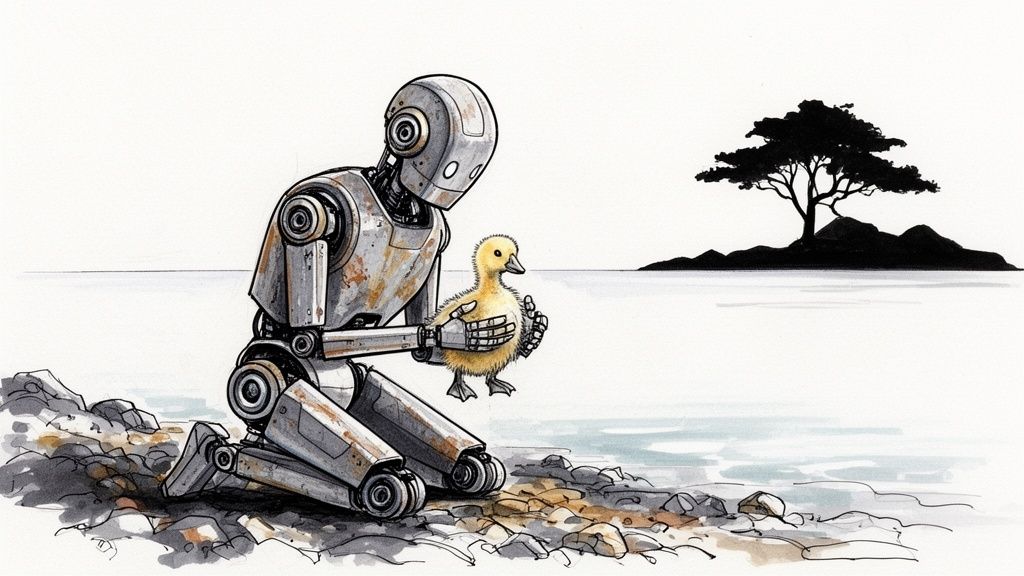
This book is a standout because it explores complex themes of technology versus nature, adaptation, and what constitutes a family, all within an accessible and engaging narrative. Roz’s evolution from a programmed machine to a caring, maternal figure offers a powerful lesson on empathy and connection. It challenges students to think critically about intelligence, consciousness, and the definition of life itself, making it one of the most uniquely imaginative and recommended books for elementary students.
Why It Belongs on This List
The Wild Robot is a cornerstone text for integrated STEAM (Science, Technology, Engineering, Arts, and Math) curricula. Its story provides a natural bridge between literature and scientific concepts like animal behavior, ecosystems, and robotics. The book’s short chapters and interspersed illustrations make it an excellent choice for read-alouds, independent reading, and reluctant readers, fostering both a love for stories and a curiosity about the world.
Actionable Classroom & Home Activities
- Ecosystem Dioramas: Have students build dioramas of the island ecosystem from the book. This hands-on project helps them visualize the environment and understand the interdependent relationships between the different animal characters and their habitats.
- "What Makes a Family?" Discussion: Use Roz and Brightbill’s relationship as a starting point for a conversation about non-traditional families and the idea that family is defined by love and care, not biology. Students can draw or write about what makes their own family special.
- Robot Design Challenge: Challenge students to design their own "wild robot" suited for a different environment (desert, arctic, etc.). They should consider what adaptations their robot would need to survive and interact with local wildlife, combining creativity with engineering principles.
7. Bridge to Terabithia by Katherine Paterson (Grades 4-7)
Katherine Paterson's Bridge to Terabithia is a poignant and unforgettable Newbery Medal winner that has been a staple in upper elementary and middle school classrooms for decades. The novel follows the deep friendship between Jess Aarons and Leslie Burke, two imaginative outsiders who create a magical kingdom named Terabithia in the woods. Their sanctuary allows them to escape the difficulties of their real lives until an unexpected tragedy forces Jess to confront profound grief and loss.
This book is a masterclass in emotionally honest storytelling, offering young readers a gentle yet powerful exploration of friendship, imagination, and the complexities of human feeling. It doesn't shy away from difficult topics, instead providing a framework for students to understand and process sorrow in a supported way. Its inclusion in this list of recommended books for elementary students is due to its unparalleled ability to foster emotional intelligence and empathy.
Why It Belongs on This List
Bridge to Terabithia provides an essential, age-appropriate introduction to the concept of grief, making it a vital resource for social-emotional learning. The story validates the power of imagination as a coping mechanism and celebrates the kind of transformative friendship that leaves a lasting impact. For educators and parents, it serves as a powerful tool to open conversations about life's most challenging moments, teaching children that it is possible to find strength and hope even after loss.
Actionable Classroom & Home Activities
- Mapping Terabithia: Encourage students to draw or build a map of Terabithia based on the descriptions in the book. This creative activity helps them engage with the setting and understand its importance to Jess and Leslie.
- Symbolism Hunt: Use the book to teach literary devices like symbolism. Discuss what the bridge, the creek, and Terabithia itself represent. This builds critical reading skills while deepening comprehension.
- Guided Journaling on Friendship: Provide safe, structured journal prompts about friendship. Ask students to write about a time a friend helped them, what makes a good friend, or how they can honor a friendship, connecting their own experiences to the novel's themes.
8. The Tale of Despereaux by Kate DiCamillo (Grades 3-6)
Kate DiCamillo’s Newbery Medal-winning novel, The Tale of Despereaux, is a modern fairy tale that enchants readers with its lyrical prose and timeless themes. The story follows Despereaux Tilling, a small mouse with unusually large ears, who falls in love with a human princess and dares to dream beyond the confines of his world. Woven together with the parallel stories of a rat named Roscuro and a servant girl, Miggery Sow, the narrative explores courage, love, forgiveness, and redemption.
This book is a masterclass in storytelling, blending adventure, fantasy, and profound emotional depth. DiCamillo’s unique narrative voice, which directly addresses the reader, creates an intimate and engaging read-aloud experience. It's one of the most highly recommended books for elementary students because it respects their intelligence, presenting complex characters and moral questions in a way that is both accessible and thought-provoking. The intricate plot encourages readers to make connections between seemingly disparate storylines.
Why It Belongs on This List
The Tale of Despereaux stands out for its sophisticated language and classic literary feel, making it an excellent bridge to more complex novels. It provides a rich opportunity to discuss literary elements like theme, character development, and narrative structure. The book’s central message, that even the smallest and most unlikely individual can be brave and change the world, is both empowering and inspirational for young readers navigating their own sense of identity and purpose.
Actionable Classroom & Home Activities
- Character Web: Create a large character web on a poster board that connects Despereaux, Princess Pea, Roscuro, and Miggery Sow. As you read, add details about their motivations, fears, and how their actions impact one another.
- "Light vs. Dark" Thematic Discussion: Use a Venn diagram to compare the literal and figurative concepts of light and darkness in the story. Discuss how characters like Despereaux seek the light while others, like Roscuro, are drawn to the darkness, and what these choices represent.
- Fairy Tale Comparison: Read a classic fairy tale, like Cinderella or Rapunzel, alongside the novel. Have students chart the similarities and differences in plot, character archetypes, and morals to understand how DiCamillo uses and subverts genre conventions.
9. The Book Scavenger by Jennifer Chambliss Bertman (Grades 4-7)
Jennifer Chambliss Bertman’s The Book Scavenger is a thrilling modern mystery that perfectly captures the magic of reading. The story follows twelve-year-old Emily as she moves to San Francisco, the home of her literary idol, Garrison Griswold. Griswold is the mastermind behind an online game called Book Scavenger, where books are hidden across the country for others to find. When Griswold is attacked, Emily and her new friend James stumble upon a mysterious, unpublished book that might be the key to a new, epic game.
This novel is a brilliant celebration of books, puzzles, and friendship. It masterfully weaves together ciphers, codes, and literary history, creating an interactive reading experience that encourages problem-solving and critical thinking. The fast-paced plot and engaging characters make it an excellent choice for readers who love adventure and a good puzzle, positioning it as one of the most uniquely engaging recommended books for elementary students who enjoy interactive stories.
Why It Belongs on This List
The Book Scavenger promotes reading not as a passive activity, but as an exciting, real-world adventure. It’s a fantastic tool for librarians and teachers aiming to ignite a passion for books in reluctant readers by connecting literature to games and exploration. The story also beautifully highlights the importance of collaboration and intellectual curiosity, as Emily and James must work together to decipher the clues, making it a perfect pick for fostering a love of learning and teamwork.
Actionable Classroom & Home Activities
- Create a Classroom Scavenger Hunt: Design a simple scavenger hunt using book-related clues or simple ciphers. Hide a "prize" book in the school library or classroom to replicate the excitement of the novel's central game.
- Code-Breaking Sessions: Introduce students to basic ciphers mentioned in the book, like a Pigpen cipher or a book cipher. Have them write and decode secret messages to one another, integrating problem-solving with literacy.
- Map the Adventure: Use a map of San Francisco to track Emily and James's journey as they solve clues. This activity connects the story to real-world geography and helps students visualize the setting, enhancing comprehension and engagement.
10. Out of My Mind by Sharon M. Draper (Grades 4-7)
Sharon M. Draper's Out of My Mind is a profoundly moving and essential novel that gives voice to the unheard. The story is narrated by Melody Brooks, an eleven-year-old girl with cerebral palsy who is nonverbal and uses a wheelchair. Though she has a brilliant, photographic memory, her physical limitations cause everyone around her, including her teachers and doctors, to underestimate her intelligence.
This book is a masterclass in perspective-taking, immersing readers directly into Melody’s rich inner world and her intense frustration at being unable to communicate. When Melody gets a communication device, her world opens up, but she still faces the daunting challenges of ignorance and prejudice. Draper's narrative powerfully explores themes of inclusion, self-advocacy, disability representation, and the true meaning of intelligence.
Why It Belongs on This List
Out of My Mind is a critical addition to any elementary library because it directly challenges preconceived notions about disability. It serves as a powerful catalyst for conversations about accessibility, empathy, and treating every individual with dignity. The novel stands as one of the most highly recommended books for elementary students for its ability to build genuine understanding and champion inclusivity, making it a cornerstone for fostering a compassionate school culture. For more resources, explore our guide to books about social-emotional learning.
Actionable Classroom & Home Activities
- Communication Exploration: Research different types of augmentative and alternative communication (AAC) devices. Have students reflect on how technology can bridge communication gaps and discuss the importance of listening with more than just your ears.
- "Inclusion Team" Scenario: Present students with a scenario where a new student like Melody joins their class. Have them brainstorm specific, actionable ways they could be a good friend and ensure the classroom environment is welcoming and accessible for everyone.
- Advocacy Poster Project: Ask students to create posters that highlight the book's key messages, such as "Don't judge a book by its cover" or "Everyone deserves a voice." Display these posters to reinforce the themes of acceptance and understanding.
Top 10 Elementary Book Comparison
| Title | 🔄 Implementation complexity | ⚡ Resource requirements | 📊 Expected outcomes | 💡 Ideal use cases | ⭐ Key advantages |
|---|---|---|---|---|---|
| Wonder (R.J. Palacio) | Moderate — needs guided discussion on bullying/sensitivity | Moderate — teacher guides, time for discussions | Strong empathy, improved perspective-taking | SEL, anti-bullying programs, book clubs | ⭐ High emotional impact; multi-perspective teaching |
| The One and Only Ivan (K. Applegate) | Low–Moderate — read‑aloud friendly; prepare for bittersweet themes | Low — accessible text, illustrations, conservation supplements | Increased compassion for animals; conservation awareness | Read‑alouds, animal-welfare lessons, book clubs | ⭐ Award-winning, emotionally resonant |
| Ramona Quimby series (B. Cleary) | Low — episodic, easy to sequence in lessons | Low — short texts, minimal prep for guided reading | Builds reading confidence and stamina; relatable social skills | Early elementary guided reading, interventions | ⭐ Timeless humor and relatability |
| Hatchet (G. Paulsen) | Moderate — prepare for intense survival scenes and pacing | Moderate — background on survival; cross-curricular ties | Strong problem-solving, resilience, engagement for reluctant readers | Middle-school curriculum, outdoor education, genre study | ⭐ Tension-driven narrative that teaches perseverance |
| Pax (S. Pennypacker) | Moderate — dual narrative needs scaffolding for younger readers | Moderate — discussion guides; prep for themes of war/separation | Deeper empathy for displacement; nuanced emotional insight | SEL, refugee-awareness units, literature circles | ⭐ Lyrical prose with balanced dual perspectives |
| The Wild Robot (P. Brown) | Low–Moderate — accessible but includes ecological/philosophical ideas | Low — illustrations support comprehension; STEAM resources available | Encourages STEM curiosity, environmental empathy, family discussions | STEAM integration, ecosystem units, read‑alouds | ⭐ Illustrated, appeals to visual and STEM learners |
| Bridge to Terabithia (K. Paterson) | Moderate — requires careful emotional preparation for grief | Moderate — counseling support useful; creative activities recommended | Helps process grief; builds imagination and resilience | Grief counseling, imagination/creative writing units | ⭐ Deep emotional resonance; literary merit (Newbery) |
| The Tale of Despereaux (K. DiCamillo) | Low–Moderate — multiple storylines but read‑aloud friendly | Low — illustrations aid comprehension; vocabulary supports | Fosters empathy, moral reflection, language development | Read‑alouds, fairy‑tale units, vocabulary lessons | ⭐ Lyrical fairy‑tale style with redemption themes |
| The Book Scavenger (J. C. Bertman) | Moderate — puzzle elements need facilitation for some readers | Moderate — puzzle materials, possible location activities | Boosts curiosity, analytical skills, reading enthusiasm | Library programs, mystery units, classroom scavenger hunts | ⭐ Engaging, encourages real‑world exploration and book love |
| Out of My Mind (S.M. Draper) | Moderate–High — sensitive disability topics require careful facilitation | Moderate — disability-awareness resources and discussion planning | Strengthens advocacy, inclusion, deep empathy for communication differences | Disability-awareness curricula, SEL, inclusion programs | ⭐ Powerful, authentic voice offering rare representation |
Turn the Page to a New Adventure
The journey through the ten books detailed in this guide is more than just a reading list; it’s an expedition into the heart of what makes stories so powerful. From the profound empathy learned alongside Auggie Pullman in Wonder to the raw survival instincts discovered with Brian in Hatchet, each narrative serves as a critical building block in a child's emotional and intellectual development. The selection of recommended books for elementary students presented here was curated to open doors to complex themes like resilience, friendship, loss, and the courage to be different.
As we've explored, these stories are not passive experiences. They are active invitations for young readers to ask questions, challenge their perspectives, and see the world through a new lens. The journey with Ivan the gorilla teaches compassion for all living things, while Leslie and Jess in Bridge to Terabithia show us the transformative power of imagination and the deep ache of grief. These are not just adventures on a page; they are life lessons wrapped in compelling prose.
Actionable Takeaways for Parents and Educators
The true magic happens when these stories leap from the book and into real-world conversations and activities. To make the most of this list, consider these key takeaways:
- Connect Reading to Real-World Empathy: Use books like Out of My Mind and Wonder as springboards for discussions about inclusivity and disability. Ask your child or student: "How can we make our classroom or community more welcoming for everyone, like the characters in the book tried to do?"
- Embrace the Tough Topics: Don't shy away from the difficult themes presented in books like Pax or Bridge to Terabithia. These narratives provide a safe, structured way to talk about complex emotions like loss, conflict, and separation. Use the suggested discussion prompts to guide these sensitive but vital conversations.
- Extend the Learning Beyond the Page: The journey doesn't end with the final chapter. For a book like The Wild Robot, explore simple robotics with a STEM kit. After reading The Book Scavenger, create your own literary scavenger hunt in your neighborhood or school library. These hands-on activities cement the book's themes and make reading an interactive adventure.
- Champion Reader Choice: While this list provides a strong foundation of recommended books for elementary students, its ultimate purpose is to spark a love of reading. Use these titles as a starting point, but pay close attention to what resonates with your young reader. If they love Gary Paulsen's survival tales, introduce them to other adventure stories. If Ramona Quimby's antics make them laugh, explore other humorous, character-driven series.
Building a Lifelong Love of Reading
The goal of introducing children to high-quality literature isn't just to improve their reading level; it's to cultivate a lifelong relationship with stories. When a child finds a book that feels like it was written just for them, it creates a powerful, positive association with reading that can last a lifetime. This list is a toolkit designed to help you facilitate that connection.
By actively engaging with these titles, using the classroom tips, and exploring the "read-alike" suggestions, you are not just teaching a child to read. You are showing them how to navigate their own world with more kindness, think more critically about the challenges they face, and find joy and solace in the boundless worlds that books offer. The adventure that begins with a single recommendation can lead to a future filled with curiosity, understanding, and an endless appetite for learning. The next chapter is theirs to write.
As a family-run publisher, Number 6 Publishing is dedicated to creating the kind of unforgettable stories that spark a child's imagination and nurture their emotional growth. We believe the right book can change a life, which is why we craft compelling narratives that resonate with young readers. Explore our catalog of award-winning titles and discover your child's next favorite adventure at Number 6 Publishing.