
First grade is a transformative year where the squiggles on a page magically morph into worlds of wonder, friendship, and adventure. For educators and parents, the goal isn't just to teach children how to read, but to foster a deep, lifelong love for stories. But how do we move beyond rote memorization and make reading an exciting, joyful experience? The key lies in varied, engaging, and purposeful reading activities that meet young learners where they are, building both confidence and competence.
This guide provides a curated collection of 10 powerful reading activities for first grade, designed to build essential skills in phonics, fluency, and comprehension while sparking genuine curiosity. Central to a first grader's reading adventure is the development of strong comprehension, which can be significantly boosted through effective active reading strategies from the very beginning.
Each activity is detailed with practical, step-by-step implementation plans, differentiation tips for diverse learners, and ways to connect with emotionally resonant stories, like those from Number 6 Publishing. Our goal is to ensure that every child can find their place in the world of books. This comprehensive list moves beyond theory to offer actionable strategies for the classroom and home. From guided reading and interactive read-alouds to buddy reading and phonics games, you will find a wealth of ideas to support your young readers. Let's dive into the strategies that will turn your first graders into confident, enthusiastic readers for life.
1. Guided Reading Groups
Guided Reading is a cornerstone of effective first-grade literacy instruction. This small-group approach involves a teacher working with 4-6 students who share similar reading levels and instructional needs. The core idea is to provide targeted support using texts that are slightly challenging but manageable, often called the students' "instructional level." This method ensures that every child receives the specific guidance they need to progress.
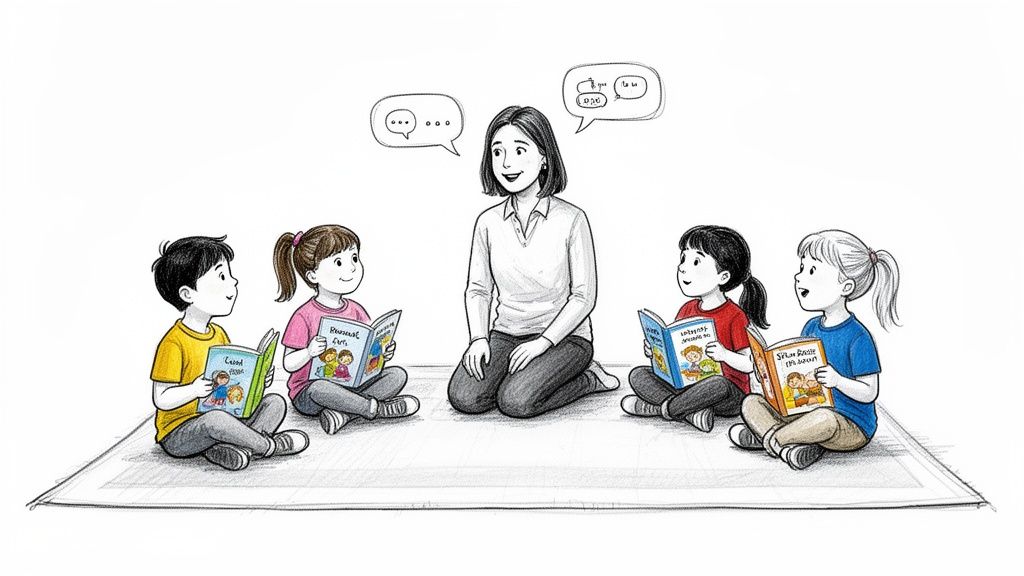
The teacher's role is to introduce vocabulary, set a purpose for reading, and offer real-time coaching as students read the text independently. This personalized attention helps first graders build confidence and apply decoding and comprehension strategies with support. It's a powerful tool for differentiated instruction, making it one of the most impactful reading activities for first grade classrooms.
How to Implement Guided Reading
A typical guided reading lesson follows a simple structure: before, during, and after reading. Before reading, introduce the book and key concepts. During reading, students read at their own pace while the teacher listens in, provides prompts, and takes notes. Afterward, a brief discussion solidifies comprehension and reinforces a specific skill.
Tips for Success
- Keep groups small and flexible. Groups of 4-6 students are ideal. Remember to adjust groupings based on ongoing assessments, as students develop at different rates.
- Use predictable texts. For early readers, books with repeating patterns and strong picture support, like many Pete the Cat stories, build confidence and fluency.
- Establish independent stations. While you meet with a group, the rest of the class should be engaged in meaningful, independent literacy centers.
- Track progress. Use running records to monitor accuracy, fluency, and comprehension. This data is crucial for planning instruction and understanding each child's needs. To better understand how to select appropriate texts, you can learn more about how guided reading levels are determined.
Guided reading provides the focused, scaffolded instruction that is essential for helping first graders become proficient, independent readers. It addresses individual needs in a way that whole-group lessons cannot, making it an invaluable part of a balanced literacy program.
2. Interactive Read-Aloud Sessions
An interactive read-aloud is far more than simply reading a story to the class. It is a purposefully planned, expressive reading of a text where the teacher models fluent reading and comprehension strategies, pausing to engage students in rich conversation. This whole-group activity is foundational for building listening comprehension, expanding vocabulary, and fostering a deep, shared love for stories, making it one of the most essential reading activities for first grade.
Unlike independent reading, this shared experience allows first graders to access complex texts and ideas above their own reading level. By hearing a skilled reader, children internalize the rhythm, intonation, and joy of storytelling. The teacher guides them to think critically about the text by asking questions, prompting predictions, and making connections, which builds the crucial comprehension skills they will later apply to their own reading.
How to Implement Interactive Read-Alouds
The magic is in the interaction. Before reading, introduce the book and do a "picture walk" to build anticipation and activate prior knowledge. While reading, pause at key moments to ask open-ended questions like, "What do you think will happen next?" or "How do you think the character is feeling right now?" Afterward, facilitate a brief discussion or a follow-up activity, such as drawing a favorite scene or acting out a part of the story.
Tips for Success
- Choose engaging books. Select stories with rich illustrations, strong narratives, and relatable characters. Books with repeating patterns, like Brown Bear, Brown Bear, What Do You See?, are perfect for encouraging participation.
- Be expressive. Use different voices for characters, vary your volume, and use facial expressions to bring the story to life and keep students captivated.
- Ask thoughtful questions. Move beyond simple recall questions and prompt students to infer, predict, and connect the story to their own lives.
- Reread favorites often. Repetition is a powerful tool for first graders. Rereading a beloved book reinforces vocabulary and deepens comprehension with each pass.
Interactive read-alouds create a vibrant community of readers and thinkers. They provide a joyful entry point into complex literacy skills and underscore the many benefits of reading aloud to children.
3. Phonics-Based Sound and Word Games
Phonics-based games transform foundational literacy skills into a joyful, interactive experience. Instead of rote memorization, these activities allow first graders to manipulate sounds and letters, building a concrete understanding of how words work. The core principle is to make learning phonics an active process, targeting everything from letter-sound recognition and blending to segmenting and building simple words. This playful approach is key to developing phonemic awareness and decoding skills.
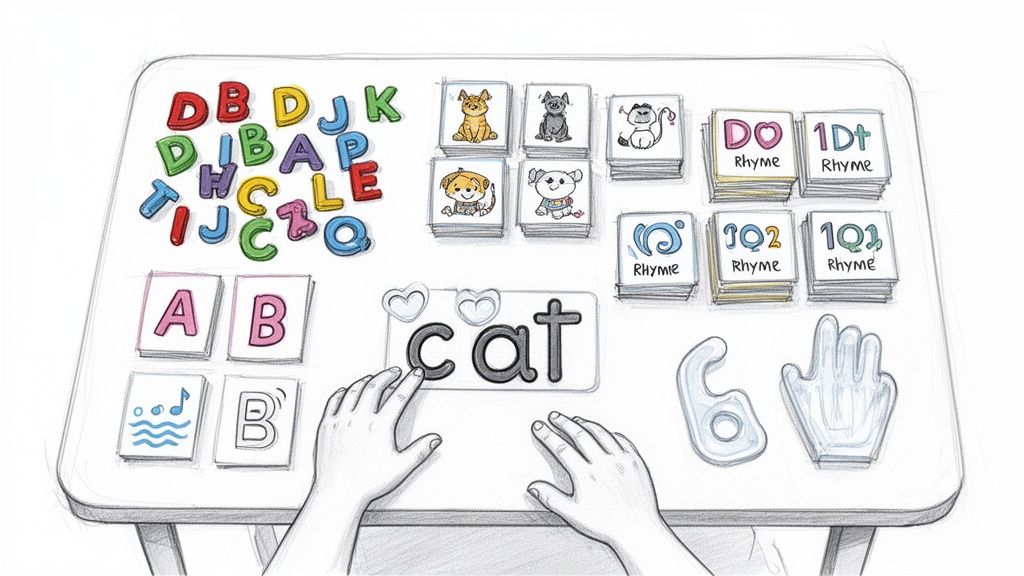
Through activities like sound scavenger hunts, rhyming memory match-ups, or building words with magnetic letters, students connect abstract phonetic concepts to tangible actions. This hands-on engagement helps solidify their understanding and makes practice feel like play. Incorporating these into daily routines provides the repetition needed for mastery, making them essential reading activities for first grade to build confident decoders.
How to Implement Phonics Games
Successful implementation involves variety and a clear connection to instruction. For example, a "sound hunt" can have students search the classroom for objects starting with the /b/ sound. Word-building games can use letter tiles or magnetic letters to create words within a specific word family, like "cat," "hat," and "mat." The goal is for the game to reinforce a specific phonics skill being taught.
Tips for Success
- Connect to Reading. Choose games that reinforce the phonics patterns found in the books students are currently reading to create a direct application of skills.
- Start Simple. Begin with games focusing on single letter-sound correspondence before moving on to more complex tasks like CVC word blending or segmenting.
- Rotate Games Regularly. Keep engagement high by introducing new games or variations of familiar ones in your literacy centers. Novelty prevents boredom and keeps practice fresh.
- Use Multi-Sensory Tools. Incorporate sand trays for letter writing, play-doh for word building, and picture cards for sorting to appeal to different learning styles.
Phonics games are incredibly effective because they provide targeted practice in a low-stakes, high-engagement format. They allow first graders to experiment with language, make mistakes, and build a strong foundation for reading fluency and comprehension without the pressure of formal drills.
4. Buddy Reading and Peer Partnerships
Buddy Reading, also known as peer-assisted learning, pairs students together to share the reading experience. This strategy can involve pairing a stronger reader with an emerging reader, matching students of similar abilities, or even partnering first graders with older students from another grade. Partners take turns reading aloud, offering support with difficult words, and discussing the story, creating a supportive and collaborative environment.
This approach helps build fluency, confidence, and comprehension in a low-stakes setting. By working with a peer, students are more willing to take risks and practice their skills without the pressure of reading in front of the whole class. This makes it one of the most effective reading activities for first grade for fostering both academic growth and positive social interactions.
How to Implement Buddy Reading
Successful buddy reading starts with clear expectations. Before pairing students, model how to be a good partner: how to listen actively, how to offer help kindly ("Let's sound it out together"), and how to ask thoughtful questions about the book. Partners can take turns reading pages, paragraphs, or even just sentences, depending on their comfort level.
Tips for Success
- Establish clear routines. Teach students specific roles, such as "Reader" and "Coach." The Coach's job is to listen and provide support, not just give the answer.
- Pair students strategically. Consider not only reading levels but also personalities. Sometimes pairing students with similar interests can be highly motivating.
- Choose appropriate texts. Select books that are engaging and at a level the pair can manage together. Books with predictable text and strong illustrations, like Elephant & Piggie books by Mo Willems, are perfect for this.
- Provide sentence starters. Give students prompts to guide their discussions, such as "My favorite part was..." or "I wonder why the character..."
Buddy reading transforms reading from a solitary task into a shared, joyful activity. It empowers students to become teachers and learners simultaneously, building a strong sense of classroom community and a shared love for stories.
5. Literacy Centers and Stations
Literacy centers are a fundamental component of a balanced literacy classroom, creating a dynamic environment where students practice skills independently. These designated areas allow first graders to rotate through various hands-on activities, reinforcing concepts from whole-group and small-group instruction. This approach fosters student independence and provides the teacher with crucial time to conduct guided reading groups.
The power of literacy stations lies in their ability to offer differentiated practice. While one group works on building CVC words with magnetic letters, another might be listening to an audiobook and drawing their favorite scene. These self-directed reading activities for first grade keep every student productively engaged in meaningful literacy work, building stamina and a sense of ownership over their learning.
How to Implement Literacy Centers
Implementation requires clear routines and explicit instruction. Begin by introducing one station at a time, modeling exactly how to use the materials and what the expectations are. A typical classroom might include a word work station (phonics), a writing station, a listening station, and a reading comprehension station. Students rotate through these in small groups over the course of a week.
Tips for Success
- Start small and build. Introduce just two or three centers at first. Once students master the routines, gradually add more complex stations to your rotation.
- Use visual directions. Create instruction cards with pictures and simple text for each station to help first graders work independently without interrupting the teacher.
- Model, model, model. Explicitly teach and practice the procedures for each center before students are expected to complete them on their own. This upfront investment saves time later.
- Keep materials organized. Use clearly labeled bins, folders, or trays for each station. This makes transitions smooth and cleanup efficient. A well-organized system is key to making centers work, a concept championed by experts like Debbie Diller.
By providing structured, independent practice, literacy centers empower first graders to apply their skills in various ways. They are an essential tool for managing a differentiated classroom and fostering a love of reading.
6. Book Tasting and Literature Circles (Adapted for First Grade)
Combining the excitement of a "book tasting" with simplified "literature circles" creates a dynamic experience that fosters a love for reading. A book tasting introduces first graders to a variety of books in a low-pressure, celebratory way. Students "sample" different texts, often organized by themes or genres, much like tasting different foods at a restaurant. This exposure builds excitement and helps children discover new interests.
Literature circles, adapted for this age, are small, student-led discussion groups. After sampling books, students can form groups to talk about a shared text. This approach empowers young readers to share their ideas, practice listening skills, and build comprehension together. It transforms reading from a solitary task into a social, engaging event, making it one of the most community-oriented reading activities for first grade.
How to Implement Book Tastings and Literature Circles
Set up stations around the classroom, each with a stack of books related to a theme like animals, friendship, or adventure. Give students a simple "menu" or placemat to jot down or draw their thoughts. After the "tasting," allow students to form small groups based on a book they all enjoyed and want to discuss further.
Tips for Success
- Curate diverse collections. Ensure the books you select represent diverse cultures, families, and abilities. Mix new titles with beloved classics to broaden their horizons.
- Provide discussion starters. Teach simple sentence stems like, "I liked when..." or "This part reminds me of..." Use visual cue cards with pictures to help guide conversations.
- Keep circles small. Start with groups of just 3-4 students to ensure everyone gets a chance to speak. The teacher can rotate between groups to facilitate and model good discussion.
- Make it a celebration. For a book tasting, add simple decorations like tablecloths and placemats. For literature circles, celebrate the end of a book discussion with a related craft or activity. To take this idea further, you can get tips on how to start a book club with young readers.
This combined approach is perfect for introducing new genres and encouraging student choice. It builds a vibrant classroom reading community where every child's voice and preference is valued.
7. Writing in Response to Reading (Interactive Writing and Shared Writing)
Connecting reading and writing is a powerful way to deepen comprehension and build communication skills. Interactive and shared writing activities involve the teacher and students composing a text together, with the teacher acting as the scribe while thinking aloud about the writing process. This collaborative approach makes writing accessible and demonstrates how thoughts and ideas from reading can be translated into written words.
The teacher guides the students, modeling everything from letter formation and spelling to sentence structure and organization. This method bridges the gap between receptive language (reading) and expressive language (writing), giving first graders the confidence to see themselves as authors. It’s an ideal way to reinforce phonics, sight words, and story structure, making it one of the most integrated reading activities for first grade.
How to Implement Writing in Response to Reading
This activity typically follows a read-aloud. After reading a book like The Very Hungry Caterpillar, the teacher might say, "Let's write about the butterfly's life cycle together." Students contribute ideas, and the teacher scribes them on an anchor chart, explicitly pointing out writing conventions along the way. For example, the class could collaboratively write a thank-you note to a guest reader or create a new ending for a familiar story.
Tips for Success
- Share the pen. In interactive writing, invite students to come up and write a known letter, sound, or word within the shared text.
- Focus on the message first. Emphasize getting ideas on paper over perfect mechanics. Celebrate all contributions to encourage risk-taking.
- Think aloud constantly. Model your writing process by saying things like, "I need a space between my words," or, "I hear the /m/ sound at the start of 'Monday,' so I'll write an M."
- Display the work. Post the co-created charts and stories in the classroom. This validates students' work and creates a print-rich environment they can reference. To learn more about this approach, educators often turn to the work of pioneers like Irene C. Fountas and Gay Su Pinnell.
Shared and interactive writing activities make the reading-writing connection visible and tangible, showing students how authors craft texts and empowering them to do the same. This supportive practice builds a strong foundation for independent writing.
8. Decodable Books and Controlled-Text Reading Practice
Decodable books are a powerful tool designed to help first graders apply their phonics knowledge in a tangible way. Unlike other texts, these books primarily feature words with phonetically consistent patterns that students have already been taught. This controlled-text approach allows young readers to practice decoding skills and build confidence by successfully sounding out words, rather than relying on guessing from pictures or memorization.
This systematic practice is crucial for developing decoding automaticity, where sounding out words becomes quick and effortless. By providing texts that are 95% decodable based on the phonics skills they know, we give students a clear pathway to reading success. This makes controlled-text reading one of the most effective reading activities for first grade to build a solid foundation for fluency.
How to Implement Decodable Reading
The key to using decodable books is aligning them directly with your phonics instruction. After a lesson on the short 'a' sound, for example, provide students with a book filled with words like "cat," "Sam," "ran," and "a." Students should first read the book independently or with a partner, focusing on sounding out each word. Subsequent re-reads can then focus on building fluency and expression.
Tips for Success
- Align with instruction. Ensure the decodable texts you use match the specific phonics skills you have recently taught. A mismatch can lead to frustration.
- Re-read for fluency. Encourage students to read the same decodable book multiple times. The first read is for accuracy, while later reads build speed and confidence.
- Keep it balanced. Decodable books are for skill practice. Continue to immerse students in rich, engaging literature through read-alouds to build vocabulary and a love for stories.
- Focus on success. The goal is for students to feel successful. Celebrate their ability to read a whole book by themselves using the skills they've learned. You can find excellent decodable reader sets through programs like the Wilson Reading System.
Using decodable books provides the targeted, systematic practice that solidifies phonics skills, transforming first graders from tentative decoders into confident, capable readers. It bridges the gap between learning letter sounds and reading connected text.
9. Dramatic Play and Story Re-enactment
Dramatic play and story re-enactment invite first graders to step inside a story, physically embodying characters and plots from books they have read. This approach turns passive reading into an active, kinesthetic experience, where students can explore a character's feelings and motivations firsthand. By acting out a story, children deepen their comprehension, build verbal fluency, and develop empathy in a playful, collaborative setting.
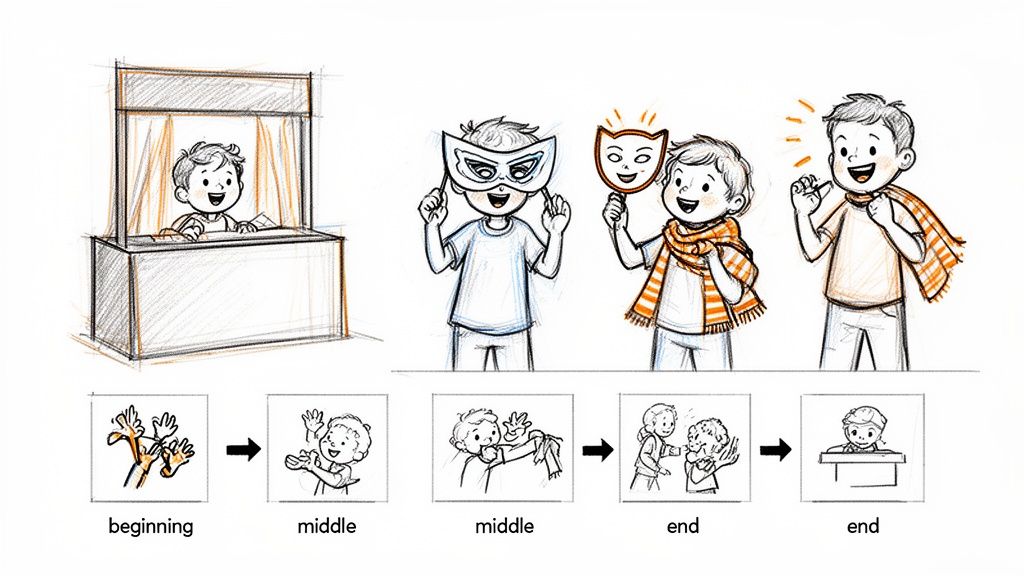
From informal role-play with props to more structured reader's theater scripts, dramatic play makes literary elements tangible. When a child pretends to be the determined pig from The Three Little Pigs or the mischievous cat from Pete the Cat, they are not just recalling events; they are interpreting them. This makes it one of the most memorable and engaging reading activities for first grade.
How to Implement Dramatic Play
Begin by reading a story with strong, distinct characters and a clear plot. After reading, discuss the characters and sequence of events. Then, provide simple props, puppets, or costumes and invite students to act out the story in a designated space. This can be done as a whole class, in small groups, or individually at a dramatic play center.
Tips for Success
- Provide simple props. You don't need elaborate costumes. Scarves, hats, and simple cardboard cutouts are often enough to spark imagination.
- Reread the text first. A quick reread just before acting ensures the story's language and plot are fresh in students' minds.
- Model expectations. Show students how to use their voices, bodies, and expressions to portray a character. Explicitly teach how to work together and take turns.
- Use reader's theater. For students who may be hesitant, reader's theater scripts allow them to read from a page, reducing the pressure of memorization and improvisation.
- Connect to comprehension. Ask questions like, "Why do you think the wolf acted that way?" to link the play back to character analysis and motivation.
Dramatic play is an invaluable tool for making reading a joyful, embodied experience. It helps children build confidence, social skills, and a profound connection to the stories they read. To further enhance dramatic play, incorporating powerful acting exercises for beginners can help first graders develop their expressive skills and confidence in story re-enactments.
10. Home Reading Connections and Family Literacy Partnerships
Building a strong bridge between school and home is a powerful way to accelerate a child's reading journey. Home reading connections and family literacy partnerships create a supportive ecosystem where learning extends beyond the classroom walls. This approach involves intentionally providing families with resources, guidance, and encouragement to foster a love of reading at home, reinforcing skills learned in school.
The goal is not to assign homework but to empower families to engage in joyful, low-pressure literacy moments. When families feel equipped and involved, children see reading as a valued, enjoyable activity, not just a school task. This partnership is one of the most effective reading activities for first grade because it creates consistent, positive reinforcement that significantly boosts student confidence and achievement.
How to Implement Home Reading Connections
Start by creating simple, accessible ways for families to participate. A weekly take-home book bag with a few just-right books and an optional activity card is a great beginning. Monthly newsletters with tips on asking questions about a story, like those found in The Kissing Hand, can also be very effective. The key is to make engagement easy and meaningful for busy families.
Tips for Success
- Offer low-pressure ideas. Suggest simple activities like picture walks, telling stories about the pictures, or reading for just 10 minutes before bed.
- Provide accessible materials. Send home guides explaining phonics concepts in family-friendly terms. If possible, offer materials in families' home languages.
- Celebrate all engagement. Use a simple reading log where families can share positive moments, not just track minutes. Avoid making it feel like a high-stakes assignment.
- Host family literacy nights. Invite families to school for fun, interactive reading events. Model simple strategies and provide take-home resources that are easy to use.
- Communicate positively. Use tools like ClassDojo or simple notes home to share progress and celebrate a child’s growing love for reading.
Fostering a strong home-school partnership validates the family's role as their child's first teacher and builds a community of readers that supports every first grader's success.
First-Grade Reading Activities: 10-Item Comparison
| Approach | Implementation complexity 🔄 | Resource requirements ⚡ | Expected outcomes 📊 | Ideal use cases 💡 | Key advantages ⭐ |
|---|---|---|---|---|---|
| Guided Reading Groups | High — ongoing grouping, detailed lesson planning, classroom management | Leveled texts, teacher prep time, running records, small-group space | Targeted decoding & comprehension growth; frequent progress data | Differentiated instruction; intensive small-group support | Precise differentiation; real-time teacher intervention |
| Interactive Read-Aloud Sessions | Moderate — requires expressive delivery and planning | High-quality picture books, optional props, teacher modeling skill | Increased vocabulary, listening comprehension, classroom community | Whole-class language development; introducing themes or complex texts | Models fluent reading; builds oral language and engagement |
| Phonics-Based Sound and Word Games | Low–Moderate — simple routines, short activities | Manipulatives (letters, cards), printable materials, brief setup | Improved letter-sound automaticity and phonemic awareness | Short practice, centers, targeted phonics intervention | Multisensory practice; easy differentiation and quick wins |
| Buddy Reading and Peer Partnerships | Low — partner matching and clear routines needed | Paired books, brief training scripts, occasional cross-class coordination | Improved fluency, confidence, social reading skills | Paired practice, cross-age mentoring, fluency building | Low teacher load; motivates readers through peer support |
| Literacy Centers and Stations | High — extensive setup, clear procedures, rotation management | Multiple station materials, labeled containers, timers, digital options | Broad skill reinforcement, increased independence, differentiated practice | When teacher runs guided groups; routines for independent practice | Maximizes active engagement; addresses multiple literacy modalities |
| Book Tasting & Literature Circles | Moderate — curating diverse books and teaching discussion roles | Wide book selection, themed displays, discussion prompts | Greater book choice, engagement, genre awareness, discussion skills | Boosting reading interest; author/theme studies; choice-based learning | Fosters autonomy and exposure to diverse texts |
| Writing in Response to Reading | Moderate — teacher scribing and modeling in real time | Writing supplies, anchor charts, display space, time for shared composition | Reinforced comprehension; improved writing confidence & conventions | Integrating reading-writing instruction; processing read-alouds | Authentic writing context; models spelling/grammar in meaning-making |
| Decodable Books & Controlled-Text Practice | Low — selection aligned to phonics sequence; routine practice | Decodable book sets, phonics scope, small-group/one-on-one time | Stronger decoding automaticity and early fluency; assessment insights | Systematic phonics programs; beginning decoders | Efficient decoding practice; reduces guessing strategies |
| Dramatic Play & Story Re-enactment | Moderate — space, props, and clear expectations required | Props/costumes, simple scripts, rehearsal time, dedicated area | Deeper comprehension, memory for story sequence, oral language growth | Kinesthetic learners; reader’s theater; character study | Highly engaging; builds fluency and emotional connection |
| Home Reading Connections & Family Partnerships | Moderate — ongoing outreach, accessible materials, coordination | Take-home books, multilingual guides, reading logs, event planning | Increased daily reading, stronger home–school partnership, long-term gains | Extending classroom learning into homes; family engagement initiatives | High impact on reading outcomes; builds family capacity to support readers |
Building a Lasting Love for Stories
The journey through first-grade literacy is one of the most transformative in a child's academic life. As we've explored, creating a vibrant, effective reading environment isn't about finding a single magic bullet. Instead, it's about weaving together a rich tapestry of experiences that address both the science and the art of reading. The array of reading activities for first grade detailed in this guide, from structured Guided Reading Groups to the creative freedom of Dramatic Play, all work in concert to build confident, engaged, and joyful readers.
Your role as an educator, parent, or caregiver is to be the architect of this environment. By thoughtfully blending these diverse approaches, you create a balanced literacy diet that nourishes every aspect of a young reader's development. This balance is the key to preventing reading from feeling like a chore and transforming it into a cherished adventure.
From Foundational Skills to Lifelong Passion
The most critical takeaway is the dual importance of skill and will. On one hand, systematic and explicit instruction in phonics, decoding, and fluency is non-negotiable. Activities like Phonics-Based Games and practice with Decodable Books build the essential machinery of reading. They give children the tools they need to unlock the code of written language, providing the confidence that comes from tangible progress and mastery. This is the "how" of reading.
On the other hand, we must simultaneously nurture the "why." This is where Interactive Read-Alouds, Buddy Reading, and adapted Book Tastings shine. These activities cultivate a deep, intrinsic motivation to read. They connect words on a page to community, empathy, and boundless imagination. When a child re-enacts a story with friends or shares a powerful book with a family member, they are learning that reading is a gateway to connection and understanding. This emotional and social engagement is the fuel that will power their reading journey for years to come.
Your Actionable Path Forward
Moving from inspiration to implementation is the next crucial step. To ensure these strategies take root, consider the following actions:
- Create a "Literacy Calendar": Map out your weeks and months, intentionally scheduling a mix of activities. Designate certain days for Literacy Centers, set aside consistent time for Interactive Read-Alouds, and plan a special "Book Tasting" event each quarter. This transforms good intentions into a concrete, actionable plan.
- Observe and Adapt: The most powerful tool you have is observation. Pay close attention to what sparks excitement and where students might be struggling. Use the quick formative assessment ideas from each activity to gather data, not for grades, but for guidance. Is a child thriving in Buddy Reading but hesitant during independent practice? That insight allows you to provide targeted support.
- Prioritize a Print-Rich Environment: Your classroom or home library is the heart of your reading program. Ensure it is filled with a wide range of accessible, diverse, and high-interest texts. Include decodable readers alongside beautiful picture books, non-fiction texts, and poetry. Make books an irresistible invitation.
By embracing this balanced, responsive, and joyful approach, you do more than just teach children how to read. You are cultivating the habits of mind and heart that will define them as lifelong learners. The confidence they build sounding out their first CVC words will be the same confidence they draw upon when tackling a complex chapter book years from now. The empathy they feel for a character in a story will shape the kindness they show to a classmate on the playground. This is the profound, lasting impact of nurturing a love for stories from the very beginning.
Ready to fill your library with books that spark curiosity and build character? Explore the curated collection at Number 6 Publishing, where every story is crafted to engage young readers and support the very reading activities for first grade discussed here. Find your next great read-aloud or guided reading set at Number 6 Publishing.