
Imagine a world where the sky turns black with dust and hope feels as scarce as rain. This is the stark reality for Billie Jo Kelby, the young girl at the center of Karen Hesse's award-winning novel, Out of the Dust. Her story is a powerful, unflinching journey into the heart of the 1930s American Dust Bowl.
Stepping Into Billie Jo's World
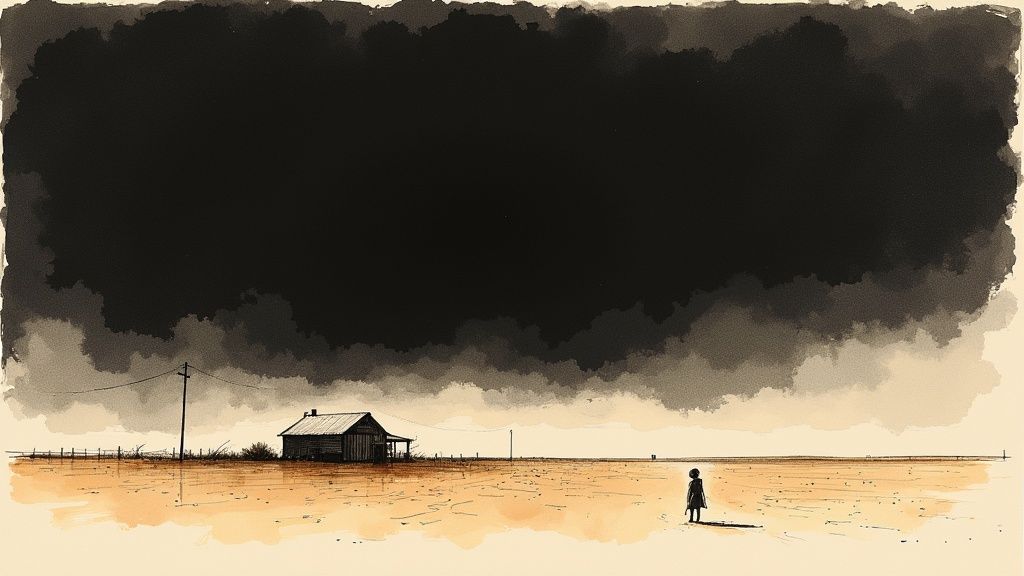
To really get inside Out of the Dust, you first have to appreciate the unique way Karen Hesse tells the story. She uses a free-verse poetic style, with each short entry feeling like a diary page ripped from Billie Jo’s life.
This isn't just a gimmick; it's the very soul of the narrative. The sparse lines and raw emotion perfectly mirror the desolate, windswept landscape of the Oklahoma Panhandle. It's a choice that gives us an unfiltered connection to Billie Jo’s innermost thoughts, her fears, and her quiet, resilient hopes, pulling you right into her world.
Why This Story Matters
This book is so much more than just a piece of historical fiction. It's a landmark piece of children's literature that vividly captures a critical, often overlooked, period in American history. It masterfully blends historical fact with real literary artistry, creating an unforgettable experience that sticks with you long after you turn the final page.
Out of the Dust won the prestigious Newbery Medal in 1998, cementing its status as a modern classic. The story immerses readers in the years 1934-1935, offering a poignant look at the Great Depression through the eyes of a fourteen-year-old girl struggling with unimaginable loss and the simple act of survival.
What to Expect From This Guide
Think of this guide as a map to help you journey alongside Billie Jo. We'll explore her profound story of loss, resilience, and the slow, difficult process of healing. By digging into its unique narrative style and the historical grip of the Dust Bowl, you'll gain a much deeper appreciation for this timeless tale.
We'll be unpacking a few key things:
- The Historical Context: First, we have to understand the real-world disaster of the Dust Bowl that shaped every aspect of Billie Jo's life.
- Plot and Character Analysis: Then, we'll walk through the key events and explore what makes the characters tick.
- Core Themes and Symbols: Finally, we’ll uncover the deeper meanings behind the dust, the piano, and that persistent, stubborn search for hope.
By setting the stage properly, we can fully grasp the emotional weight and enduring power of Out of the Dust. You can learn more about this award-winning novel and its incredible educational significance.
Understanding the Dust Bowl Reality
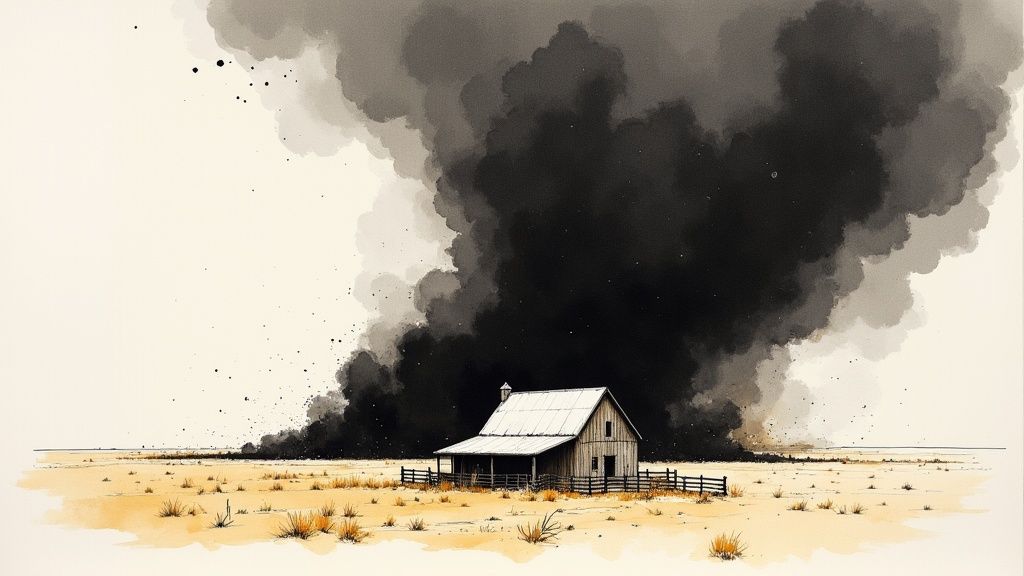
To really feel the grit and despair in Out of the Dust, you have to get a handle on the real-life disaster that shaped Billie Jo's world. The story is set against the backdrop of the Dust Bowl, a catastrophic environmental event that hammered the American Great Plains throughout the 1930s.
This wasn't just a dry spell. Think of it as a perfect storm: a severe drought slammed into a landscape already weakened by decades of farming practices that had stripped away the native grasses holding the soil down. Add in some relentless, powerful winds, and millions of acres of rich topsoil basically turned to powder, just waiting for the next gust to carry it away.
The Black Blizzards
Picture a tsunami, but instead of water, it's a terrifying, rolling wall of black soil soaring hundreds of feet into the air. These storms, known as "Black Blizzards," would swallow the sun in the middle of the day.
They could tear across the plains at speeds up to 60 miles per hour, carrying so much static electricity that they’d short out car engines and make blue flames flicker along barbed-wire fences. The dust was so fine it would worm its way through every crack of a house, blanketing furniture, food, and the people hiding inside. Just breathing was a constant risk, often leading to a deadly lung condition called dust pneumonia.
The Dust Bowl was one of the worst environmental disasters in U.S. history. It devastated eight states and left over 100 million acres of farmland useless. At its peak, crop failures in the hardest-hit areas shot past 90%, forcing thousands of families from their homes.
In Out of the Dust, this historical reality isn't just a setting—it's a character, and it’s the villain. The dust kills the crops, sickens the community, and creates the suffocating sense of hopelessness that Billie Jo and her family have to fight against every single day.
From History to Story
Knowing this context changes how you read the novel. It goes from being a simple story to a powerful piece of living history. Every single challenge Billie Jo faces is tied directly to this real-world catastrophe.
- Ruined Wheat: When her father's crops fail, it isn't just bad luck. It’s the direct result of the drought and wind erosion.
- Constant Cleaning: The endless chore of sweeping dust out of the house shows the daily, losing battle families waged against the encroaching wasteland.
- Health Crises: The threat of dust pneumonia isn't just a plot point; it's a real, tangible danger hanging over every character.
By rooting her story in this harsh reality, Karen Hesse gives themes like survival and resilience incredible weight. The characters' struggles feel more real, and their small victories shine that much brighter against the bleak, dusty backdrop. This powerful connection between fiction and history is what makes so many great historical fiction books for young adults so memorable. It turns the story of Out of the Dust into a testament to the strength of the human spirit.
Mapping Billie Jo's Journey Through the Seasons
The story of Out of the Dust follows the rhythm of the seasons, each one marking a new chapter in Billie Jo Kelby's life. Her journey unfolds between the spring of 1934 and the fall of 1935, giving us a powerful, front-row seat to her struggle with survival, grief, and the slow, hard road to healing.
We first meet Billie Jo in the Winter and Spring of 1934, where life is a constant, grinding battle. The Kelby family is fighting a losing war against the dust that smothers their crops and creeps into every crack of their home. But even in the grit, there are glimmers of hope—mostly found in Billie Jo’s piano playing and her mother’s quiet dream of getting apple trees to grow.
A Devastating Turning Point
Then, in the Summer of 1934, everything changes. A terrible accident with a pail of kerosene leaves Billie Jo’s mother horrifically burned and her own hands scarred, robbing her of her ability to play the piano. It’s a single, awful moment that shatters the family’s fragile world and throws them into a period of deep loss.
When her mother dies, Billie Jo and her father are plunged into a grief so profound it feels like its own kind of dust storm. Outside, the world is choked with dirt; inside their home, it’s choked with silence and guilt. Their relationship withers, becoming as barren as the Oklahoma farmland surrounding them.
This infographic lays out the arc of Billie Jo’s journey, from the environmental hardship to the personal tragedy and, finally, toward recovery.
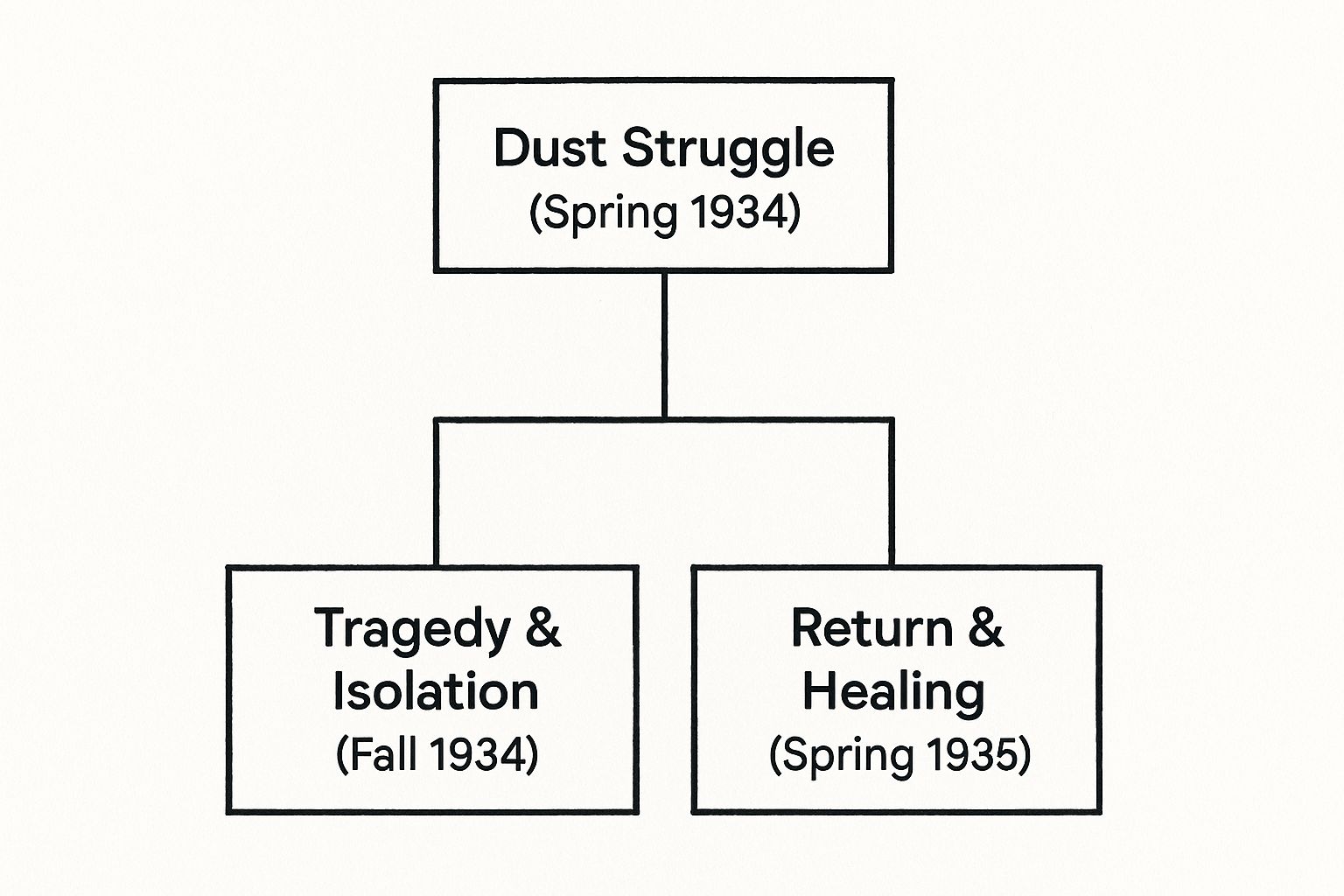
You can clearly see how the story moves from one kind of struggle to another before the slow climb back to life can even begin.
The Long Road Back
By Winter 1935, Billie Jo is utterly alone. Her hands, once her greatest source of joy, are now just a painful, constant reminder of all she's lost. Her father, lost in his own sorrow, can't give her the comfort she desperately needs.
This part of the book is all about Billie Jo's internal battle with guilt and her external fight against a world that feels like a dead end. Her identity as a pianist is gone, leaving a gaping hole she has no idea how to fill.
Feeling trapped, she makes a desperate choice. In the Spring of 1935, she hops a freight train and heads west, believing escape is her only answer. But what starts as a journey away from home ends up being a journey back to herself.
She quickly learns you can't outrun the dust. It's a part of her, just like her father is a part of her. With this new understanding, she turns around and goes back home, finally ready to face her pain and start putting the pieces of her life back together. This decision to return is the true start of her healing.
Analyzing the Characters and Their Burdens
At its core, Out of the Dust is a story about people pushed to their absolute limits, not just by the dust storms raging outside, but by the emotional storms raging within. The characters Karen Hesse creates are so much more than historical figures; they’re real, breathing people carrying unimaginable weight, and their quiet struggles are what make the novel so unforgettable.
The entire story unfolds through the eyes of Billie Jo Kelby, a resilient and fiery young protagonist who is deeply wounded. When we first meet her, her world is her piano. Music is her joy, her escape, her identity—a splash of color in a world quickly turning to grey dust.
But after a horrific accident robs her of her mother and scars her hands, Billie Jo's world shatters. The piano, once her greatest source of freedom, becomes a constant, painful reminder of all she's lost. Her journey from that point on is a desperate search for a new identity when her old one has been so violently burned away.
A Family Fractured by Grief
Billie Jo’s father, Bayard Kelby, is a man who seems as hardened and weathered as the land he farms. He’s a quiet, stubborn farmer locked in a losing fight with the earth itself, long before the novel’s central tragedy. He’s a man who shows his love through sheer persistence, not through words.
After his wife's death, Bayard retreats completely. He cocoons himself in silence, leaving a vast, empty canyon between himself and the daughter who needs him more than ever. His grief makes him emotionally mute. The slow, painful effort to bridge that distance is the emotional heart of the story.
Even in death, Billie Jo's mother, Polly, remains a powerful presence. We feel her in the memory of her music and see her in the apple trees she so lovingly tended. She represents a quiet strength and a hope for something better, a gentle soul standing against the harshness of their world.
The Kelby family’s dynamic is a raw look at how trauma can cause communication to just... stop. Each one of them is trapped on their own island of grief, unable to reach the others, which only deepens their suffering.
Finding Hope in the Community
While the Kelby family’s struggle is front and center, the supporting characters are the small flickers of light that keep hope alive. They remind us that even when your world feels broken, a community can be a lifeline.
- Arley Wanderdale: The local music teacher, he sees the talent in Billie Jo and gives her chances to play, reminding her of who she was before the accident.
- Mad Dog Craddock: Another young musician, his quiet friendship and shared love for music offer Billie Jo a rare glimpse of normalcy and companionship.
These characters are so important because they see beyond Billie Jo's scars. They represent a life outside her family's silent pain, showing her that healing is still possible. Watching characters navigate such profound emotional territory is a powerful experience, which is why so many people connect with books that teach empathy.
Here’s a closer look at how the main characters’ internal and external worlds collide and evolve throughout the story.
Character Arcs and Core Conflicts
| Character | Primary Internal Conflict | External Struggle | Development Journey |
|---|---|---|---|
| Billie Jo | Overwhelming guilt over her mother's death and a loss of identity after her hands are burned. | Surviving the Dust Bowl and navigating her father's silence. | Learns to forgive herself, redefines her relationship with music, and rebuilds her bond with her father. |
| Bayard | Inability to express his grief or connect with his daughter after his wife's death. | The relentless failure of his farm against the dust and drought. | Slowly emerges from his shell of grief to finally reconnect with Billie Jo, showing vulnerability and love. |
| Polly | (Posthumous) A desire for a better life and hope for her unborn child, cut tragically short. | The harsh realities of the Dust Bowl that threatened her dreams. | Her memory serves as a guiding force for Billie Jo and Bayard, representing hope and the need for forgiveness. |
These journeys are what give the novel its lasting impact. It's not just a story about dust—it's about how people find a way to grow again after everything has been stripped away.
Unpacking the Core Themes and Symbols

What makes Out of the Dust stick with you long after you've closed the cover? It's the way the story is built on powerful, universal ideas that give it so much emotional weight. This isn't just a book about a historical event; it's a deep dive into the human heart's incredible ability to endure, to forgive, and to find tiny glimmers of light even in the darkest of times.
Right at the center of it all is the theme of resilience. Billie Jo’s journey is a masterclass in survival. She doesn't just physically make it through the Dust Bowl; she has to navigate the internal wasteland of her own grief and guilt. We watch as she slowly, painstakingly, finds the strength to piece her life back together.
That journey is tied up in the incredibly difficult process of forgiveness. The silence between Billie Jo and her father is suffocating, thick with unspoken blame. A massive part of their healing comes from learning to forgive each other, but the hardest act of forgiveness is the one Billie Jo must grant herself.
Symbols That Tell the Story
Karen Hesse is a master at using simple, tangible objects to represent the story’s biggest ideas. Think of them as a kind of emotional shorthand, helping us feel what the characters can't always put into words.
-
The Dust: It’s more than just dirt; it’s the book's main antagonist. The dust is a symbol of suffocation, despair, and even death. It chokes the land, the lungs, and the human spirit, a relentless force that everyone is constantly fighting.
-
The Piano: The piano is Billie Jo. At first, it's her joy, her passion, her voice. After the accident, it becomes a painful monument to everything she's lost. Her eventual return to its keys is a powerful signal of her emotional rebirth.
-
Apple Blossoms: Her mother's apple trees represent a fragile, almost stubborn kind of hope. The fact that they can blossom at all, right in the middle of all that dust, is a potent reminder that life can find a way to grow, even in the absolute harshest conditions.
The novel’s ability to tackle these profound themes with such grace is a key reason for its acclaim. It’s a testament to the power of young adult literature to explore complex human experiences in an accessible yet deeply moving way.
This is exactly why the book found a perfect home with its publisher, Scholastic. At a time when they were having massive commercial success with series like Harry Potter, Out of the Dust reinforced their reputation for championing powerful, award-winning literary works right alongside the blockbusters. This balance of art and commerce is what helps shape reading habits for millions of young people.
Discussion Questions to Take You Deeper
To really get to the heart of Out of the Dust, you have to dig a little deeper than just the surface plot. The questions that follow are perfect for book clubs and classrooms, designed to push readers to explore the story's hidden layers and share what they discovered.
Think of these questions as a launchpad for great conversation, not just a simple quiz. Talking through these topics is a fantastic way to get better at analyzing literature. If you're looking to really sharpen those skills, it's worth checking out how to develop reading comprehension skills with some focused practice.
Questions on Style and Structure
-
How did Karen Hesse’s choice to use free-verse poetry shape your emotional connection with Billie Jo? Do you think the story would have hit you the same way if it were written in standard paragraphs?
-
The novel is organized by the seasons. How does this cycle of spring, summer, fall, and winter reflect Billie Jo’s own journey through grief, anger, and eventually, healing?
-
Let's talk about the quiet moments in the book, especially between Billie Jo and her father. What do those long silences manage to say that words just can't?
Questions on Themes and Characters
-
Forgiveness is a huge theme here. Who do you think needs forgiveness the most in the story, and do they ever truly find it? How does Billie Jo’s own struggle with forgiveness change who she is?
-
Even when things seem completely hopeless, where do you see small signs of hope surviving? Think about symbols like the piano, the mail-order catalogues, or the apple blossoms.
"Out of the Dust" forces us to confront how a person can lose their identity and have to rebuild it from the ashes. It's a powerful lesson in resilience.
- Beyond the dust storms, what other major battles is Billie Jo fighting? How do her private, internal struggles stack up against the massive disaster happening outside her door?
For students who want to pull their thoughts together into a clear argument, it's always helpful to have some good strategies for writing better essays in your back pocket.
Common Questions About Out of the Dust
Diving into a unique novel like Out of the Dust often brings up some great questions about its style, history, and the deeper story it tells. Let’s clear up some of the most common ones that readers, students, and book clubs ask.
A lot of people who pick up the book for the first time want to know if Billie Jo’s story is real. While Billie Jo herself is a fictional character, Karen Hesse built her world on a foundation of solid historical fact. She did deep research into the 1930s Dust Bowl, so the "Black Blizzards," the poverty, and the day-to-day struggles are all painfully authentic.
Why Is It Written This Way?
The format is another thing people ask about right away. Writing Out of the Dust in free verse was a deliberate choice, and it’s one of the most powerful things about the book. This poetic, almost diary-like style does a couple of things beautifully.
First, it perfectly captures the sparse, unforgiving landscape of the Oklahoma Panhandle. Second, it gives us a raw, unfiltered look straight into Billie Jo’s heart and mind. The short, punchy entries mean not a single word is wasted, which mirrors a life where everything—from money to hope—is in short supply. It makes the emotional gut-punches land that much harder.
For those curious about different ways to take in the story, exploring various audiobook use cases can show how a powerful narrative like this one can be brought to life through a great narrator.
Symbols and Age Recommendations
The piano is probably the most important symbol in the book. Before the accident, it's everything to Billie Jo—it’s her passion, her talent, and her bond with her mother. After, it becomes a heartbreaking reminder of everything she's lost. Her journey back to playing the piano is a huge part of her healing and finding herself again.
The novel is generally recommended for readers aged 11 and up, or grades 6-9. While the verse format is easy to read, the story deals with some heavy themes like death, grief, and depression. It’s best suited for middle and high schoolers who are ready to talk about that kind of emotional depth.
Getting a handle on these key pieces really enriches the whole experience, turning a simple story into a profound journey through history and the strength of the human spirit.
At Number 6 Publishing, we believe stories like this are essential for building empathy and understanding. Discover more powerful young adult and middle-grade books by exploring our curated collections at https://www.number6publishing.com.