
Make Way for Ducklings, Robert McCloskey’s treasured 1941 picture book, tells the heartwarming story of a duck family on a quest to find a safe home in the heart of Boston. It's so much more than a simple animal tale; the book’s wonderfully detailed illustrations and timeless themes of family, safety, and community have made it an absolute classic, charming generations of young readers.
The Enduring Charm of a Picture Book Classic
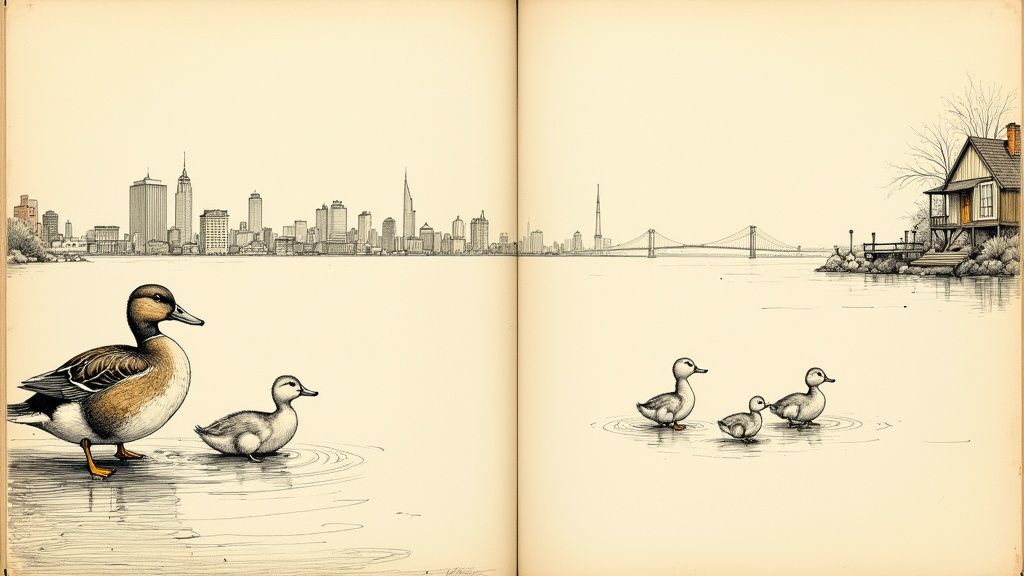
Even decades after its first printing, Make Way for Ducklings continues to win over new little readers. So, what is it about this seemingly simple story that gives it such incredible staying power? The magic is all in how Robert McCloskey blended a gentle, flowing narrative with his now-iconic, lifelike drawings to create a world you can't help but get lost in.
The story pulls at a universal desire we all have: the search for a safe place to call home. That single idea feels just as urgent and important today as it did back in the 1940s.
And its appeal isn't just a feeling; the numbers back it up. By 2003, the book had sold over two million copies. That's a staggering achievement, speaking volumes about its popularity and lasting power across more than sixty years. You can dig into more details about its journey in the full Wikipedia entry for Make Way for Ducklings.
Why the Story Still Resonates
The book’s real strength lies in how its core pieces fit together so perfectly. Its gentle pacing gives children plenty of time to soak in every detail of the Mallards’ big adventure, while its deep connection to the city of Boston makes the setting feel like a character in its own right. It's this beautiful mix of art, story, and place that truly elevates it.
It pulls this off through a few key elements:
- A Universal Narrative: The story of parents just trying to find a safe place for their kids is a deeply human (and animal!) experience that everyone can connect with.
- Stunning Artwork: McCloskey’s charcoal drawings give the book a warm, nostalgic feel that just pulls you right into the Mallards' world.
- Community Spirit: The simple kindness shown by Officer Michael sends a powerful, positive message about how communities can and should support one another.
The lasting appeal of stories like 'Make Way for Ducklings' is a fantastic starting point for parents interested in nurturing a love of books at home. It’s a classic that shares a lot of common ground with other beloved tales, which you can read more about in our exploration of Where the Wild Things Are.
Following the Mallards on Their Boston Adventure
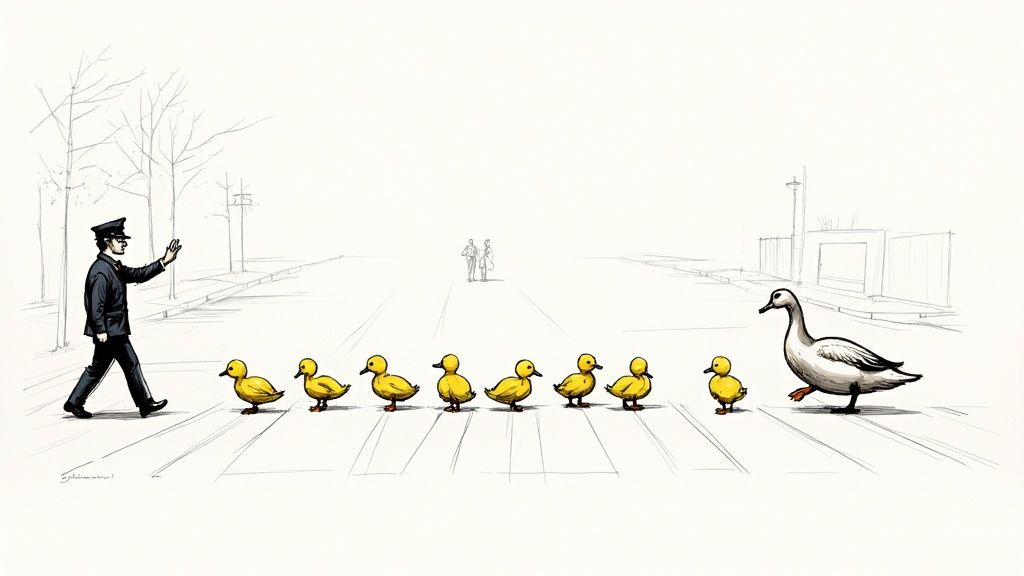
Make Way for Ducklings kicks off with a quest every family understands: finding the perfect place to call home. We meet Mr. and Mrs. Mallard as they fly over Boston, searching for a safe spot away from predators like foxes and turtles. They tour iconic spots from Beacon Hill to Louisburg Square, but nothing seems quite right.
This careful search taps into a deep parental instinct—the drive to find a secure, nurturing space for your children. The Mallards finally settle on a quiet island in the Charles River. It’s a perfect mix of safety and tranquility, with the added perk of peanuts from friendly people in swan boats.
The Hatching and a Journey Begins
Once they've settled in, Mrs. Mallard lays eight eggs. Soon, she's the proud mother to Jack, Kack, Lack, Mack, Nack, Ouack, Pack, and Quack. With the family complete, a new goal emerges: Mrs. Mallard decides the Boston Public Garden is the ideal place for her ducklings to grow up. But getting there from the Charles River is no small feat.
Mr. Mallard flies ahead to check out the route, leaving Mrs. Mallard to lead their brood on the most important walk of their young lives. This is where the story's gentle tension really starts to build. She painstakingly teaches her ducklings to walk in a neat line, prepping them for the chaos of city streets that stand in their way. Their march across busy roads is a beautiful metaphor for the challenges, big and small, that families face together.
The core of the adventure lies in this determined march. It's a powerful narrative of a mother's resolve to guide her children through a world that wasn’t built for them, relying on her own courage and the kindness of others.
A Community Comes Together
The story hits its heartwarming peak at a bustling intersection. As Mrs. Mallard and her eight little ones try to cross, the city traffic screeches to a halt. A kind police officer, Michael, spots their dilemma and steps in without a second thought.
In that famous scene, he holds up his hand, stopping cars, trucks, and buses to let the tiny family pass safely. Officer Michael's simple act of compassion is the emotional heart of the story. He even calls headquarters to send a police car to protect them for the rest of the way, ensuring they make way for ducklings all the way to the Public Garden pond. This moment shows how a small gesture of kindness can make a world of difference, turning the Mallards' successful journey into a victory for the compassionate spirit of the entire city.
Meet the Creator Robert McCloskey
The artist behind the beloved classic Make Way for Ducklings was Robert McCloskey, a man whose passion for his craft brought the Mallard family to life with incredible realism. Born in Ohio, McCloskey was a fine arts student in Boston and New York, but he found the art world at the time a bit stale. It was an editor who gave him the push he needed, telling him to draw what he knew best—his own childhood.
That simple piece of advice sent him down the path to children’s literature, where his unique talent for capturing everyday life with warmth and detail really found its footing. His approach wasn't just about drawing; it was about full immersion, a commitment that came to define his work and set a new standard for picture book illustration.
A Dedication to Authenticity
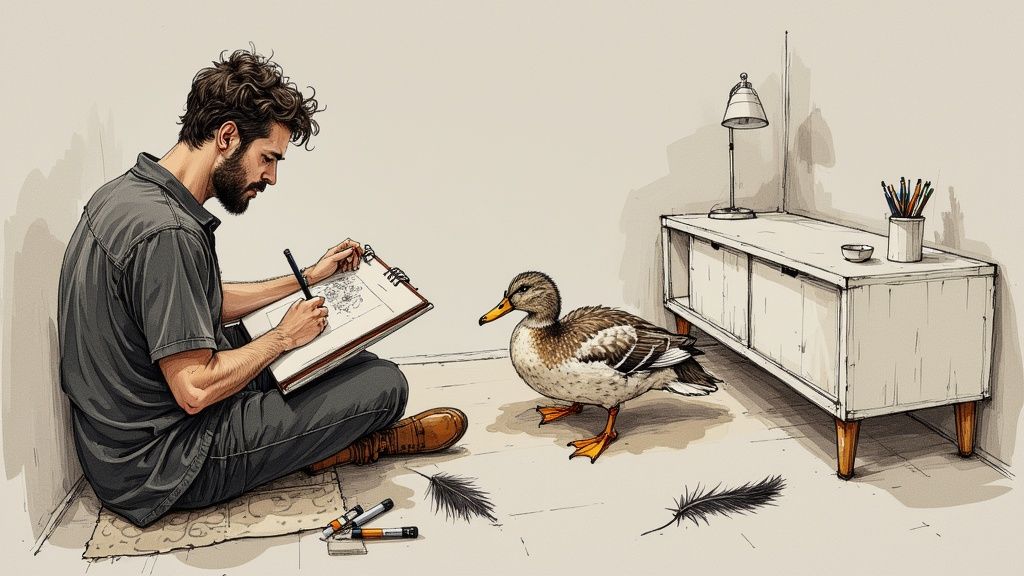
McCloskey’s process for Make Way for Ducklings is the stuff of legend among illustrators. To get the Mallards just right, he went way beyond sketching from a distance. In a now-famous move, he bought live ducks from a market and brought them home to his Greenwich Village apartment.
For weeks, those ducks waddled around his studio while he sketched them from every possible angle. He was studying their anatomy, how they moved, and even their quirky little personalities. This is precisely why every duckling in the book feels so real and full of life—they were based on actual subjects who quacked and splashed around in his bathtub.
McCloskey’s method wasn't just about drawing animals; it was about understanding them. He believed that to make the characters believable, he had to know them intimately, a philosophy that shines through in every detailed feather and expressive posture.
An Enduring Artistic Legacy
All that hard work paid off. Robert McCloskey is one of the very few creators to have won the prestigious Caldecott Medal twice—first for Make Way for Ducklings in 1942 and again for Time of Wonder in 1958. His work truly elevated the picture book to an art form, showing that kids' stories could be both simple and deeply meaningful.
He left behind a legacy of meticulous craftsmanship and a genuine respect for his young audience. By grounding his charming stories in reality, he created timeless worlds that feel both magical and completely true. To learn more about the lives and works of creators like Robert McCloskey, you can explore other celebrated authors and discover their stories.
The Unique Artistry of the Illustrations
While the story of the Mallard family is undeniably charming, it’s the illustrations in Make Way for Ducklings that truly make it a legend. Robert McCloskey’s artwork is so unique that it’s become just as famous as the story itself, creating a world that feels both nostalgic and incredibly alive.
The book’s signature sepia-toned look wasn’t an accident; it was the result of a deliberate and painstaking artistic process. McCloskey was a master of detail, choosing to work with charcoal to capture the soft textures of the ducklings’ feathers alongside the grand, architectural lines of Boston’s cityscape. This specific medium allowed for a rich shading and depth that bright colors might have washed out.
This artistic choice was a huge reason the book won the prestigious 1942 Caldecott Medal. The award specifically celebrated his detailed charcoal illustrations, which were transferred to zinc plates for a printing process called lithography. This technique perfectly preserved the warmth and texture of his original drawings, giving the book its timeless quality. You can read more about the book's accolades and history on Wikipedia.
How Lithography Shaped the Look
Think of lithography as a special way of "stamping" an image from a prepared surface. For Make Way for Ducklings, the process was pretty hands-on:
- Drawing on Stone or Metal: First, McCloskey had to recreate his charcoal drawings onto zinc plates using a greasy crayon.
- Chemical Treatment: The plates were then treated with a chemical solution, which made the non-greasy parts absorb water.
- Applying the Ink: When oily ink was rolled over the plate, it stuck only to the greasy drawing—not the damp, blank areas.
- Printing the Image: Finally, paper was pressed against the plate, transferring the inked image and creating the final page.
This old-school method gave the illustrations a soft, grainy texture that’s almost impossible to replicate with today’s digital tools. It's the reason every page feels like a handcrafted piece of art, inviting you to slow down and explore every little detail. The process itself is a fascinating subject, and if you're curious about illustration techniques, you might enjoy our list of the best books about illustration.
Boston as a Main Character
McCloskey’s illustrations do a lot more than just show what’s happening in the story; they build an entire world. Through his art, the city of Boston becomes a character in its own right. Those sweeping, double-page spreads of Beacon Hill and the Public Garden aren’t just backdrops—they are living, breathing portraits of a city.
The real genius of the artwork lies in its perspective. McCloskey often draws scenes from a low, duck’s-eye view. This makes the grand city streets and towering buildings feel even more imposing, really highlighting the bravery of this little duck family on their big journey.
From the expressive, determined face of Mrs. Mallard to the individual personalities hinted at in each of her eight ducklings, the illustrations tell a story all on their own. They set the mood, establish the stakes, and forge an emotional connection that has helped Make Way for Ducklings capture hearts for over 80 years.
What's Really Going On in the Story?
It’s easy to get swept up in the adorable sight of waddling ducks and charming Boston streets, but Make Way for Ducklings has stuck around for over 80 years for much deeper reasons. This isn’t just a simple story about a family of ducks; it’s a timeless tale that gets at the heart of what we all care about: finding a safe place to call home, the power of family, and the incredible impact of a little kindness from our community.
The entire adventure kicks off with the Mallards’ hunt for a home. This is something every parent can relate to—that deep-seated need to find a secure and nurturing place for your kids to grow up. Mr. and Mrs. Mallard aren't just looking for any old pond. They’re on a mission to find a true sanctuary, a place where their ducklings can be safe from the world’s dangers. Their careful search, weighing the pros and cons of each spot, feels just like the real-life worries and hopes that come with raising a family.
It’s All About Family
At its core, this is a beautiful story about being a parent. When Mrs. Mallard guides her eight little ones through the noisy, chaotic city, she becomes a powerful symbol of a mother’s love and courage. She's their teacher, their protector, and their leader all in one, showing just how much work it takes to navigate a world that isn't always built for the little ones.
And the ducklings? They follow her in that perfect, single-file line, a visual reminder of the strength we find when we stick together. That image of family unity is a huge part of why the story feels so comforting and has been loved for generations.
The book gently shows that while being a parent is full of challenges, it's all built on an unshakable promise to your kids. For a young reader, it’s a perfect introduction to the big ideas of family and what it means to look out for each other.
The Power of a Kind Community
Maybe the most unforgettable part of Make Way for Ducklings is the moment Officer Michael steps in. When he stops all that traffic just for a family of ducks, the story delivers its most important message: we’re all better off when we look out for one another.
Officer Michael’s simple act of kindness is a huge lesson in social responsibility. He sees that the Mallards are in a tough spot and uses his authority to help, proving that true strength lies in compassion. It’s a powerful moment that teaches kids about empathy and how even small acts of kindness can make the world a safer, better place for everyone. Children’s books are a wonderful way to introduce these big social and emotional ideas, a topic that connects to the importance of representation in children’s books.
To really see how these ideas are woven into the story, let's break them down.
Key Themes in Make Way for Ducklings
This table gives a quick look at the central themes in the book and where you can spot them in the story.
| Theme | Description | Example from the Story |
|---|---|---|
| Search for Safety | The universal desire for a secure place to raise a family, free from harm. | The Mallards reject several locations because of dangers like foxes and turtles before choosing the island. |
| Parental Responsibility | The deep love and dedication parents have in guiding and protecting their children. | Mrs. Mallard teaches her ducklings to walk in a line and bravely leads them across busy streets. |
| Community and Kindness | The idea that a compassionate community supports and protects its most vulnerable members. | Officer Michael and his colleagues stop traffic to ensure the ducklings can cross the road safely. |
Looking at these themes, it's clear why the book is so much more than a cute animal story—it’s a reflection of the values that build strong families and communities.
The Book’s Lasting Cultural Legacy
It’s one thing for a book to be well-loved, but it’s another thing entirely for it to become part of a city’s very identity. Make Way for Ducklings managed to do just that, weaving itself so deeply into the fabric of Boston that it feels like it’s always been there. It’s far more than just a story—it’s a cultural institution.
This connection isn't just sentimental. The story was officially named the state children's book for the Commonwealth of Massachusetts, a formal recognition of its place in the state's heritage. You can dig into the history of its special status in the official Make Way for Ducklings records.
From Page to Park Landmark
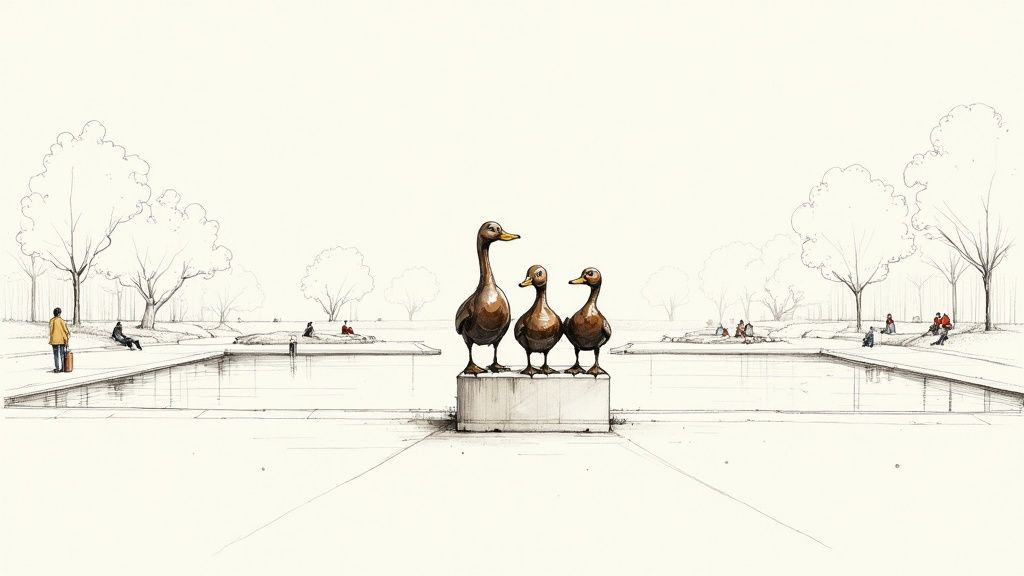
For anyone walking through the Boston Public Garden, the book’s legacy is impossible to miss. There you’ll find the famous bronze statues of Mrs. Mallard and her eight ducklings, marching in a perfect, determined line.
Created by sculptor Nancy Schön and installed in 1987, this charming piece has become one of Boston’s most beloved landmarks. It’s a constant hub of activity, with families and tourists stopping for photos, and kids climbing right up to sit with the little bronze family. The statues aren't just art to be looked at; they bring the story to life, creating a real, tangible connection between the book and the city.
The statues are also the heart of a cherished local tradition: the annual Duckling Day parade. Every Mother's Day, hundreds of kids and their parents dress up as ducklings and retrace the Mallards' famous journey through Boston, ending right at the iconic sculptures.
A Global Cultural Touchstone
While Boston is the heartland of the Mallard family, the story’s reach is truly global. Its simple but powerful themes of family, perseverance, and community kindness resonate everywhere.
Schools and libraries around the world still use the book to teach children about helping others, facing challenges, and even how wildlife can adapt to city life. Make Way for Ducklings didn't just tell a good story. It helped shape the cultural identity of a major American city and captured the imaginations of millions, securing its place as a true cultural touchstone for generations.
Common Questions About the Book
Whether you're a parent sharing this story for the first time or a teacher pulling a well-loved copy off the shelf, a classic like Make Way for Ducklings always gets people wondering. This simple story has sparked plenty of curiosity over the years.
Let's dive into some of the most common questions and peel back the layers on what makes the Mallard family's adventure so special.
What Is the Best Age for This Book?
Make Way for Ducklings really hits its sweet spot for kids between the ages of 3 and 7. The story is easy to follow, and the detailed illustrations are fantastic for holding the attention of preschoolers and early elementary kids just getting the hang of longer plots.
But honestly, the book’s charm goes way beyond that age range. Its themes of family, finding a safe home, and the kindness of strangers are universal. It’s a wonderful read-aloud experience, meaning older siblings and adults still find plenty of joy in the Mallards' trek across Boston.
Can You Visit the Places in the Book?
Yes, you absolutely can! That’s one of the most magical things about this story—it’s a real-life Boston tour. You can literally walk the same path the Mallard family did.
All the key landmarks from the book are still there and easy to find:
- The Charles River: Where Mr. and Mrs. Mallard first look for a place to nest.
- Beacon Hill: The historic, charming neighborhood they march right through.
- The Boston Public Garden: Their final, perfect destination.
Of course, the most famous spot is the bronze statue of Mrs. Mallard and her ducklings in the Public Garden. For any fan of the book, it's a must-see.
Why Are the Illustrations Not in Color?
Robert McCloskey made a deliberate artistic choice to draw with charcoal on lithograph plates. This process is what gives the book its iconic, warm sepia-toned images that feel so classic.
This monochromatic style wasn't a limitation; it was a huge strength. It lets McCloskey’s incredible detail and shading really shine, creating a rich visual world that focuses on texture and emotion without the distraction of bright colors. It's a big part of what gives the book its timeless feel.
At Number 6 Publishing, we believe stories like this are essential for sparking curiosity and a lifelong love of reading. To discover more books with heart, come visit us at https://www.number6publishing.com.