
Jean Craighead George’s Newbery Medal-winning novel, Julie of the Wolves, drops you right into the heart of the Alaskan tundra with a young Iñupiaq girl named Miyax. It’s an unforgettable story about being caught between two worlds—the ancient traditions of her people and the beckoning call of the new. To survive, she has to do the unthinkable: learn to speak the language of wolves. It’s a powerful, timeless tale about who we are, what it takes to stay alive, and the deep, often forgotten connection between humanity and the wild.
A Timeless Story of Survival and Identity
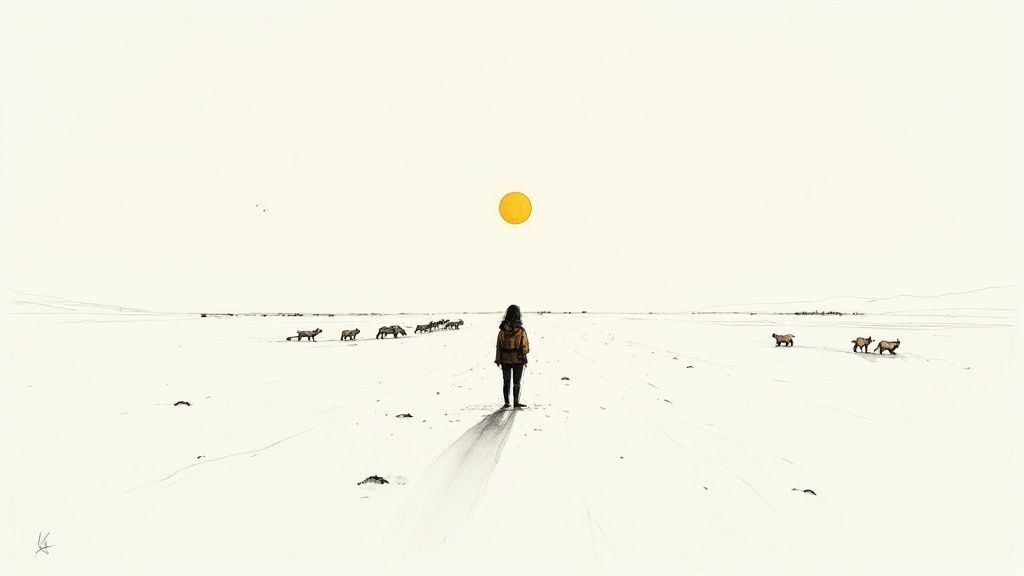
Can you imagine being thirteen years old, completely alone in the vast, unforgiving Alaskan wilderness? No food, no shelter, not even a map to point the way. That’s exactly where we find Miyax at the start of Julie of the Wolves. She's running away from an arranged marriage and a life she doesn't want, only to find herself in a truly desperate situation where her only guide is the ancient wisdom her father passed down to her.
Her only hope rests with a nearby wolf pack. Drawing on her father's teachings, she begins the slow, dangerous work of watching them, trying to piece together their complex social world and find a way to communicate. It’s an incredible testament to her spirit that she not only survives this way but eventually earns her place among them, forging a bond that goes far beyond species.
A Journey Between Two Worlds
At its core, Julie of the Wolves is a story about a girl torn between two names, two lives. In the modern world of San Francisco, she’s Julie, an American girl writing to her pen pal, Amy. But out on the Arctic tundra, she is Miyax, an Iñupiaq girl whose identity is tied to the land and its creatures. This split is the heart of the novel’s conflict, as Miyax struggles to figure out where she truly belongs. It’s a classic coming-of-age journey, making it a must-read for anyone interested in the best coming-of-age novels that dive into the messy, beautiful complexities of growing up.
The novel really makes you think about some big questions:
- How do you honor your heritage while still finding your place in a world that’s always changing?
- When we cut ourselves off from nature, what essential part of ourselves do we lose?
- What does family truly mean? Can it include more than just human relationships?
This blend of a gripping wilderness adventure and a deep cultural exploration is what gives the book its staying power. Miyax's story isn't just about staying alive—it's about discovering who you are when everything you thought you knew is stripped away.
Her reliance on the wolves for both survival and companionship drives home one of the book’s central themes: that nature offers a kind of wisdom and community that modern life often makes us forget. This profound connection is what elevates Julie of the Wolves from a simple adventure story to a meaningful reflection on identity and belonging that still resonates with readers, decades after it was first published in 1972.
A Journey Across the Alaskan Tundra: Plot Summary
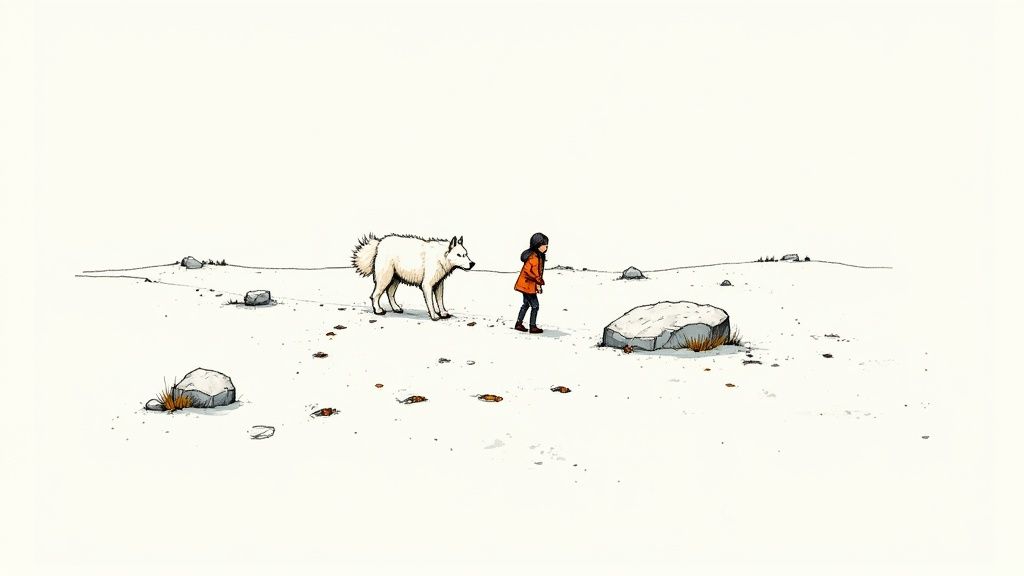
The story opens on the vast, unforgiving North Slope of Alaska, a landscape as brutal as it is beautiful. Here, we find Miyax, a thirteen-year-old Iñupiaq girl, utterly alone and on the brink of starvation. She’s running from an arranged marriage, fleeing a village life that felt suffocating and foreign, with a desperate hope of reaching her pen pal in San Francisco.
Her journey quickly becomes a raw story of survival. Lost, with no map and her hope fading, Miyax turns to the only other creatures she can find: a pack of Arctic wolves. She begins to recall the lessons her father, Kapugen, taught her about the old ways.
This sparks a patient and incredibly risky experiment. Miyax starts to watch the wolves, meticulously studying their complex language of growls, yips, and postures. She isn't just trying to copy them; she's making a profound, respectful effort to truly understand their world and earn a place within it.
Her entire focus lands on the pack’s powerful leader, a stunning black wolf she names Amaroq. By carefully mimicking submissive gestures and proving she's no threat, Miyax slowly, painstakingly earns his trust. In a stunning turn, the wolves begin to accept her. They leave food for her and welcome her into their circle. She has found an unlikely family in the wild.
Part One: Amaroq, the Wolf
This first section of the book is an absolute masterclass in wilderness survival and the art of interspecies communication. As Miyax leans into her Iñupiaq identity, she learns to live as one with the tundra. She builds a sod house for shelter, fashions tools from whatever she can scavenge, and becomes an expert at reading the Arctic's subtle signs. Her life is now completely intertwined with the wolf pack.
The bonds she forms are deep and complex. The key members of the pack aren't just animals; they become distinct characters in her life:
- Amaroq: The intelligent and majestic leader who essentially becomes a father figure.
- Silver: Amaroq’s mate, a fiercely protective and nurturing presence.
- Kapu: Her favorite pup, whose playful spirit gives her joy and a feeling of real connection.
- Jello: A nervous, outcast wolf whose behavior teaches her valuable lessons about the pack’s social order.
Miyax’s life falls into a natural rhythm, guided by the changing seasons and the hunt. She’s no longer just trying to survive—she’s actually thriving, finding a sense of belonging she never had in the human world. It’s a quiet, powerful testament to her own strength and the wisdom of the natural world.
Part Two: Miyax, the Girl
The story then flashes back, showing us exactly what drove Miyax out into the wilderness in the first place. We learn about her early years living with her father on the coast, a time when he taught her all the traditional Iñupiaq ways. That idyllic childhood came to an abrupt end when he was believed to have been lost on a seal hunt, forcing her to go live with an aunt.
This part of the novel details her difficult adjustment to village life and the encroaching pressures of modernity. Her arranged marriage to a boy named Daniel, who has developmental disabilities, becomes unbearable when he tries to assault her. This traumatic event is the final straw, the thing that pushes her to make a desperate run toward a different kind of life in America, a life symbolized by her pen pal, Amy.
This section provides the crucial backstory, painting a vivid picture of a girl caught between two worlds. It throws the conflict between ancient traditions and the disruptive influence of the "gussaks" (white people) into sharp relief, setting the stage for the heartbreak that’s yet to come.
Part Three: Kapugen, the Hunter
Back in the present, Miyax's world is shattered. The peaceful, rhythmic life she has built with the wolves is violently ripped apart by the arrival of a bush plane. In a horrifying moment of casual cruelty, hunters in the plane shoot and kill Amaroq from the sky, simply for sport. His death is a devastating blow, destroying the family she had so carefully built and her idealized view of the wilderness.
Heartbroken and completely disillusioned, Miyax pushes on, but the tundra feels hollow and empty now. She finally reaches the coast, only to make a shocking discovery: her father, Kapugen, is alive. But he is not the man she remembers. He has married a white woman, fully embraced modern technology, and even takes part in the same kind of sport hunting that killed her beloved Amaroq.
This final confrontation forces Miyax to face a harsh new reality. The "old ways" she clung to for survival are disappearing, and the modern world she once dreamed of is deeply, tragically flawed. The novel closes with Miyax standing at a crossroads, walking away from her father's new life and toward a future she must now figure out for herself.
Unpacking The Core Themes Of The Novel
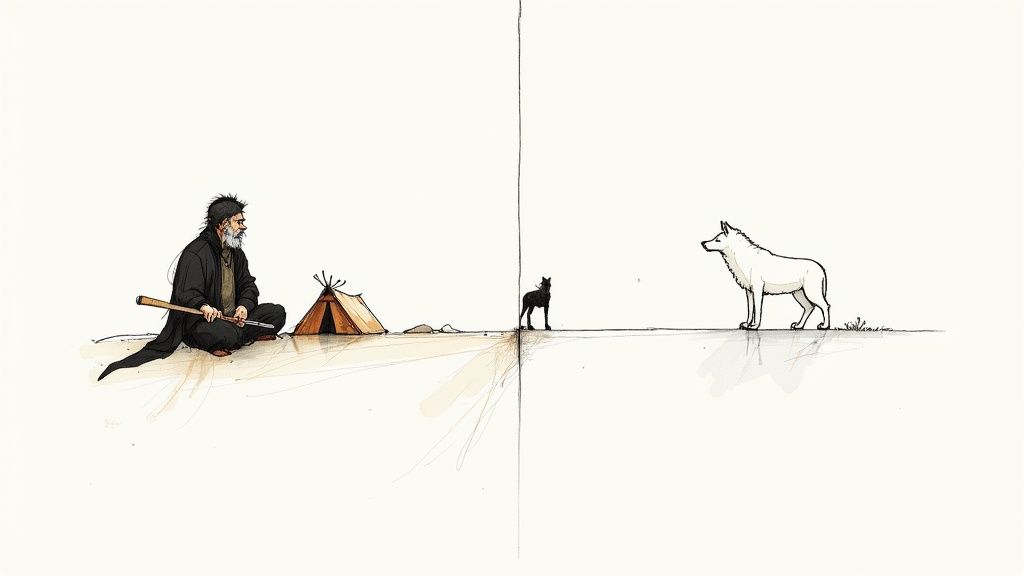
While Julie of the Wolves reads like a pulse-pounding adventure on the surface, its real power is buried just beneath the snow. This isn't just a story about a girl surviving the cold; it's a deep, thoughtful look at what it means to belong, to be human, and to find your footing in a world of clashing values.
The most obvious theme is survival, but the book explores it from several angles. First, there's the raw physical fight against the Arctic itself—the gnawing hunger, the brutal winds, and the ever-present danger. To make it, Miyax has to learn how to build shelter, find food, and understand the subtle language of the tundra.
But her survival goes deeper than that. It's also cultural and emotional. She doesn't conquer the wild with force; she survives by using the ancestral Iñupiaq knowledge her father taught her. This spiritual and intellectual survival is just as vital as the physical, allowing her to connect with the wolves and find a way to live in harmony with the land.
The Clash Between Tradition And Modernity
A major conflict driving the story is the friction between the "old ways" of the Iñupiaq people and the "new ways" of the modern, Western world. This internal battle is perfectly captured in the main character, who carries two names: Miyax, tying her to her indigenous roots, and Julie, which connects her to American culture through a pen pal.
Miyax’s run into the wilderness is, at its core, an escape from the worst parts of modernity—a forced marriage and a community that has lost touch with its traditions. Out on the tundra, she rediscovers the wisdom and beauty of her heritage, finding a sense of family with the wolves that she couldn't find in the human world.
But the story is too smart to paint a simple good-versus-evil picture. The modern world also offers knowledge, connection (through her pen pal, Amy), and opportunity. The book makes it clear that this is a conflict with no easy answers.
The real tragedy of the novel is how the modern world, with its thoughtless cruelty, crashes into the sanctuary Miyax has found. The hunters who shoot Amaroq from an airplane represent the destructive force of modernity, shattering her dream of a life lived in harmony with nature.
Humanity's Connection To The Natural World
Maybe the most powerful theme in Julie of the Wolves is the profound, almost spiritual bond between humans and nature. Miyax doesn't just tame the wolves. She communicates with them, respects their pack dynamics, and eventually becomes one of them. Amaroq, the alpha male, becomes a father figure to her, providing the guidance, protection, and companionship she desperately needed.
This relationship redefines what "family" and "community" can mean. For Miyax, the wolf pack is a far more stable and loving family than the one she fled. The book shows the natural world not just as a setting, but as a living, breathing entity with its own spirit. It's the tundra and its creatures that give Miyax the identity and belonging she can't find anywhere else. The authentic portrayal of this bond is a huge reason the book is so important, a point that ties into the broader discussion about representation in children's books.
This table breaks down how these core ideas play out in Miyax's story.
Core Thematic Elements in the Novel
| Theme | Description | Example from the Story |
|---|---|---|
| Survival | Miyax's struggle is physical, cultural, and emotional, requiring resilience and ancestral knowledge. | She uses her father's teachings about wolf behavior to signal submission and gain the pack's trust. |
| Tradition vs. Modernity | The conflict between Iñupiaq heritage and Western influence shapes Miyax's identity crisis. | Her father, Kapugen, ultimately embraces modern life, even participating in the sport hunting that killed Amaroq. |
| Human-Nature Connection | The deep bond between Miyax and the wolf pack illustrates a powerful interspecies relationship. | Miyax mourns Amaroq's death with a grief as profound as losing a human family member. |
In the end, Julie of the Wolves is about the search for a home in a world where the old and new ways feel impossible to reconcile. Miyax's journey shows her that survival is more than just staying alive—it's about holding on to who you are while finding your way through a world that's constantly changing.
The Characters at the Heart of the Story
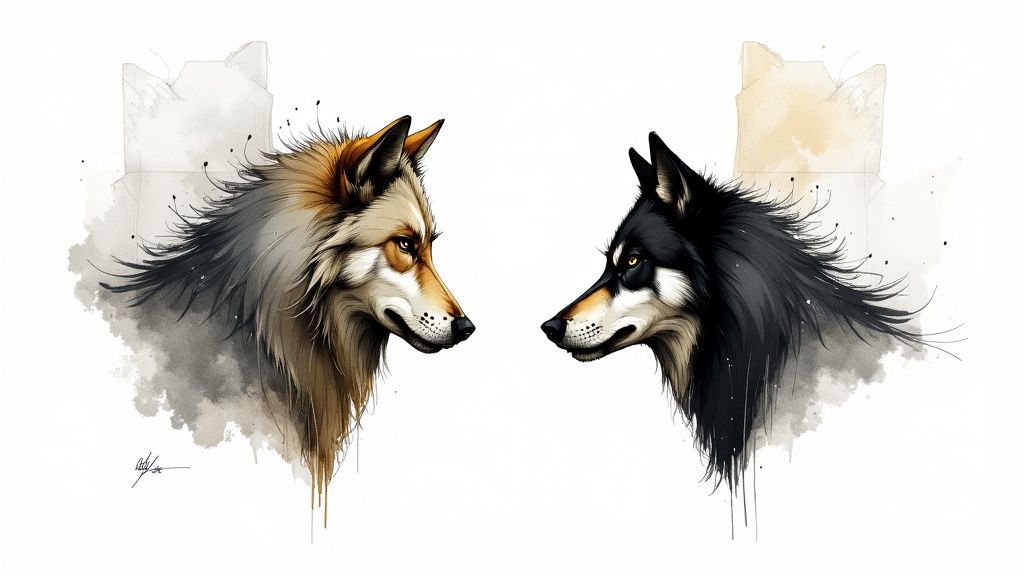
What really gives Julie of the Wolves its lasting power are its unforgettable characters—both human and animal. This isn't just a survival story. It's a deep dive into identity and connection, all seen through the eyes of its fierce protagonist and the unlikely family she builds in the wild.
At the center of it all is a young Iñupiaq girl, a girl caught between two worlds. This conflict is captured perfectly in her two names. To the modern world, she is Julie, the name she uses when writing to her pen pal, Amy, in America. But in her heart, and out on the vast tundra, she is Miyax. This is the name that anchors her to her heritage and the land.
Miyax or Julie: A Dual Identity
Miyax is the soul of this story. At just thirteen years old, she shows incredible intelligence, courage, and an almost instinctual understanding of the natural world. Fleeing a dangerous arranged marriage, she finds herself completely alone in the Arctic wilderness—a situation that would break most adults.
But Miyax doesn't just survive; she thrives. She does it not with force, but with observation, patience, and a deep respect for the old ways her father taught her. Her dual identity creates the book's central struggle. As Julie, she dreams of a new life in San Francisco, filled with the promises of American modernity. As Miyax, she finds a profound sense of belonging with the wolves, living a life governed by ancient rhythms.
Miyax’s journey is a powerful reminder that identity is often complex and multifaceted. She isn't just one person or the other; she is a blend of both her worlds, and her story is about finding a way to reconcile these seemingly opposing parts of herself.
The Wolf Pack: A Found Family
One of the most extraordinary parts of Julie of the Wolves is how it portrays the wolves. They aren't just animals; they're fully realized characters with their own complex social structure and language. Jean Craighead George masterfully gives them distinct personalities, making them essential to Miyax's survival, both physically and emotionally.
The pack becomes the true family Miyax never had, offering the stability and affection she lacked in the human world.
- Amaroq: The majestic, intelligent pack leader. He’s a noble, powerful figure who becomes a surrogate father to Miyax, teaching her the unwritten rules of the tundra and giving her protection. His death is easily the story's most heartbreaking moment.
- Silver: Amaroq’s mate, representing the nurturing, maternal side of the pack.
- Kapu: A playful pup who becomes Miyax's closest companion. He symbolizes the simple joy and connection she discovers in her new life.
By learning their "language" of whines, yips, and body postures, Miyax bridges the gap between species. The bond she forms with them is both beautiful and profound.
Kapugen and Amy: Influential Figures
Though we see them less often, two other characters are absolutely crucial in shaping Miyax’s worldview.
Her father, Kapugen, is a powerful presence even when he's not there. The memories of his teachings about the old Iñupiaq ways are what give Miyax the skills to survive on the tundra. He represents the ideal of a life lived in harmony with nature—a vision that is tragically shattered when she finally finds him again, fully assimilated into the modern world.
On the other side of this is Amy, her pen pal in San Francisco. Amy is never seen, but she represents the powerful lure of the American dream. She is the destination Julie is running toward, a symbol of hope and a completely different future. Together, Kapugen and Amy are the two poles of Miyax’s world, pulling her in opposite directions as she struggles to forge her own path.
The Author and the Book's Lasting Legacy
To really get to the heart of Julie of the Wolves, you first have to understand the incredible woman who wrote it, Jean Craighead George. She wasn't just an author; she was a lifelong naturalist who poured her deep respect for the wild into every page. That passion is what gives the story an authenticity that still feels raw and real today.
George grew up surrounded by naturalists, so a love for the wilderness was practically in her DNA. Her writing stands out for its careful research and its portrayal of animals as complex beings with their own societies, not just simple creatures. This deep-seated knowledge is exactly why Miyax’s bond with the wolf pack feels so genuine and emotionally powerful.
She didn’t just guess what it would be like to communicate with wolves—she studied them, immersing herself in their world to bring their story to life. This blend of accuracy and empathy is the secret sauce that turned a great adventure into a timeless classic.
A Newbery Medal and a Place in History
It didn't take long for the literary world to recognize what George had created. The Newbery Medal in 1973 was a massive acknowledgment of the book's power, cementing its place among the most celebrated classics for young readers.
Winning this award was a huge deal. It proved that a story so unflinching about survival, identity, and the environment could connect with a massive audience. It was more than a win for the book; it was a win for a kind of storytelling that doesn't talk down to its readers or shy away from tough subjects. You can explore more about the book's critical acclaim and see why it's still studied for its groundbreaking narrative.
Cultural and Educational Significance
The influence of Julie of the Wolves reaches far beyond awards. For decades, it’s been a fixture in classrooms and school libraries everywhere because its rich themes make it an amazing teaching tool.
Educators have used the novel to open up conversations about:
- Indigenous Cultures: The story is a powerful gateway to discussing Iñupiaq traditions and the struggles Indigenous communities face in a modernizing world.
- Environmentalism: Miyax’s profound connection to the tundra serves as a poignant lesson on conservation and why we need to respect our planet.
- Resilience and Character: Her journey is an incredible example of courage, resourcefulness, and the sheer strength of the human spirit.
Julie of the Wolves set a new standard for wilderness survival stories. It showed that these books could be more than just thrilling adventures—they could be deep explorations of culture, identity, and our place in the natural world.
You can see the book's DNA in so many of the survival stories that came after it. By telling Miyax's story with such honesty and heart, Jean Craighead George gave us more than just a book. She created a legacy that keeps inspiring, teaching, and challenging us to see the world, and ourselves, in a whole new light.
Resources for Teachers and Book Clubs
Bringing Julie of the Wolves into a classroom or a book club is a fantastic way to open up powerful conversations about survival, culture, and our connection to the natural world. But to get the most out of it, you need a good framework to guide the discussion. That's what this section is all about.
These resources are designed to spark curiosity and give you some structure, whether you're a teacher building a lesson plan or a book club leader prepping for a meeting. We want to help you move beyond just recapping the plot and get into a truly meaningful analysis of Miyax’s incredible journey.
Thought-Provoking Discussion Questions
Sometimes the best way to really get inside a story is to just start asking big questions. These prompts are meant to kickstart those conversations and encourage everyone to share their own take on Miyax's experiences.
- Miyax has two names, Julie and Miyax. How does this dual identity shape her choices and how she sees the world?
- What is the book trying to tell us about the meaning of "family"? How does Miyax's relationship with the wolf pack challenge or expand our own ideas of kinship?
- Think about the arctic tundra. In what ways does this environment feel like its own character in the story?
- Let's talk about the ending. What does Kapugen's transformation reveal about the clash between tradition and modernity? Did you find the ending hopeful, or was it tragic?
For book clubs that meet online, finding the right platform can make a huge difference in keeping the conversation flowing. There are many great alternatives to Facebook for managing book club discussions that help keep things organized and fun.
Creative Project and Activity Ideas
To really bring the story to life, a few hands-on projects can make all the difference. These activities are easy to adapt for different age groups and work well for both individuals and group settings.
- Cultural Deep Dive: Spend some time researching the Iñupiaq people of Alaska. Put together a presentation or a short report on their traditions, language, relationship with the land, and the challenges they face today. This gives so much crucial context to Miyax’s story.
- Wolf Behavior Study: Jean Craighead George was a dedicated naturalist, and her depiction of wolf communication is a huge part of the novel. Have your group research real-life wolf pack dynamics—their social structures and vocalizations—and then compare what you find to the book.
- Artistic Response: Create a piece of art that captures a key scene, theme, or feeling from the book. It could be anything—a drawing of Amaroq, a sculpture of the tundra landscape, or even a poem written from Miyax’s point of view.
By digging into the cultural and ecological layers of the story, readers can gain a much deeper appreciation for what Miyax went through. These activities help turn the book from something you just read into a world you can actively explore.
This novel is also a perfect jumping-off point for finding other powerful stories. For anyone interested in going further, exploring a good list of Native American books for kids can introduce you to even more incredible perspectives.
Answering Your Questions About Julie of the Wolves
Whether you're picking up Julie of the Wolves for the first time or revisiting it after many years, this incredible story always sparks curiosity. It’s a book that gets you thinking about survival, culture, and our connection to the animal world. Let's dig into some of the questions that come up most often.
A big question for many is, where does this all take place? The story is set entirely on the North Slope of Alaska, a massive, wild tundra. This isn't just a simple setting; the raw, unforgiving land is practically a character itself, challenging Miyax at every step and truly shaping her incredible journey.
People also wonder if this is a true story. Miyax's tale is a work of fiction, but the author, Jean Craighead George, was a passionate naturalist. She poured countless hours into researching both Iñupiaq culture and the real-life behavior of wolves, which is why Miyax’s bond with her wolf pack feels so authentic and powerful.
Finding Meaning in the Story
So, what's the deal with Miyax's two names? It's a question that gets right to the heart of the book. "Miyax" is her Iñupiaq name, tying her to her ancestors and the ways of the natural world. "Julie" is her English name, the one she uses with her pen pal, and it represents the modern American life she thinks she wants. This duality is central to her struggle to figure out who she really is.
Why did she run away to begin with? Miyax fled her home after being forced into an arranged marriage with a boy named Daniel, a situation that became frightening and dangerous. This traumatic experience pushed her to escape, hoping to find a better life with her pen pal in San Francisco.
The powerful, and somewhat heartbreaking, ending often leaves readers with a lot to think about. It forces us to see that the old, traditional ways and the modern world are clashing, leaving Miyax stuck at a crossroads without any easy answers.
Finally, what's the right age for a reader to tackle this book? It famously won the Newbery Medal, an award for children's literature, but it deals with some heavy themes like abandonment, survival, and assault. Because of this, it’s best suited for middle-grade readers, usually ages 10 to 14. These topics open the door for important conversations but are best approached with a bit of guidance.
At Number 6 Publishing, we know that stories like Miyax's are vital for young readers. They spark meaningful conversations and help build a deeper sense of empathy. To find more unforgettable books and hand-picked reading lists to inspire a child in your life, come visit us at https://www.number6publishing.com.