
Finding a literary agent is so much more than just having a good manuscript. It’s a mix of a killer query letter, a polished book, and a smart, targeted submission strategy. Think of it less like a lottery and more like a professional campaign where you’re focusing on agents who represent your genre and are actively looking for new writers. This means putting in the work—research, personalization, and a whole lot of resilience.
Setting Realistic Expectations for Finding an Agent

Before you even think about writing a query letter, let's get one thing straight about the publishing world. The road to finding an agent is almost always a marathon, not a sprint. Getting your expectations in check from the start is the best way to build the thick skin you'll need to see this through.
The truth is, agents are absolutely buried in submissions. They’re the gatekeepers for publishing houses, sifting through thousands of manuscripts to find the rare few they think can actually sell. That’s not meant to scare you; it’s meant to get you ready for the level of quality and professionalism that's required.
Understanding the Numbers Game
The competition out there is no joke. Agents in big markets can get around 2,000 submissions a year, but they might only sign two or three new authors from that pile. That gives any single submission about a 1 in 1,000 chance of making the cut.
With odds like that, your submission package—your query, your synopsis, and those first few pages—has to be perfect. There's just no room for error when an agent has a hundred other emails waiting.
"The truth of the matter is that you’re more likely to get representation with agents who are hungry for that genre RIGHT NOW, not 2 to 4 years ago."
This is a critical point. It really drives home why timely, focused research is everything. The agent who landed a huge fantasy deal last year might be hunting for a contemporary romance this year. Your job is to figure out what they want now.
Why Agents Are So Selective
A literary agent doesn't just forward your manuscript and hope for the best. They invest their own time, reputation, and resources into your career. Since their paycheck is a 15% commission on your earnings, they only take on writers they feel confident they can sell. It’s a business, and that forces them to be incredibly discerning.
An agent is looking at more than just good writing. They’re asking:
- Marketability: Does this book fit into the current market? Is there an audience ready to buy it?
- Author Platform: Especially for non-fiction, do you have an audience or expertise that will help sell the book?
- Career Potential: Do you have more book ideas? Agents want to build long-term careers, not just sell a single book.
Thinking about your work through this lens helps you see your book not just as your art, but as a product. While an agent is a huge part of the puzzle, understanding the bigger picture of how to get a book deal clarifies what an agent is ultimately trying to achieve for you.
For some writers, especially in niche areas like children's books, there are other paths to consider. You can check out our guide on children's book publishers that accept unsolicited manuscripts for some of those alternatives. Adopting this professional mindset from day one can turn your agent search from a vague hope into a real, strategic plan.
Getting Your Manuscript Submission-Ready

Before you even think about sending a query letter, your manuscript has to be as polished as you can possibly make it. That first look an agent takes at your pages is everything. It's a moment that can make or break your chances.
A clean, professionally prepared manuscript does more than just present your story well. It tells the agent you're a serious author, someone who respects their time and understands how this industry works. This isn't about getting a first draft done; it's about taking that draft through several crucial stages of refinement. Trying to skip these steps is one of the fastest routes to the rejection pile.
The Self-Editing Gauntlet
You are, and always will be, your own most important editor. Once you type "The End," the single best thing you can do for your book is to walk away. Give it a few weeks, maybe even a month. That time and distance will give you the fresh eyes you need to spot the plot holes, clunky sentences, and pacing problems that were invisible before.
When you dive back in, think big picture first. Don't waste time fixing commas when an entire chapter isn't working.
- Macro Edits: Start with the foundation—plot, character development, pacing, and the overall structure. Does the story make sense from start to finish? Are your characters' choices believable?
- Micro Edits: After the story is structurally sound, you can zoom in. This is where you hunt down weak verbs, trim wordy sentences, and polish your prose until it gleams.
This is never a one-and-done process. Real self-editing often takes two, three, or even more passes to get right.
Leveraging Beta Readers and Critique Partners
At some point, you'll have taken the manuscript as far as you can on your own. That's when you need to bring in outside perspectives to see the things you can't. This is where beta readers and critique partners become your secret weapons.
Beta readers act as your test audience, giving you feedback on the experience of reading your book. Critique partners, who are usually writers themselves, can offer more detailed, craft-focused advice.
A classic mistake is giving your manuscript only to friends and family. They mean well, but their feedback is almost always too kind. You need honest, constructive criticism from people who know your genre and aren't afraid to tell you what needs fixing.
As feedback rolls in, look for the patterns. If one person doesn't like a character, that's just an opinion. If three people all say the same character feels flat, you know you've got work to do.
Knowing Your Genre and Comps
An agent needs to know exactly where your book would sit on a shelf at Barnes & Noble. Before you write your query, you have to be able to clearly define your book’s genre, age category (like Middle Grade, Young Adult, or Adult), and even its subgenre (like space opera or cozy mystery). Getting this wrong signals to an agent that you haven't done your research.
You'll also need what are called comparative titles, or "comps." These are recent books, usually published in the last 2-3 years, that have a similar tone, theme, or target audience as your own. Comps are a kind of industry shorthand, giving an agent an immediate sense of your book's place in the market.
Final Polish and Professional Formatting
Once all the editing is done, the last step is to format your manuscript to the industry standard. This isn't the place to get creative; it's about professionalism. Using a weird font or strange spacing can immediately mark you as an amateur.
Standard Manuscript Formatting Checklist:
- Font: Stick with 12-point Times New Roman. It's the standard for a reason.
- Spacing: Double-space the entire document, with no extra spaces between paragraphs.
- Margins: Set 1-inch margins on all four sides.
- Indentation: Indent the first line of every paragraph by 0.5 inches. Set this in your word processor; don't just hit the tab key.
- Page Header: Every page should have a header in the top right corner with your last name, the book's title (can be shortened), and the page number.
A clean, properly formatted manuscript ensures that nothing gets between the agent and what truly matters: your story.
How to Research Agents and Build Your Target List
With your manuscript polished and ready to go, your job description changes. It's time to put on your detective hat. The goal here isn't just to find any agent; it's to find the right agent for your book.
Blanketing the industry with queries is a recipe for a full inbox of rejections. A targeted, well-researched approach is what separates serious authors from the hopefuls. Your mission is to build a curated list of 10-15 agents who are not only a perfect fit for your genre but are actively searching for a book exactly like yours. This shows you respect their time and know your place in the market.
Where to Start Your Agent Search
Knowing where to look is half the battle. A simple Google search can throw an overwhelming amount of information at you, but thankfully, there are a few go-to resources that publishing pros rely on.
These platforms are the industry standard for a reason—they consolidate crucial information and make your search far more efficient. Start by filtering for agents who represent your specific genre and age category. This will give you a solid long list that you can start whittling down.
Top Resources for Agent Research
Finding the right platform can make all the difference. Here’s a quick breakdown of the best places to start your agent research, each with its own strengths.
| Resource | Best For | Key Feature | Cost |
|---|---|---|---|
| Publishers Marketplace | In-depth market intelligence | Tracks real-time book deals | Subscription |
| Directory of Literary Agents | Building a broad initial list | Comprehensive agent profiles & guidelines | Free |
| QueryTracker | Organizing submissions & data | User-submitted query stats & response times | Free (Premium available) |
| Manuscript Wish List | Finding agents actively seeking your story | Agents post exactly what they want to see | Free |
Using a combination of these tools gives you a 360-degree view of the agent landscape, from who's selling what to who is hungry for a story just like yours.
Using Manuscript Wish List to Find Hungry Agents
One of the most powerful tools in an author's arsenal is the Manuscript Wish List (#MSWL). Think of it as a direct line into an agent's brain. Instead of guessing what they might like, agents use #MSWL to tell you exactly what they're desperate to find in their inbox.
An agent might tweet that they're searching for a rom-com with a specific trope or a sci-fi novel set in a unique, unexplored world. This is gold. It allows you to tailor your query and prove you're the perfect fit.
The #MSWL platform makes it easy to search by keyword, genre, or a specific agent's name, helping you pinpoint professionals who are already looking for you. These wishlists also reveal fascinating industry trends. For instance, Young Adult (YA) fiction is a hot ticket for 2025, racking up 56 mentions in the 100 most recently updated MSWL profiles. Over half of those agents are specifically seeking YA for readers aged 12-18, a clear sign of market demand.
Digging Deeper Into Agent Profiles
Once you have a list of potential agents, the real work begins. It’s time to vet them. An agent's website and social media presence are treasure troves of information that will tell you if you truly click.
Look beyond the basic "I represent thrillers" line.
Go to their agency's website and read their bio carefully. Check out their client list. Have they represented books you admire? Do their clients' careers seem to be on a path you’d like for yourself? This isn’t just about selling one book; it’s about finding a long-term business partner.
Read any interviews they've given or blog posts they've written. This is your chance to get a feel for their personality and editorial style. Some agents are heavily editorial, while others are more hands-off. Knowing their approach is crucial. As you get a feel for the industry, it's also smart to look into the best book publishers for first-time authors to understand the full landscape.
Don't Overlook Newer Agents
It's easy to get star-struck and only query the big-name agents with decades of massive sales. While they're obviously successful, they're also buried under a mountain of submissions.
Newer agents, on the other hand, are actively building their client lists and can be an incredible find for a debut author. They are often hungry for fresh talent and may have more time to dedicate to your career. Plus, they work at established agencies, so they have the full support and mentorship of senior colleagues.
Sometimes, finding an agent who is genuinely passionate about your work is far more valuable than being just another manuscript in a very big pile.
Writing a Query Letter That Gets Results
Think of your query letter as your book’s resume and your professional handshake, all rolled into one. It’s a sales pitch, no doubt, but a very specific and strategic one. The entire goal of this single page is to hook an agent so deeply that they simply have to request your manuscript.
This isn’t just about rattling off a plot summary. It's your chance to flash your unique voice, prove you understand where your book fits in the market, and present yourself as a professional they'd actually want to work with. Every word matters. One wrong move can send an otherwise great book straight to the slush pile.
Deconstructing the Perfect Query Letter
A truly effective query letter isn't some kind of mysterious art—it follows a well-worn path. Getting these three key parts right will put you miles ahead of the competition.
- The Personalization and Hook: This is your opening. It needs to grab the agent's attention right away and prove you've done your homework.
- The Book Pitch (Synopsis): Here’s the main event. This is where you sell your story, making it sound absolutely irresistible.
- The Author Bio and Housekeeping: This is how you wrap things up, introducing yourself and giving the agent the necessary manuscript details.
This structure is what agents expect to see. Trying to get too creative with the format often just signals that you're an amateur who hasn't learned the basic rules of the game.
Nailing the Opening Hook
Whatever you do, don't start with "Dear Agent." Your first sentence is a golden opportunity to create an immediate, personal connection. This is where all that research you did pays off.
Address the agent by name and mention something specific that led you to them. Did you fall in love with a book they represented? Did you see a #MSWL tweet that sounded like it was written just for your story? This instantly shows you’re not just spamming a generic list.
Right after that, you hit them with your hook. This is a quick, one- or two-sentence pitch that boils your novel down to its core conflict and stakes. It should be short, punchy, and make them lean in.
Key Takeaway: A query letter is not the place for a long, rambling plot summary. It’s a high-level pitch designed to make an agent say, "I need to read more." You have to balance intrigue with clarity, giving them just enough to get them excited without revealing every single twist.
For a thriller, a hook might sound something like this: "When a disgraced journalist discovers the missing plane she's investigating is linked to her own sister's disappearance, she must expose the truth before she becomes the conspiracy's next victim." See? Intriguing.
Crafting a Compelling Synopsis
This is where so many writers get stuck. You have to somehow shrink your 80,000-word masterpiece down to about 200-250 words. The trick is to stick to the absolute essentials of the story arc.
- Introduce the Protagonist: Who is your main character, and what is the one thing they want more than anything else?
- Establish the Inciting Incident: What kicks the story into gear and turns their world upside down?
- Detail the Central Conflict and Stakes: What’s standing in their way, and what’s at risk if they fail?
- End with a Hint of the Climax: Leave the agent hanging. Don't spoil the ending, but tease the impossible choice or final showdown your character is heading toward.
And remember, this section should sound like your book. If your novel is funny, the synopsis better be funny. If it’s dark and gritty, let that tone come through in your writing.
The Professional Author Bio
Now it’s time to briefly introduce yourself. Keep it short, professional, and relevant. If you don’t have any fancy publishing credits, that’s perfectly okay—don’t try to make things up.
Instead, focus on anything that makes you uniquely qualified to write this story. Did you draw from a powerful personal experience? Do you have a professional background that adds a layer of authenticity?
For example, if you're an ER nurse and you’ve written a medical drama, you absolutely have to mention that. If you’ve written a historical epic and have a degree in that period’s history, include it. If you have nothing directly relevant, a simple, confident sentence about who you are is all you need.
Since a query letter is your first professional introduction, learning how to write a cover letter that gets noticed can give you a real edge. This kind of communication is a learned skill, and mastering it is a huge step. To finish, just close with the basics: your book's title, genre, age category, and final word count. Thank the agent for their time, and you’re good to go.
Managing Submissions and Agent Responses
You’ve polished your manuscript and built a killer query list. That’s a huge accomplishment. Now comes the part that tries every writer’s soul: clicking 'send' and officially entering the querying trenches. This phase is all about staying organized, acting like a pro, and managing your own hopes while you wait.
Trying to navigate this process without a system is a one-way ticket to anxiety and fumbled opportunities. You absolutely need a way to track who you’ve queried, when you sent it, and what they said. Trust me, a simple, clean spreadsheet will become your best friend.
A Sane System for Tracking Your Submissions
Forget trying to remember it all or digging through a chaotic inbox. A submission tracker is non-negotiable if you want to stay sane and professional. It doesn't need to be fancy, but it does need to hold a few key details for every agent on your list.
Just create a few columns:
- Agent Name: Their full name.
- Agency: The name of their literary agency.
- Date Sent: The exact date your query went out.
- Materials Sent: Was it just the query, or did they ask for pages right away? Note it here.
- Response: This is where you’ll log their reply—rejection, partial request, full request.
- Response Date: The day their response landed in your inbox.
- Follow-Up Date: Pop in a future date to send a gentle nudge if you haven't heard back within their stated timeline.
This simple tool gives you a clear, at-a-glance dashboard of your progress. It helps you avoid embarrassing mistakes, like querying the same agent twice, and lets you spot any patterns in the feedback you’re getting.
Learning to Read the Tea Leaves: Decoding Responses
Once the emails start trickling in, you’ll notice they tend to fall into a few distinct categories. Knowing what each one means is crucial for figuring out what to do next. Just know this upfront: the vast majority of responses will be rejections. That’s a completely normal part of this game.
The most common reply is a form rejection. It’s a generic, often automated email politely saying "no thanks." It feels impersonal because it is, and it offers zero specific feedback. Don’t take it personally. It just means your project wasn't the right fit for that specific agent at that moment.
A personalized rejection is a definite step up. This means the agent, or their assistant, actually took a moment to write a sentence or two about your submission. It's still a 'no,' but it's an encouraging sign that your writing was compelling enough to warrant a personal comment.
The one you’re really waiting for is a request for a partial or full manuscript. This is a massive win! It means your query letter and sample pages did their job perfectly. Take a moment to celebrate, then send the requested material promptly and—of course—update your spreadsheet.
A Reality Check on Agent Signing Rates
It’s so important to keep the numbers in perspective here. Even for new agents hungry to build their client list, the odds are incredibly long. Take debut agent Jenna Satterthwaite, for instance. In 2024, she received 3,627 queries but signed only 20 new clients. Of those, seventeen came directly from the slush pile, which works out to a signing rate of just 0.47% from unsolicited queries. You can dig into more of these fascinating agent statistics to better understand what they mean for authors.
When an Offer Comes In: What to Do Next
If an agent falls in love with your manuscript, they’ll email you to schedule a phone or video call. This is "The Call," and it’s likely when they will offer you representation. It’s an amazing, exhilarating moment, but remember: it’s also a business meeting. Go in prepared with questions about their vision for your book, how they like to communicate, and their strategy for submissions.
If you get an offer, standard industry etiquette is to immediately notify any other agents who are currently reading your partial or full manuscript. Give them a clear deadline—usually one to two weeks—to finish reading and make their own offer if they’re interested. This simple professional courtesy ensures you can make a fully informed decision about who will be the best career partner for you. Managing this final step with grace is a critical skill when you’re learning how to find a literary agent who’s truly the right fit.
Common Questions About Finding a Literary Agent
The path to finding the right literary agent is often winding, and it's completely normal for questions to bubble up. Getting clear answers to these common hang-ups can make the whole process feel less intimidating and help you avoid rookie mistakes that can slow you down. Let's tackle some of the most frequent questions writers have during this make-or-break phase.
This chart quickly lays out the essential flow of the submission process.
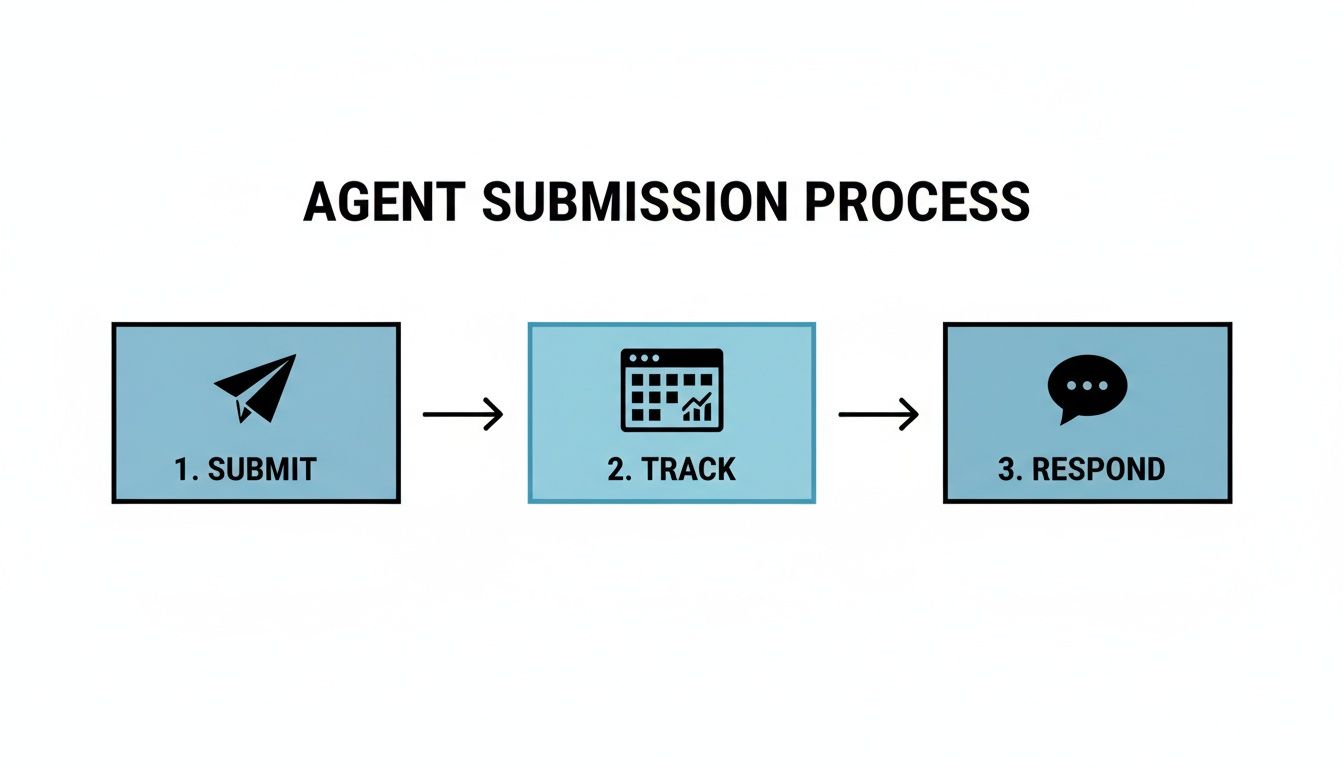
It shows you the main stages, from sending out that first query to handling the replies, which really underscores why an organized, professional approach is so important.
How Many Agents Should I Query at Once?
This is one of the biggest questions on every writer's mind. It's so tempting to just blast your query to every agent on your list and hope for the best, but a more strategic, measured approach will serve you far better in the long run. The key is to work in small, targeted batches.
Most authors who've been through the trenches will tell you to send out queries in rounds of 8-12 agents. This strategy isn't arbitrary; it serves a crucial purpose. Think of that first batch as a test run for your entire submission package.
If you send out 10 queries and all you hear back is radio silence—or a string of form rejections—that's a pretty clear signal that something in your approach needs tweaking. This feedback loop is pure gold. It gives you a chance to hit pause, take another look at your query letter or opening chapters, and make smart adjustments before you reach out to the next group of agents on your list.
Do I Need a Social Media Following?
The pressure to build an author platform, particularly a hefty social media following, is a huge source of anxiety for writers. The real answer? It honestly depends on the type of book you've written.
For fiction authors, the answer is almost always no. Agents and editors are laser-focused on one thing above all else: the quality of your manuscript. A phenomenal story is your greatest weapon, and a low follower count won't stop an incredible book from getting representation.
For non-fiction, however, the game changes. A strong, established platform is often seen as a prerequisite. Publishers need to know that you already have an audience eager to buy your book. In that case, your following is proof of concept and market demand.
Key Takeaway: While a solid social media presence might occasionally be a tie-breaker between two very similar fiction submissions, it's almost never a deal-maker or deal-breaker. Pour your energy into making your manuscript impossible to put down.
What to Do If You Get an Offer
That email or phone call with an offer of representation is the moment every author dreams about. First things first, stop and celebrate! You've hit a massive milestone. Once you've had a chance to let it sink in, it's time to handle the next steps like a pro.
Your immediate task is to politely inform any other agent who is currently reading your full or partial manuscript. Let them know you've received an offer and give them a clear, reasonable deadline to respond with their own decision.
This is standard industry courtesy, and agents absolutely expect it. Here’s a quick breakdown:
- Notify Everyone Promptly: Send a short, professional email to all agents who have your materials.
- Set a Firm Deadline: Give them 1-2 weeks to finish reading and get back to you.
- Weigh Your Options: If you're lucky enough to get multiple offers, you'll be in the fantastic position of choosing the agent who is the best long-term partner for your writing career.
Following this protocol ensures you make a thoughtful, well-informed choice. For those curious about the bigger picture of the book world, you can get a different perspective by reading our guide on how to become a publisher.