
At its heart, Frindle tells the story of Nick Allen, a clever fifth-grader who decides to invent a new word for "pen." What starts as a simple classroom experiment quickly turns into a battle of wits with his teacher, igniting a phenomenon that sweeps the nation. Andrew Clements's classic book is a wonderful look at how one small idea can challenge the rules and completely change how we think about language. It’s a story about creativity, a little bit of rebellion, and the incredible power a single word can hold.
Why Frindle Still Captures Our Imagination
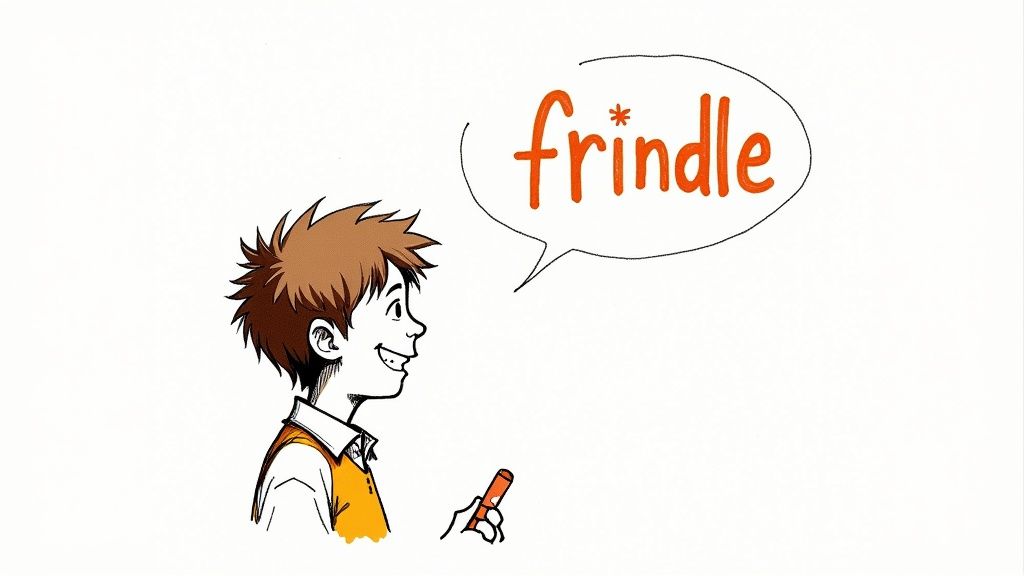
What is it about a book from 1996 that still feels so fresh and important today? The magic of Frindle is in its simple but powerful question: who gets to decide what words mean? This isn't just a tale of a kid trying to get a rise out of his teacher; it's a brilliant look at how language is a living thing that breathes, grows, and changes.
The main character, Nick Allen, is the perfect embodiment of the curiosity and creative fire that burns in every kid. When he starts calling a pen a "frindle," he's not just being a troublemaker. He's putting a classroom lesson to the test—the idea that people create words, and those words get their meaning when we all agree to use them. His small act of defiance snowballs into a real-world experiment that spirals beautifully out of control.
The Spark of an Idea
The story really takes off when Nick's idea runs headfirst into the unmovable force that is his language arts teacher, Mrs. Granger. She is the gatekeeper of tradition, rules, and the way things have always been done. Their back-and-forth becomes the heart of the story, a fantastic chess match between a student’s wild creativity and a teacher’s firm grip on structure.
This dynamic is exactly what pulls young readers in. It validates their own questions about the world and proves that even a fifth-grader can have an idea powerful enough to shake things up. The story teaches a huge lesson without ever feeling like a lecture.
At its core, Frindle is a celebration of intellectual curiosity. It encourages kids to not just accept the world as it is but to ask "why" and imagine how it could be different.
More Than Just a Word
As the word "frindle" escapes the classroom, spreads through town, and eventually hits the national news, the story blossoms into something much bigger. It touches on several key themes that resonate with readers of all ages:
- The Power of Collective Action: It starts with one person's idea, but it takes a whole community to turn that spark into a real movement.
- Media and Influence: The book smartly shows how a little media attention can turn a small trend into a cultural sensation.
- Challenging Authority: It dives right into the tension between following the rules and thinking for yourself—a timeless theme in any school.
This layered storytelling is why Frindle has become such a beloved staple in classrooms. Its fun plot and relatable characters make it one of the best books for reluctant readers, helping to spark a love for stories that challenge and inspire. It’s a book that doesn't just entertain; it makes you think.
The Teacher Who Inspired the Tale
To really get the magic of Frindle, you first have to understand the storyteller, Andrew Clements. Long before he became a bestselling author, Clements spent his days in the one place a story like this could ever take root: a classroom. His time as a teacher wasn't just a day job; it was the wellspring of creativity that brought Nick Allen and Mrs. Granger to life.
Clements wasn't just writing about a school—he was writing about his world. He knew the specific energy of a classroom, the quiet power plays between students and teachers, and those little sparks that fly when a curious kid questions a rule. That firsthand experience is what makes Frindle feel so real. It’s a story told from the inside.
He saw firsthand how kids think, how they challenge things, and how they have this amazing knack for coming up with huge ideas. Nick Allen is basically a love letter to all the clever, creative, and sometimes troublemaking students Clements taught over the years.
From the Front of the Classroom to the Writer's Desk
Andrew Clements didn't just stumble into writing beloved children's books. He taught for seven years, soaking up priceless insights into the world of young students. He got their language, their sense of humor, and their natural urge to see how far they could push the boundaries. This genuine empathy is the secret sauce in his writing.
When he moved into writing and editing children's books, he was able to mix his love for a good story with a deep respect for his audience. He never, ever talked down to kids. Instead, he took on big ideas—like how language works, the pressure to conform, and the power of the media—and made them exciting and easy to grasp.
Andrew Clements believed that children's books should be both fun and meaningful. He saw stories as a way to start important conversations, trusting that young readers were more than capable of wrestling with big ideas.
This belief is the heart and soul of the book. The story of the word frindle is more than just a funny prank; it’s a brilliant way to show how language changes over time. Clements took a complex linguistic idea and spun it into a thrilling adventure any fifth-grader could get excited about. It’s a perfect example of his special talent.
A Legacy of Empowering Young Readers
Clements’ work always comes back to one core idea: the power of kids. He wrote stories where children were the ones making things happen, the ones who could see the world differently and get others to follow. He knew that one student with one clever idea could actually make a difference.
His books often feature:
- Relatable Student Protagonists: Characters like Nick are smart and creative, but they’re also real kids with flaws.
- Respect for Teachers: Mrs. Granger might be the "villain," but she's also shown as a sharp, dedicated teacher, which makes their conflict much more interesting.
- Ideas as the Main Event: The real action in his stories isn't a physical fight but a battle of wits or a creative experiment.
Once you know Andrew Clements' background, you see that Frindle is so much more than a clever tale. It’s a direct reflection of an author who spent his life celebrating the curiosity of children. He championed their ability to think for themselves, question the way things are, and ultimately, change the world—one word at a time. His legacy is a powerful reminder that sometimes, the biggest ideas come from the youngest minds in the room.
The Story of How a Word Was Born
The whole Frindle phenomenon starts with a single spark of curiosity in a fifth-grade classroom. It all begins when Nick Allen, a kid known for his creative thinking and occasional troublemaking, decides to throw a wrench in the gears of his famously strict language arts teacher, Mrs. Loretta Granger. Her absolute devotion to the dictionary gives him the perfect opening.
After giving a report on how words are made, Nick lobs a question that seems innocent but is really a clever trap: who actually decides which words go into the dictionary? Mrs. Granger explains that people do, simply by agreeing to use them. For Nick, this isn't just a fact from a lesson plan; it's a direct challenge. He immediately sees a chance to put this theory to the test in the real world.
From a Joke to a Movement
Nick’s plan is simple but brilliant. He decides to invent a new name for something everyone uses every day: a pen. He christens it a "frindle." He gets his friends on board, and they all make a pact to only use the new word when asking for something to write with.
What starts out as a small inside joke begins to catch on, spreading like a rumor through the school hallways. The commitment from Nick and his friends turns their little act of rebellion into a genuine grassroots movement. It was a perfect example of how a simple idea can grow far beyond its starting point through creative problem-solving techniques.
Mrs. Granger, however, is not a fan. She sees "frindle" as a direct challenge to classroom order and a sign of disrespect for the rules of language. She draws a line in the sand, creating a zero-tolerance policy and handing out detention to any student caught using the word.
This growing conflict between the student and the teacher is what really drives the story forward. It becomes a classic battle of innovation versus tradition, with Nick pushing for change and Mrs. Granger defending the established order.
This clash of wills just adds fuel to the fire. The more Mrs. Granger pushes back, the more popular "frindle" becomes. Getting detention turns into a badge of honor, and the students rally around their new word as a symbol of unity. The conflict quickly blows up from a classroom spat into a school-wide standoff.
A Word Takes on the World
The story really takes off when the local newspaper catches wind of the "word war" brewing at Lincoln Elementary. A reporter writes a feature story about the clever fifth-grader and his unbending teacher, and this local coverage turns "frindle" from a schoolyard fad into a regional phenomenon.
From there, things spiral. The story gets picked up by national news, and suddenly, "frindle" is everywhere. A sharp local businessman spots an opportunity and starts selling merchandise with the word on it—t-shirts, hats, and of course, actual frindles. First published in 1996, Andrew Clements's novel has become a modern classic, selling over 2.5 million copies worldwide and cementing its place in schools and libraries.
The end of the story isn't some big, dramatic event, but a slow, satisfying reveal that plays out over a decade. The book jumps forward 10 years, showing us that "frindle" has achieved the ultimate win: it's been officially added to the dictionary.
In a touching final scene, a grown-up Nick gets a package from Mrs. Granger. Inside is a new dictionary, a heartfelt letter, and the very first "frindle"—the pen he used to sign all those detention slips. Her letter reveals that she was secretly his biggest supporter the whole time, playing the villain to give his word the pushback it needed to truly take flight.
Analyzing the Book's Core Characters
At its heart, Frindle is a story fueled by two unforgettable characters locked in a battle of wits. The entire narrative really hinges on the push-and-pull between Nick Allen, the fifth-grade idea man, and Mrs. Granger, the unshakeable keeper of the dictionary. Their conflict is the engine that turns a classroom prank into a full-blown cultural phenomenon.
To really get what makes the story tick, we have to look past their surface roles. It’s tempting to label them hero and villain, but they're far more complex than that. Nick isn't just a class clown, and Mrs. Granger is so much more than a stuffy old teacher. They're two sides of the same coin, both deeply passionate about words, just with completely different ways of showing it.
The Idea Man Nick Allen
Nick Allen is the spark that lights the whole fire. He’s a fifth-grader with a super-quick mind and a real talent for thinking outside the box. He doesn't actually set out to cause trouble; he's just genuinely curious about how things work, especially language. When he learns that words are invented by people, his first instinct is to see if he can do it himself.
His creation of the word frindle doesn’t come from a place of disrespect but from a pure, simple desire to see an idea come to life. Nick is the embodiment of youthful innovation and the courage it takes to question why things are the way they are. He shows us that one person, no matter how young, can start something huge. His real strength is his ability to rally others around his idea, turning a personal experiment into a movement.
The journey of the word 'frindle' itself perfectly mirrors the power of a single idea taking root, as you can see below.
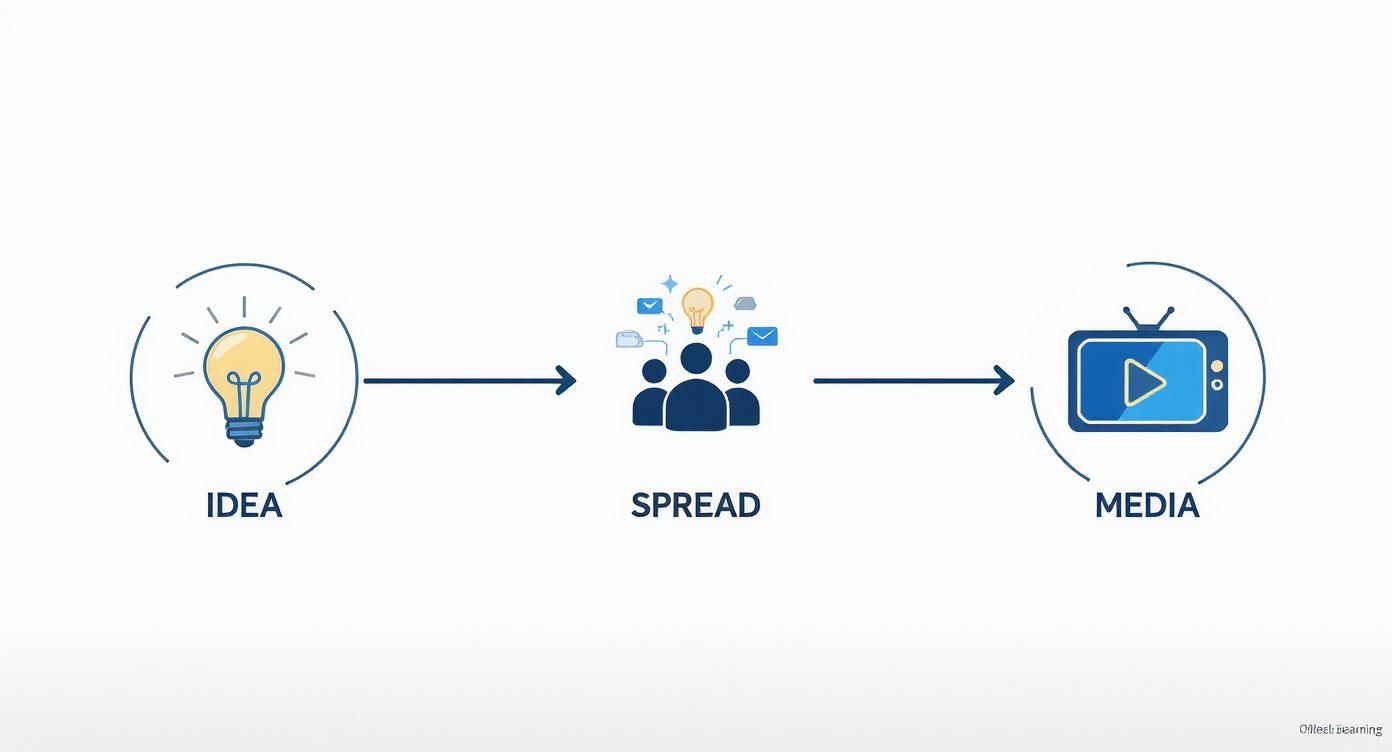
This map shows how Nick's little idea needed social buy-in and a media spotlight to really become part of the culture.
The Guardian of Language Mrs Granger
Mrs. Loretta Granger is the perfect opponent for Nick. She’s a force to be reckoned with, a teacher who treats the dictionary with an almost religious reverence. On the surface, she seems like a rigid traditionalist, dead-set on crushing Nick's little rebellion. She even dishes out detention for every single use of the word "frindle," which sets up the book's main conflict.
But there’s so much more going on with her. She isn't truly against creativity; she's testing its strength. Mrs. Granger understands something critical that Nick is just starting to figure out: for an idea to last, it has to survive being challenged. Her fierce resistance isn't designed to destroy "frindle" but to forge it into something stronger.
As the story eventually reveals, Mrs. Granger is playing the part of the antagonist for a secret purpose. She provides the very friction Nick’s spark needs to catch fire and spread, all while secretly rooting for him from the sidelines.
Her character is a masterclass in subtlety. Let's be honest, without her determined pushback, "frindle" would have been a forgotten classroom joke in about a week. She is the gatekeeper who forces the new word to prove its worth.
A Dynamic of Mutual Respect
What really makes Frindle so brilliant is the relationship that builds between these two. This isn't a simple good-versus-evil story. It’s a chess match where both players have a quiet, growing admiration for the other's moves.
This dynamic really comes through in a few key ways:
- Nick's Persistence: He never backs down, even with daily detentions looming. He’s all-in on his idea.
- Mrs. Granger's Letter: The final reveal of her letter shows she was a mentor all along, not an enemy.
- Their Shared Passion: Both characters have an intense love for words. It's the very foundation of their conflict.
To get a clearer picture of how these two forces match up, let’s put them side-by-side.
Character Analysis Nick Allen vs Mrs Granger
| Attribute | Nick Allen | Mrs. Granger |
|---|---|---|
| Initial Motivation | Curiosity about word origins; testing the limits of rules. | Upholding the sanctity of the English language and its established rules. |
| Key Actions | Invents the word "frindle" and rallies students to use it. | Forbids the use of "frindle" and assigns detention to offenders. |
| Underlying Goal | To prove that language is dynamic and created by people. | To secretly test the resilience of Nick's idea and make it stronger. |
| Character Arc | Matures from a clever prankster to someone who understands the power and responsibility of ideas. | Revealed to be a secret mentor who was fostering innovation, not stifling it. |
By the end of the book, it’s clear they weren’t really enemies. They were collaborators in a grand, unspoken experiment. Mrs. Granger taught Nick that ideas need challengers to survive, and Nick reminded her that language is a living thing that belongs to everyone. Their relationship proves that our biggest challenges often bring about our greatest growth.
Exploring the Main Themes and Lessons
So why does a story about a kid who makes up a new word for a pen still get kids, teachers, and parents so excited? The real magic of Frindle is found in the deep, powerful themes it tucks inside a simple and fun story. It’s more than just a book; it’s a brilliant window into how language actually works.
The story shows us that words don’t have any built-in meaning. They’re just sounds we all agree on. Nick Allen’s little experiment with the word "frindle" is a perfect, bite-sized example of this big linguistic idea. His new word catches on not because it's special, but because a community of people decides, together, to start using it.
This is exactly how language evolves in the real world. Linguists estimate that while 5,000 to 10,000 new words pop up in English every year, only about 1% actually stick around and get used widely. Frindle puts this process on full display, showing how change can bubble up from the ground level.
Creativity Versus Authority
Beyond the wordplay, Frindle gets into the classic tug-of-war between creativity and authority. Nick is the curious kid, the innovator who wants to see things differently. Mrs. Granger represents the rules and structures that keep everything in order.
But their battle isn't just about a troublemaker and a strict teacher. It’s a much more interesting look at a dynamic we all need. Think about it: without Mrs. Granger pushing back, Nick's idea might have just been a silly classroom joke that fizzled out. Her resistance is what turned "frindle" into a cause—a symbol of student spirit.
This part of the story gets us asking some important questions:
- When do we really need rules to learn and grow?
- When do those same rules hold back great new ideas?
- How can we question things in a way that’s respectful but still effective?
The book shows that the best stuff happens right in the middle of this tension. Creativity needs some structure to push against, and authority needs to be open enough to let in fresh thinking. It’s a lesson that applies way beyond the classroom.
At its core, Frindle teaches that one person's idea, no matter how small, has the potential to create a ripple effect with unintended and far-reaching consequences. It champions the power of individual thought while respecting the role of the systems we live in.
The Power of Unintended Consequences
Another big takeaway from Frindle is seeing how one tiny action can snowball into something huge. Nick Allen wasn't trying to become a national celebrity or get a new word in the dictionary. He was just a fifth-grader trying out an idea.
But that idea took on a life of its own. First his classmates used it, then the local newspaper wrote about it, then a businessman started selling frindle-branded gear, and before he knew it, the story was everywhere. This shows just how ideas can spread like wildfire, especially in a connected world. Once you put an idea out there, you don't always get to control where it goes.
This is a really relevant lesson for kids today, reminding them to think about what might happen as a result of their actions. It’s about understanding influence and responsibility. Exploring these ideas is so important, and seeing strong representation in children's books helps kids imagine themselves as people who can make a real difference. Frindle nails this by showing a regular kid who causes an extraordinary chain of events, empowering every child who reads it.
Using Frindle as a Teaching Tool

Andrew Clements’s Frindle isn't just a fun story for kids; it’s a goldmine for the classroom. The book is a fantastic launchpad for all sorts of learning opportunities. With a plot and characters that kids instantly connect with, it provides the perfect way for educators and parents to dig into big ideas about language, rules, and influence.
The book naturally turns reading from a quiet, solo activity into a live, interactive experience. By bringing Nick and Mrs. Granger’s conflict into your classroom, you can get some really lively debates going and encourage students to think a little deeper about the world. The whole story of the word frindle is the perfect case study for lessons in linguistics, social studies, and even how the media works.
Sparking Critical Conversations
At its core, Frindle is a book that just begs to be discussed. You can use the story to kickstart conversations that really challenge students to look beyond the obvious. It’s these kinds of talks that build the critical thinking and analytical skills they’ll need for years to come.
Here are a few questions to get the ball rolling:
- Rules and Authority: Do you think Nick was right to challenge Mrs. Granger? When is it a good idea to question the rules, and when should we just follow them?
- Language Evolution: Before you read this book, where did you think words came from? How did the story of frindle change how you think about language?
- Media Influence: How did the newspaper and TV reporters change what was happening with "frindle"? Is media attention always a good thing?
- Character Motivation: Was Mrs. Granger the "villain" of the story, or was she a "hero"? Why do you think so?
Questions like these do more than just check if a student was paying attention. They push kids to come up with their own opinions and, just as importantly, learn how to defend them. For a deeper dive into this, you might find these reading comprehension strategies for teachers really helpful.
Bringing Frindle to Life with Activities
Getting hands-on is one of the best ways to make the book's themes stick. These activities let students step right into Nick Allen's shoes and feel the power of words for themselves. For teachers, Frindle is also a masterclass in sparking a love for language and offers great strategies for engaging reluctant readers, turning a simple lesson into a memorable adventure.
The most effective teaching moments often arise when students can connect a story's concepts to their own creative impulses. Frindle provides a perfect blueprint for this kind of active, memorable learning.
Ready to try it out? Here are a few projects you can run with:
- Invent-a-Word Challenge: Challenge your students to invent a brand-new word for an everyday object in the classroom. They'll need a definition and an origin story, and then they have to try to get everyone else to use it for a week. You can even track the word's popularity on a chart to see if it catches on!
- Hold a Formal Debate: Split the class into two teams and hold a formal debate on the topic: "Resolved: Nick Allen's creation of 'frindle' was a disruptive act that undermined school authority." This is a fantastic way to get them digging for evidence in the text to back up their arguments.
- Write a News Report: Let your students become journalists for a day. Have them write a newspaper article or create a short TV news broadcast about the "frindle" craze sweeping through Lincoln Elementary. This activity is perfect for exploring different perspectives and understanding the media's role in shaping a story.
Questions Everyone Asks About Frindle
Decades after it first hit bookshelves, Andrew Clements's classic story still gets people talking. Both new readers and old fans often wonder about the story's big showdown, its real-life influence, and the deeper ideas hiding between the pages. Here are some straightforward answers to the questions we hear most often.
The fact that Frindle is still so loved is a testament to its fantastic storytelling. It’s a cornerstone of children's literature, which is a huge part of the global book market. For 2024-2025, the book market is expected to bring in about USD 142 billion, and fiction makes up nearly 60% of that. It just goes to show that people will always have an appetite for imaginative stories like this one. You can find more details about global book market trends on publishingperspectives.com.
What Is the Main Conflict in Frindle?
At its heart, the story is a battle of wits between Nick Allen, a super-creative fifth-grader, and his very proper language arts teacher, Mrs. Granger. The whole thing kicks off when Nick invents the word "frindle" to replace the word "pen," all to test a lesson Mrs. Granger taught about how words are made.
Mrs. Granger, who sees the dictionary as the ultimate authority, is not having it. Their disagreement quickly blows up from a simple classroom tiff into a movement that takes over the school and then the whole town. It’s a classic showdown: Nick's fresh thinking versus Mrs. Granger's deep respect for tradition.
Is Frindle a Real Word in the Dictionary?
Inside the world of the book, "frindle" gets the ultimate win—it's officially added to the dictionary. This happens ten years after Nick first made it up, proving his point that if enough people use a word, it becomes real.
In our world, though, "frindle" isn't an official word you'll find in major dictionaries like Merriam-Webster or the Oxford English Dictionary. Thanks to the book's popularity, pretty much everyone knows what it means, but it hasn't made that final leap into official language.
The story’s ending drives home its biggest idea: language isn’t set in stone. It's a living thing that belongs to the people who use it, and they have the power to change it.
What Is the Moral or Main Lesson of the Story?
The biggest takeaway from Frindle is that language is alive and belongs to all of us. But the story also dives into a few other big ideas:
- Creativity and Innovation: It’s a huge celebration of thinking outside the box and daring to challenge how things are done.
- The Power of an Idea: The book shows how one small, playful idea can spiral into something with a massive, life-changing impact.
- Respectful Rebellion: It makes a great point about challenging the rules, not just to be difficult, but with smarts, purpose, and persistence.
What Age Group Is Frindle Recommended For?
Frindle is a perfect fit for kids between 8 and 12 years old, which usually lines up with grades 3 through 7. Its fun plot, characters you can't help but root for, and big ideas make it a go-to choice for teachers, book clubs, and family reading time.
At Number 6 Publishing, we believe stories like Frindle are what spark a lifelong love for books. We’re all about helping parents and educators discover books that make kids curious and happy. Let us help you find your next great read with our handpicked book lists and original stories.
Visit us to explore stories that matter at https://www.number6publishing.com.