
Chicka Chicka Boom Boom is one of those timeless children's books that gets stuck in your head—in the best way possible. It uses a simple, rhythmic chant to tell the story of the entire lowercase alphabet racing to the top of a coconut tree. It’s a playful and unforgettable first introduction to the ABCs, and its magic is all in its brilliant simplicity and incredibly vibrant art.
Why This Rhythmic Alphabet Adventure Endures
For over three decades, the catchy chant of letters scrambling up a coconut tree has been a staple in classrooms and bedtime stories all over the world. Chicka Chicka Boom Boom is so much more than just an alphabet book; for many kids, it's a genuine rite of passage and a joyful first leap into reading.
So, what’s the secret? The book’s lasting appeal comes from a perfect mix of rhythm, repetition, and visual storytelling. It manages to turn abstract symbols into lively little characters, all on a mission to get to the top of that tree.
The whole plot hangs on a simple, playful question: will there be enough room for all the letters? This creates just enough gentle suspense to keep little ones completely captivated from beginning to end.
A Foundation Built on Fun
What really makes this book stand out is how it turns learning into a game. The jazzy, chant-like text is so catchy that kids can't help but recite it along with you. This is a huge boost for alphabet recognition and developing phonological awareness without ever feeling like a lesson.
The story cleverly avoids dry, boring instruction. Instead, it pulls kids right into a dynamic world where letters are the active, tumbling heroes of the story.
It’s an approach you see in many of the best children’s classics. For another great example of how adventure and learning can blend together, check out our guide to Maurice Sendak's iconic book, Where the Wild Things Are.
By giving the alphabet personality, the book helps kids form a real connection with the letters. They aren't just shapes on a page anymore; they're a tumbling, climbing, and resilient group that you can't help but root for.
The Creative Story Behind the Coconut Tree
The undeniable magic of Chicka Chicka Boom Boom comes from a perfect team-up of three creative geniuses: authors Bill Martin Jr. and John Archambault, alongside illustrator Lois Ehlert. Their work together wasn’t just a collaboration; it was a fusion of talents that created a multi-sensory experience where rhythmic words and eye-popping visuals are completely inseparable.
The plot itself sounds simple enough on the surface. “A told B, and B told C, ‘I’ll meet you at the top of the coconut tree.’” That one little invitation sparks a chaotic, joyful race as every single lowercase letter scrambles up the trunk. The pile-up that follows—"Skit skat skoodle doot. Flip flop flee"—is pure, energetic fun that also happens to be a great little lesson in cause and effect.
Then, just as the tree bends and the letters tumble into a giant heap, the uppercase "mamas and papas and uncles and aunts" show up to patch up their banged-up little ones. It's such a clever way to wrap up the story. Not only does it solve the problem, but it also paints a picture of the relationship between lowercase and uppercase letters that feels incredibly natural and comforting.
The Power of Rhythm and Collage
But the real secret sauce is in how the story is told. Martin and Archambault gave the text a jazzy, chant-like rhythm that practically begs to be read out loud. It's this musical quality that helps the alphabet sequence stick in a child’s mind so much better than just reciting A, B, C.
Lois Ehlert’s iconic artwork provides the visual knockout punch. She used a bold, cut-paper collage technique that turns the letters into living, breathing characters, each one buzzing with energy. Her unique style is a masterclass in visual storytelling. You can actually see more examples of incredible artwork in our list of the best books about illustration.
This combination of lyrical text and striking art is what makes the book a classic. It doesn't just show the alphabet; it lets kids feel the thrill of the climb, the drama of the fall, and the warmth of being helped back up.
This masterful approach has secured the book’s spot on countless shelves. Since it first hit the scene in 1989, Chicka Chicka Boom Boom has sold more than 30 million copies worldwide, becoming a true fixture in homes and classrooms everywhere. You can learn more about its incredible journey on the publisher's page for this classic.
Unpacking The Core Learning Opportunities
The catchy rhythm of Chicka Chicka Boom Boom is what first pulls kids in, but that’s just the beginning. The book is secretly packed with powerful learning moments that sneak past a child’s defenses, delivering essential skills wrapped up in a fun, unforgettable story.
At its heart, the book is a masterclass in introducing the alphabet. It gives each letter a personality and a shared goal—making it to the top of that coconut tree. This simple trick turns abstract symbols into characters kids can root for, helping them build a real connection with the ABCs.
It also brilliantly handles the concept of lowercase and uppercase letters. When the "mamas and papas" show up to rescue their little ones, it creates a perfect, family-centered analogy for big and small letter pairs. It’s a comforting and clever way to cement this idea in a young reader's mind.
Building Foundational Skills
Beyond just the letters, the book’s real value lies in the more complex skills it teaches. It quietly introduces core concepts that form the bedrock for both reading and emotional intelligence. For parents and teachers, recognizing these layers turns a simple read-aloud into a much richer experience.
The story itself offers clear lessons in:
- Cause and Effect: Why did the letters fall? The tree bent because there were too many of them! It’s a straightforward sequence that helps little ones grasp that actions have consequences.
- Resilience: The letters don’t just give up after their big tumble. They get dusted off, patched up, and are ready for another go. This shows kids that it's perfectly okay to fall down and try again.
- Community and Support: Seeing the uppercase "adults" rush in to help the fallen lowercase letters is a beautiful picture of family and community coming together when things get tough.
This mix of literacy and social-emotional learning is what makes Chicka Chicka Boom Boom so special. It’s not just an alphabet book; it's a tool for building phonological awareness while nurturing empathy and strength.
This table breaks down some of the key developmental benefits tucked inside the story's playful pages.
Educational Benefits of Chicka Chicka Boom Boom
| Learning Domain | Specific Skill Developed | Example from the Book |
|---|---|---|
| Literacy | Alphabet Recognition (Lowercase & Uppercase) | The little letters climb the tree, and their "mamas and papas" (uppercase) come to help. |
| Phonological Awareness | Rhyme and Rhythm | The repetitive, sing-song text helps children hear the sounds and patterns in language. |
| Cognitive Development | Sequencing & Order | The letters are introduced sequentially, reinforcing the order of the alphabet. |
| Cognitive Development | Cause and Effect | "Too many letters up the coconut tree!" leads to the inevitable "Chicka Chicka... BOOM! BOOM!" |
| Social-Emotional Learning | Resilience | After falling, the letters get up, get bandaged, and are ready for a new challenge. |
| Social-Emotional Learning | Community & Support | The uppercase letters coming to the aid of the lowercase letters shows the power of family. |
As you can see, these elements all work in harmony to create a strong learning foundation. To dive deeper into how stories support a child's growth, you can check out our guide on how to develop reading comprehension skills.
Bringing the Alphabet to Life with Fun Activities
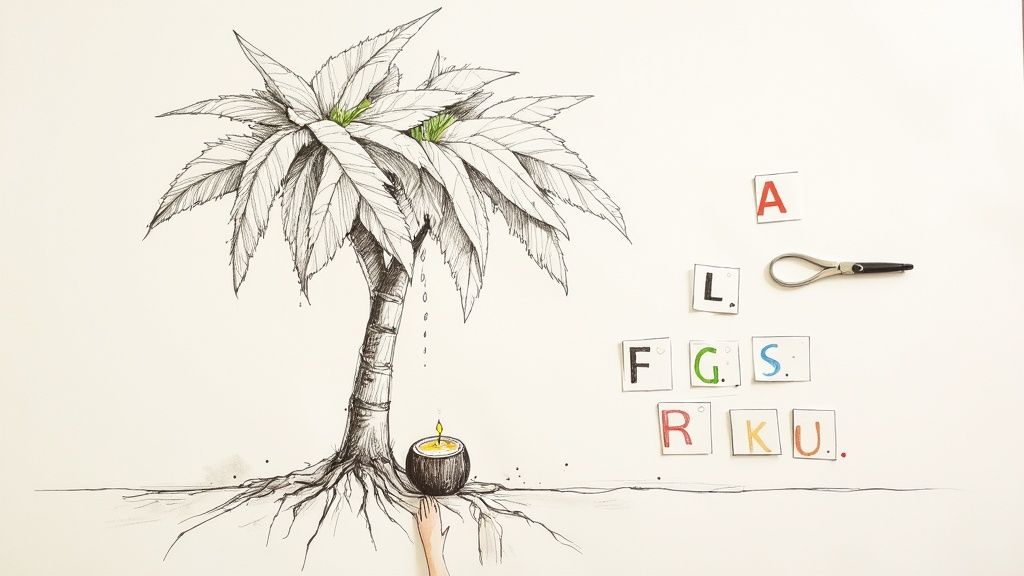
The fun of Chicka Chicka Boom Boom doesn't have to stop when you turn the last page. The best way to really cement those alphabet lessons is to bring the story into playtime with some hands-on activities.
By turning abstract letters into tangible objects kids can touch and move around, you make learning feel less like a lesson and more like a game. The key is to keep things simple, fun, and creative.
DIY Coconut Tree Craft
A great place to start is by making your very own coconut tree. This super simple craft brings the book's setting to life and creates the perfect stage for all sorts of letter play.
- Build the Tree: Just grab some brown construction paper for the trunk and green paper for the palm leaves. Glue them onto a larger sheet of paper to create your scene.
- Add the Letters: Give your child some alphabet stickers, foam letters, or even letters you’ve cut from an old magazine. They can stick them all over the tree, acting out the story as they go.
This isn’t just about having fun, either. It’s fantastic for reinforcing letter recognition, and all that peeling and sticking is a great workout for their fine motor skills.
The real magic happens when you connect the physical act of crafting with the story itself. When a child places the letter 'A' on the trunk, they're not just handling a sticker—they're helping a character climb the tree.
Sensory and Matching Games
For a completely different kind of tactile fun, sensory bins are a brilliant tool. Fill a small tub with something like kinetic sand, rice, or even dried beans. Then, just hide a set of magnetic or plastic letters inside for your child to dig in and discover.
Another engaging idea is a simple matching game. You can cut out "coconuts" from brown paper and write lowercase letters on them. Then, have your child match them to their uppercase counterparts—just like the "mamas and papas" from the end of the book.
To keep the learning going, you can also break out some coloring pages for children, which offer another great way for kids to get familiar with the alphabet. These simple games turn what could be boring repetition into a playful challenge, helping build a much deeper connection to all 26 letters.
Understanding Its Place in Childrens Literature
How on earth does a simple alphabet book stay on the bestseller list for decades? Chicka Chicka Boom Boom isn’t just another popular story; it’s a permanent fixture on the early childhood bookshelf, showing some serious staying power in a ridiculously crowded market.
Its secret really lies in its timeless, universal appeal. The book brilliantly marries a playful, singsong narrative with a clear educational goal. That simple combination makes it a trusted pick for parents and teachers, year after year, allowing it to easily hold its own against shifting trends and the endless stream of digital distractions.
The children's book market is absolutely massive. In 2022, over 250 million kids' books were sold around the globe, yet classics like this one consistently hold their ground. While some print sales took a small dip in early 2024, board book sales showed some real muscle, proving that a well-made physical book is still very much in demand. You can find more details about children's book sales trends at WordsRated.com.
A Staple for Every Bookshelf
A huge part of its success comes down to its format. The board book version is practically indestructible, which is perfect for the enthusiastic (and let’s be honest, often destructive) hands of babies and toddlers. Its reputation is so solid that it has become a go-to baby shower gift and a true cornerstone for any child's first library.
The book's genius is in its simplicity. It doesn’t need gimmicks or trendy pop culture references. What it offers is a pure, joyful, and effective way to learn that feels brand new for every little one who picks it up.
This enduring quality makes it an easy recommendation for anyone starting a library for a young child. If you're looking to explore other fantastic choices for the little ones, you might find this guide to the best board books for babies really helpful. At the end of the day, the continued success of Chicka Chicka Boom Boom just goes to show that a great story with a strong educational heart will always find its audience.
The Cultural Impact Beyond the Printed Page
You can't contain the infectious rhythm of Chicka Chicka Boom Boom. Some stories are just destined to leap off the page, and this is one of them. Its simple plot, vibrant art, and cast of playful letters have turned it into a true cultural touchstone, captivating new generations across all kinds of different media.
The book’s journey into other formats really took off with an animated short. It perfectly captured the jazzy, chaotic energy of the story, bringing it to life with motion and sound. That adaptation, often paired with an equally catchy children's song, helped cement the book's chant as an unforgettable part of childhood for millions.
From Page to Stage
The story’s real strength is how well its core message travels. The alphabet race, the big tumble, and the community of helpers—these elements translate seamlessly to other formats. It proves that the tale of the tumbling alphabet has a universal appeal that hits home with audiences, no matter how they experience it.
The narrative of resilience, community, and playful chaos is so strong that it works just as well on a stage as it does on a page. It’s a story that invites participation, making it a natural fit for interactive adaptations.
More recently, the book was even reimagined as a full-fledged musical. After a sold-out premiere, it launched a national tour, showing just how well the story can hold the attention of entire families in a theatrical setting.
This success isn't surprising when you look at the numbers. The board book holds 44% fame recognition and 29% popularity among those who know it, which speaks volumes about its solid reputation. You can discover more insights about the book’s theatrical journey on License Global.
By expanding so successfully into animation, music, and the stage, Chicka Chicka Boom Boom has cemented its legacy. It’s far more than just a classic book—it’s a dynamic and enduring cultural phenomenon.
Your Questions About Chicka Chicka Boom Boom, Answered
Parents and educators always ask how they can get the most out of Chicka Chicka Boom Boom. It's a fantastic learning tool, and with a little guidance, you can really unlock its potential. Here are a few practical answers to the most common questions we hear.
What Is The Best Age To Introduce This Book?
This is one of those wonderfully versatile books that grows with your child. Its magic really shifts and deepens as they get older.
- Infants and Toddlers (6-24 months): For the little ones, the board book version is perfect. They’re completely drawn in by the rhythmic flow of the words and Lois Ehlert's bright, bold visuals. It’s a fantastic sensory experience for them.
- Preschoolers (ages 2-5): This is where it becomes a powerhouse for teaching. It’s a fun, no-pressure way to introduce letter identification, the sequence of the alphabet, and the difference between big and little letters. The predictable pattern is great for building confidence in kids who are just starting their reading journey.
How Can I Use This Book To Teach The Alphabet Effectively?
The trick is to make it an active, hands-on experience. As you read, make sure to point to each letter while you say its name. You can even use the book as a visual guide while you sing the alphabet song together.
The real key is connecting the story to the world around them. After you've finished reading, pull out some magnetic letters and have your child match them to the letters on the page. Or, get some letter stickers and build your very own coconut tree on a piece of paper. That kind of repetition and multi-sensory fun is what really makes the learning stick.
Are There Other Similar Books My Child Might Enjoy?
Absolutely! If that rhythmic, educational style was a hit, you’ve got some great options to explore next.
You’ll definitely want to look for Chicka Chicka 1, 2, 3, which takes the same playful idea and applies it to numbers. Another Bill Martin Jr. classic, Brown Bear, Brown Bear, What Do You See?, is fantastic for its simple repetition and cadence. And if you love the artwork, Lois Ehlert's Eating the Alphabet is another wonderful choice that showcases her signature vibrant style.
At Number 6 Publishing, we believe stories should spark curiosity and bring joy. Explore our curated book lists and find your child’s next great reading adventure at https://www.number6publishing.com.