
Moving from picture books to chapter books is a monumental step in a child's reading journey. It’s the moment they learn to navigate longer stories, deeper characters, and more complex themes, building the stamina and confidence needed for a lifetime of learning. For educators and parents, finding the right chapter books for elementary students is crucial. The goal is to select stories that not only match a student's developing reading level but also ignite their curiosity, build empathy, and make them excited to turn the next page.
This curated list is designed to do just that. We've gathered a collection of timeless classics and modern masterpieces that speak to the heart of what it means to be a kid. From tales of unlikely friendships and laugh-out-loud family antics to epic survival adventures and powerful historical narratives, these books are more than just stories. They are foundational tools for building confident, compassionate, and engaged readers.
Each recommendation includes practical guidance on grade levels, key themes, and whether the book shines as an independent read or a shared experience. To foster a lifelong love for reading and truly unlock these new worlds for young readers, consider the incredible benefits of reading aloud to children, which builds crucial literacy foundations and strengthens family or classroom bonds. Whether you're stocking a K-5 classroom library, curating a homeschool curriculum, or searching for the perfect bedtime story, you'll find trusted, actionable recommendations here to guide your choices and inspire your young reader.
1. Because of Winn-Dixie by Kate DiCamillo
Kate DiCamillo’s Newbery Honor-winning novel, Because of Winn-Dixie, is a cornerstone of modern children’s literature and a perfect entry point into more complex chapter books for elementary students. The story follows ten-year-old India Opal Buloni, who has just moved to a small town in Florida with her preacher father. Feeling lonely and isolated, her life changes when she rescues a scruffy, smiling stray dog she names Winn-Dixie, after the grocery store where she found him.

Through her bond with Winn-Dixie, Opal begins to open her heart and connect with the quirky, often lonely, residents of her new community. This heartwarming tale gently explores profound themes of grief, forgiveness, and the power of friendship to heal old wounds. Its lyrical prose and emotionally resonant narrative make it an unforgettable read that speaks to both children and adults.
Why It's a Top Pick
Because of Winn-Dixie stands out for its masterful character development and its ability to tackle serious topics with grace and hope. It’s an ideal choice for transitioning readers from early chapter books to middle-grade novels. The book’s short, focused chapters build reading stamina, while the complex emotional landscape provides rich ground for discussion. Its wide adoption in school curricula and summer reading programs attests to its enduring value and impact.
Classroom and At-Home Implementation
- Grade Level: Ideal for 3rd–5th grade (ages 8–10).
- Best For: Independent reading, but also an exceptional read-aloud choice for sparking family or classroom conversations about empathy and belonging.
- Key Themes: Friendship, loss, community, forgiveness, family relationships.
Actionable Tips for Engagement:
- Read the First Chapter Aloud: Hook young readers by sharing the charming and chaotic first meeting between Opal and Winn-Dixie. DiCamillo’s voice is so engaging that hearing it aloud immediately builds investment.
- Create a "Character Constellation": Have students draw a map showing how Winn-Dixie connects Opal to other characters like Miss Franny Block, Gloria Dump, and Otis. This visualizes the book's central theme of community.
- "Ten Things" Writing Prompt: Inspired by Opal asking her father to tell her ten things about her mother, have students write ten things about a person, pet, or place that is important to them.
- Gateway to DiCamillo: Use this book as an introduction to Kate DiCamillo's other beloved works, such as The Tale of Despereaux or The Miraculous Journey of Edward Tulane, which explore similar themes of love and loss.
2. Charlotte's Web by E.B. White
E.B. White’s Charlotte's Web is a timeless masterpiece and an essential experience in children's literature. It tells the story of Wilbur, a humble pig destined for the dinner table, and his extraordinary friendship with Charlotte, a clever spider who hatches a plan to save his life. Through her miraculous web-spinning abilities, Charlotte proves that even the smallest creature can make a profound impact, weaving words like "Some Pig" and "Terrific" to convince the humans of Wilbur's worth.
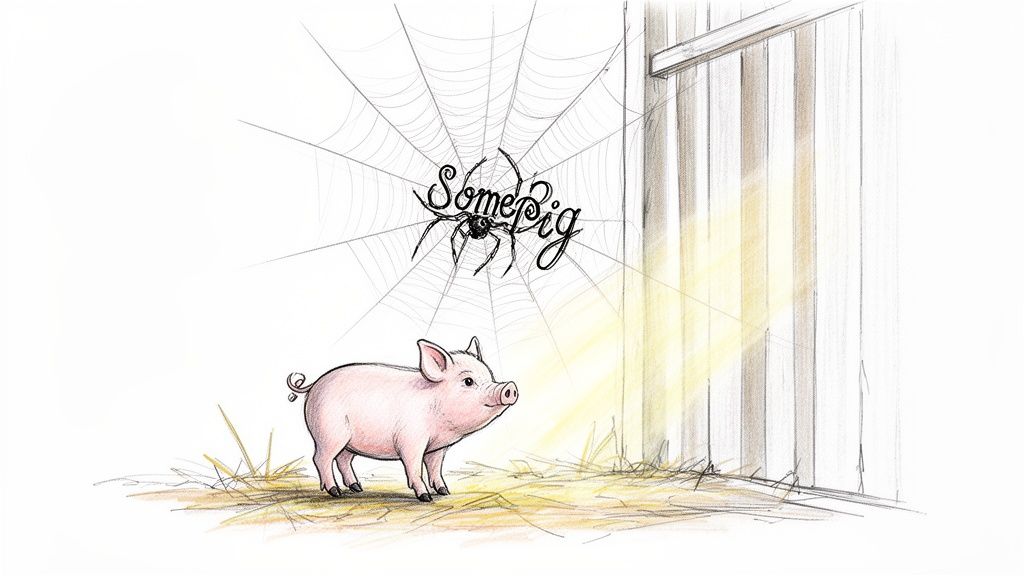
This foundational chapter book masterfully blends gentle humor with poignant themes of friendship, mortality, and the enduring power of legacy. White's elegant prose and Garth Williams' iconic illustrations create a world that is both idyllic and real, teaching young readers about the natural cycles of life and death with unparalleled grace and sensitivity. It’s a story that resonates deeply, leaving a lasting impression on anyone who reads it.
Why It's a Top Pick
Charlotte's Web is celebrated for its ability to introduce complex, mature themes in a way that is accessible and comforting for young minds. The story of Wilbur and Charlotte is one of the most powerful introductions to the concepts of loyalty and loss, making it one of the most important chapter books for elementary students. Its status as a curriculum staple and a frequent choice for family read-alouds for over 70 years is a testament to its enduring emotional depth and beautifully crafted narrative. Explore why it's a constant on reading lists for 4th graders.
Classroom and At-Home Implementation
- Grade Level: Ideal for 2nd–5th grade (ages 7–10).
- Best For: A perfect first "long" chapter book for independent readers, and an exceptional read-aloud for classrooms and families to explore deeper life lessons.
- Key Themes: Friendship, loss, sacrifice, the circle of life, legacy.
Actionable Tips for Engagement:
- Read the Opening Chapters Aloud: The initial chapters detailing Fern's devotion to saving Wilbur establish a strong emotional connection that will carry readers through the entire story.
- Prepare for the Ending: Gently preview the book's themes by discussing how friendships can last even when people (or animals) are gone. This helps prepare students for the poignant conclusion.
- Inspirational Word Webs: Have students create their own paper or yarn spiderwebs. In the center, they can write an encouraging word for a friend or classmate, just like Charlotte did for Wilbur.
- Book vs. Movie Comparison: After finishing the novel, watch the classic 1973 animated film adaptation. Use a Venn diagram to compare and contrast the two, sparking a discussion about storytelling across different media.
3. The One and Only Ivan by Katherine Applegate
Katherine Applegate's Newbery Medal-winning novel, The One and Only Ivan, offers a profoundly moving narrative told from a unique perspective: a silverback gorilla living in a shopping mall. Based on a true story, the book introduces readers to Ivan, a gentle giant who has spent 27 years in a concrete enclosure. His world expands with the arrival of Ruby, a baby elephant, whose presence awakens Ivan’s long-dormant memories of the wild and his desire for a better life.
Written in spare, powerful prose, Ivan's first-person narration is both accessible and emotionally resonant. The book gently explores complex themes of animal welfare, friendship, hope, and the definition of "home." By giving a voice to a non-human character, Applegate fosters deep empathy in young readers, making this one of the most impactful chapter books for elementary students learning about social justice and compassion.
Why It's a Top Pick
The One and Only Ivan stands out for its masterful use of an anthropomorphic narrator to tackle serious real-world issues. The short, almost poetic chapters are perfect for students building reading endurance, while the story’s emotional depth invites critical thinking and rich discussion. Its blend of heartwarming friendship and a powerful call to action makes it an unforgettable and important read that has been widely embraced in school curricula and reading clubs.
Classroom and At-Home Implementation
- Grade Level: Ideal for 4th–6th grade (ages 9–12).
- Best For: Independent reading, literature circles, and as a powerful classroom read-aloud to introduce topics of animal rights and activism.
- Key Themes: Animal welfare, friendship, hope, perseverance, art as communication.
Actionable Tips for Engagement:
- Explore the True Story: Before reading, share the real-life story of Ivan the gorilla. This provides crucial context and makes the fictional narrative even more powerful and engaging for students.
- Create "Promise" Art: Ivan uses his art to make a promise to Ruby. Have students create a piece of art that represents a promise to someone or something important to them, like a friend, pet, or the environment.
- Discuss Narrative Voice: Lead a discussion on why the author chose to tell the story from Ivan's point of view. How does this perspective change how readers feel about the events in the book?
- Pair with Nonfiction: Extend the learning by pairing the novel with nonfiction texts or short documentaries about gorilla conservation, animal sanctuaries, or Jane Goodall's work to connect fiction with real-world action.
4. Ramona Series (Starting with Ramona the Pest) by Beverly Cleary
Beverly Cleary’s Ramona series is a foundational pillar of children’s literature, perfectly capturing the tumultuous, funny, and often misunderstood world of a young child. Starting with Ramona the Pest, the series introduces readers to Ramona Quimby, a spirited and imaginative girl whose good intentions frequently lead to chaotic but hilarious situations. The books follow her from kindergarten through elementary school, making her journey exceptionally relatable for young readers.
Cleary’s genius lies in her ability to portray the world from a child's perspective, where small daily events feel monumental. Ramona’s struggles with her teacher, her older sister Beezus, and the confusing rules of the adult world are presented with empathy and humor. These episodic stories validate children’s feelings and experiences, celebrating their creativity, resilience, and unwavering spirit.
Why It's a Top Pick
The Ramona series has remained a staple for over 70 years because it so masterfully reflects the inner life of a child. It’s an essential collection of chapter books for elementary students because it builds reading confidence with its accessible, episodic chapters. Cleary’s straightforward prose and realistic character development provide a perfect model for understanding character motivation and emotional growth, all while making readers laugh out loud.
Classroom and At-Home Implementation
- Grade Level: Ideal for 1st–4th grade (ages 6–9).
- Best For: Independent reading, guided reading groups, and read-alouds that spark discussions about perspective-taking and problem-solving.
- Key Themes: Family dynamics, growing up, school life, emotional expression, resilience.
Actionable Tips for Engagement:
- Start with Ramona the Pest: While many books can be read as standalones, beginning with Ramona’s kindergarten adventures provides crucial context for her character.
- Create a "Ramona Moment" Journal: Encourage students to write about a time they felt misunderstood or when their actions had unexpected consequences, just like Ramona. This builds a powerful personal connection to the character.
- Discuss Actions and Consequences: Use Ramona’s misadventures (like breaking a raw egg on her head) as a starting point to discuss cause and effect, intentions versus outcomes, and empathy.
- Explore More by Cleary: The Ramona series is a gateway to Beverly Cleary’s interconnected world on Klickitat Street. For another classic adventure, check out The Mouse and the Motorcycle by Beverly Cleary.
5. Hatchet by Gary Paulsen
Gary Paulsen’s Newbery Honor-winning novel, Hatchet, is a masterclass in survival fiction and a compelling choice for older elementary students ready for a gripping adventure. The story centers on 13-year-old Brian Robeson, who finds himself the sole survivor of a plane crash in the vast Canadian wilderness. With nothing but the clothes on his back and a hatchet his mother gave him, Brian must learn to survive on his own.
Paulsen's precise, visceral prose plunges the reader directly into Brian's struggle for survival, from building a shelter and making fire to finding food and fending off wildlife. The narrative is an intense, page-turning exploration of resilience, resourcefulness, and the profound connection between humans and nature. It’s one of those essential chapter books for elementary students that bridges the gap to more mature middle-grade literature.
Why It's a Top Pick
Hatchet is renowned for its high-stakes plot and its deep psychological exploration of a character pushed to his limits. It captivates readers, especially those who crave action and adventure, and serves as an excellent vehicle for teaching problem-solving, perseverance, and self-reliance. Its short, taut chapters are perfect for building reading momentum, making it a favorite among reluctant readers and a staple in advanced reading programs.
Classroom and At-Home Implementation
- Grade Level: Ideal for 5th–6th grade (ages 10–12), particularly for mature or advanced readers.
- Best For: Independent reading for thrill-seekers, read-alouds in upper elementary classrooms, and literature circles focused on survival themes.
- Key Themes: Survival, resilience, self-reliance, nature, divorce, personal transformation.
Actionable Tips for Engagement:
- Set the Stage: Before reading, provide context about Brian’s family situation (his parents’ recent divorce) and the initial plane crash. This emotional backstory is crucial to understanding his internal journey.
- Create a Survival Pack: Pose the question: "If you were Brian, what three items (besides a hatchet) would you want to have?" This sparks critical thinking about priorities and problem-solving.
- Map Brian's Progress: Have students track Brian’s key survival achievements on a timeline or map, such as making his first fire, finding berries, or catching a fish. This helps visualize his growth and learning.
- Explore the Sequels: After finishing, introduce students to the "alternate ending" sequels like Brian's Winter, which explores what would have happened if Brian hadn't been rescued before winter. Discuss how an author’s choices shape a narrative.
6. Bridge to Terabithia by Katherine Paterson
Katherine Paterson’s powerful Newbery Medal-winning novel, Bridge to Terabithia, is a profound and moving story that has remained a staple in children’s literature for decades. The book introduces readers to fifth-graders Jess Aarons and Leslie Burke, two lonely children who forge an inseparable bond. To escape the pressures of school and family life, they create a magical kingdom in the woods called Terabithia, a secret world where they can reign as king and queen.
This beautifully written novel masterfully blends the real-world challenges of growing up with the boundless power of imagination. It doesn't shy away from difficult emotions, tackling themes of friendship, creativity, and grief with honesty and sensitivity. The story’s heart-wrenching twist teaches a difficult but vital lesson about loss, resilience, and the enduring legacy of friendship, making it one of the most impactful chapter books for elementary students ready for emotional depth.
Why It's a Top Pick
Bridge to Terabithia is a literary masterpiece that respects its young readers' ability to understand complex feelings. It beautifully illustrates how imagination can be a sanctuary and a source of strength in difficult times. While known for its sad ending, the book ultimately offers a message of hope and healing, showing how Jess uses the lessons learned from his friendship with Leslie to build a bridge to his own future.
Classroom and At-Home Implementation
- Grade Level: Best suited for 4th–6th grade (ages 9–12).
- Best For: Advanced readers, book clubs, and guided classroom discussions. It is an excellent read-aloud, but requires thoughtful preparation for its emotional content.
- Key Themes: Friendship, imagination, loss, grief, coming-of-age.
Actionable Tips for Engagement:
- Prepare for the Themes: Before starting, open a gentle discussion about the power of friendship and imagination. It is also wise to prepare readers for the book’s exploration of grief, framing it as a story about honoring a friend’s memory.
- Visualize Terabithia: Encourage students to draw, paint, or build a model of their vision of Terabithia. This artistic activity helps them connect with Jess and Leslie’s creative world and process the story's events.
- Create a "Legacy" Jar: After finishing the book, have students write down positive memories of Leslie and the gifts she gave Jess (like courage, imagination, and friendship) on slips of paper and place them in a jar. This focuses on her lasting impact.
- Discuss Character Growth: Use a T-chart to track how Jess changes from the beginning of the story to the end. This helps students analyze how his friendship with Leslie helped him become a more courageous and open-hearted person.
7. The Wild Robot by Peter Brown
Peter Brown’s The Wild Robot masterfully blends science fiction with a heartfelt nature story, creating an unforgettable reading experience for elementary students. The novel begins when a robot, ROZZUM unit 7134 or "Roz," washes ashore on a remote island. With no memory of her past or purpose, she must learn to survive in the wilderness by observing and adapting to the island's animal inhabitants.

After accidentally orphaning a gosling, Roz takes on the role of an adoptive mother, forming an unlikely family and, eventually, a community. This innovative survival story is elevated by Brown’s own beautiful illustrations, which pair with poetic prose to explore profound themes of adaptation, parenthood, belonging, and the intersection of technology and nature.
Why It's a Top Pick
The Wild Robot is a standout choice among chapter books for elementary students because it challenges traditional genre boundaries. The narrative is both a thrilling adventure and a gentle reflection on what it means to be alive and to care for others. Its short chapters and integrated illustrations make complex themes accessible, building reading confidence while encouraging visual literacy. The story prompts critical thinking about environmental harmony, empathy, and community in a way that resonates deeply with young readers.
Classroom and At-Home Implementation
- Grade Level: Ideal for 3rd–6th grade (ages 8–12).
- Best For: Independent reading for advanced readers, or a fantastic read-aloud for classrooms exploring themes of science, nature, and empathy.
- Key Themes: Survival, adaptation, nature vs. technology, family, community, belonging.
Actionable Tips for Engagement:
- Illustrative Storytelling: Before reading a chapter, have students examine the accompanying illustration and predict what might happen. Discuss how the images add emotion and detail to the text.
- Nature Observation Journal: Inspired by Roz learning about her environment, encourage students to keep a "wild robot" journal. They can observe and sketch plants and animals in their own backyard or a local park.
- Discuss "Otherness": Use Roz’s journey from a strange outsider to a beloved community member to spark conversations about empathy, inclusion, and what it feels like to be different.
- Gateway to Sequels: If readers love Roz's story, introduce them to the exciting sequel, The Wild Robot Escapes, which continues her incredible journey of self-discovery and connection.
8. Pax by Sara Pennypacker
Sara Pennypacker’s Newbery Honor-winning novel, Pax, is a profound and moving story that challenges older elementary readers with its emotional depth and sophisticated themes. The book tells the story of Peter, a twelve-year-old boy, and his beloved pet fox, Pax. When Peter’s father enlists in a war, he is forced to abandon Pax in the wild and move in with his grandfather, hundreds of miles away.
Immediately consumed by guilt and loyalty, Peter runs away to find his fox. The narrative alternates between Peter’s arduous journey and Pax’s struggle for survival in an unfamiliar environment. This powerful novel explores the devastating costs of war, the deep bonds between humans and animals, and the true meaning of family and responsibility.
Why It's a Top Pick
Pax is an exceptional choice for mature readers ready to engage with complex, emotionally resonant material. Pennypacker's dual-narrative structure is masterfully executed, giving equal weight to both Peter's and Pax's experiences and fostering deep empathy in the reader. The novel doesn’t shy away from difficult topics like war, loss, and environmental destruction, making it a powerful tool for building critical thinking and emotional intelligence. It’s one of those essential chapter books for elementary students that will stick with them long after the final page.
Classroom and At-Home Implementation
- Grade Level: Best for 5th–6th grade (ages 10–12), particularly for advanced readers.
- Best For: Independent reading for mature students, book clubs, or a guided classroom novel study where complex themes can be discussed with support.
- Key Themes: War and conflict, human-animal bonds, loyalty, loss, environmentalism, personal responsibility.
Actionable Tips for Engagement:
- Provide Emotional Context: Before reading, have a gentle conversation about the realities of war and separation to prepare students for the book's emotional weight.
- Create Character Journals: Have students write journal entries from the perspectives of both Peter and Pax. This helps them process the events of the dual narrative and explore each character's distinct voice and motivations.
- Discuss the Dual Narrative: After reading a few chapters from each perspective, pause to discuss how seeing the story from two different viewpoints shapes the reader’s understanding and builds suspense.
- Connect to Personal Responsibility: Use the story to spark discussions about our responsibilities to animals, the environment, and each other, especially during difficult times.
9. Fablehaven Series (Starting with Fablehaven by Brandon Mull)
Brandon Mull's Fablehaven series is a thrilling gateway into epic fantasy for elementary students, perfect for those ready to commit to a multi-book adventure. The story introduces siblings Kendra and Seth Sorenson, who go to stay with their estranged grandparents. They soon discover their grandparents' vast estate is no ordinary farm; it is Fablehaven, one of the last secret refuges for magical creatures.
As Kendra and Seth unravel the preserve's secrets, they find themselves at the center of a high-stakes battle between good and evil. Mull's intricate world-building, combining familiar fairy-tale creatures with unique inventions, captivates young readers. The series masterfully balances breathtaking action with genuine family dynamics and complex moral questions about rules, obedience, and courage.
Why It's a Top Pick
The Fablehaven series excels at building a complex narrative arc across five books, teaching readers about plot development and character growth over a long-form story. Unlike standalone chapter books for elementary students, it encourages sustained engagement and reading stamina. The contrasting personalities of cautious, rule-following Kendra and impulsive, curious Seth provide relatable entry points for different types of readers, and their evolution is a core strength of the series.
Classroom and At-Home Implementation
- Grade Level: Ideal for 4th–6th grade (ages 9–12).
- Best For: Independent readers who love fantasy, but also a fantastic series for a family or classroom read-aloud to tackle over a semester.
- Key Themes: Rules and consequences, courage, family, good vs. evil, responsibility.
Actionable Tips for Engagement:
- Read Sequentially: Emphasize that this series must be read in order, starting with Fablehaven, as the plot and character development build directly on previous events.
- Create a "Magical Creature Field Guide": As students encounter new beings like fairies, satyrs, and golems, have them create a guide with drawings, descriptions, and rules for interacting with them.
- Discuss Character Growth: Pause after key events to discuss how Kendra and Seth change. Ask questions like, "How would Seth have handled this situation in Book 1 versus now?"
- World-Building Project: Inspired by Fablehaven's hidden world, challenge students to design their own magical preserve. What creatures would it protect? What would be the rules for visitors?
10. Roll of Thunder, Hear My Cry by Mildred D. Taylor
Mildred D. Taylor’s Newbery Medal-winning novel, Roll of Thunder, Hear My Cry, is a powerful and essential work of historical fiction that offers older elementary students a profound look into American history. The story is set in rural Mississippi during the Great Depression and follows nine-year-old Cassie Logan and her family. The Logans are Black landowners in a community grappling with systemic racism and economic injustice, and they fight to maintain their land, dignity, and independence against overwhelming odds.
Told through Cassie’s determined and observant eyes, the novel does not shy away from the harsh realities of the Jim Crow South. However, its true strength lies in its depiction of the Logan family’s resilience, pride, and unwavering love. Taylor’s masterful storytelling celebrates Black agency and courage, providing a crucial counternarrative to simplified historical accounts.
Why It's a Top Pick
Roll of Thunder, Hear My Cry is a challenging yet vital read that builds empathy and historical understanding. It serves as an important bridge to more mature young adult literature by introducing complex themes of social justice, prejudice, and integrity. The narrative is driven by strong, unforgettable characters who model courage in the face of injustice. Its frequent inclusion in school curricula for upper elementary and middle school grades highlights its lasting educational and emotional impact.
Classroom and At-Home Implementation
- Grade Level: Ideal for 5th–7th grade (ages 10–12).
- Best For: Guided reading groups, classroom novel studies, or a read-aloud for mature listeners, as it requires historical context and discussion.
- Key Themes: Family, land ownership, racism, social justice, resilience, dignity.
Actionable Tips for Engagement:
- Build Historical Context: Before starting, provide background on the Great Depression and Jim Crow laws. Use videos, photos, or short articles to help students understand the setting.
- Establish Discussion Norms: Create a safe classroom environment for discussing sensitive topics like racism. Set clear guidelines for respectful and empathetic conversation.
- Focus on Resistance and Resilience: Guide discussions to focus on the Logan family’s strength, cleverness, and acts of resistance rather than solely on their victimization. Ask students to track every instance where the family stands up for themselves.
- Connect to Primary Sources: Supplement the fictional narrative with primary sources like photographs from the era or excerpts from oral histories to deepen students' understanding of the time period. For more recommendations, you can learn about other exceptional African American books on number6publishing.com.
10 Elementary Chapter Books Comparison
| Title | Complexity / Narrative 🔄 | Resources / Reading & Prep ⚡ | Expected Outcomes / Impact 📊 | Ideal Use Cases / Classroom Tips 💡 | Key Advantages ⭐ |
|---|---|---|---|---|---|
| Because of Winn‑Dixie — Kate DiCamillo | Moderate — linear emotional arc with some layered themes 🔄 | Low‑Moderate — ~182 pp; grade 3–5; brief sensitive-topic prep ⚡ | Builds empathy, belonging, reading confidence 📊 | Read‑aloud kickoff; 3–5 units on community and feelings 💡 | Accessible prose, strong protagonist, Newbery Honor ⭐ |
| Charlotte's Web — E.B. White | Moderate — anthropomorphic farm tale with some lyrical passages 🔄 | Moderate — ~184 pp; grade 2–5; prepare for death discussion ⚡ | Teaches loyalty, mortality, literary language appreciation 📊 | Curriculum staple; compare with films/plays; art activities 💡 | Timeless appeal, exemplary prose, many adaptations ⭐ |
| The One and Only Ivan — Katherine Applegate | Moderate — first‑person animal voice, episodic short chapters 🔄 | Low‑Moderate — 256 pp (many short chapters); grade 4–6; prep on animal welfare ⚡ | Empathy for animals, activism thinking, sustained engagement 📊 | Lit circles, animal‑welfare units, pre‑reading real‑life context 💡 | Newbery Medal, engaging voice, short‑chapter accessibility ⭐ |
| Ramona Series (start: Ramona the Pest) — Beverly Cleary | Low — episodic, humorous everyday scenes 🔄 | Low — multiple short books; K–4; minimal prep, flexible pacing ⚡ | Social‑emotional growth, humor, relatable childhood perspective 📊 | Independent reading, guided groups, character writing prompts 💡 | Relatable protagonist, episodic flexibility, enduring popularity ⭐ |
| Hatchet — Gary Paulsen | Moderate‑High — tense survival realism, sparse prose 🔄 | Moderate — ~184 pp; grade 5–7; prep for mature themes (crash, loss) ⚡ | Problem‑solving, resilience, gateway to MG/YA fiction 📊 | Advanced reader programs, survival units, outdoor ed extensions 💡 | High engagement, realistic survival detail, sequels available ⭐ |
| Bridge to Terabithia — Katherine Paterson | High — literary, magical realism with emotional weight 🔄 | Low‑Moderate — ~128 pp; grade 4–6; requires emotional support and prep ⚡ | Emotional literacy, grief processing, imaginative coping strategies 📊 | Gifted/advanced groups, grief discussions, art/writing responses 💡 | Lyrical prose, Newbery winner, deep thematic resonance ⭐ |
| The Wild Robot — Peter Brown | Moderate — sci‑fi + nature, illustrated, dual perspective 🔄 | Moderate — ~288 pp with illustrations; grade 4–6; visual prep benefits pacing ⚡ | Adaptation, caregiving themes, visual‑text literacy 📊 | Visual‑text lessons, environmental units, sketch‑before‑read activities 💡 | Strong illustrations, cross‑genre appeal, series continuation ⭐ |
| Pax — Sara Pennypacker | High — dual human/animal narratives, sustained emotional arc 🔄 | High — ~368 pp; grade 5–7; significant emotional/context prep ⚡ | Complex empathy, ethics of war/separation, narrative perspective skills 📊 | Book clubs, advanced readers, units on conflict and responsibility 💡 | Dual‑perspective depth, Newbery Honor, emotionally rich storytelling ⭐ |
| Fablehaven Series (start: Fablehaven) — Brandon Mull | High — layered world‑building across multiple long volumes 🔄 | High — 345–585 pp per book; grade 4–7; series commitment and tracking tools ⚡ | World‑building literacy, long‑arc character growth, imaginative complexity 📊 | Fantasy cohorts, extended reading programs, world‑building projects 💡 | Rich mythology, sibling protagonists, strong series momentum ⭐ |
| Roll of Thunder, Hear My Cry — Mildred D. Taylor | High — historical realism with systemic racial themes 🔄 | Moderate — ~276 pp; grade 5–7; requires historical context and sensitive facilitation ⚡ | Historical empathy, social justice awareness, critical discussion skills 📊 | U.S. history/literature integration, civil‑rights units, primary‑source pairing 💡 | Cultural significance, Newbery winner, powerful portrayal of resistance ⭐ |
Building a Library of Stories That Matter
The journey through the world of chapter books is a pivotal rite of passage for every elementary student. Moving from picture-heavy pages to text-rich narratives is more than just a developmental milestone; it is the moment a child discovers that stories can build entire worlds inside their own minds. The ten books explored in this list, from the heartfelt friendship in Charlotte's Web to the raw survival of Hatchet, represent powerful gateways into this new and exciting literary landscape. They are not merely collections of words but vessels for empathy, resilience, and complex emotional understanding.
As you introduce these stories, whether as a read-aloud at bedtime or an independent reading assignment in the classroom, you are doing far more than teaching vocabulary and plot structure. You are equipping young readers with the tools to navigate life’s biggest questions. With Ramona Quimby, they learn that it is okay to be perfectly imperfect. With Opal Buloni and her dog Winn-Dixie, they see how connection can heal the deepest loneliness. Through the eyes of Cassie Logan in Roll of Thunder, Hear My Cry, they confront injustice and discover the unshakeable power of family and dignity.
From Reading to Understanding: Fostering Deeper Connections
The true magic of these chapter books for elementary students lies in their ability to spark meaningful conversations. The suggestions for discussion prompts and extension activities provided for each book are designed to transform passive reading into an active, engaging experience. These conversations build crucial bridges between the fictional world on the page and the real world the child inhabits.
Consider these key takeaways as you continue to build your child's or student's library:
- Empathy is a Learned Skill: Books like The One and Only Ivan and Pax place readers directly into the minds of non-human characters, challenging them to see the world from a profoundly different perspective. This act of imaginative empathy is a foundational skill for developing compassion and understanding toward others.
- Resilience Can Be Modeled: Characters facing immense challenges, like Brian in Hatchet or Leslie and Jess in Bridge to Terabithia, provide powerful models of resilience. Discussing their struggles and triumphs helps children develop their own emotional toolkit for facing adversity.
- Humor and Adventure Fuel Engagement: Not every lesson needs to be somber. The delightful misadventures in the Ramona series or the magical quests in Fablehaven remind us that joy and excitement are essential ingredients for creating a lifelong love of reading. When a book is fun, the learning feels effortless.
- Diversity in Stories Matters: A well-rounded reading list should act as both a mirror and a window. It is vital for children to see their own experiences reflected in stories while also being exposed to lives, cultures, and histories different from their own.
Your Role as a Reading Guide
Your enthusiasm and engagement are the most critical factors in a child’s reading journey. When you make time to read together, ask thoughtful questions, and show genuine interest in their literary discoveries, you send a powerful message: stories matter, and your thoughts about them matter, too. Don't be afraid to tackle the tougher themes present in some of these books; these are often the stories that leave the most lasting impact. To support parents in fostering a rich reading environment, consider exploring further resources for reading development.
Ultimately, the goal is not just to get through a list of recommended books. It is to cultivate a habit of curiosity, a hunger for stories, and the confidence to explore the vast universe of literature. The right book, at the right moment, can illuminate a child's understanding of themselves and their place in the world. By thoughtfully curating the chapter books for elementary students you share, you are giving them a gift that will enrich their lives long after the final page is turned.
At Number 6 Publishing, we are dedicated to discovering and sharing stories that inspire, challenge, and delight young readers. We believe that exceptional children's literature is the cornerstone of a compassionate and curious generation. Explore our catalog of thoughtfully crafted books to find the next great adventure for your elementary student at Number 6 Publishing.