
Middle school is a time of immense growth, change, and self-discovery. The right book can be a friend, a guide, and a window to new worlds. For parents and educators, finding stories that resonate with this unique age group is crucial. Stories that tackle complex feelings with honesty and inspire curiosity are more than just entertainment; they are essential tools for development. At Number 6 Publishing, we believe in the power of narrative to shape young minds, which is why we’ve curated this list of essential books for middle schoolers.
This is more than just a list of popular titles. It's a comprehensive resource designed to help you select stories that build empathy, spark conversation, and help tweens see themselves and their world in new ways. We've included a diverse range of genres and formats, from timeless classics to groundbreaking graphic novels, ensuring there’s something for every reader. For parents seeking to guide their children through this pivotal reading stage, finding good books to read for teens is crucial for fostering their emotional understanding and engagement with literature.
Inside this guide, you will find:
- Detailed Synopses: Get a clear picture of each book's plot and central themes.
- Why It Works: We break down why each selection is a powerful choice for middle-grade readers.
- Practical Applications: Discover actionable ideas for classroom and library use, including discussion starters and thematic connections.
- Read-Alike Suggestions: Find the perfect next book for readers who loved a particular title.
Each entry is structured to provide the specific insights you need to build a robust and impactful classroom or home library, making it easier than ever to connect young readers with books they'll love.
1. Wonder by R.J. Palacio
R.J. Palacio’s Wonder is a cultural touchstone in middle-grade literature, telling the powerful story of Auggie Pullman, a 10-year-old boy with a rare facial difference attending a mainstream school for the first time. The narrative unfolds through multiple perspectives, offering a panoramic view of Auggie’s fifth-grade year and its impact on his family, his new classmates, and the wider school community. It's a cornerstone among books for middle schoolers because it directly confronts the social challenges of this age group, including bullying, friendship, and the struggle to fit in, all while championing the profound impact of empathy and kindness.
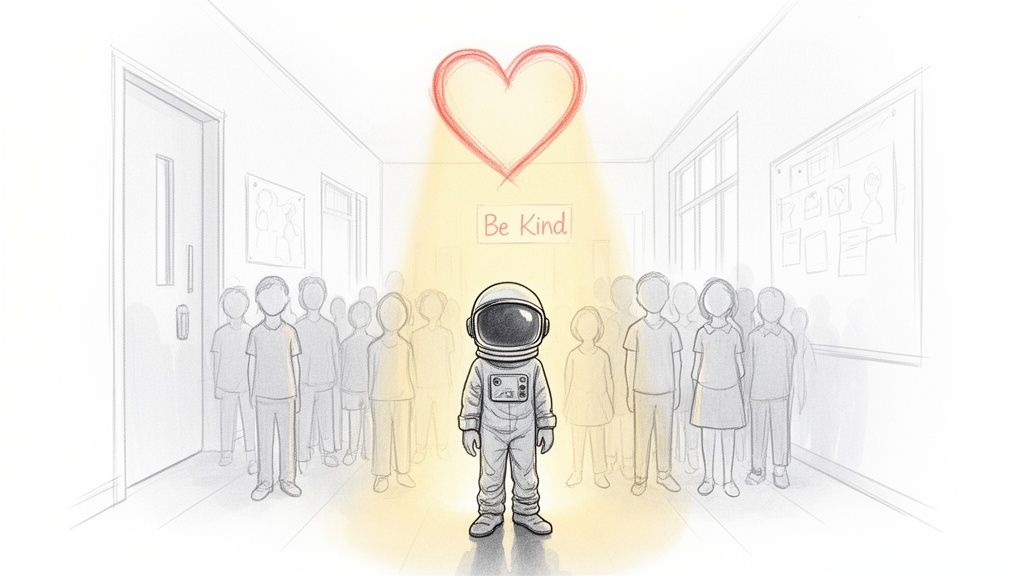
The book's emotional honesty and accessible prose make it an ideal choice for initiating crucial conversations. Its structure, which shifts between the voices of Auggie, his sister Via, and his friends, masterfully demonstrates that every person has a story and that kindness is a conscious choice. This multi-perspective approach is a key reason Wonder resonates so deeply and has become a staple in curriculums worldwide.
Why It Works for Middle Schoolers
Wonder meets middle schoolers exactly where they are: navigating complex social hierarchies and forming their identities. The novel provides a safe, relatable framework for discussing difficult topics like prejudice and social isolation. Its central theme, "Choose Kind," is a simple yet powerful message that empowers young readers to make a positive difference in their own communities. The success of school-wide Wonder reading programs and kindness initiatives demonstrates its lasting impact beyond the page.
Classroom and Library Applications
- Journaling with Precepts: Use Mr. Browne’s precepts (e.g., "When given the choice between being right or being kind, choose kind") as daily or weekly journal prompts for student reflection.
- Perspective Analysis: Assign students to analyze how the story changes when told from different characters' viewpoints. Discuss how understanding someone else's perspective can foster empathy.
- Extend the Universe: Pair the novel with its companion book, Auggie & Me, to explore the backstories of key characters like Julian, Christopher, and Charlotte, deepening the conversation about motivation and change.
- Community Kindness Project: Inspire students to create a classroom or school-wide "kindness project" based on the book's themes, encouraging them to track and celebrate acts of compassion.
For more ideas on how to build a diverse and engaging library, explore our comprehensive guide on essential books for middle schoolers to read.
2. Hatchet by Gary Paulsen
Gary Paulsen's Hatchet is a masterclass in survival fiction and a rite of passage for countless young readers. The story follows 13-year-old Brian Robeson, who becomes the sole survivor of a plane crash and is left to fend for himself in the vast Canadian wilderness with only a hatchet. This gripping narrative is more than just an adventure; it's a profound exploration of resilience, resourcefulness, and the power of the human spirit to endure against overwhelming odds. It has earned its place as a quintessential selection among books for middle schoolers by combining high-stakes action with deep internal growth.
The novel’s raw, direct prose pulls readers into Brian's struggle, making his triumphs and failures feel immediate and personal. As he learns to make fire, find food, and build shelter, Brian undergoes a significant transformation from a city boy dependent on modern comforts to a self-reliant survivor attuned to the natural world. This journey of self-discovery and perseverance is what makes Hatchet a timeless and impactful read for an audience on the cusp of their own adolescent transformations.
Why It Works for Middle Schoolers
Hatchet speaks directly to the middle schooler's burgeoning sense of independence and their capacity for abstract thought. The story is a powerful metaphor for facing personal challenges, as Brian must overcome not only the wilderness but also his own fear and despair. The novel validates the idea that mistakes are a critical part of learning and that true strength comes from within. Its straightforward, high-interest plot makes it accessible even to reluctant readers, while its thematic depth provides ample material for reflection.
Classroom and Library Applications
- Survival Scenario Challenges: Present students with problem-solving exercises based on Brian's situation. Ask them to brainstorm how they would find food, water, and shelter using only the resources available to him.
- Nature Journaling: Encourage students to start a nature journal, similar to how Brian observes his environment. This activity connects the text to real-world biology and environmental science concepts.
- Mindset and Growth Analysis: Chart how Brian’s mental and emotional state changes throughout the novel. Discuss key moments that trigger shifts in his mindset from despair to determination.
- Genre Study: Compare Hatchet to modern survival stories in books or film to analyze how the survival genre has evolved. Discuss themes of human versus nature and the role of technology.
3. The Baby-Sitters Club (graphic novel series) by Raina Telgemeier
Raina Telgemeier’s graphic novel adaptations of Ann M. Martin’s The Baby-Sitters Club have revitalized a classic series for a new generation. These books follow the entrepreneurial adventures of Kristy, Mary Anne, Claudia, and Stacey as they launch a neighborhood baby-sitting business. Telgemeier’s expressive, accessible art style brings contemporary energy to timeless themes of friendship, responsibility, and navigating the early stages of adolescence. This series is a powerful gateway among books for middle schoolers, bridging the gap between text and visual storytelling to engage even the most reluctant readers.
The graphic novel format makes complex social dynamics and emotional arcs easy to follow, allowing readers to interpret character feelings through both dialogue and illustration. The success of the recent Netflix adaptation has further cemented the series' place in pop culture, making its stories of teamwork and personal growth more relevant than ever. The blend of nostalgia and modern appeal has made these books a staple in school libraries and reading intervention programs nationwide.
Why It Works for Middle Schoolers
The Baby-Sitters Club graphic novels resonate with middle schoolers by portraying relatable, everyday challenges. The characters deal with friendship squabbles, family issues, first crushes, and the pressures of school, all while running a small business. The series models problem-solving, collaboration, and conflict resolution in a low-stakes, supportive environment. Its focus on female friendship and empowerment provides positive role models, while the visual format boosts reading confidence and comprehension.
Classroom and Library Applications
- Entrepreneurship Project: Task students with creating a business plan for their own "club," outlining their services, marketing strategies, and rules, just like the BSC.
- Character and Conflict Analysis: Use specific scenes to discuss friendship dynamics. Ask students to identify a conflict and brainstorm different ways the characters could have resolved it.
- Gateway to Other Formats: Introduce the graphic novels first, then encourage students to read Ann M. Martin’s original prose novels to compare storytelling styles and character development.
- Visual Literacy Discussion: Analyze how Telgemeier uses panel layouts, color, and character expressions to convey emotion and advance the plot without words.
To discover more engaging visual stories, check out our guide on finding the best graphic novels for middle schoolers.
4. Percy Jackson & The Olympians: The Lightning Thief by Rick Riordan
Rick Riordan’s The Lightning Thief is a modern classic that single-handedly revitalized interest in Greek mythology for an entire generation. The story introduces readers to 12-year-old Percy Jackson, a boy with ADHD and dyslexia who discovers he is the son of Poseidon. This revelation thrusts him into a hidden world of gods, monsters, and demigods at Camp Half-Blood. Riordan brilliantly weaves ancient myths into a contemporary, action-packed quest, making this one of the most engaging books for middle schoolers who crave adventure.
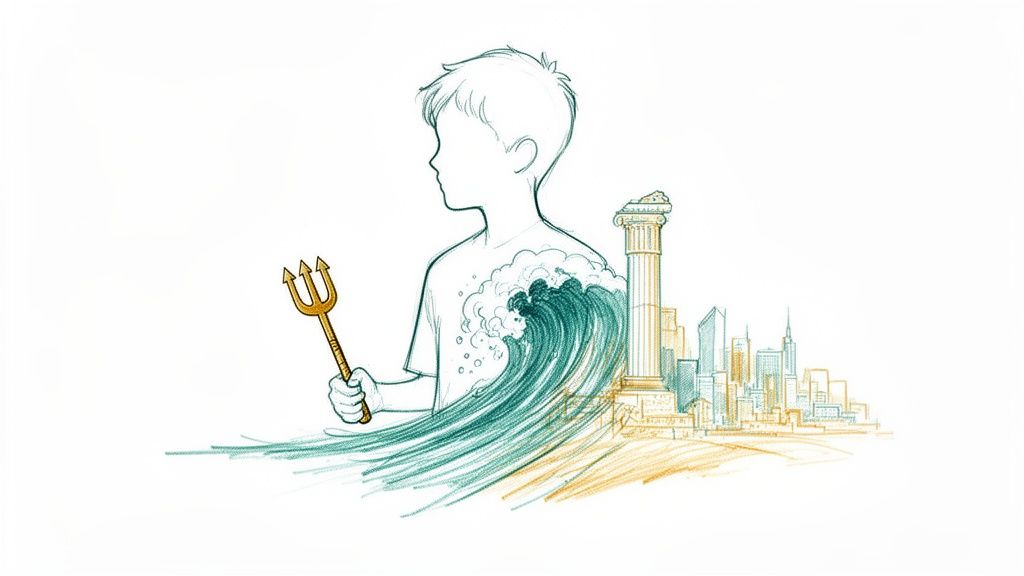
The series' genius lies in its ability to make millennia-old stories feel fresh, relevant, and exciting. Percy's sarcastic wit and relatable struggles with school and identity make him a character that young readers instantly connect with. The narrative validates neurodivergence by reframing Percy's ADHD and dyslexia as battlefield reflexes and a natural aptitude for ancient Greek, empowering students who may face similar challenges.
Why It Works for Middle Schoolers
The Lightning Thief is a perfect blend of high-stakes fantasy and the familiar anxieties of being a preteen. Percy's journey is not just about battling monsters; it's about finding his place, learning to trust others, and understanding who he is. The fast-paced plot and humorous tone make it an accessible entry point to complex themes like destiny, heroism, and family dynamics. Its success has spawned a massive franchise, including the Rick Riordan Presents imprint, which introduces readers to diverse mythologies from around the world.
Classroom and Library Applications
- Mythology Comparison: Pair chapters with excerpts from classical mythology texts like Ovid's Metamorphoses or D'Aulaires' Book of Greek Myths to compare ancient and modern interpretations.
- Create-a-Quest Project: Have students design their own heroic quest, complete with a divine parent, magical items, and mythological monsters to overcome.
- Neurodiversity Discussion: Use Percy's character as a starting point for conversations about neurodiversity, focusing on how perceived weaknesses can be strengths in different contexts.
- Connect to History: Integrate the book into social studies or history units on ancient Greece, using Camp Half-Blood as a lens to explore Greek culture, government, and art.
5. The One and Only Ivan by Katherine Applegate
Katherine Applegate's Newbery Medal-winning novel, The One and Only Ivan, offers a profoundly moving story told from the perspective of a silverback gorilla living in captivity at a shopping mall. For 27 years, Ivan’s world is a small glass enclosure until the arrival of Ruby, a baby elephant, awakens his memory and sense of responsibility. The novel’s quiet power and heart-wrenching emotional core make it a standout among books for middle schoolers, as it explores deep themes of friendship, art, memory, and the true meaning of home.
Inspired by a true story, the book uses spare, poetic prose that captures Ivan’s voice with authenticity and grace. This unique narrative perspective allows young readers to step outside their own experience and see the world through another’s eyes. The story's gentle pacing builds to a powerful climax, demonstrating how one small promise can ignite immense change, making it a compelling read that lingers long after the final page.
Why It Works for Middle Schoolers
The One and Only Ivan connects with middle school readers by tackling complex moral questions in an accessible, emotionally resonant way. Ivan's journey from passive observer to active protector mirrors the developing sense of justice and agency in young adolescents. The story provides a powerful platform for discussing animal welfare, ethical treatment, and the impact of human actions on the natural world, empowering students to think critically about their own responsibilities.
Classroom and Library Applications
- Point of View Study: Analyze how Ivan’s perspective as a non-human narrator shapes the story. Discuss the author’s use of simple language to convey complex emotions and ideas.
- Art as Communication: Ivan uses his drawings to make a promise and communicate his desire for a better life for Ruby. Have students create their own art projects to express an important message or feeling.
- Research the True Story: Encourage students to research the real Ivan the gorilla. Compare and contrast the fictional narrative with the historical facts to deepen their understanding of the story's origins.
- Debate and Discussion: Organize a classroom debate around the ethics of keeping animals in captivity versus sanctuaries. Use the novel as a primary text to support arguments.
To explore more titles that foster this kind of emotional connection, check out our list of powerful books that teach empathy.
6. Refugee by Alan Gratz
Alan Gratz’s Refugee masterfully interweaves the harrowing journeys of three young protagonists separated by time and geography yet united by a desperate search for safety. The novel follows Josef, a Jewish boy fleeing Nazi Germany in 1939; Isabel, a Cuban girl escaping unrest in 1994; and Mahmoud, a Syrian boy fleeing the civil war in 2015. Their distinct narratives unfold in parallel, creating a gripping and unforgettable tapestry of the refugee experience that culminates in a stunning, interconnected conclusion. It is a vital addition to any collection of books for middle schoolers, offering a timely and humanizing look at global crises.
The book’s power lies in its unflinching yet accessible portrayal of loss, resilience, and the universal need for a home. Gratz does not shy away from the dangers and heartbreaks each character faces, making their courage and hope all the more profound. By connecting historical events to a modern crisis, the novel builds a powerful bridge of empathy, helping young readers understand that the challenges faced by refugees are not confined to the past but are an urgent, ongoing reality.
Why It Works for Middle Schoolers
Refugee speaks directly to a middle schooler’s developing sense of justice and their growing awareness of the world. The fast-paced, action-driven plot keeps readers engaged, while the short, alternating chapters make complex historical and geopolitical issues digestible. The story provides an essential lens for understanding concepts like displacement, prejudice, and humanitarianism, empowering students to see the faces and stories behind the headlines. Its emotional depth makes it an unforgettable read that sparks critical thinking and compassion.
Classroom and Library Applications
- Historical Context Jigsaw: Divide students into three groups, each researching the historical context of one protagonist's story (Nazi Germany, the Cuban rafter crisis, or the Syrian civil war). Have them present their findings to provide a foundation for understanding.
- Mapping the Journeys: Use a world map to trace the physical journeys of Josef, Isabel, and Mahmoud. This visual activity helps students grasp the immense distances and geographic obstacles involved in their quests for safety.
- Character Venn Diagram: Have students use a three-circle Venn diagram to compare and contrast the characters' experiences, challenges, and sources of hope, highlighting both unique and universal aspects of their stories.
- Connecting to Current Events: Pair readings from the book with vetted news articles or short documentaries about modern refugee situations. Facilitate a sensitive discussion about how the themes in Refugee connect to the world today.
For more resources to help young readers engage with complex global topics, see our list of the best books for middle schoolers to read.
7. The Terrible Two by Mac Barnett and Jory John
Mac Barnett and Jory John’s The Terrible Two is a laugh-out-loud tale of rivalry, pranks, and the unexpected formation of a powerful friendship. The story follows Miles Murphy, the new kid in Yawnee Valley, a town famous for its cows. Miles was a legendary prankster at his old school, but he quickly discovers that his new school already has a resident trickster, the clever and elusive Niles Sparks. This hilarious novel is a standout among books for middle schoolers, particularly for reluctant readers, as it combines clever scheming with genuine heart.
The book is filled with witty dialogue, illustrated factoids about cows, and detailed diagrams of elaborate pranks, making it a visually engaging and fast-paced read. The central conflict between Miles and Niles, a "prank war" for school supremacy, eventually evolves into a brilliant partnership. This transformation explores themes of collaboration, finding your place, and understanding that even rivals can become the best of friends.
Why It Works for Middle Schoolers
The Terrible Two perfectly captures the middle school desire for identity and recognition, channeling it into creative and humorous rebellion. The book celebrates intelligence, ingenuity, and teamwork, showing readers that cleverness can be a superpower. Its focus on lighthearted mischief provides a high-interest entry point for discussing friendship dynamics, dealing with boredom, and the ethics of rule-breaking in a safe, fictional context. The book's humor and accessible plot make it an irresistible choice for readers who may not gravitate toward more serious literature.
Classroom and Library Applications
- Prank for Good: Challenge students to design a "prank for good," a harmless and positive surprise for another class or a teacher, promoting creative and kind-hearted thinking.
- Humor Analysis: Discuss the difference between funny pranks and mean-spirited bullying. Use examples from the book to create a classroom definition of what makes a joke land well versus one that hurts.
- Cow Fact-Checking: The book is filled with amusing "facts" about cows. Have students research the real science behind cows and create their own illustrated fact sheets comparing the book's humor with reality.
- Creative Writing Prompt: Ask students to write a short story from the perspective of Principal Barkin, describing the events of a school day filled with pranks from the "Terrible Two."
8. Amal Unbound by Aline Sax
Aisha Saeed’s Amal Unbound offers a powerful, eye-opening look into the life of a 12-year-old Pakistani girl whose dreams of becoming a teacher are abruptly halted when she is forced into indentured servitude. The story follows Amal's journey from a vibrant, book-loving girl to a servant in a wealthy, corrupt family’s estate. It stands out among books for middle schoolers by tackling heavy themes like child labor, social injustice, and the fight for education with nuance and hope.
The novel provides a window into a different culture while exploring universal themes of resilience, courage, and the power of knowledge. Amal’s unwavering determination to learn and her subtle acts of defiance create a compelling narrative that is both heartbreaking and inspiring. Saeed’s prose is accessible and emotionally resonant, making a complex global issue understandable for a young audience without diminishing its gravity.
Why It Works for Middle Schoolers
Amal Unbound empowers middle school readers by showing them that one young person’s voice can create change, even in the face of overwhelming odds. The book challenges them to think critically about privilege, particularly educational access, and the freedoms they may take for granted. Amal's story fosters empathy and a sense of global citizenship, encouraging students to look beyond their own experiences and understand the struggles of others around the world.
Classroom and Library Applications
- Global Context Discussion: Use the novel as a starting point to research and discuss global issues like child labor, girls' education inequality, and social justice. Connect the story to the work of real-world organizations.
- Character and Theme Analysis: Have students track Amal’s character development, focusing on how she uses her education and courage to navigate her circumstances. Discuss themes of hope, injustice, and resistance.
- Journaling on Privilege: Prompt students to reflect on the role of education in their own lives. Ask them to write about what it means to have the freedom to learn and pursue their dreams.
- Pair with Nonfiction: Supplement the novel with articles, documentaries, or guest speakers who can provide factual context on the state of education for girls in different parts of the world.
9. Pier Kids by Mohammed Achaari
Mohammed Achaari’s Pier Kids offers a poignant and unflinching look at youth homelessness, telling a powerful story of resilience, friendship, and survival on the streets of a bustling city. The narrative follows a group of young people who form a chosen family, navigating daily challenges with ingenuity and courage. It stands out among books for middle schoolers by addressing a difficult, often invisible, social issue with profound empathy, treating its characters not as victims but as complex, resourceful individuals. This novel provides a vital window into a reality many young readers may not be familiar with, fostering a deeper understanding of community and social responsibility.
The book’s strength lies in its authentic portrayal of the characters' lives, showing their struggles alongside their moments of joy, creativity, and unwavering support for one another. Achaari’s writing avoids sentimentality, instead focusing on the dignity and humanity of his protagonists. This honest approach makes Pier Kids a catalyst for meaningful conversations about social justice, systemic inequality, and the true meaning of home.
Why It Works for Middle Schoolers
Pier Kids challenges middle schoolers to look beyond their own experiences and consider the complex realities faced by their peers. The story’s focus on friendship and loyalty in the face of adversity resonates with this age group’s own developing social bonds. It provides a safe yet impactful entry point for discussing mature themes like poverty and homelessness, encouraging critical thinking about the world and their place in it. The book empowers readers by showing how empathy can lead to action and awareness.
Classroom and Library Applications
- Content Considerations: Before introducing the book, provide context and content warnings regarding the themes of homelessness and poverty. Be mindful of students' individual circumstances.
- Systemic Causes Discussion: Facilitate a structured discussion about the systemic causes of homelessness, using the book as a starting point to explore social and economic factors.
- Community Connection: Connect the novel’s themes to the local community by researching and discussing local organizations that support unhoused populations.
- Activism and Awareness: Inspire students to develop a small-scale awareness campaign or service-learning project, such as a donation drive or informational poster series, to support local homelessness initiatives.
10. New Kid by Jerry Craft (Graphic Novel)
Jerry Craft's Newbery Medal-winning graphic novel New Kid offers a poignant and often humorous look at the middle school experience through the eyes of Jordan Banks, a twelve-year-old artist who is one of the few students of color at a prestigious private school. Jordan must navigate the challenging social dynamics of his new environment while trying to stay true to his Washington Heights neighborhood roots. This title is a vital addition to any collection of books for middle schoolers because it uses the accessible graphic novel format to tackle complex themes of identity, microaggressions, and the challenge of code-switching between different worlds.
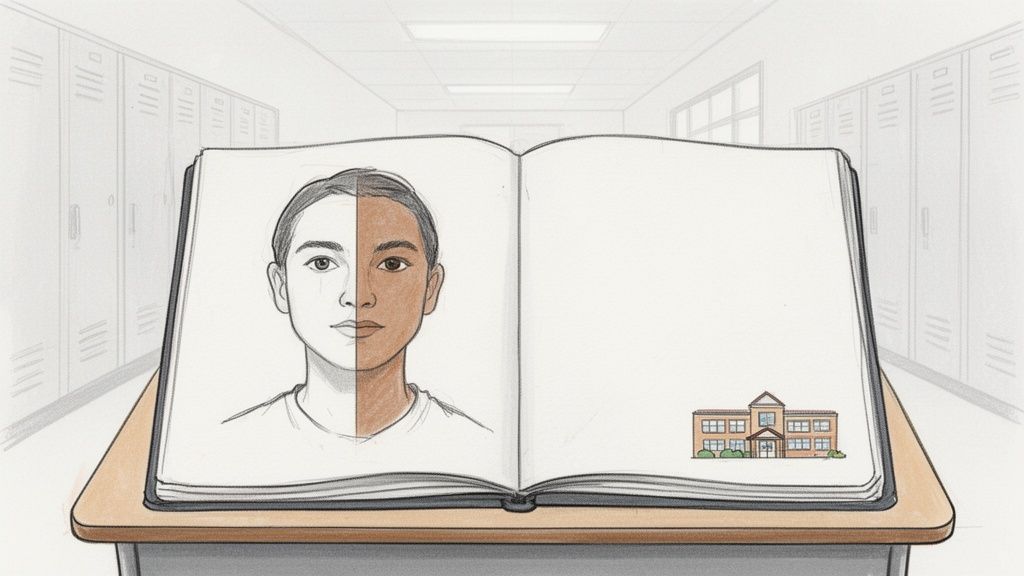
The book's authentic voice and visually engaging narrative make it incredibly appealing to young readers. Craft’s masterful illustrations not only tell the story but also enrich it with subtle details and emotional depth, making abstract social issues feel concrete and personal. Jordan’s sketchbook entries, which are woven into the story, provide an intimate glimpse into his thoughts and feelings, creating a strong connection with the reader.
Why It Works for Middle Schoolers
New Kid speaks directly to the adolescent search for belonging and identity. Middle schoolers are acutely aware of social hierarchies and the feeling of being an outsider, and Jordan's journey provides a relatable and validating narrative. The graphic novel format lowers the barrier to entry for reluctant readers while offering a sophisticated story that encourages critical thinking about race, class, and privilege in a way that is both meaningful and age-appropriate.
Classroom and Library Applications
- Discuss Microaggressions: Use specific panels from the book to initiate conversations about what microaggressions are, how they feel, and how to respond to them as an ally.
- Identity Mapping: Have students create their own "identity maps" or sketchbook pages similar to Jordan’s, exploring the different parts of their lives and how they navigate them.
- Analyze Visual Storytelling: Examine how Jerry Craft uses color, panel layout, and character expression to convey emotion and advance the plot. Discuss the choices an author-illustrator makes.
- Continue the Conversation: Pair New Kid with its companion novel, Class Act, which follows Jordan's friend Drew, to deepen the discussion on social and systemic issues from another character's perspective.
Comparison of 10 Middle School Books
| Title | 🔄 Implementation complexity | ⚡ Resource requirements | 📊 Expected outcomes | Ideal use cases | ⭐ Key advantages | 💡 Quick tips |
|---|---|---|---|---|---|---|
| Wonder — R.J. Palacio | Moderate — multi‑perspective text needing facilitation | Low — single 250‑page novel; film/companion texts available | Builds empathy, kindness, classroom dialogue | Character education; 5th–6th grade curricula; kindness initiatives | ⭐⭐⭐⭐ Emotional honesty and broad classroom appeal | Pair with "Auggie & Me"; use precepts as journal prompts |
| Hatchet — Gary Paulsen | Low — linear first‑person survival narrative | Low — single novel; optional outdoor activities/journals | Teaches resilience, problem‑solving, engagement | Outdoor education, STEM units, reluctant older readers | ⭐⭐⭐⭐ Highly engaging survival/practical skills | Use nature journaling and survival scenario exercises |
| The Baby‑Sitters Club (Raina Telgemeier) | Low — episodic graphic format, easy to implement | Moderate — multi‑volume series; visual materials/library demand | Increases engagement and visual literacy | Reading intervention; reluctant readers; book clubs | ⭐⭐⭐⭐⭐ Exceptionally effective for struggling readers | Use as gateway to original series; pair with entrepreneurship lessons |
| Percy Jackson: The Lightning Thief — Rick Riordan | Moderate — mythology integration and series planning | High — multiple books, media tie‑ins, curricular materials | High engagement; sparks interest in mythology and reading | Mythology units, reluctant readers (esp. boys), transmedia projects | ⭐⭐⭐⭐⭐ Mass appeal; motivates further reading and study | Pair with classical texts; create quest‑based projects |
| The One and Only Ivan — Katherine Applegate | Low — short, lyrical animal POV requiring sensitive discussion | Low — single shorter novel; film tie‑in available | Enhances emotional literacy, empathy for animals | Empathy lessons, environmental/animal welfare units | ⭐⭐⭐⭐ Award‑winning, poetic prose that prompts reflection | Research the real Ivan; use art projects to express emotions |
| Refugee — Alan Gratz | High — interwoven timelines needing historical prep | Moderate — supplemental historical/contextual resources | Develops global awareness and empathy for displaced people | Social studies, current events, social justice discussions | ⭐⭐⭐⭐ Teachable text for migration and human rights topics | Provide context for each period; pair with documentaries |
| The Terrible Two — Macaulay Culkin & B.B. Garrison | Low — fast‑paced, humorous dual‑protagonist story | Low — single novel; minimal materials | Boosts engagement, creativity; prompts ethics conversations | Reluctant readers; humor‑based clubs; creative writing activities | ⭐⭐⭐ High entertainment value; encourages imaginative thinking | Discuss prank ethics and differentiate funny vs. mean |
| Amal Unbound — Aline Sax | Moderate — sensitive social issues require contextual prep | Moderate — background materials on child labor and nonprofits | Raises awareness of global inequality; promotes empowerment | Global education, social justice curricula, book clubs | ⭐⭐⭐⭐ Strong cultural authenticity and a resilient female lead | Provide context about child labor; link to educational charities |
| Pier Kids — Mohammed Achaari | High — multiple perspectives on homelessness need careful facilitation | Moderate — content warnings; community resource connections | Builds empathy for marginalized youth; fosters critical discussion | Social awareness programs; activism‑oriented education | ⭐⭐⭐ Authentic portrayal of homelessness and resilience | Use content warnings; connect learning to local services |
| New Kid — Jerry Craft | Moderate — graphic format with guided discussions on race | Moderate — copies of graphic novel; classroom discussion time | Promotes conversations on identity, microaggressions, belonging | Diversity & inclusion curricula; middle‑school ELA | ⭐⭐⭐⭐ Award‑winning representation; accessible format | Use to discuss code‑switching and pair with "Class Act" |
Building a Library That Inspires
The journey through middle school is a whirlwind of change, growth, and self-discovery. The books middle schoolers read during this pivotal time do more than just fulfill a class assignment; they serve as mirrors reflecting their own experiences and windows into the lives of others. The collection we've explored, from the profound empathy in Wonder to the gripping historical tapestry of Refugee, offers a powerful starting point for parents, educators, and librarians aiming to build a truly impactful library.
Each book provides a unique entry point into complex themes. New Kid uses the graphic novel format to brilliantly dissect issues of race, class, and identity, while Hatchet offers a timeless, visceral tale of survival and resilience. These are not just stories; they are tools for building critical thinking skills, fostering empathy, and initiating crucial conversations about the world we live in. By intentionally selecting a diverse range of books for middle schoolers, we empower them to see beyond their own perspectives and connect with the shared human experience.
Key Takeaways for Cultivating Lifelong Readers
As you move forward, remember that the goal is not just to get kids to read, but to help them love to read. This means creating an environment where reading is a joy, not a chore.
Here are the most important takeaways from our exploration:
- Diversity is Non-Negotiable: A compelling library must include a wide spectrum of voices, genres, and experiences. Titles like Amal Unbound and the graphic novel adaptation of The Baby-Sitters Club show that powerful stories come in many different forms and from many different cultures.
- Meet Readers Where They Are: A reluctant reader might be captivated by the humor and visuals in The Terrible Two or New Kid, while a more advanced reader might dive deep into the mythological world of Percy Jackson. Offering choice is crucial for engagement.
- Discussion Deepens Understanding: The real magic happens after the last page is turned. Using the discussion prompts and teaching guides provided for each book can transform a solitary reading experience into a shared journey of discovery, helping students connect the book's themes to their own lives.
Actionable Next Steps for Your Library
Building an inspiring collection of books for middle schoolers is an ongoing process. The right book at the right time can change a young person's life, igniting a passion that lasts well beyond their school years.
To continue this important work, consider these practical steps:
- Conduct a Library Audit: Review your current classroom or home library. Does it reflect a wide range of genres, authors, and character experiences? Identify gaps and make a wish list based on the themes and styles we've discussed.
- Empower Student Choice: Create opportunities for students to select their own books. Set up a book tasting event, start a student-led book club, or simply make regular trips to the school or public library. When students have ownership over their reading, their engagement skyrockets.
- Expand Your Resources: A single list is just the beginning. To further inspire young readers and guide their choices, consider exploring curated reading lists for various age groups and interests. These resources can help you discover new authors and titles that will resonate with your readers.
Ultimately, the power of a book lies in its ability to connect, to challenge, and to inspire. By thoughtfully curating the stories we place in the hands of young readers, we are not just teaching them to decode words on a page. We are equipping them with the empathy, curiosity, and critical understanding needed to navigate an increasingly complex world and become the courageous, compassionate leaders of tomorrow.
At Number 6 Publishing, we are passionate about finding and sharing the stories that matter. We believe the right book can change a life, which is why we specialize in creating compelling middle-grade and YA titles that resonate with today's young readers. Explore our catalog to discover your next classroom favorite at Number 6 Publishing.