
You've poured your heart and soul into your manuscript, and now you face the next great challenge: finding a home for your story. For many debut authors, navigating the complex world of publishing can feel overwhelming. The path from a finished draft to a published book is often unclear, leaving writers wondering where to even begin their search. This is a common hurdle, but with the right resources, you can confidently identify and connect with the right partners for your work.
This guide simplifies that journey. We've curated a list of the best publishers for new authors, focusing on those actively seeking fresh voices and providing clear submission pathways. Before you delve into finding a publisher, ensure your manuscript is strong. For new authors, we recommend consulting a comprehensive a guide to writing books for beginners to refine your draft.
Each entry in this listicle breaks down exactly what you need to know, from submission guidelines and supported genres to the unique benefits each publisher or platform offers. You’ll find direct links and practical insights to help you make an informed decision. Our goal is to equip you with the tools to find a publisher that not only accepts your genre but also aligns with your creative vision, turning your publishing aspirations into a reality.
1. Number 6 Publishing: Champion for Overlooked Voices in Children's & YA Lit
For new authors navigating the competitive landscape of children’s and young adult literature, Number 6 Publishing stands out as a premier destination. This family-run independent press was founded with a clear mission: to defy industry gatekeeping and provide a platform for overlooked voices. It has established itself as one of the best publishers for new authors by actively seeking out and championing writers who might otherwise be passed over by larger, more traditional houses.
The publisher's strength lies in its passionate, hands-on approach. Unlike massive corporations where debut authors can get lost in the shuffle, Number 6 Publishing offers personalized attention to every project. This ensures each book receives the care and dedication it needs to succeed, from initial manuscript to final placement in schools, libraries, and homes.
Key Strengths and Author Benefits
Number 6 Publishing distinguishes itself through a commitment to narrative depth and emotional honesty. Their curated catalog focuses on middle grade and YA fiction (ages 8 to 14), spanning whimsical fantasies and poignant coming-of-age stories. Titles like A Complicated Journey and Eleanor the Mockingbird exemplify their dedication to powerful storytelling that resonates with young readers.
- Championing Underrepresented Voices: Their core philosophy is to amplify authors without extensive industry connections, creating a more inclusive literary landscape.
- Personalized Author Experience: The family-run model guarantees a collaborative and supportive partnership, a significant advantage for a debut author's journey.
- Focused Genre Expertise: Their specialization in children's and YA literature means their team possesses deep market knowledge and a genuine passion for the genre.
- Educational and Community Support: They actively support educators and families by creating curated reading lists, such as their "best-of" lists for YA fantasy and romance, which helps connect authors' works with a dedicated audience.
Submission Guidelines and Practical Tips
Submitting to Number 6 Publishing is a straightforward process, designed to be accessible. They are known for welcoming unsolicited manuscripts, which is a major benefit for unagented writers.
Pro Tip: Before submitting, thoroughly review their existing catalog. Tailor your query letter to demonstrate how your manuscript aligns with their mission of delivering imaginative, heartfelt stories for young readers. Show that you understand and appreciate their unique brand.
For those looking to explore similar opportunities, Number 6 Publishing also provides valuable resources. For a detailed list of other inclusive publishers, you can explore their guide on children's book publishers that accept unsolicited manuscripts.
Why It's a Top Choice for New Authors
| Feature | Advantage for New Authors |
|---|---|
| Mission-Driven Focus | Aligns with authors who want to tell meaningful, emotionally honest stories. |
| Independent & Family-Run | Offers a level of personal attention and investment rare in the industry. |
| Unsolicited Submissions | Provides a direct pathway to publication without needing a literary agent. |
| Curated Catalog | A smaller, high-quality list means each title is a priority for their team. |
While their catalog is more selective compared to major publishers and pricing details require direct inquiry via their website, these aspects reflect a commitment to quality over quantity. For a new author seeking a true partner in publishing, Number 6 Publishing offers an unparalleled opportunity to bring a meaningful story to the world.
Website: https://www.number6publishing.com
2. Reedsy Publishers Directory
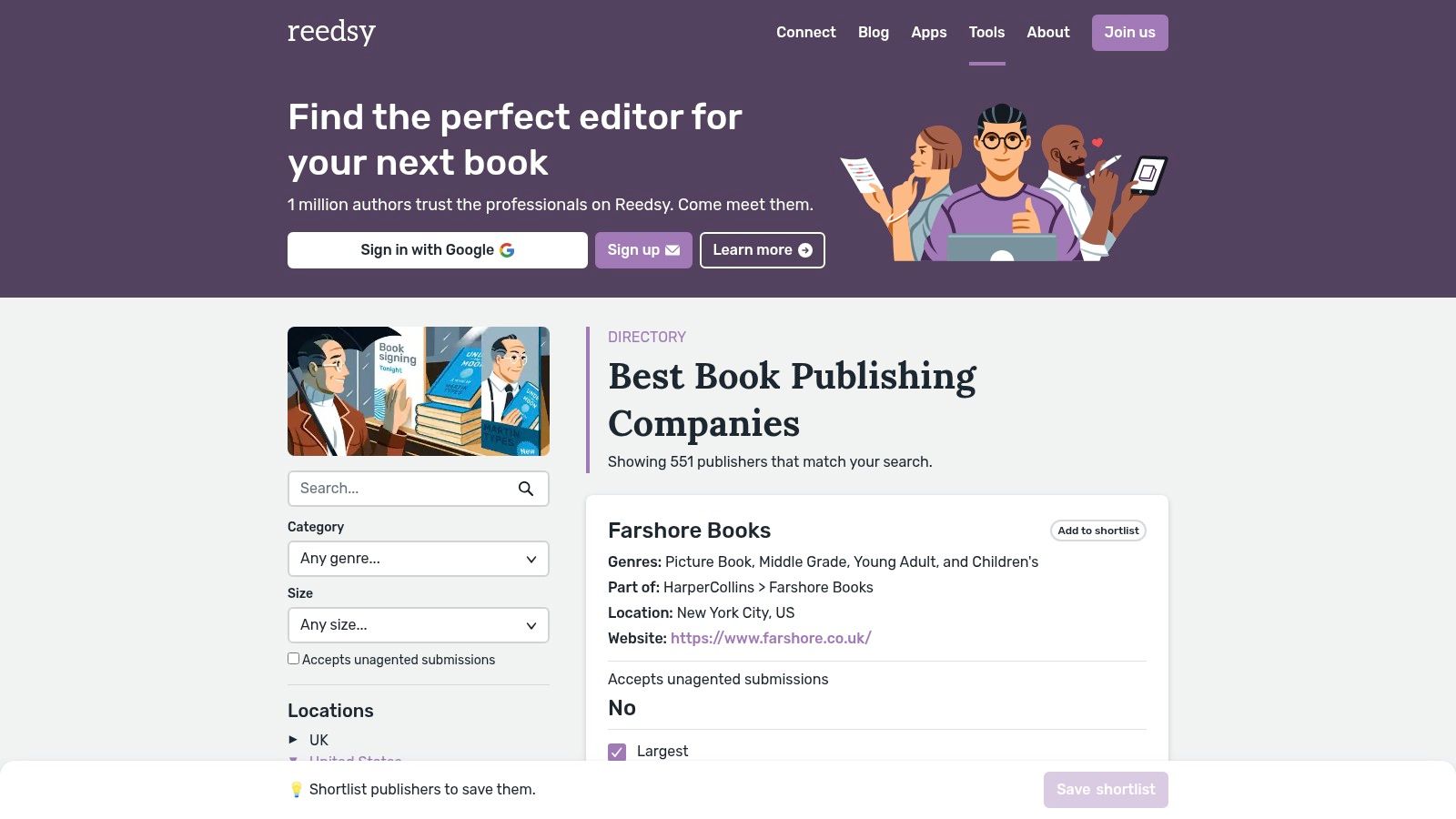
Instead of a single publisher, Reedsy offers a powerful free tool that acts as a launchpad for your submission journey: its comprehensive Publishers Directory. Think of it less as one door and more as a master key to hundreds of potential homes for your manuscript. For new authors overwhelmed by the sheer number of presses, this resource is an indispensable starting point to create a targeted submission list.
The directory shines in its robust filtering system, which is a significant time-saver. You can immediately narrow down a vast list of publishers by crucial criteria like genre, location, and, most importantly for many debut writers, whether they accept unagented submissions. This feature alone makes it one of the best publishers for new authors to research, as it filters out presses that are currently inaccessible without an agent.
Key Features and How to Use Them
The platform is designed for efficiency. Each listing provides at-a-glance notes and direct links to the publisher’s website and submission guidelines, eliminating tedious searching.
- Filter Strategically: Start by selecting your specific genre (e.g., "Young Adult Fantasy," "Crime Fiction"). Next, apply the "Accepting Unagented Submissions" filter. This will instantly generate a curated list of relevant, accessible publishers.
- Verify Guidelines: While Reedsy’s directory is frequently updated, publisher needs can change quickly. Always click through to the publisher’s official website to verify their current submission status and guidelines before preparing your query.
- Explore the Ecosystem: Reedsy integrates its directory with its marketplace of vetted freelance professionals. If you find your manuscript needs a final polish or a professional cover design to meet a publisher's standards, you can easily find experienced editors and designers right on the platform.
Pros and Cons
| Strengths | Weaknesses |
|---|---|
| Free and Comprehensive: Access to hundreds of listings with no cost. | Verification Required: You must double-check each publisher's guidelines independently. |
| Excellent Filters: Saves hours of research by narrowing options to relevant presses. | Includes Closed Presses: Some major publishers listed do not accept unsolicited work. |
| Focus on Small/Mid-Size Presses: Strong coverage of independent publishers open to debut authors. | Not a Publisher Itself: Reedsy is a directory, not the final destination for your book. |
Ultimately, the Reedsy Publishers Directory empowers new authors by turning a daunting research task into a manageable, strategic process. It’s an essential tool for building a smart submission plan.
Website: Reedsy Publishers Directory
3. Poets & Writers Small Presses Database
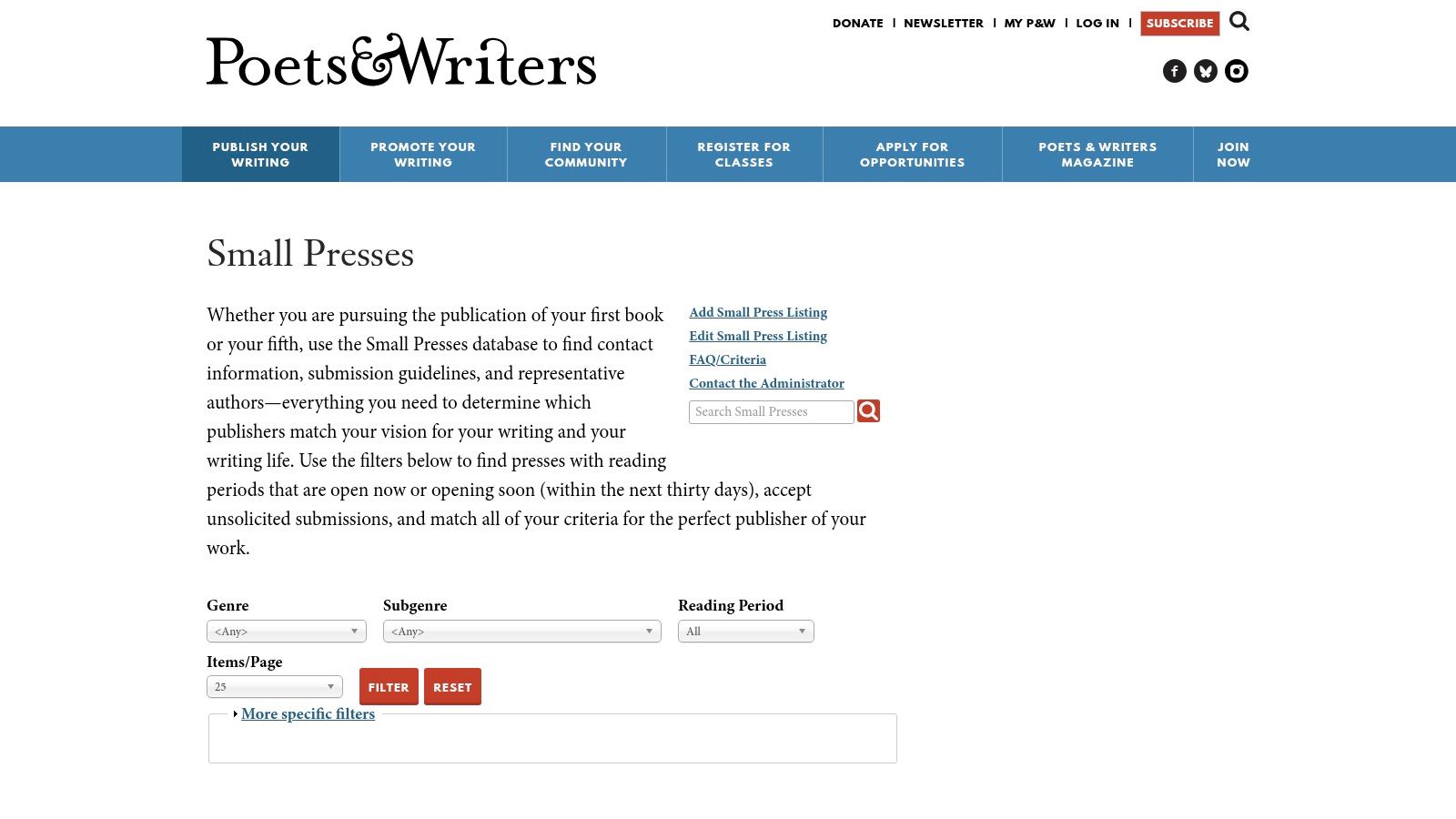
For authors specializing in literary fiction, poetry, or creative nonfiction, the Poets & Writers Small Presses Database is a cornerstone resource. Backed by a trusted US-based nonprofit, this free database focuses on curating a list of reputable independent and small presses. Its mission is to connect emerging writers with publishers who are actively seeking new voices, making it one of the best publishers for new authors to research in the literary space.
The database's primary strength lies in its meticulous curation and specific filters. It helps authors sidestep the common pitfall of submitting to vanity or predatory presses by vetting each publisher. This focus on quality and legitimacy provides invaluable peace of mind for new writers navigating the complex world of independent publishing.
Key Features and How to Use Them
The platform is streamlined to help you find suitable presses quickly and confidently. Each listing includes the last updated date, a link to the press's website, and direct access to their submission guidelines.
- Filter with Precision: Immediately apply filters for presses that are "Currently Accepting Unsolicited Submissions" and have "No Reading Fees." This narrows your search to the most accessible and cost-effective options.
- Target by Genre: Use the genre filters (e.g., "Fiction," "Poetry," "Nonfiction") to ensure your work aligns with the publisher's catalog. This database is also an excellent resource for writers looking to find publishers that prioritize diverse voices. You can learn more about the importance of representation in literature to better inform your submissions.
- Check the "Last Updated" Date: Before investing time in a submission packet, check when the listing was last updated. Always click through to the publisher’s official website to confirm they are still accepting submissions and to review their guidelines in detail.
Pros and Cons
| Strengths | Weaknesses |
|---|---|
| Free and Highly Trusted: A respected, no-cost resource in the literary community. | Leans Literary: Fewer options for commercial or genre fiction like sci-fi or romance. |
| Eliminates Predatory Presses: Editorial vetting reduces risks for authors. | Verification is Essential: Authors must still cross-reference all details on the press's site. |
| Excellent Niche Filters: Specific filters for open reading periods and no fees. | US-Centric: The focus is primarily on presses based in the United States. |
The Poets & Writers Small Presses Database is an essential tool for any serious literary writer. It simplifies the discovery process and connects authors with credible, mission-driven independent presses ready to discover the next generation of talent.
Website: Poets & Writers Small Presses Database
4. Submittable Discover
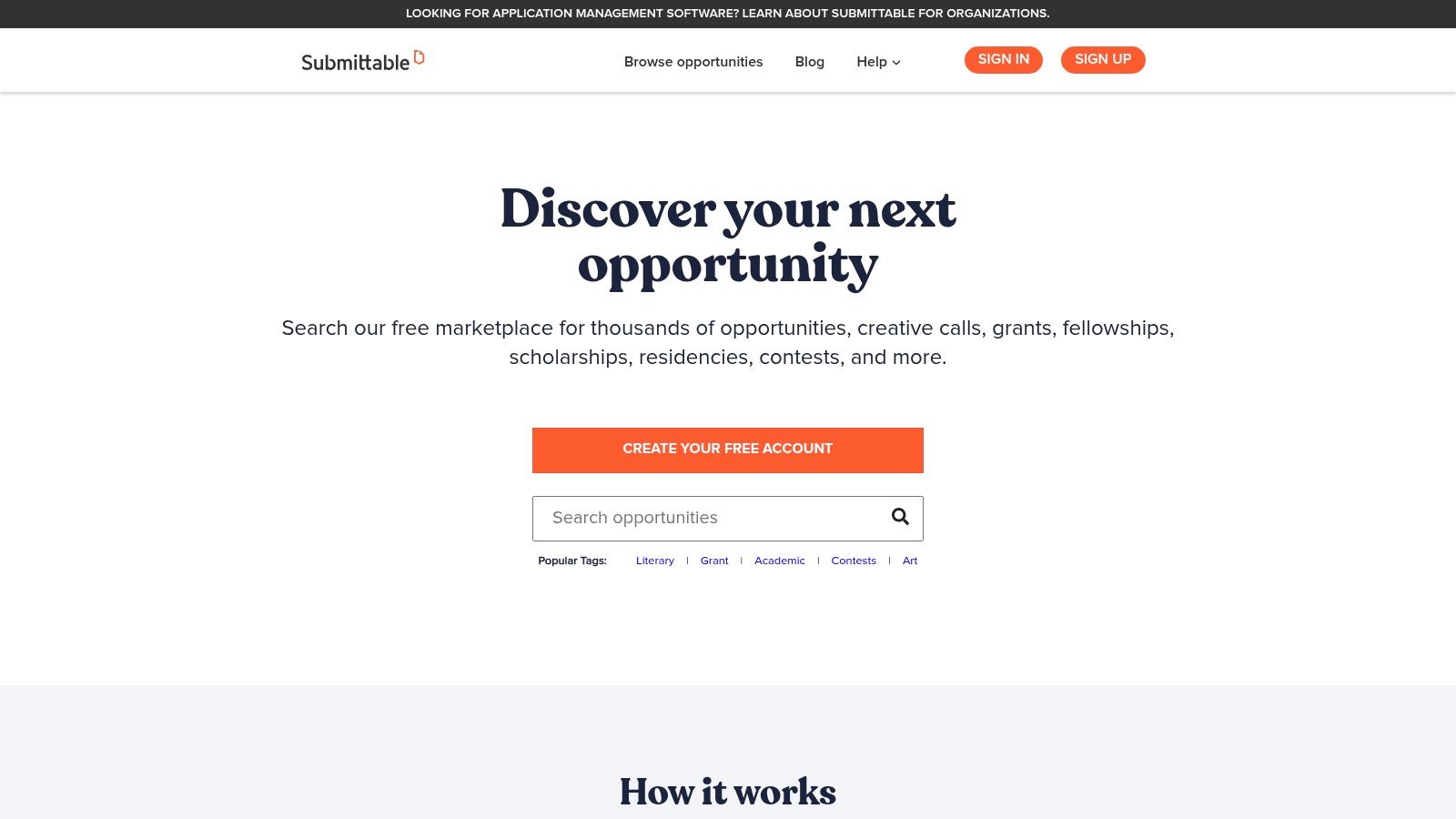
While not a publisher itself, Submittable is the engine that powers the submission process for thousands of literary magazines, university presses, and independent publishers. Its Discover feature is a searchable marketplace of active opportunities, making it an essential tool for writers seeking a home for their work. For new authors, it provides a direct, transparent pipeline to presses actively looking for manuscripts.
The platform streamlines the often-chaotic process of tracking submissions. Instead of juggling dozens of different portals and email threads, Submittable centralizes your applications, providing a clear dashboard of your pending, accepted, and declined submissions. This organization makes it one of the best publishers for new authors to engage with, as it simplifies managing multiple queries simultaneously.
Key Features and How to Use Them
The user-friendly interface is designed for discovery and application management. Each listing clearly outlines the opportunity, guidelines, and any associated fees, ensuring full transparency before you submit.
- Filter with Precision: Use the robust search filters to find relevant opportunities. You can narrow your search by genre, deadline, and over 175 specific tags (e.g., "debut author," "no agent required"). A crucial filter is the "no fee" option, which helps writers on a budget find free submission opportunities.
- Save and Follow: Don’t have your materials ready yet? You can "Save" opportunities to a personal list or "Follow" specific organizations to be notified of their future calls for submission. This helps you build a long-term, strategic submission plan.
- Read Guidelines Carefully: Every publisher on Submittable sets its own unique guidelines. Pay close attention to requirements for formatting, cover letters, and what to include in your submission package. Adhering to these rules is critical for making a good first impression.
Pros and Cons
| Strengths | Weaknesses |
|---|---|
| Centralized Platform: Manages submissions to many presses from a single dashboard. | Fees Can Add Up: Many contests and some journals charge reading or entry fees. |
| Transparent Fees: Clearly states any costs associated with submitting upfront. | Not All-Encompassing: Many publishers do not use Submittable for their queries. |
| Excellent Searchability: Powerful filters make finding relevant opportunities easy. | Requires an Account: You must create a free account to browse and submit. |
Submittable Discover transforms the submission process from a logistical headache into an organized, manageable task. It empowers new authors by connecting them directly with a vast network of reputable presses and literary opportunities actively seeking new voices.
Website: Submittable Discover
5. Duotrope
For authors who prefer a data-driven approach, Duotrope is a powerful subscription-based resource for finding publishers and literary agents. Instead of just listing markets, it provides detailed statistics that help you make strategic submission decisions. It's an exceptional tool for authors who want to move beyond guesswork and use real-world data to target presses with the highest likelihood of responding.
The platform's main advantage is its wealth of information on response times, acceptance rates, and payment levels. This data, gathered from thousands of user reports, gives you a realistic picture of what to expect from each publisher or journal. For writers tired of sending work into a void, Duotrope offers a clear, analytical path, making it one of the best publishers for new authors to research by providing transparency into the often opaque submission process. A 10-day free trial is available, after which a subscription is required.
Key Features and How to Use Them
Duotrope excels at transforming overwhelming market research into a manageable, data-backed workflow. The personal submission tracker is a standout feature, allowing you to monitor all your queries in one place.
- Analyze Market Data: Before submitting, check a publisher's listing for their average and median response times. This helps you set realistic expectations and avoid markets known for extremely long waits. Also, look at their reported acceptance rates to gauge competitiveness.
- Use the Submission Tracker: Log every submission you send out. Duotrope will use this data to alert you when a publisher is overdue based on their typical response window, prompting you to follow up professionally.
- Filter with Precision: Use the advanced search filters to find markets that match your exact needs. You can filter by genre, subgenre, submission fees (or lack thereof), payment rates, and even specific themes for upcoming issues or anthologies.
Pros and Cons
| Strengths | Weaknesses |
|---|---|
| Data-Driven Insights: Provides valuable statistics on response times and acceptance. | Requires a Paid Subscription: Access is behind a paywall after the free trial. |
| Powerful Submission Tracker: Helps you organize and manage your submission workflow. | Focus on Smaller Markets: Strongest for literary journals and small presses. |
| Reduces "Submission Black Holes": Helps you target responsive and active publishers. | Data is User-Reported: Accuracy can vary depending on user participation. |
Duotrope is an invaluable investment for the serious author who wants to optimize their submission strategy. By combining market research with a personal tracking system, it empowers you to approach publishing with logic and precision.
Website: Duotrope
6. NewPages — Calls for Submissions
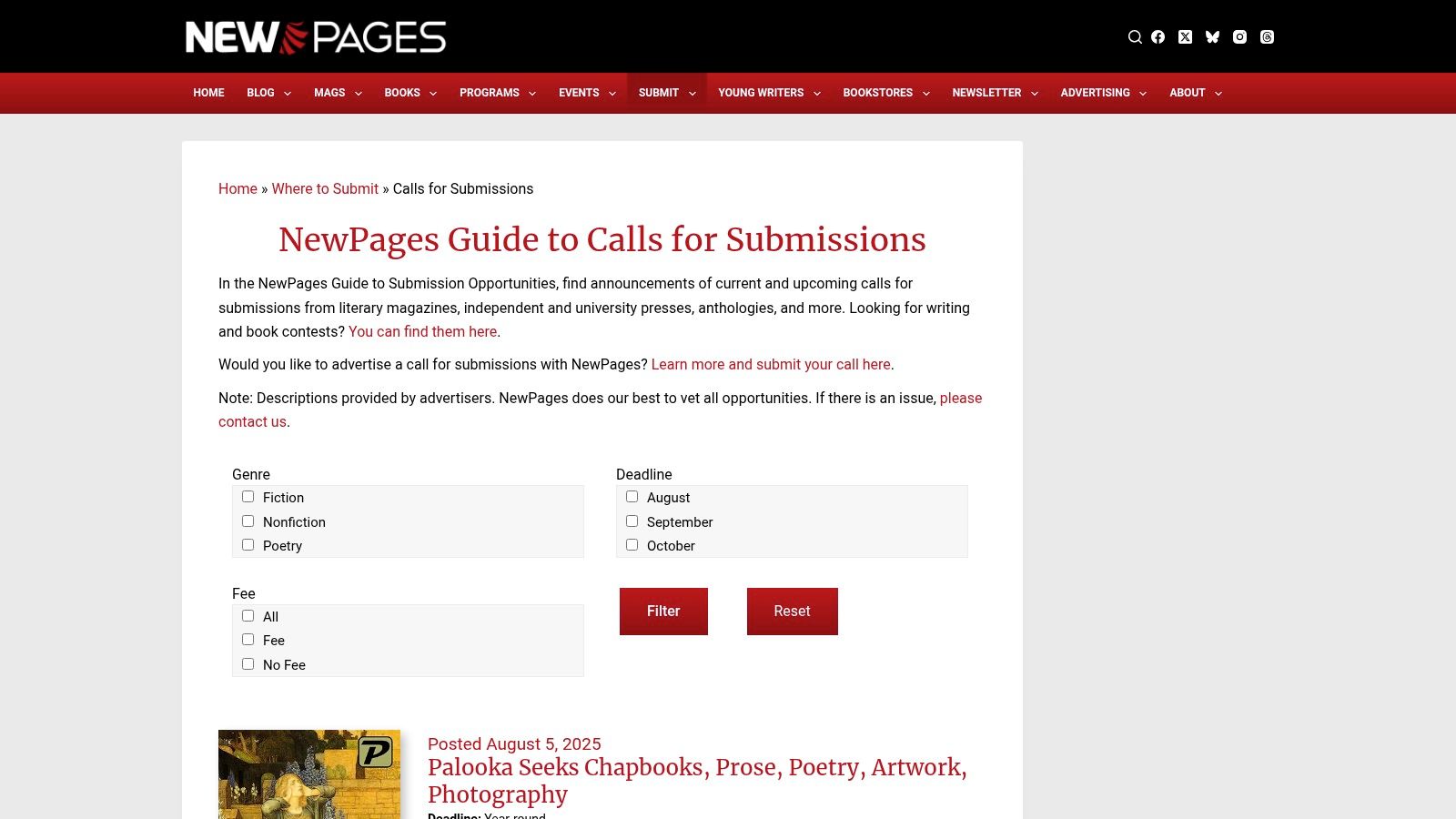
NewPages has long been a trusted resource in the literary community, offering a goldmine for authors seeking timely opportunities. Its "Calls for Submissions" section is a straightforward, no-frills bulletin board that lists current submission calls from small presses, university presses, literary journals, and anthologies. This makes it an invaluable tool for discovering time-sensitive openings that might not appear on larger, more static directories.
For new authors, this platform provides a direct line to presses actively looking for new work right now. Instead of researching publishers who may or may not be open, NewPages presents a curated feed of who is accepting manuscripts and what they are looking for. This focus on current, actionable opportunities is why it's one of the best publishers for new authors to consult for finding a home for their work, especially for short story collections, poetry, and niche manuscripts.
Key Features and How to Use Them
The site’s strength lies in its simplicity. Listings are presented chronologically, with clear deadlines and direct links, making it easy to scan for relevant calls.
- Scan Regularly: New calls are added frequently. Make it a habit to check the listings weekly to catch new opportunities, especially those with short submission windows for specific anthologies or themed calls.
- Look Beyond Book Publishers: NewPages is excellent for finding opportunities with literary magazines and journals. Getting a short story or excerpt published can build your writing credentials, which is a great strategic move before querying a full manuscript.
- Vet Each Opportunity: Since NewPages is an aggregator, the quality and reputation of the listed presses can vary. Always research each publisher or journal independently. Look for their website, previously published works, and any author testimonials to ensure they are a good fit.
Pros and Cons
| Strengths | Weaknesses |
|---|---|
| Free and Frequently Updated: A constantly refreshed source of current opportunities at no cost. | Requires Independent Vetting: You must research each listing's credibility. |
| Focus on Active Calls: Only lists presses and journals that are currently seeking submissions. | Basic Interface: The site is functional but lacks advanced filtering options. |
| Excellent for Niche Genres: Great for discovering calls for specific themes, poetry, and short fiction. | Listings Are Bulletin-Style: No direct integration; you must track everything yourself. |
NewPages cuts through the noise by focusing on one simple thing: who wants your manuscript right now. It’s an essential bookmark for any author actively sending out their work.
Website: NewPages Calls for Submissions
7. Amazon Kindle Direct Publishing (KDP)
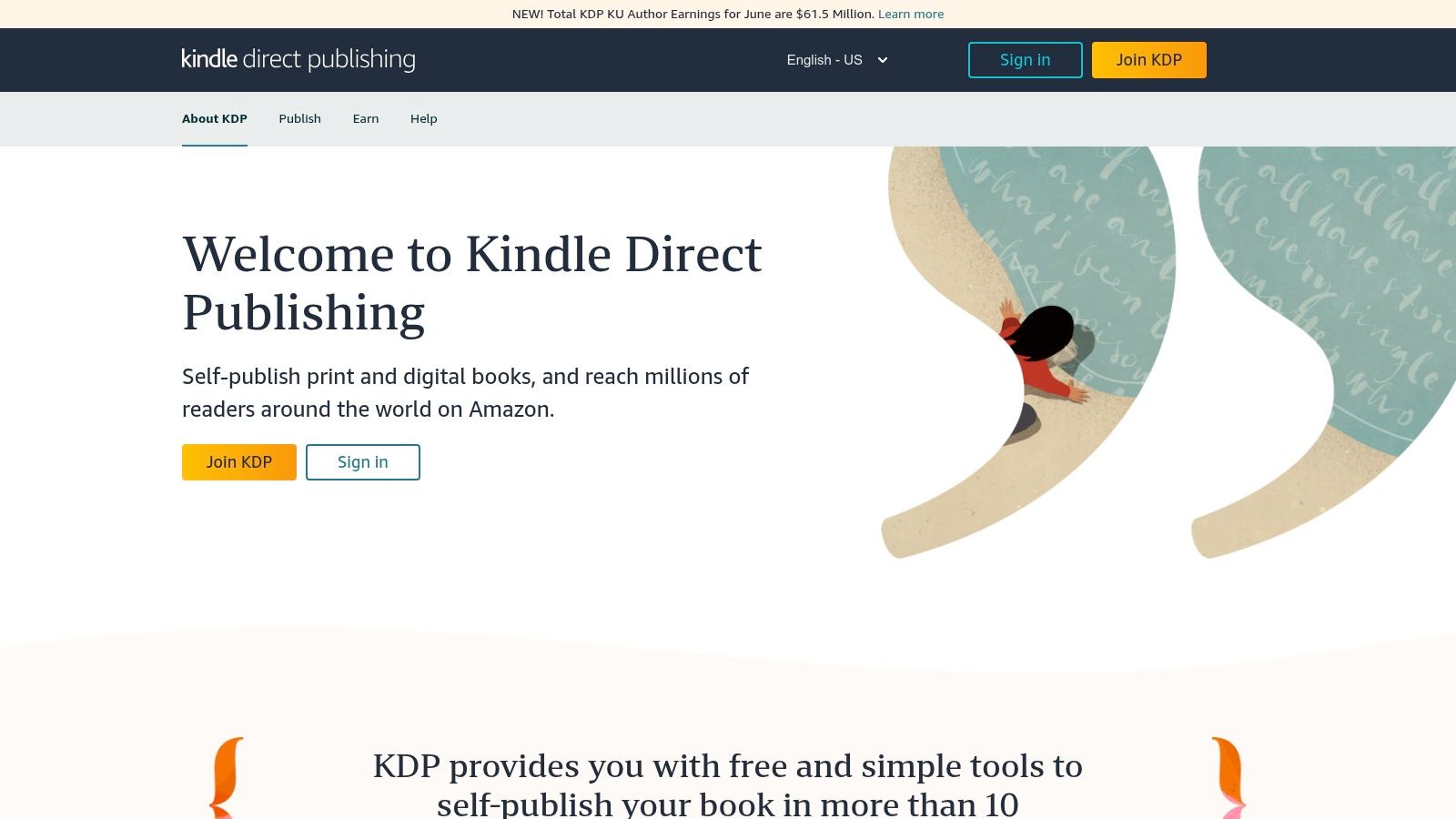
For authors seeking complete control and a direct-to-market path, Amazon Kindle Direct Publishing (KDP) represents a monumental shift in the publishing landscape. It isn't a traditional publisher that acquires rights; instead, it's a powerful self-publishing platform that allows any writer to publish eBooks and print-on-demand books for a global audience. For many new authors, KDP is the ultimate tool for bypassing gatekeepers and building a readership from scratch.
What makes KDP one of the best publishers for new authors is its unparalleled accessibility and speed. You can upload a formatted manuscript, design a cover, set your price, and have your book live on Amazon marketplaces worldwide within 72 hours, all with no upfront fees. This makes it a popular choice for authors who want to test a book's market viability or build a backlist of titles quickly.
Key Features and How to Use Them
The KDP dashboard gives authors a transparent view of their sales and full control over their book's metadata and pricing, a level of control absent in traditional publishing.
- Set Your Royalties: For eBooks priced between $2.99 and $9.99, you can earn up to 70% royalty in eligible territories. For paperbacks, you earn a 60% royalty rate, from which printing costs are deducted. Use the built-in calculators to see your potential earnings.
- Leverage KDP Select: You can choose to enroll your eBook in KDP Select, an optional 90-day program. This makes your book available in Kindle Unlimited (where you get paid per page read) and grants you access to promotional tools like Kindle Countdown Deals.
- Market Your Book: Success on KDP depends heavily on your marketing efforts. You are the publisher, so you must drive discovery. Once your book is published, use social media, mailing lists, and Amazon Ads to find your readers. For more on building an audience, you can learn how authors develop reader engagement on Number 6 Publishing's blog.
Pros and Cons
| Strengths | Weaknesses |
|---|---|
| Full Creative and Pricing Control: You decide every aspect of your book and its price. | Requires Author Marketing: Discoverability is entirely your responsibility. |
| Fast Time-to-Market: Go from final manuscript to live book in just a few days. | Royalty Restrictions: The 70% rate has price and territory limitations. |
| No Upfront Costs: It is free to publish; costs are only deducted from print sales. | Stigma and Competition: The platform is crowded, making it hard to stand out. |
KDP empowers new authors by removing traditional barriers, offering a direct line to millions of readers. It places the power, and the responsibility, squarely in the author's hands.
Website: Amazon Kindle Direct Publishing
Top 7 Publisher Platforms Comparison
| Item | Implementation Complexity 🔄 | Resource Requirements ⚡ | Expected Outcomes 📊 | Ideal Use Cases 💡 | Key Advantages ⭐ |
|---|---|---|---|---|---|
| Number 6 Publishing | Moderate – family-run, curated catalog | Low to moderate – focused personal care | Quality, diverse children’s & YA books | Authors seeking personalized attention and niche impact | Amplifies underrepresented voices; access to schools |
| Reedsy Publishers Directory | Low – user-friendly digital directory | Minimal – free online access | Quick shortlist of suitable small & mid-size presses | New authors seeking debut-friendly publishers | Free, comprehensive filtering; consolidates info |
| Poets & Writers Small Presses | Low – trusted nonprofit database | Minimal – free and online | Reliable literary-focused press matches | Literary fiction, poetry, creative nonfiction authors | Reduces risk from vanity presses; regularly updated |
| Submittable Discover | Moderate – platform account setup required | Moderate – free sign-up, some fee listings | Access to thousands of active calls and contests | Authors applying to contests, presses accepting fees | Centralizes submissions; transparent fees |
| Duotrope | Moderate to high – paid subscription and data-driven | Paid subscription needed | Data-informed submissions with response tracking | Authors prioritizing acceptance likelihood and timing | Response stats; submission tracking; editor insights |
| NewPages — Calls for Submissions | Low – simple bulletin-style listings | Free access | Exposure to open calls from indie and university presses | Authors seeking diverse current open submission windows | Free and frequently updated; broad opportunity mix |
| Amazon Kindle Direct Publishing (KDP) | Moderate – self-publishing platform setup | Low to moderate – no fees, printing costs | Rapid global self-publishing with royalty income | Authors wanting fast, full control over publishing | High royalties; instant market access; no upfront fees |
Your Next Chapter: Turning Your Manuscript into a Published Book
Navigating the path to publication can feel like an epic quest, but armed with the right tools and information, you're well-equipped for the journey ahead. This guide has provided you with a curated map, detailing seven powerful resources designed to connect emerging writers like you with potential publishing partners. From the targeted listings of genre-specific imprints to broad, searchable databases, your mission is to find the one that aligns with your unique story and author goals.
The key takeaway is that there is no single "best" path for every author. The ideal choice depends entirely on your manuscript, your genre, and your personal publishing aspirations. The tools we've explored serve different functions: some help you find traditional independent presses, while others give you the framework to self-publish with total creative control.
Charting Your Course: Actionable Next Steps
To move forward effectively, it's time to transition from research to action. Instead of getting overwhelmed by options, focus on a structured approach to your submissions strategy.
- Finalize Your Shortlist: Revisit the tools discussed, such as the Reedsy Publishers Directory and Duotrope. Based on your genre (e.g., YA fantasy, middle-grade adventure) and submission preferences (agent-required vs. open submissions), create a targeted list of 5-10 publishers that feel like a strong potential fit for your manuscript.
- Create a Submission Packet: For each publisher on your shortlist, meticulously prepare the required materials. This typically includes a polished query letter, a concise synopsis, and the first few chapters of your manuscript, formatted exactly to their specifications. Attention to detail is crucial here; it shows professionalism and respect for their guidelines.
- Develop a Tracking System: Use a simple spreadsheet or a dedicated tool like Submittable to track your submissions. Note the publisher's name, the date you submitted, the materials sent, and their stated response time. This organization will help you manage follow-ups and avoid duplicate submissions.
Making the Right Choice for Your Story
Choosing a publisher is one of the most significant decisions you will make in your author career. As you evaluate your options, consider these critical factors:
- Genre Alignment: Does the publisher have a proven track record with books like yours? Look at their backlist and current catalog. A publisher specializing in literary fiction is unlikely to be the right home for a commercial YA romance.
- Author Support and Royalties: What level of editorial, marketing, and distribution support do they offer? Understand their royalty structure and what you can expect in terms of an advance, if any.
- Community and Connection: Publishing is about more than just printing a book; it's about connecting with readers. Once your book is out in the world, a vital part of your long-term success involves actively building an engaged online community around your work. Look for a publisher that values author-reader relationships and supports your efforts to grow your platform.
Ultimately, finding the best publishers for new authors means finding the publisher that is best for you. Trust your instincts, champion your story, and remember that every submission is a step forward. Your manuscript is a key that can unlock many doors, and with these resources, you now have a ring full of them. The next chapter is waiting to be written.
Ready to partner with a publisher that champions heartfelt stories for young readers and supports underdog authors? Number 6 Publishing is dedicated to bringing inclusive and imaginative middle grade and YA books to life. Explore our submission guidelines and see if we're the right home for your manuscript at Number 6 Publishing.