
First grade marks a pivotal moment in a child's reading journey. It's the year when foundational skills solidify and a genuine love for stories begins to blossom. But with countless options, finding the right 1st grade level books can feel overwhelming for parents, caregivers, and educators alike. Whether you're searching for decodable texts to build phonics skills, engaging stories for read-alouds, or a digital library to supplement classroom learning, navigating the options is a significant challenge. To effectively guide children through this stage, it helps to understand the underlying principles of cognitive development in early childhood, as this knowledge provides a framework for selecting materials that meet them where they are.
This guide simplifies the search by pinpointing the best destinations for building a first-grade library. We have curated and reviewed the seven most effective sources, from massive online marketplaces like Amazon and Barnes & Noble to specialized educational platforms such as Epic and Reading A‑Z. We also explore mission-driven options like Bookshop.org that support independent bookstores.
Our goal is to provide a clear, actionable roadmap. For each platform, we detail its unique strengths, target audience, and best-use cases, complete with direct links and illustrative screenshots. This curated list ensures you can confidently choose the 1st grade level books that will inspire, educate, and ignite a lifelong passion for reading in your emerging reader.
1. Collections - Our Books
For parents, educators, and librarians seeking more than just another story, the Collections page from Number 6 Publishing serves as a powerful and thoughtfully curated resource. This independent publisher distinguishes itself not by the sheer volume of its catalog, but by its deep commitment to emotional honesty and narrative craft. It is an exceptional starting point for anyone looking to find high-quality, meaningful 1st grade level books that nurture empathy and spark curiosity.
The platform excels at organizing its titles into intuitive, themed collections. This heart-first approach simplifies the discovery process, allowing you to move beyond generic age labels and find books that resonate with specific developmental needs and classroom goals. Instead of overwhelming you with endless options, Number 6 Publishing presents a focused selection that reflects its core values: championing overlooked perspectives and telling stories with genuine emotional depth.
Why It Stands Out as a Premier Choice
Number 6 Publishing's "Collections" page is more than a simple product listing; it’s a guided exploration into literature that matters. The platform’s strength lies in its meticulous curation, which is particularly beneficial when searching for books for first graders. At this critical age, stories help shape a child's understanding of the world, and this publisher’s focus on empathy and unique voices provides a rich foundation.
The user experience is clean and straightforward, prioritizing content over clutter. Each collection, whether grouped by theme like "classroom reads" or by age, feels intentional. This makes it an invaluable tool for educators building lesson plans around social-emotional learning or for parents looking to introduce complex themes in an accessible, age-appropriate manner.
Key Features and Practical Applications
The platform’s design and content are optimized for practical use by its target audience of parents, teachers, and librarians.
- Thematic Curation: Instead of just filtering by genre, you can browse collections built around concepts like emotional honesty, imagination, or coming-of-age stories. This is perfect for building a classroom library with a specific focus.
- Support for Educators: The publisher often provides additional resources and context for its titles, making it easier to integrate them into curriculum. Their blog frequently highlights top picks, including a detailed guide to their Top 10 Books for 1st Graders.
- Focus on Indie Voices: Discover unique stories that offer fresh perspectives you won't find from mainstream publishers. This is essential for creating a diverse and inclusive reading list that reflects a wider range of experiences.
Navigating Potential Limitations
As a smaller independent publisher, Number 6 Publishing has a more limited catalog compared to major houses. This means that while the quality is high, the quantity is smaller. Additionally, distribution can be a factor. Some titles might be less readily available at large retailers and could sell out faster directly from the publisher’s site. It’s a good idea to plan purchases in advance, especially for classroom sets.
Despite these considerations, the unique value and thoughtful curation make this platform an indispensable resource for finding truly special 1st grade level books.
| Feature Analysis | Strengths & Weaknesses |
|---|---|
| Selection Quality | Pro: Exceptionally high-quality, emotionally resonant stories. Con: Smaller, more focused catalog than major publishers. |
| User Experience | Pro: Clean, intuitive interface with helpful thematic collections. Con: Lacks the advanced filtering tools of larger retail sites. |
| Availability | Pro: Direct-from-publisher access ensures support for an indie press. Con: Some titles may have limited availability or sell out quickly. |
| Target Audience Fit | Pro: Perfectly tailored for educators and parents seeking meaningful, empathy-building literature. Con: May not appeal to those seeking mainstream, franchise-based characters. |
Website: https://www.number6publishing.com/collections/our-books
2. Amazon (marketplace)
When sheer volume and immediate availability are the top priorities, Amazon’s massive marketplace is an unparalleled resource for finding 1st grade level books. Its primary strength lies in its enormous, in-stock catalog that spans every conceivable category, from popular series and classroom sets to niche decodable readers and out-of-print classics. For parents, teachers, and homeschoolers needing a one-stop shop, it’s often the fastest and most efficient option.
The platform excels at bundling and series availability. You can easily find complete sets of Bob Books, Step into Reading leveled readers, or the entire Elephant & Piggie collection in a single click. This is a significant time-saver compared to sourcing individual titles from multiple stores.
Why It Stands Out
Amazon's key differentiator is the combination of its vast new book inventory with a robust third-party marketplace. This dual system means that if a specific edition or a beloved but out-of-print title isn't available new, you can almost always find a used copy from a marketplace seller. Furthermore, its powerful filtering tools, while sometimes overwhelming, allow you to narrow searches by format, reading level (like Guided Reading Level or Lexile), and specific series.
Pro Tip: Use the "Look Inside" feature to preview the text and illustrations before you buy. This is incredibly helpful for assessing if the sentence structure and vocabulary are a good match for your first grader's current reading ability.
Key Features and Usage Tips
| Feature | How to Use It Effectively |
|---|---|
| Advanced Search Filters | Go beyond a simple search. Use the left-hand sidebar to filter by "Age Range" (select 6-8 years), "Book Format" (Paperback, Hardcover, Kindle), and "Customer Reviews" to find highly-rated options. |
| Multiple Formats | Check for Kindle and Audible versions. An audiobook can be a great companion to a physical book, helping emergent readers with fluency and pronunciation. |
| Wish Lists & Registries | Teachers can create a "Classroom Wish List" to share with parents, making it easy for them to purchase and donate specific books needed for the classroom library. |
| Prime Shipping | For last-minute needs, such as replacing a lost library book or getting a new reader for a weekend, Prime’s Same-Day or One-Day delivery options are invaluable. |
Pros and Cons
-
Pros:
- Unmatched Selection: The inventory of new and used 1st grade level books is virtually endless.
- Competitive Pricing: Frequent discounts, especially on popular book sets and bundles.
- Convenience: Fast shipping and multiple format options streamline the purchasing process.
-
Cons:
- Overwhelming Choice: The sheer number of options can make discovery difficult without a specific title in mind.
- Marketplace Variability: When buying used, carefully check seller ratings and item descriptions for book condition.
Website: https://www.amazon.com/s?k=first+grade+books
3. Barnes & Noble
For those who appreciate a more curated and traditional bookstore experience translated online, Barnes & Noble offers a well-organized and trustworthy place to find 1st grade level books. Its strength lies in its editorial curation, which filters the overwhelming market down to high-quality, popular, and educationally-sound selections. This makes it an ideal starting point for parents and teachers who want librarian-style recommendations without endless scrolling.
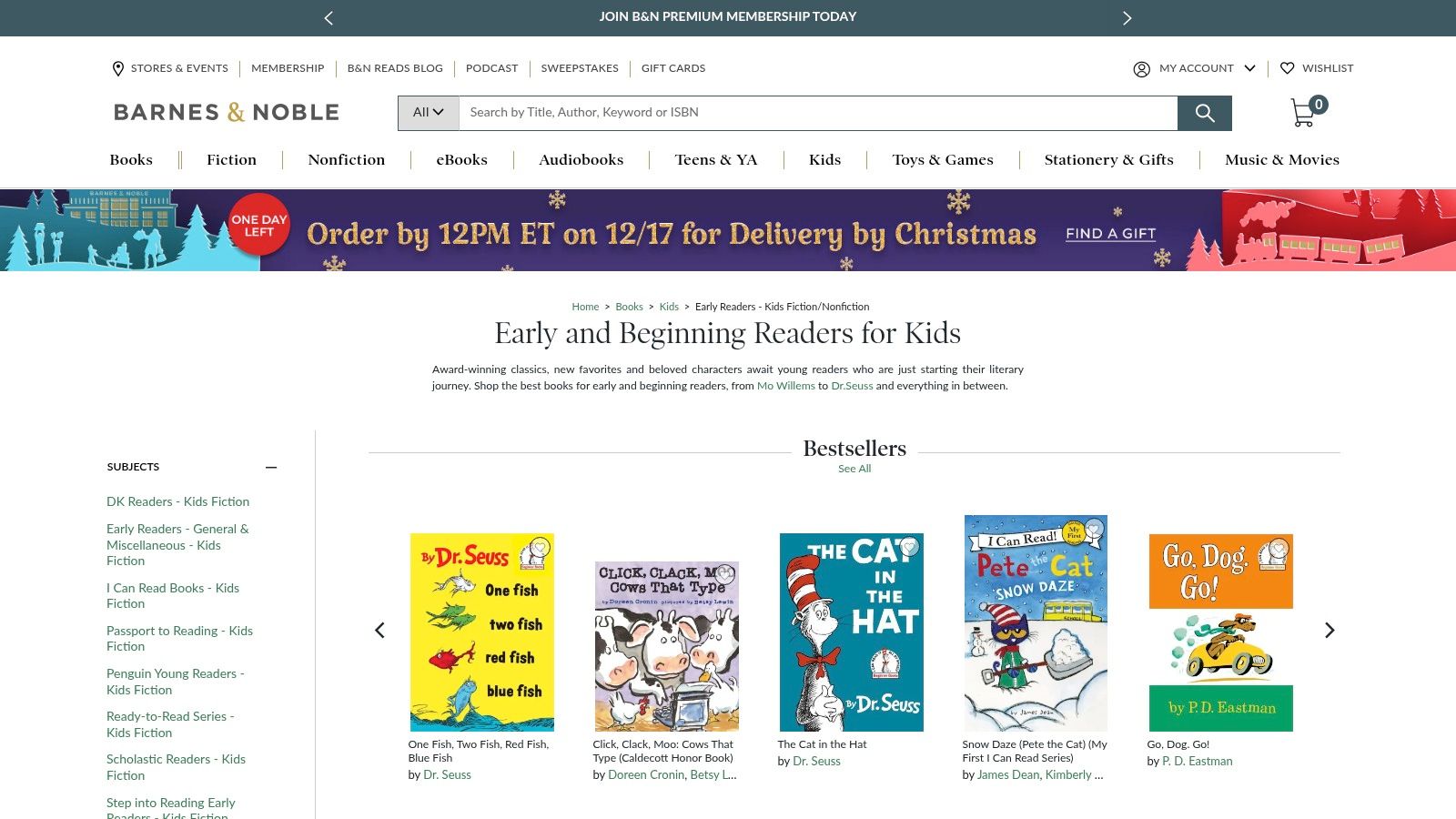
The platform features dedicated shopping pages for grade levels and beginning readers, making it simple to browse relevant titles. You can easily find classic series like Frog and Toad alongside modern, Science of Reading-aligned phonics sets, all presented with clear guidance that inspires confidence in your purchase.
Why It Stands Out
Barnes & Noble stands out by blending the convenience of online shopping with the tangible benefits of a brick-and-mortar store. Unlike purely online marketplaces, it offers in-store pickup, allowing you to check local availability and get books in hand the same day. This hybrid model is perfect for last-minute school projects or for those who prefer to see a book before buying. Their editorial lists and curated value sets also provide a level of guidance that can be missing from larger, algorithm-driven sites.
Pro Tip: Check the "Kids' Book Hangout" section online for curated lists like "Best Beginning Reader Books" and seasonal promotions. These editor-picked collections are a fantastic way to discover new favorites and find value sets.
Key Features and Usage Tips
| Feature | How to Use It Effectively |
|---|---|
| Grade-Specific Pages | Navigate directly to the "Books for Grades 1-2" section. This pre-filters the catalog to show age-appropriate fiction, non-fiction, and workbooks, saving significant search time. |
| In-Store Pickup | Use the "Check Store Availability" button on a book’s product page. You can reserve the item online and pick it up at your local store, often within hours, avoiding shipping costs and delays. |
| Curated Value Sets | Look for bundled sets of popular series, such as I Can Read! or Pete the Cat. These are often discounted and provide a great way to build a home or classroom library with consistent characters and reading levels. |
| B&N Membership | If you're a frequent buyer, consider the Premium Membership. It offers benefits like free shipping with no minimum purchase and discounts, which can quickly pay for itself. |
Pros and Cons
-
Pros:
- Strong Curation: Expertly selected collections make it easy to find high-quality 1st grade level books.
- Local Pickup Option: The "Buy Online, Pick Up in Store" feature provides immediate access and easy returns.
- Clear Guidance: Excellent organization by age, series, and reading level helps you choose with confidence.
-
Cons:
- Smaller Selection: The inventory is less exhaustive than Amazon's, especially for niche or out-of-print titles.
- Shipping Costs: A free-shipping threshold applies to non-members, which may be a factor for smaller orders.
4. Scholastic Store (shop.scholastic.com)
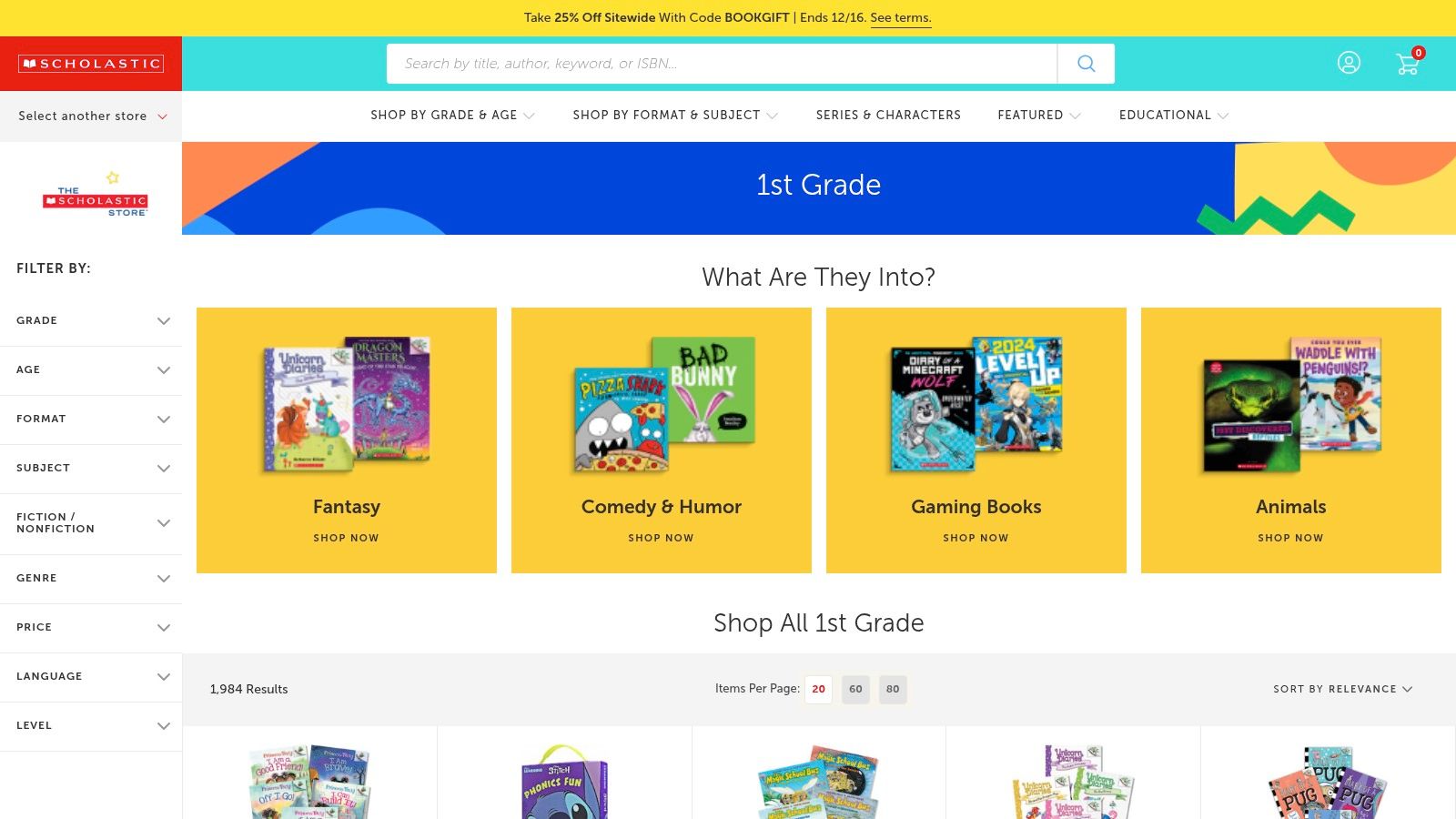
For generations, Scholastic has been a trusted name in children’s literacy, and its online store is a powerful resource specifically curated for parents and educators. It excels at providing high-quality, educationally-vetted 1st grade level books and materials that align directly with developmental milestones. The platform isn’t just a retailer; it’s an extension of Scholastic’s deep expertise in childhood education, offering thoughtfully grouped collections and series.
The store's dedicated first-grade section is a standout feature, eliminating the guesswork that often comes with browsing massive marketplaces. Here, you’ll find everything from phonics-focused Bob Books sets to the popular Branches line of early chapter books, all organized to support a child's transition from emergent to independent reader. This curation makes it an ideal destination for those seeking a guided shopping experience.
Why It Stands Out
Scholastic's key differentiator is its publisher-driven expertise. Unlike general marketplaces, every item in the store is backed by educational research and an understanding of what makes young readers tick. The site provides a unique blend of engaging stories and foundational skill-building resources, like decodable readers and guided reading mini-books. This direct link between entertainment and education is Scholastic's core strength.
Their editorial recommendations and curated "value packs" offer significant value, bundling popular titles and series at a discount. For parents wanting to build a home library or teachers stocking a classroom, these collections are both economical and effective.
Pro Tip: Look for the "Branches" line of early chapter books. These books are specifically designed for newly independent readers with short chapters, engaging plots, and supportive text features, making them a perfect bridge to longer novels.
Key Features and Usage Tips
| Feature | How to Use It Effectively |
|---|---|
| Grade-Specific Storefront | Navigate directly to the "1st Grade" section from the homepage. This instantly filters the catalog to show only age-appropriate books, workbooks, and value packs. |
| Value Packs & Book Sets | Browse the "Value Packs" to get complete sets of popular series like Dragon Masters or Fly Guy at a lower cost per book compared to buying them individually. |
| Scholastic Mini-Books | For educators and homeschoolers, explore the printable Mini-Books subscription. It provides access to hundreds of leveled mini-books that can be printed for guided reading practice. |
| Seasonal & Holiday Picks | Check the homepage for curated lists based on upcoming holidays or seasons. This is a great way to find timely and relevant 1st grade level books to keep reading exciting. |
Pros and Cons
-
Pros:
- Expert Curation: All content is selected by literacy experts, ensuring grade-level appropriateness.
- Exclusive Series: Home to popular and trusted series like Clifford, The Magic School Bus, and the Branches line.
- Excellent Value: Book sets and frequent promotions provide cost-effective ways to build a library.
-
Cons:
- Rotating Inventory: Some special offers and book packs are time-limited or seasonal.
- Classroom Focus: Certain resources, like the Mini-Books subscription, are primarily designed for educators and may be too extensive for single-family use.
Website: https://shop.scholastic.com/parent-ecommerce/grades/1st-grade.html
5. Bookshop.org
For those who want the convenience of online shopping combined with the community-focused mission of a local bookstore, Bookshop.org is a fantastic resource for discovering 1st grade level books. The platform serves as an online storefront that directly supports independent bookstores across the country. Its primary strength is its curated, human-touch approach, offering lists created by booksellers, educators, and literary organizations, making the discovery process feel more like a personalized recommendation than a search algorithm.
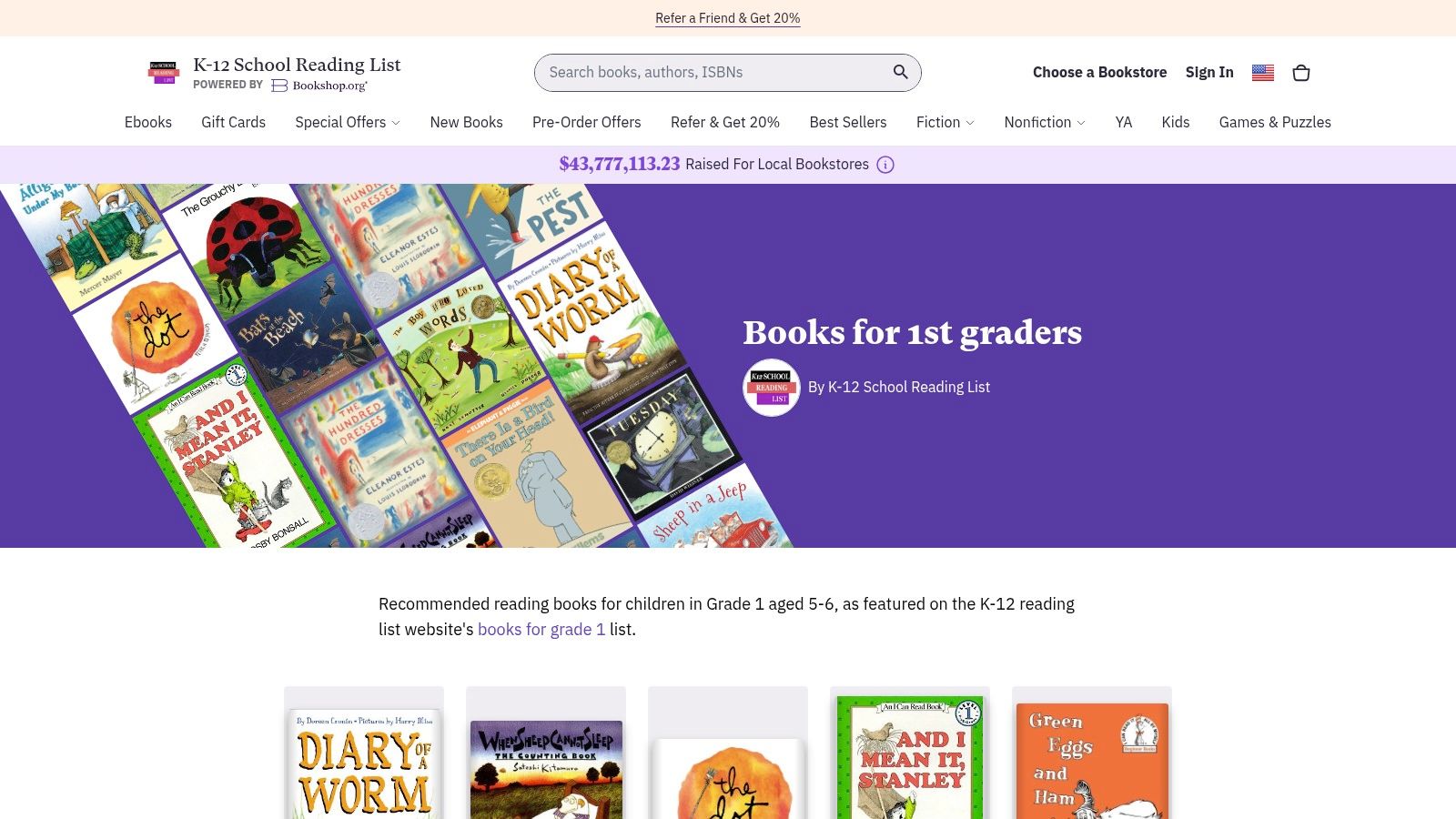
This mission-driven model provides a powerful alternative to large-scale marketplaces. When you purchase, a portion of the profit goes into a pool that is evenly distributed among participating independent stores. You can also choose to direct the full profit from your order to a specific local bookstore, creating a direct financial impact on a shop you love.
Why It Stands Out
Bookshop.org's key differentiator is its powerful blend of e-commerce efficiency and curated discovery, all while championing small businesses. Instead of overwhelming you with millions of unfiltered results, it presents thoughtful collections like "Books for 1st Graders" or lists themed around specific topics like empathy or STEM. This makes it much easier for parents and teachers to find high-quality, impactful, and often diverse titles without endless scrolling. It's like having a trusted librarian guide your selections.
Pro Tip: Explore the "Browse" section and look for lists created by organizations like the American Library Association or We Need Diverse Books. These lists are goldmines for finding award-winning and culturally relevant 1st grade level books you might not have found otherwise.
Key Features and Usage Tips
| Feature | How to Use It Effectively |
|---|---|
| Curated Reading Lists | Start with the site's official lists for age groups (like 6-8 years) and then explore user-created lists. Search for topics like "early chapter books" or "social-emotional learning" to find specialized collections. |
| Find a Bookstore Map | Use the interactive map to locate an independent bookstore near you. By selecting it as your affiliate, 100% of the profit from your eligible orders will go directly to that store. |
| Gift Wrapping Options | Many items can be gift-wrapped for a small fee, making it an excellent option for sending birthday or holiday presents directly to a young reader. Check for the gift wrap option on the product page. |
| Straightforward Fulfillment | Shipping is handled via major carriers like USPS and UPS, with transparent, flat-rate costs clearly displayed at checkout. There are no complex subscription models to navigate. |
Pros and Cons
-
Pros:
- Supports Small Business: Every purchase contributes to the financial health of U.S. independent bookstores.
- Expert Curation: The site excels at offering well-vetted, high-quality book lists, simplifying discovery.
- User-Friendly Interface: The clean design makes it easy to browse and find what you're looking for without distractions.
-
Cons:
- Less Competitive Pricing: You are less likely to find the deep discounts or flash sales common on larger retail sites.
- Stock and Availability: Some niche or less common titles may be out of stock or have longer shipping times compared to massive warehouses.
Website: https://bookshop.org/lists/books-for-1st-graders
6. Epic (digital library)
For parents and educators seeking an all-you-can-read digital library, Epic is a powerhouse platform specifically designed for kids. It provides subscription-based access to a vast collection of 1st grade level books, audiobooks, and learning videos, making it a digital-first alternative to purchasing individual titles. Its widespread adoption in U.S. schools means many first graders are already familiar with its kid-safe, intuitive interface.
The platform is particularly effective for encouraging reading exploration. A child can sample the first book in a series like Mercy Watson or listen to a "Read-To-Me" version of a picture book, all without the commitment of a purchase. This risk-free approach allows young readers to discover new authors and genres based on their ever-changing interests, making reading feel more like a fun activity than a chore.
Why It Stands Out
Epic’s key differentiator is its model of unlimited access combined with a school-centric focus. Educators can use Epic School for free during school hours, seamlessly integrating digital reading into their curriculum. This creates a powerful home-school connection when families subscribe, allowing students to continue reading their favorite books or assignments after school. The library is curated for quality and includes thousands of high-interest titles from major publishers.
Pro Tip: Use the "Assign" feature (available to educators and parents) to create custom reading lists for your first grader. You can group books by theme, reading level, or a specific phonics skill you're working on, providing a guided reading path.
Key Features and Usage Tips
| Feature | How to Use It Effectively |
|---|---|
| Leveled Reading Collections | Browse collections curated by reading level systems like Guided Reading Level (GRL) or Accelerated Reader (AR). This helps you quickly find a large pool of books that are just right for your child’s ability. |
| Read-To-Me Functionality | Encourage independent reading by having your child follow along with the highlighted text as the book is read aloud. This feature is excellent for building fluency and sight word recognition. |
| Offline Access | Before a road trip or flight, use the mobile app to download a selection of 1st grade level books and audiobooks. This ensures you have screen-time options that are both educational and entertaining, no Wi-Fi needed. |
| Progress Tracking | The parent dashboard provides insights into how many books your child has finished, minutes read, and their favorite topics. Use this to celebrate reading milestones and discover new areas of interest. |
Pros and Cons
-
Pros:
- Cost-Effective Access: A flat subscription fee unlocks a library of over 40,000 titles, far cheaper than buying them individually.
- Classroom Familiarity: Many students already use and love the platform at school. As one of the best reading apps for kids, its design is proven to be engaging.
- Great for Sampling: Allows kids to try out different series or genres before you commit to buying physical copies.
-
Cons:
- Subscription Model: You don't own the books, and titles can be added or removed from the library.
- Screen Time: It's a digital-only platform, which may be a concern for families trying to limit screen exposure.
Website: https://www.getepic.com
7. Reading A‑Z / Raz‑Plus (Learning A‑Z)
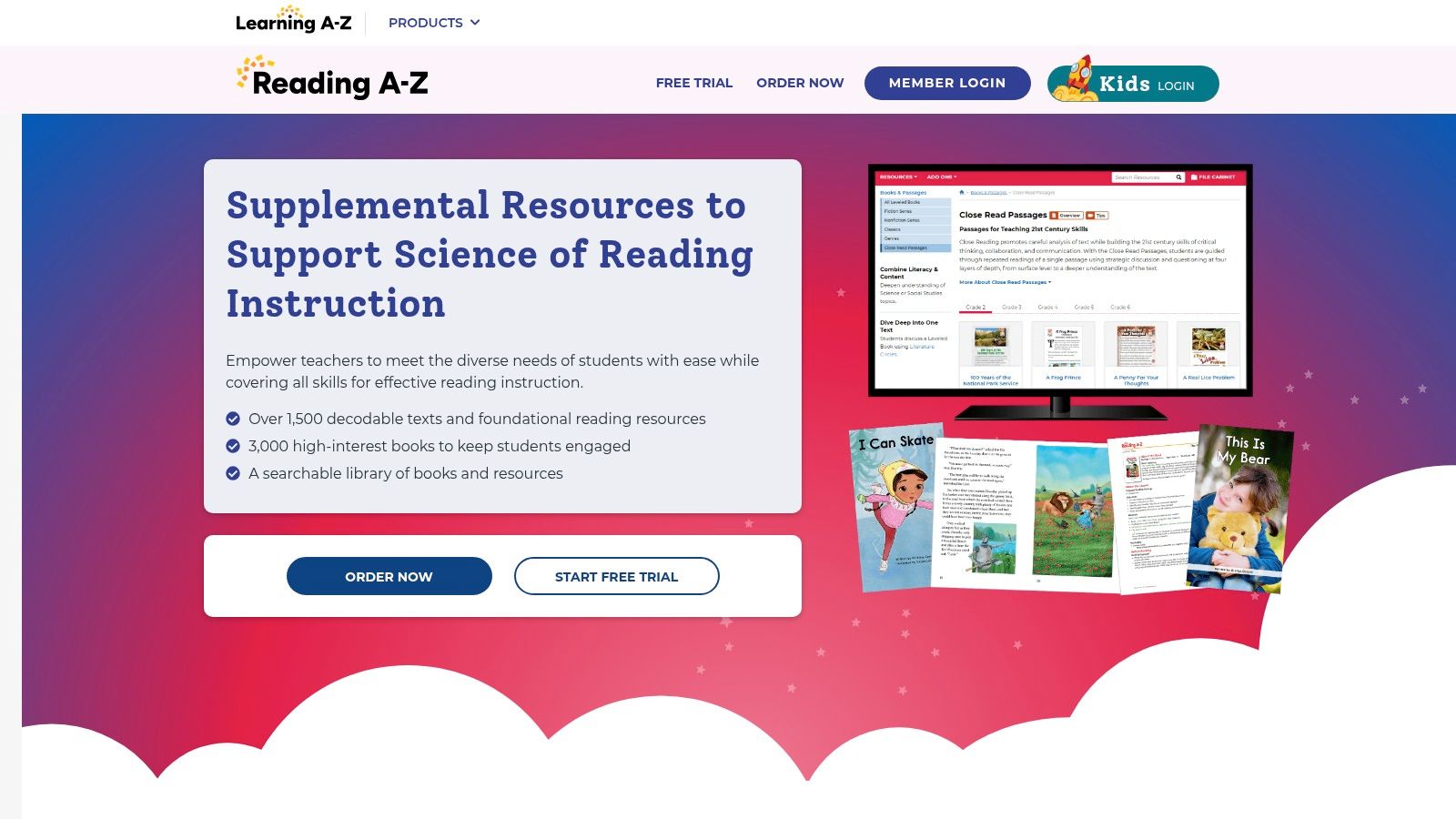
For educators and homeschool families seeking a comprehensive, curriculum-aligned reading program, Reading A‑Z and its digital companion, Raz‑Plus, are powerhouse resources. This subscription-based platform provides access to a massive digital library of thousands of printable and online 1st grade level books, meticulously organized by guided reading levels, phonics skills, and themes. It’s less of a bookstore and more of a complete instructional toolkit designed for targeted reading practice.
The core strength of Reading A‑Z is its ability to provide precisely leveled content that meets a child exactly where they are. Whether a first grader is just mastering CVC words or is already reading simple chapter books, the platform has appropriate decodable texts, nonfiction readers, and illustrated stories ready to be printed or assigned digitally.
Why It Stands Out
Reading A‑Z’s primary differentiator is its direct alignment with classroom instructional practices. The books are not just stories; they are tools created to build specific skills, from phonemic awareness to reading comprehension. The platform includes corresponding lesson plans, worksheets, and comprehension quizzes for nearly every book, offering a structured, school-like experience at home. The ability to print books in various formats, such as foldable mini-books, makes it incredibly cost-effective for building a large physical library of practice readers.
Pro Tip: Use the "Level Correlation Chart" on the website to match the platform's levels (e.g., Level F, G, H) to other systems your child's school might use, like Fountas & Pinnell or Lexile, ensuring consistent practice.
Key Features and Usage Tips
| Feature | How to Use It Effectively |
|---|---|
| Leveled Book Library | Use the filters to find books by a specific Guided Reading Level (GRL), phonics skill (e.g., "long a"), or topic (e.g., "Community Helpers"). This allows for highly targeted practice. |
| Printable & Projectable Books | Print single-sided versions for read-alouds or double-sided, foldable "mini-books" that kids can color and keep. Projectable versions are great for shared reading on a tablet. |
| Raz‑Plus Student Portal | If you have Raz‑Plus, create a student account where your child can listen to books being read, read them independently, and take a comprehension quiz. It tracks their progress automatically. |
| Multilingual Resources | Many popular leveled books are available in Spanish and French, providing excellent support for bilingual learners or students in immersion programs. |
Pros and Cons
-
Pros:
- Vast Leveled Library: Thousands of books ensure you never run out of level-appropriate reading material.
- Curriculum-Aligned: Directly supports school-based reading instruction with lesson plans and quizzes.
- Cost-Effective: A single subscription provides unlimited access to printable books, far cheaper than buying individual readers.
-
Cons:
- Subscription Model: Not ideal for one-off book purchases; requires an ongoing commitment.
- Educator-Focused Interface: The navigation and wealth of resources can feel overwhelming for parents new to reading instruction.
Website: https://www.readinga-z.com
1st Grade Books — 7-Source Comparison
| Title | Complexity / Setup (🔄) | Resources / Availability (⚡) | Outcomes / Impact (📊⭐) | Best for (Use cases) (💡) | Top advantage (⭐) |
|---|---|---|---|---|---|
| Collections - Our Books | 🔄 Low — simple curated page | ⚡ Medium — smaller indie catalog | 📊 Curated, emotionally rich picks; high-quality match to values ⭐⭐ | 💡 Parents, teachers, librarians seeking meaningful, age-appropriate reads | ⭐ Championing overlooked indie voices |
| Amazon (marketplace) | 🔄 Low — search and filter driven | ⚡ Very High — vast inventory, fast shipping | 📊 Wide selection and quick fulfillment; variable listing quality ⭐⭐⭐ | 💡 Last-minute orders, format comparisons, out-of-print finds | ⭐ Inventory breadth & speed |
| Barnes & Noble | 🔄 Medium — curated categories + in-store pickup | ⚡ Medium — reliable stock, local availability | 📊 Librarian-style curation and easy returns ⭐⭐ | 💡 In-person shopping, local pickup, curated early-reader lists | ⭐ Local store access + clear age guidance |
| Scholastic Store (shop.scholastic.com) | 🔄 Low–Medium — grade-specific storefront | ⚡ Medium — publisher-aligned resources | 📊 Classroom-aligned sets and printable mini-books ⭐⭐ | 💡 Teachers/parents building classroom packs or grade-level libraries | ⭐ Publisher expertise in grade-appropriate literacy |
| Bookshop.org | 🔄 Low — browse curated lists | ⚡ Medium — indie fulfillment, occasional OOS | 📊 Curated lists with community impact; supports indies ⭐⭐ | 💡 Buyers who want librarian recommendations and to support local bookstores | ⭐ Purchases benefit independent bookstores |
| Epic (getepic.com) | 🔄 Medium — subscription and account setup | ⚡ High — instant digital access, offline options | 📊 Fast access to leveled audiobooks/ebooks; non‑ownership model ⭐⭐ | 💡 Classroom-wide reading, quick sampling before print purchase | ⭐ Large kid-safe library instantly available |
| Reading A‑Z / Raz‑Plus | 🔄 Medium–High — subscription + teacher setup | ⚡ High — massive printable/digital leveled library | 📊 Strong alignment with guided-reading levels and lesson plans ⭐⭐⭐ | 💡 Structured classroom programs and at-home guided practice | ⭐ Extensive decodables, printable mini-books & assessments |
Building Your First Grader’s Perfect Bookshelf
Navigating the world of 1st grade level books can feel like an overwhelming quest, but as we've explored, you have a powerful array of tools at your disposal. The journey from sounding out simple words to confidently reading chapter books is a significant one, and the right resources make all the difference. This isn't about finding a single, perfect platform; it's about building a dynamic, personalized library that grows with your young reader.
The key takeaway is to embrace a multi-faceted approach. Your first grader's reading needs are not static. They change from month to month and even day to day. A successful reading strategy involves blending resources to meet these evolving needs, ensuring that reading remains an exciting adventure rather than a daunting task.
Synthesizing Your Toolkit for Success
Think of the resources we’ve covered as different tools in a toolbox, each with a specific purpose. Your goal is to select the right tool for the right job at the right time.
- For Foundational Skills: When your child is focused on mastering phonics and building decoding fluency, Reading A-Z / Raz-Plus is an unparalleled resource. Its structured, leveled, and decodable texts provide the targeted practice necessary to build a strong foundation. This is where the mechanics of reading are honed.
- For Endless Variety and Digital Access: To keep reading exciting and accessible anywhere, Epic offers an incredible digital library. Its "Read-to-Me" feature and vast selection can spark curiosity and provide support for developing readers, making it perfect for exploration and building a love for stories.
- For Building a Home Library: When you want to purchase physical books, your choice of retailer matters. Amazon and Barnes & Noble offer massive selections and convenience, making them ideal for finding popular series and specific titles. For a more mission-driven purchase that supports independent bookstores, Bookshop.org provides a curated experience that often highlights unique and diverse voices.
- For Fostering a Lifelong Reading Habit: Scholastic excels at creating excitement around reading. Its book fairs, clubs, and carefully curated collections are designed to make children want to read. It's a fantastic resource for discovering new series and authors that will hook your first grader and keep them turning pages.
Actionable Steps to Create a Thriving Reader
So, where do you go from here? The most effective strategy is to create a reading ecosystem that supports every facet of your child's development. Don't rely on just one source.
- Assess and Target: Start by identifying your reader's current stage. Are they working on CVC words? Then prioritize decodable texts from a resource like Reading A-Z. Are they starting to read with more expression? Introduce them to engaging read-alouds from Bookshop.org or your local library to model fluency.
- Blend Digital and Physical: Use a digital tool like Epic for variety and on-the-go reading, but complement it with physical books. The tactile experience of holding a book, turning its pages, and seeing it on a shelf builds a tangible connection to reading.
- Empower with Choice: Let your first grader be part of the selection process. Browse Barnes & Noble or Scholastic together. Letting them choose books based on their interests, whether it's about dinosaurs, friendships, or fantasy, gives them ownership over their reading journey. This single step can transform a reluctant reader into an enthusiastic one.
Ultimately, the goal is to build a rich and varied bookshelf that reflects your child's unique personality and supports their educational needs. By combining skill-building resources with books that inspire joy, curiosity, and empathy, you're not just teaching a child to read; you're nurturing a reader for life. You are equipping them with the tools to explore new worlds, understand diverse perspectives, and unlock their own potential, one page at a time.
For stories that are intentionally crafted to build empathy and emotional intelligence, explore the curated collection at Number 6 Publishing. Our books are designed to spark meaningful conversations and help young readers navigate complex feelings, making them a perfect addition to any first grader's library. Discover titles that nurture the heart as well as the mind at Number 6 Publishing.